Mental Health Break

A gorgeous rendering of flights around the globe:

Rollin Bishop has details:

“North Atlantic Skies” is a data visualization of the airline flights across the North Atlantic between Canada, the United States, and Europe in August 2013. The visualization was created by NATS, a United Kingdom air traffic control service provider, and showcases a period of 24 hours with 2,524 flights total. We previously wrote about a similar visualization by NATS of airline flights in Europe.

28 Strangers vs 600,000 DCers

That’s the measure of this country’s commitment to democratic self-government. The duly elected officials of Washington DC have been moving ahead with plans to decriminalize possession of marijuana, reducing the current penalties from $1,000 and a one-year jail-sentence to a $25 civil fine and a 60-day jail sentence for public smoking. The latest public opinion polls put support for outright legalization in the District at 63 percent:

Washingtonians of every age, race and ethnicity — teenagers and seniors, blacks and whites — registered double-digit increases in support of legalization. Even among those who oppose legalization, nearly half support relaxing punishment for marijuana possession to a fine of $100 or less.

So you have close to unanimity of the city’s residents and voters behind the current proposal. But in America – unlike any other democratic country on the planet – the voters in Washington DC can simply be over-ruled by a handful of congressmen from other parts of the country on the House Appropriations Committee. And so this condescending douchebag from Maryland gets to preach to Washingtonians as if we were incapable of running our own lives:

“Congress has the authority to stop irresponsible actions by local officials, and I am glad we did for the health and safety of children throughout the District,” Representative Andy Harris, the Maryland Republican who proposed the provision, said in a statement.

It’s all for the children! But wait! The House Committee can only remove funding for implementing any such change in the law; it cannot actually change the law. And the only parts of the new law that require funding for enforcement are – yep! -the penalties:

Eliminating the previous criminal penalties … costs nothing. So by preventing funding for DC’s decriminalization law, House Republicans could end enforcement for the few penalties that remain. That would leave DC with decriminalization but no ability to enforce civil fines or jail time — something that looks very similar to outright legalization.

Somehow I doubt that an act of brazen contempt for democracy will lead to a triumph of democracy. The full House will have to vote on this at some point. But, in the last days of Prohibition, you never know.

Update from a reader on Twitter:

Maliki Won’t Budge

As the Iraqi president refuses to step down and instead vows to move ahead with forming his own government, Juan Cole sees the crisis deepening:

Al-Maliki rather outrageously accused those who called for him to step down in favor of a government of national unity of de facto allying with ISIS, a would-be al-Qaeda affiliate, and the remnants of the Baath Party that used to rule Iraq in former dictator Saddam Hussein’s day.

Shiite leader Muqtada al-Sadr put forward a 6-point plan for ending the crisis. He urges that the ‘moderate Sunnis’ be separated from ISIS terrorists and called for a government of national unity (exactly what al-Maliki just rejected). He also called on Iraqis to act against any foreign incursions into Iraq.

At the same time, Ali al-Hatim, leader of the Council of Sunni Tribes, rejected the notion of al-Maliki gaining a third term: “He has to go, like it or not.” He characterized al-Maliki’s rule as “rule by Iran.” He also denounced the present constitution as an “occupation constitution.”

But even if Maliki were willing to step down, replacing him wouldn’t be easy:

“There is no chance of the elites coming together to confront the serious threat to the state that ISIS presents with Maliki at the helm,” said Emma Sky, who served as the political advisor to Gen. Ray Odierno during his tenure as the top U.S. general in Iraq. “The best hope is that the elites agree on an alternative — they have the votes to do so.”

Still, finding a replacement acceptable to all of Iraq’s sects and political parties will be an extraordinarily difficult task because of the number of boxes the potential leader must check. He has to be a Shiite, but not one as harshly anti-Sunni as Maliki. He needs the military know-how to repair Iraq’s battered armed forces and oversee a counterattack against ISIS. To top it off, he needs the diplomatic skills to work with both Washington and Tehran, despite the lingering tensions between the United States and Iran.

Reading between the lines of US strategy, Mark Thompson suspects that Obama is trying to save Maliki but force him to compromise:

It’s simple: the U.S. military generally “sends messages” by attacking. Now it is sending messages by not attacking. And its target this time around isn’t the enemy, but its purported ally running the country.

While the Pentagon officially denies it, the U.S, government is dragging its feet when it comes to defending Prime Minister Nouri al-Malaki’s government in Iraq. … Washington is trying to hit the sweet spot: promise to deliver enough help in the form of air strikes and on-the-ground advisers to preserve Maliki’s government, but make sure it arrives slowly enough that he feels compelled to compromise with the Sunnis and Kurds who are now tearing the country apart.

The Ever-Expanding ISIS, Ctd

As far as Joel Wing can tell, the jihadists and their allies have effectively conquered Anbar province:

Radio Free Iraq, which has been keeping track of the security situation in Anbar estimated that up to 85% of the province is now under insurgent control. It is important to note that while the Islamic State has done plenty of fighting in Anbar there are several other major groups involved as well, such as the Baathist Naqshibandi and its Military Councils, Jaysh al-Mujahadeen, many tribes, and others. Together they have made the security forces chase them across Anbar, while seizing town after town.

Just as the Iraqi forces collapsed in Ninewa and parts of Kirkuk and Salahaddin in June, it has done the same in much of Anbar. The border crossings with Syria and Jordan are now under insurgent control, along with much of the area around Fallujah. The militants are now attempting to seize the remaining towns and cities between those two points such as Ramadi, Haditha, and Hit. The security forces, allied tribes, and the militias were already doing a bad job in holding the province before the June offensive started. They have repeatedly gone into the same towns again and again, but then leave allowing the insurgents to move right back in. Now they are fleeing like they have in the rest of the country.

Jordan claims that its border with Iraq is secure, but Jamie Dettmer fears that a third front is about to open up … in Lebanon:

Iraqi Shia militiamen who were in Syria assisting Bashar Assad’s forces mostly in the Damascus suburbs reportedly are returning home to try to battle the Sunni advance against the Shia-dominated government of Prime Minister Nouri al-Maliki.  One fighter told AP: “We took part in the fighting in Syria. But now the priority is Iraq.”

The Shia militiamen’s exodus from the fight in Syria – some estimates put their number as high as 30,000 – will leave a gap in the Assad war machine. Firas Abi Ali, an analyst with the risk assessment consultancy IHS, says Hezbollah will likely fill the gap left by Shia militiamen returning to Iraq. But he believes the withdrawal won’t be accomplished quickly, since ISIS controls the land routes, and the departure as it unfolds probably will “reduce the ability of the Syrian government to mount new offensives and place it on the strategic defensive.”

So, for ISIS and Sunni militants there is now every reason to increase the pressure in Lebanon on Iran-backed Hezbollah. And the signs are that they are.

Meanwhile, Lake and Rogin report that ISIS is trying to take over the Balad airbase, Iraq’s largest:

Of course, even if ISIS were to gain control of Balad, there is no guarantee its fighters would know how to operate or maintain the aircraft that are stored there. But an ISIS takeover of Balad would be significant nonetheless. As NBC News reported Tuesday, Iraqi officers say without air support they are on an equal footing with ISIS fighters.

Jessica Lewis—the research director for the Institute for the Study of War and a former U.S. Army intelligence officer who served in Iraq—told The Daily Beast, “It would mean that ISIS can beat the best that the Iraqi Army can muster, not just the northern units that have been ignored. It would mean strategic defeat for the Iraqi Army.”

A Poem For Thursday

6337641903_774c9f44df_b

Dish poetry editor Alice Quinn writes:

Today’s poem, “Inversnaid” by Gerard Manley Hopkins, is included in Ted Hughes’ Poetry in the Making: An Anthology of Poems and Programmes from ‘Listening and Writing.’ In the chapter “Writing about Landscape” he writes, “We all respond to beauty spots … Usually these places are famous for one thing—they look wild. . . . These are the remains of what the world was once like all over.”

Hughes describes the Hopkins poem below as “a scene in sharp focus: all gloom and brilliance, the exhilaration and uneasy sunniness of a bleak, rather lonely place … so clean and right that whenever I see anything like it in actual scenery I think—’It’s almost as good as Inversnaid.'”

It may well be one of my favorite poems of all time, and GMH one of my most beloved poets. See what you think – here’s “Inversnaid”:

This darksome burn, horseback brown,
His rollrock highroad roaring down,
In coop and in comb the fleece of his foam
Flutes and low to the lake falls home.

A windpuff-bonnet of fawn-froth
Turns and twindles over the broth
Of a pool so pitchblack, fell-frowning,
It rounds and rounds Despair to drowning.

Degged with dew, dappled with dew
Are the groins of the braes that the brook treads through,
Wiry heathpacks, flitches of fern,
And the beadbonny ash that sits over the burn.

What would the world be, once bereft
Of wet and of wildness? Let them be left,
O let them be left, wildness and wet;
Long live the weeds and the wilderness yet.

(Photo by Espen Klem)

“The Worst Quarter Since The Last Recession Ended”

GDP

That’s how Neil Irwin reads the new GDP numbers:

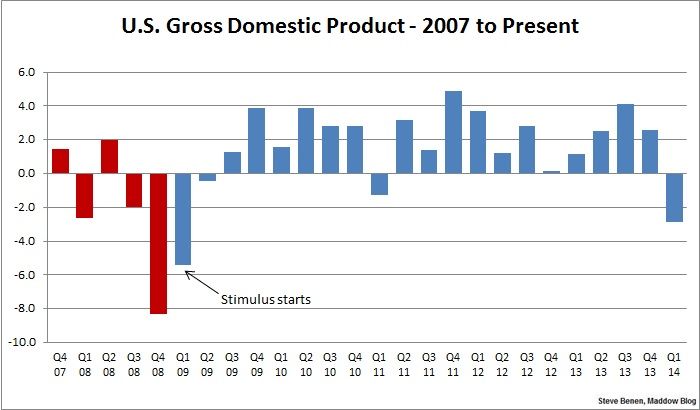
The Commerce Department revised its estimates of first-quarter gross domestic product Wednesday to show that the economy contracted at a 2.9 percent annual rate. A combination of shrinking business inventories, terrible winter weather and a surprise contraction in health care spending drove the first-quarter decline, which is the worst since the first quarter of 2009, when the economy shrank at a 5.4 percent rate.

And that contraction is worse than expected; forecasters had predicted only negative 1.8 percent. Ben Casselman has more:

Last month, I noted that negative quarters are rare outside of recessions. Quarters this bad are even rarer. There have been only two other non-recessionary quarters since World War II when the economy shrank at a rate over 2 percent. Both times, the economy entered a recession the following quarter.

That doesn’t mean we’re about to fall back into a recession. On several other occasions, negative quarters were followed by a strong rebound. Just a few years ago, for example, U.S. GDP fell 1.3 percent in the first quarter of 2011, then bounced back to post a 3.2 percent growth rate in the second quarter.

Then again, it’s worth remembering that we’re notoriously bad at predicting recessions. In fact, we aren’t even very good at knowing when we’re in one. The semi-official arbiters at the National Bureau of Economic Research didn’t identify the most recent recession until December 2008, by which point it had been underway for a year; they didn’t pick up on the 2001 recession until it was over. If we were in a recession now, we might not know it.

But Danielle Kurtzleben isn’t too worried:

Weather accounted for somewhere between 50 and 100 percent of the GDP pullback, says PNC senior economist Gus Faucher. When polar vortexes and multiple feet of snow keep people stuck at home, they just can’t get out to buy groceries or see the doctor. That’s only a temporary hit to the economy — everyone has to go to the doctor and buy food again at some point. …

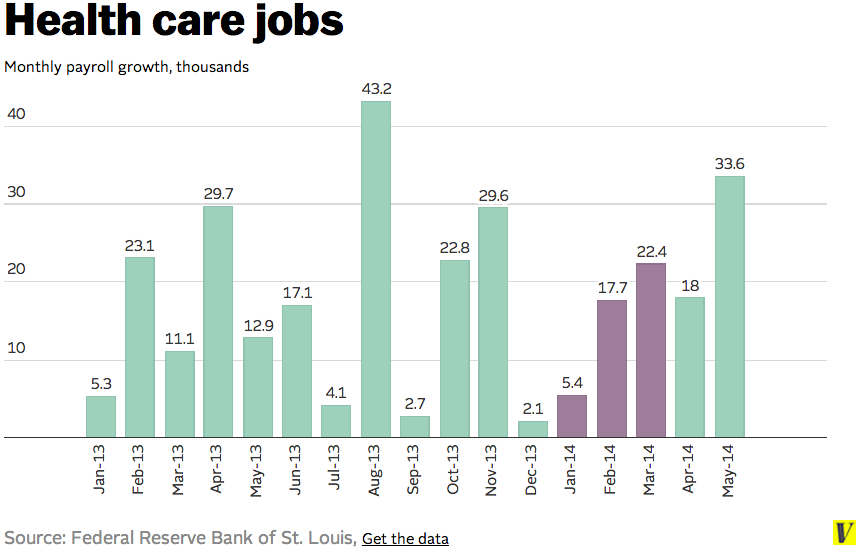
Broadly speaking, the job market isn’t growing as fast as we’d like it, but it didn’t seem to pull back in the first quarter. And though healthcare helped pull GDP downward in the first quarter, even employment in that industry didn’t appear to take a hit:

Screen_Shot_2014-06-25_at_11.58.51_AM

Danny Vinik details the dip in healthcare spending:

[The new GDP data] may be a case of bad news that’s not so bad – and maybe even good.

The reason why consumer spending fell is that health care spending decreased by 1.4 percent in the first quarter. In fact, in the BEA’s second estimate, health care spending contributed 1.01 percent to the growth rate. Under the third estimate, it subtracted 0.16 percent. In other words, health care spending went from a strong contributor to GDP growth to a detractor from it – all in a quarter when millions of Americans gained health insurance.

Daniel Gross wonders what caused that 0.16 revision:

It could be that people were hoarding medicines and avoiding going to the doctor during the cold weather. Or it could be that many newly insured people delayed going to see the doctor, buying medicine, or having procedures done in January, February, or March until their health-care premiums were fully processed by the state and federal exchanges in April. (Remember, April 1 was the deadline for signups under the Affordable Care Act). It could be that doctors are rationing health care—refusing to schedule appointments. Or it could be that many people are actually paying less for health care because they have insurance—i.e., seeing doctors with a $25 co-pay instead of going to the emergency room.

Clearly, the implementation of Obamacare is disrupting and disturbing the way that health-care services are being priced and consumed. In the first quarter, that led to lower spending—either through lower utilization, or lower prices, or some combination thereof.

Matt O’Brien calls that decline in healthcare spending “good news for our long-term budget, but bad news for our short-term growth”:

Still, this is something of the soft bigotry of a slow recovery’s expectations. The economy should be able to withstand some bad weather and bad inventories without falling back into negative territory. And it should be growing faster now to make up for that slower growth before, if the first quarter really was a blip.

Suderman gets snarky:

At the end of April, when the monthly GDP report found a sluggish, barely growing economy that had expanded by just 0.1 percent in the first quarter of the year, former White House Press Secretary Jay Carney found the good news. Health care spending was up, way up, thanks to Obamacare. The Bureau of Economic Analysis (BEA) had found that health spending had grown by 9.9 percent, the fastest growth of any quarter since 1980. The health law was working—and had saved the economy! … This was a bit rich coming from the same White House that had argued for years that the health law would hold health spending in check.

But now there’s another problem: Health spending appears not to have grown at a record rate during the first quarter of the year. It didn’t grow at all. In fact, it shrank by 1.4 percent, according to a revision released today by the BEA. … Perhaps, however, the White House, in its boundless optimism, will find the upside: The administration can now go back to arguing that Obamacare is working because it’s causing health care spending to shrink.

Matt Phillips looks ahead:

We’ll have to wait until the Census Bureau’s next services survey report in September to see whether medical care usage actually does pick up. That would stand to reason. Government estimates of increased healthcare spending were “probably more early than wrong,” wrote Morgan Stanley economic analysts in research notes. “Coverage has, in fact, expanded significantly this year, and that should support higher healthcare spending.”

Drum isn’t too optimistic:

Everyone is brushing off [the GDP decline] because other economic signals suggest it was a one-off event. And maybe so. But even if it is, it probably knocks about 1 percent off the full-year figure compared to a more normal growth rate of, say, at least 2 percent. The only way it turns out to be a nothingburger is if this number really is an anomaly and the economy makes up for it with supercharged growth for the rest of the year.

I have my doubts about that. I just don’t buy the tired excuse that the Q1 number was weather related. Something happened.

(Chart from Benen)

A Victory For Digital Privacy, Ctd

Orin Kerr predicts that yesterday’s ruling in Riley will have a broad impact on how the justice system treats our digital lives:

As readers of the blog know, the lower courts are struggling to apply old principles of the Fourth Amendment to the new facts of computers. I think Riley can be fairly read as saying that computers are a game-changer: We’re now in a “digital age,” and quantity of data and the “qualitatively different” nature of at least some digital records changes how the Fourth Amendment should apply.

That’s a big deal. It means that Riley may just be the tip of the iceberg. Computers have now generated a very different rule for searches incident to arrest: The police have to follow one rule for physical evidence and a different rule for digital evidence. If that’s true for searches incident to arrest, what other rules are also going to change?

Fernholz is on the same page:

In all likelihood, this decision won’t mean mobile phone searches are actually off-limits for cops—it won’t be hard for the police to convince a judge that a phone search is necessary if they have suspicion of a real crime. But it will mean that being detained for a minor crime won’t end with a fishing expedition into practically every aspect of your life. It’s a very modern clarification of the right guaranteed by the US founding fathers: To be secured against unreasonable searches of your person, house, papers—and iChat logs.

On the other hand, Eric Posner questions whether the court is the right place to make such culturally significant decisions:

I sympathize a bit with Alito, who in a separate opinion wonders why the Supreme Court should decide how important the privacy interest is in one’s cellphone contents. Isn’t this a better question for legislatures? …

How exactly does this court know how significant the privacy interest is? Many people don’t care much about their privacy; others do. Maybe those who care a lot don’t put personal information on their cellphones, or they ensure that it is encrypted or otherwise protected. Or they put information on their cellphones that you or I might consider personal but they don’t. Indeed, technology is not the only thing in flux here; so are social norms and personal beliefs about what information it is appropriate to share and what information should be kept to oneself.

To which Lithwick responds:

But the court didn’t have to calibrate a perfectly coherent zone of privacy; it merely had to do what it did, which is say, “Not in here, not without a warrant.” I am not sure that is based solely on how the nine use their own phones, by the way, especially given that Breyer is probably still trying to hack into his as we type. I think it’s based on a reasonable conclusion that we are entitled to an expectation of privacy in devices that are, as Roberts writes, “in fact minicomputers that also happen to have the capacity to be used as a telephone. They could just as easily be called cameras, video players, rolodexes, calendars, tape recorders, librar­ies, diaries, albums, televisions, maps, or newspapers.”

Jim Harper, who co-wrote Cato’s amicus brief, wishes the court had gone further in defining how key Fourth Amendment terms apply to our phones:

Did the Court go all the way our way? Certainly not. The Court didn’t do the simplest thing we invited, which was to state explicitly that a cell phone is an “effect” under the Fourth Amendment. (It’s essential to the holding that a cell phone is an item protected by the Fourth Amendment, but the Court should have said so to model behavior for lower courts.) The Court also did not distinguish cleanly between “search” and “seizure,” which is a distinction that courts will have to navigate if they are to get right the harder Fourth-Amendment-and-technology cases.

Still, Damon Root calls Riley “a stinging benchslap for the Obama administration and the other parties who lined up in favor of aggressive law enforcement tactics”:

For example, according to one legal filing submitted by the Obama administration, “Although cell phones can contain a great deal of personal information, so can many other items that officers have long had authority to search, and the search of a cell phone is no more intrusive than other actions that the police may take once a person has been lawfully arrested.” Translation: The Fourth Amendment should not apply.

But the problem with that boundless view of government power is that it would give the police free rein to access the emails, texts, photos, videos, and GPS tracking data of each and every person that has been placed under arrest, including those persons arrested for minor crimes such as jaywalking.

And Walter Dellinger interprets the ruling to mean that “the court may no longer be the head cheerleader for the war on drugs”:

The Supreme Court decisions from the 1970s that gave the green light to oppressive police investigative practices were to a large degree driven by the perceived need to suppress the supply of drugs.  Consider for example United States v. Robinson (1973), which allowed law enforcement officers to search without a warrant a crumpled cigarette package (that turned out to have drugs). Decided at the height of the national drug frenzy, cases like Robinson were the handmaiden of mass arrests. Because it would have been too costly and complicated to obtain warrants every time the police did of a sweep of low level street dealers, intrusive searches without warrants were a key part of drug control efforts that rely on mass arrests.

In today’s Riley decision, the court notes, almost as an aside: “We cannot deny that our decision today will have an impact on the ability of law enforcement to combat crime”—a fact that does not seem all that troubling to the justices, at least not as troubling as it would have been in prior decades.

Re-Living The Iraq War, Ctd

A reader writes:

So I was re-reading your edited volume of your Iraq War blogging, “I Was Wrong“, and came across this passage:

Maybe in a decade or so, we’ll see the real fruits of this noble, flawed experiment. I’m still hoping.

That was June 15, 2004, almost precisely 10 years ago. Sometimes you just have to whistle.

I don’t want to sound like I’m being overly harsh or having fun at your expense. To your andrew-sullivan-i-was-wrong-covercredit, you’ve been infinitely more candid about how the Iraq debacle changed your views on foreign policy than most writers, and you have enough self-awareness and self-respect to avoid the self-parodying broken-record schtick that Kristol, Feith, Wolfiwitz, Cheney, et al are currently inflicting upon us all.

But that being said, I have to look back at that sentence and highlight the word “experiment.” It didn’t occur to me on the first reading last fall, but that word sticks out now. It sounds as if Sullivan circa 2004 honestly viewed the invasion, decapitation, and military occupation of another nation as a fit activity for trial-and-error, can’t-make-an-omelet-without-breaking-a-few-eggs kind of thinking. And I am appalled. It’s an attitude right out of the 19th Century: old-fashioned imperialism coated with a veneer of respectable justification.

Maybe it’s time to just retire the terms “neoconservative” and “interventionist” altogether. Imperialism and colonialism should be called by their proper names.

More reader discussion over “I Was Wrong” here.

The Church Doubles Down On Contraception

We’ve now got the guiding document for the Vatican’s upcoming Synod of Bishops on the family. If anyone thought it would challenge established doctrine, they will be disappointed. I wasn’t expecting that, but equally, I wasn’t expecting this:

The document devotes six pages to contraception, sometimes fiercely defending Pope Paul VI’s encyclical Humanae Vitae, which deemed use of artificial contraceptives by Catholics as sinful. “The Encyclical Humanae Vitae certainly had a prophetic character in reiterating the unbreakable link between conjugal love and the transmission of life,” states the document. It says the positive aspects of Paul’s teaching are unknown by many.

“Some responses see a relation between the commonly-held contraception mentality and a pervasive gender ideology which tends to change some basic aspects of anthropology, including the meaning of the body and the difference between the sexes which is replaced with the idea of gender orientation to the point of subverting sexual identity,” it states.

That connection is not obvious to me. The signs on gay inclusiveness are also almost all negative:

The document states: “Every bishops’ conference voiced opposition to ‘redefining’ marriage.” Some responses, it says, “recommend not using phrases such as ‘gay,’ ‘lesbian’ or ‘homosexual’ to define a person’s identity.” It states: “The great challenge will be to develop a ministry which can maintain the proper balance between accepting persons in a spirit of compassion and gradually guiding them to authentic human and Christian maturity.”

The one sign of moderation is that word “gradually.”

We shouldn’t conflate some responses with the Church’s response, of course. And I haven’t read the full document. But it seems like a classic attempt by the church to understand why its messages have not reached the average Catholic. It cops to the impact of the sex abuse crisis on the moral authority of the Church but also veers into Ratzingerian memes on the reasons for the failure:

“the hedonistic culture; relativism; materialism; individualism; the growing secularism; the prevalence of ideas that lead to an excessive, selfish liberalization of morals; … [and] a culture which rejects making permanent choices.”

Boehner Pulls A Bachmann

The Speaker of the House of Representatives is going to sue Obama over his executive orders:

While Boehner has yet to announce the details of the forthcoming lawsuit, House Republicans have strongly opposed numerous unilateral decisions made by the Obama Administration, including halting deportations of immigrants who were brought to the country as children, postponing provisions of the Affordable Care Act and raising the minimum wage for federal contractors. In a letter to House members Wednesday, Boehner said he intends to bring legislation to the floor in July to “compel” Obama to follow his oath of office.

White House Press Secretary Josh Earnest didn’t say whether Obama and Boehner had discussed the lawsuit when the Speaker was at the White House Tuesday, and he criticized House Republicans for taking their opposition of the President into “a gear that I didn’t know previously existed.”

Never underestimate the cynicism of today’s GOP. Christopher Ingraham politely points to the above chart:

Back in February I analyzed the numbers on executive order frequency and found that Obama has actually been less likely to resort to the pen and phone than any president since Grover Cleveland. Just a few days ago, John Hudak at Brookings updated the chart through June 17 of this year and found that those numbers haven’t budged, at all. … As John Hudak writes, “claims that President Obama is issuing more than his predecessors is just flat wrong—and continues to be a talking point completely at odds with real data.”

Never underestimate the contempt for reality within today’s GOP. Here’s Beutler on Boehner’s nonsense:

[T]he fact that he hasn’t decided which laws the president isn’t faithfully executing, or which of those ill-executed laws merits legal action not to mention his indifference to executive overreach during the Bush yearsall pretty much give the game away. This really isn’t about the integrity of the legislature, and in a way, it really is about impeachment.

Waldman calls Boehner’s stunt “a kind of impeachment-lite”:

[M]y guess is that the suit will throw in every process complaint the Republicans have had over the last five years, because it’s mostly about Boehner’s right flank, both in Congress and in the Republican electorate. Even if the suit gets thrown out of court, Boehner will still be able to say to the eternally angry members to his right, “Hey, I’m the guy who sued Obama! I hate him as much as you do!”

How Philip Bump sees the suit:

This is generally being interpreted as Boehner expressing frustration about executive orders. That’s incorrect.

At least, that’s not the whole picture. This is, really, a fight about executive action. … In his letter to his peers, Boehner never mentions executive orders. “President Obama has circumvented the Congress through executive action,” he writes, without pointing to specific examples. The fight isn’t over executive orders; it’s over executive authority. That’s a much different — and much bigger — battle.

Arit John notes:

[While the lawsuit] could work out well for Republicans, Boehner may end up spend millions of taxpayer dollars — like the $2.3 million the GOP spent on its Defense of Marriage Act lawsuit — only to lose.

Never underestimate the profligacy of today’s GOP. Or their hypocrisy:

It’s irresistible to charge Republicans with hypocrisy, especially given the fact that they were unconcerned when the Bush administration pushed so vigorously at the limits of presidential power. Bush and his staff regularly ignored laws they preferred not to follow, often with the thinnest of justifications, whether it was claiming executive privilege to ignore congressional subpoenas or issuing 1,200 signing statements declaring the president’s intention to disregard certain parts of duly passed laws. (They pushed the limits of vice presidential power, too—Dick Cheney famously argued  that since the vice president is also president of the Senate, he was a member of both the executive and legislative branches, yet actually a member of neither and thus not subject to either’s legal constraints. Seriously, he actually believed that.)

And here’s more evidence that this is all just fodder for Fox News:

According to Erwin Chemerinsky, the dean of the University of California, Irvine Law School, the speaker of the House does not have the ability to sue the president in this situation, even if Congress says he does. Chemerinsky says “standing,” the doctrine that allows a person to file a lawsuit in federal court by demonstrating that real harm has been caused to them, is defined by the Constitution. As a result, even if Congress passes a law, or in this case a resolution, which only requires approval by the House, it will not be binding on federal courts, as the Constitution trumps any law, let alone a resolution, and does not give members of Congress the ability to sue if they cannot prove real harm.

But Charles Pierce takes the bait:

Let us have a debate, then. Let us compare what Boehner says the president has done—which, by the way, he has done less than almost all of his immediate predecessors—and then let’s compare everything his House hasn’t done because it doesn’t like the president, his party, his politics, or (sadly) his race. Let us determine who is “faithfully executing” the jobs for which they all get paid. Hell, let us determine who’s actually interested in governing the country, or is counsel for the plaintiff going to argue that, if the country elects a obstructionist Congress, and that Congress holds together, then the country need not necessarily be governed by anyone at all?

That would be an interesting point to be litigated — if, again, this were a serious legal action, and not the latest and most elaborate clown show staged by a threadbare political circus.

Update from a reader, who plays devil’s advocate:

In all fairness to Boehner and the Republicans (who absolutely don’t deserve the benefit of the doubt):

1. Comparing the number of executive orders of different presidents is completely irrelevant. The real issue is whether some of Obama’s executive orders exceed his constitutional authority, not how many he has issued or how many Reagan issued. This is a red herring.

2. Likewise, the expenditure issue is a red herring. So the House spent a couple of million dollars defending DOMA. As we liberals are fond of pointing out, that’s a trifling sum in the context of the annual expenditure of the federal government. And, at least, DOMA received a thorough and professional legal defense, so that when the Supreme Court ultimately struck it down, no one can say that was only because the defense was inadequate.

3. Even though there’s no question that Boehner’s motives here are ultra-partisan, the issues of constitutional authority are legitimate issues and there’s nothing wrong with a legal challenge. Let the Republicans spend some money on this; I wouldn’t begrudge them paying for it.

4. They probably do have a standing problem here, and the Supreme Court may well band over backwards to find such a problem in order to try to avoid dealing with this. At least some of the executive orders could be challenged by real plaintiffs with real standing, e.g., the federal contractor who objects to paying a higher minimum wage.

5. The smart legal strategy would probably be to identify those orders as to which there is a legitimate question as to whether they exceed the executive’s authority. Plainly, many of the orders that Republicans don’t like aren’t controversial in this respect, and loading a complaint up with all of these just damages the plaintiff’s credibility. On the other hand, including a few orders that the plaintiff knows it is likely to lose on may give political cover to the Supreme Court to reject other orders.

6. The inaction of Congress is not a legitimate excuse for the President acting through executive orders where same exceeds his constitutional authority. This argument, like the cost argument and the argument about number of orders, doesn’t address the bona fide balance of powers concern that lurks under the partisan surface, and the repetition of these arguments just makes Democrats look bad.

7. Along the same lines, since there actually is a bona fide constitutional issue here, allegations of racism in this debate are wildly inappropriate. No doubt, there is a not insignificant portion of the Republican base, and even of the Republicans in Congress, who are at least in part driven by racism when it comes to their opposition to Obama. But there’s a real legal issue here – and many people who are legitimately concerned about the growth of Executive power – and you can’t dismiss this simply by claiming racism or partisanship.