The Rift Widens

Polarization

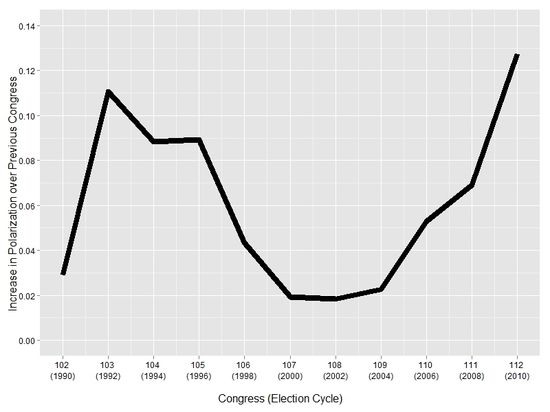
Adam Bonica expects the 112th Congress to be the most polarized in recent memory:

The hollowing out of the political center explained the momentous rise in polarization during the Southern realignment. Now that only a handful of moderates remain in the House, polarization can no longer be portrayed as a story of vanishing moderates. It appears the rise of the extremists has stepped up as the driving force behind congressional polarization.

Yglesias analyzes.

To Doubt With Conviction, Ctd

E.D. Kain engages the subject again:

I’m skeptical of the collective wisdom of the American people. I’m not any more skeptical of the people we put in government. But those people wield enormous power; and nor are they acting in isolation. What they can and cannot do is often limited by other people perhaps less brilliant or less honest. Even the most skilled technocrat with the best intentions has to navigate the labyrinthine halls of power, compromising here, giving special favors there. Often it is the very corporations and special interests that liberals decry who benefit the most from centralized power and complexity, from the good intent of human failings. Limiting government, then, in my view is a very progressive goal. We will have experts in government no matter what – and that’s not a bad thing – but we should expect what they can achieve in real life to be far less than what they can achieve in theory. They are as human as we are and as prone to mistakes. We should look to limit the scope of their mistakes.

Again, conservatives are as guilty of certainty as liberals are – often more so. 

“Selling Lead As Gold, Shit As Chanel No. 5”

Matt Taibbi reports on "rocket dockets," the high-speed housing courts that are helping major banks by speeding through foreclosures in Florida:

[The rocket docket] exists to launder the crime and bury the evidence by speeding thousands of fraudulent and predatory loans to the ends of their life cycles, so that the houses attached to them can be sold again with clean paperwork. The judges, in fact, openly admit that their primary mission is not justice but speed. One Jacksonville judge, the Honorable A.C. Soud, even told a local newspaper that his goal is to resolve 25 cases per hour. Given the way the system is rigged, that means His Honor could well be throwing one ass on the street every 2.4 minutes.

The Sharp End Of The Needle

KidneyDialysis

Robin Fields reports on the appalling state of kidney dialysis in the US, especially among Medicare patients:

Taxpayers spend more than $20 billion a year to care for those on dialysis—about $77,000 per patient, more, by some accounts, than any other nation. Yet the United States continues to have one of the industrialized world’s highest mortality rates for dialysis care. … 

Conditions within clinics are sometimes shockingly poor. I examined inspection records for more than 1,500 clinics in California, New York, North Carolina, Ohio, Pennsylvania, and Texas from 2002 to 2009. Surveyors came across filthy or unsafe conditions in almost half the units they checked. At some, they found blood encrusted in the folds of patients’ treatment chairs or spattered on walls, floors, or ceiling tiles. Ants were so common at a unit in Durham, North Carolina, that when a patient complained, a staffer just handed him a can of bug spray.

(Photo by Flickr user Canuckshutterer "Bill" (W.J. Gibson))

The Case Against Tim Pawlenty

In a rebuttal to Jonathan Bernstein, Nate Silver makes it:

The other potential flaw [with Bernstein's analysis] is in assuming that name recognition itself is something exogenous from candidate quality. In plain English: the fact that a candidate hasn’t been very successful at getting voters to recognize his name is often a sign that he is an unremarkable candidate.

DADT: Forget The Supreme Court?

Jason Mazzone thinks the Ninth Circuit DADT ruling, whatever that may be, won't be overturned by the Supreme Court:

Justice Elena Kagan has recused herself from the case. This represents some very good news for the Ninth Circuit: its decision on the merits will almost certainly be the last word in the case. This is because if the Supreme Court reviews the Ninth Circuit, it will likely split 4-4, thus automatically affirming the Ninth Circuit's decision. The Ninth Circuit has something of a reputation for zany decisions that end up being overturned. Let's see what it does now that it knows it isn't going to be reversed.

Reflections In A Mirror

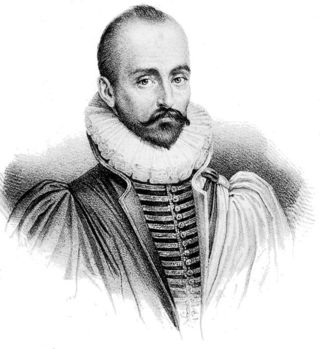
Sarah Bakewell reiterates what I’ve long argued, that the greatest blogger avant la lettre was Montaigne:

Montaigne raised questions rather than giving answers. He wrote about whatever caught his eye: war, psychology, animals, sex, magic, diplomacy, vanity, glory, violence, hermaphroditism, self-doubt.

Most of all, he wrote about himself, and was amazed at the variety he found within…

“In taking up his pen,” wrote the great essayist William Hazlitt of Montaigne, “he did 550px-Michel_de_Montaigne_1 not set up for a philosopher, wit, orator, or moralist, but he became all these by merely daring to tell us whatever passed through his mind.” He wrote about things as they are, not things as they should be—and this included himself. He communicated his being on the page, as it changed from moment to moment; we can all recognize parts of ourselves in the portrait.
In America, Ralph Waldo Emerson felt this shock of familiarity the first time he picked up Montaigne in his father’s library. “It seemed to me as if I had myself written the book, in some former life, so sincerely it spoke my thought and experience,” he wrote. “No book before or since was ever so much to me as that.” From Renaissance winegrower to nineteenth-century transcendentalist seems a big leap, yet Emerson could hardly tell where he ended and Montaigne began.

These days, the Montaignean willingness to follow thoughts where they lead, and to look for communication and reflections between people, emerges in Anglophone writers from Joan Didion to Jonathan Franzen, from Annie Dillard to David Sedaris. And it flourishes most of all online, where writers reflect on their experience with more brio and experimentalism than ever before.

Bloggers might be surprised to hear that they are keeping alive a tradition created more than four centuries ago.

Psychologists And Torture

A critical test for the integrity of American psychology: whether the Texas State Board of Psychologists will remove the license of a psychologist because he helped devise techniques for victims of the Bush administration's torture program:

The complaint, which was brought in June, alleges that the doctor misrepresented his qualifications to the C.I.A., placing “his own career and financial aspirations above the safety of others” while designing a “torture regime” with a “complete lack of scientific basis.”… The severity of the accusations led the American Psychological Association to take the rare step of submitting a public comment to the Texas licensing board. The group’s letter said that if Dr. Mitchell were a member of the professional association — he is not — and if the accusations were true, he would be expelled.

If we cannot get legal accountability for war crimes, we can at least aim for professional ethics being upheld.

Cantor Pre-Empts Clinton, Ctd

A reader writes:

You asked, “There are no parallels with this kind of direct undermining of the president on foreign policy that I can think of. Am I wrong?”

I can think of at least two from the Washington administration and one by Nixon against LBJ.

In 1791, Secretary of State Jefferson was involved in talks with the British ambassador.  Hamilton, fearful that Jefferson would take too hard a line, “secretly informed British officials that the secretary of state’s views did not represent administration policy and hence implied that they could be disregarded with impunity.”  (Alexander DeConde, A History of American Foreign Policy, p. 49)  Three years later, he undermined John Jay, who had been sent by President Washington to negotiate a treaty with the British: “Fearing any action that might endanger relations with the British, Hamilton blunted the only coercive weapon Jay possessed.  He told the British minister in Philadelphia that American policy was predicated on the principle of avoiding entanglement in European affairs and hence the US would not join the new armed neutrality.  Hamilton thus weakened Jay’s already shaky bargaining position.” (DeConde, p. 55).

More recently, and infamously, in October 1968, fearing an “October surprise,” the Nixon campaign used Anna Chennault to communicate to the Thieu government in South Vietnam that it should resist pressure from LBJ to participate in peace talks with the North Vietnamese.  Vice President Ky wrote: “out of the blue, Nixon’s supporters stepped into the picture. Approaches were made to Bui Diem, the Vietnamese ambassador in Washington, to the effect, ‘Hold on!  Don’t accept the invitation to go to Paris.  If Mr. Nixon is elected President he promises he will increase support for the Vietnam War.’” (Larry Berman, No Peace, No Honor, p. 33.)

These were all secret, of course – not public.  But sadly we have a history of undermining a sitting president’s foreign policy, all talk of politics ending at the water’s edge notwithstanding.