Bowles-Simpson And The Republican Bluff

Jonathan Chait defends his belief that the right isn't primarily motivated by a desire to shrink government:

…the debt commission's report entails a massive rollback of government. It does have some revenue increases, but those are accompanied by enormous cuts in income and corporate tax rates, and it's not clear if the net effect of the changes is to increase or decrease the share of taxes paid by the rich.

If the Republican Party was generally motivated by opposition to government, they would be dancing in the aisles.

Which, of course, some of us non-Republican small government types were doing much of last week. Bowles-Simpson is about as close to a Dish-style agenda as we can imagine. Chait goes on:

After all, this is a plan to both slash the size of government by about as much as it's ever been slashed, and slash tax rates. And yet the right's reaction is fairly tepid. The Tea Party movement is opposed. Grover Norquist is on the warpath. The Wall Street Journal editorial page is highly skeptical. I've seen a mostly positive editorial from National Review, but as of Friday evening, the Weekly Standard has written nothing at all. I wrote that the plan is overwhelmingly titled toward Republican priorities, and by that I meant putative priorities. The mixed response to a plan that would represent massive progress toward limited government makes my case for me.

Agreed.

A Breakthrough?

HILLARYBIBIMarioTama:Getty

Netanyahu has reportedly agreed to a further three-month settlement construction freeze in the West Bank (but not Jerusalem) while he and Abbas try to nail down final boundaries for a new Palestinian state. It appears he has a majority in his cabinet to approve the deal:

The deal includes a U.S. undertaking not to request a further extension of the freeze, and to veto any attempt by the Palestinians to win UN recognition of their state unilaterally…

An Israeli political source said the security cabinet vote was expected later this week and that seven ministers – Netanyahu among them – were likely to back the U.S. proposal, against six who would vote against and two who would abstain. The forum includes representatives of major coalition partners, from the center-left Labor party of Defense Minister Ehud Barak to Netanyahu's rightist Likud to the far-right Yisrael Beiteinu party of Foreign Minister Avigdor Lieberman.

The $3 billion bribe is contingent on a successful two-state agreement, and is designed to assuage Israeli security concerns:

The Obama administration would also ask Congress to approve a $3 billion sale of warplanes to Israel and, should there be peace with the Palestinians, guarantee its wider security needs. These would supplement the 20 F-35s Israel already plans to buy for $2.75 billion drawn from annual grants it gets from Washington.

So Obama's implicit willingness to take this to the UN was the stick added to the $3 billion carrot. It hasn't been an easy process, and Obama has had to allow himself to be humiliated to get this far. But we know that Obama's modus operandi is often to give his opponents a tactical victory, as long as it advances his own strategic goal. Bernard Avishai compares Obama's tortuous, humiliating approach in the peace process to his health insurance reform strategy:

The administration has been criticized for allowing Senate committees to debate the shape of the healthcare bill before committing itself to a final plan. The process was ugly; and the administration sweetened the outcome for resistant blue-dogs along the way. In the end, however, it got senators who had skin in the game, and it used their disagreements to define the "solution space" in which to intervene. And once (as Jonathan Cohn has shown) Obama saw the shape of the bill he could get, he still had to choose: let it go, for political reasons, or campaign for it, for historical ones. Had he not chosen the latter course, we would not have had a health reform bill at all.

Something like this moment is now in the offing in the Middle East. What the administration has done is allow Netanyahu the equivalent of (forgive me) pork to bring the Israeli state, so that the most critical issue defining a Palestinian state can be brought into relief. Israeli ministers most vociferously opposed to any state are justifiably in a panic (a "honey-trap" says Moshe Yaalon). Like Republicans who had hoped to kill any reform in committee, they are not so much convinced that they have lost the game as understand that now they are in one…

Ensuing negotiations, over the next couple of months, will almost certainly not produce an agreement. But they will define the solution space Obama will have to move into and the line he will have to publicly fight for. It will tee-up perhaps the most important foreign policy test of his presidency, and set up the right moment to visit Jerusalem. As with President Kennedy during the Cuban Missile Crisis–who had previously been thought weak, but proved how shows of strength require a sense of timing–it may be Obama's best chance to reignite the global hopes invested in him.

Maybe Netanyahu will have to forge a new coalition with Kadima to have this work. But it looks as if he can squeeze it by his current cabinet, which is preferable. The more right-wing a government that agrees to a two-state solution the better for the boundaries' future legitimacy. And so Obama fitfully but persistently moves toward his central goal for the next two years. A first term that brought universal healthcare to the US and a resolution of the Israel-Palestine conflict would be quite something, wouldn't it? Even the lefty complaint chorus might be able to muster a few cheers for that.

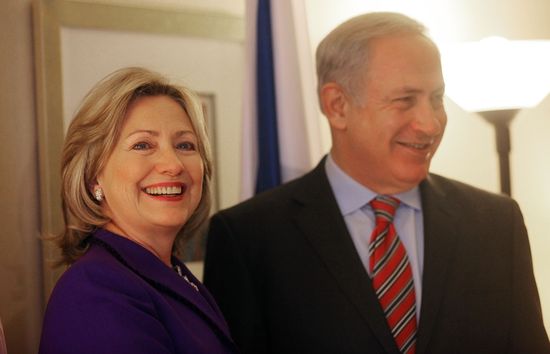
(Photo: Israeli Prime Minister Benjamin Netanyahu and U.S. Secretary of State Hillary Rodham Clinton speak with the media prior to their meeting November 11, 2010 in New York City. The two were expected to discuss the rift over settlements in Arab East Jerusalem and other Mideast peace issues. By Mario Tama/Getty Images)


The Power Of Data

Megan McArdle examines data mining, a practice that could offer benefits both medical and financial:

If we could develop more-comprehensive medical records, and collect that data in some central location, data mining might detect patterns in disease and treatment that we now discover only through painful trial and error. More than that, it could finally allow us to reach the holy grail of health-care wonks: paying for wellness rather than for doctors’ visits and procedures.

The Case Of Bristol And The Home Phone

5170161675_a7787331ae_z

Patrick at Palingates pores over the latest evidence from the phone-hacking trial of David Kernell:

With this post I want to highlight one fact in particular which has been proven over and over again: That the Palins will go out of their way to make themselves appear as victims and at the same time make the actions of the "other side" appear as horrible as possible. In addition, the Palins will not hesitate to tell smaller and bigger lies in order to achieve this goal.

Quote For The Day II

"It's definitely one big cable buy. When Governor Romney was talking about running for president, he had sent out a DVD where he was sledding in Utah with the family, talking about whether he would run or not, and everybody was baking cookies and hanging out. The difference is she has a production company willing to foot the bill for it," – Terry Sullivan, a GOP strategist, on Palin's reality show.

“Totally De-Meachamize It!”

Jack Shafer argues that against all odds, the Beastweek merger may work:

Tina Brown possesses more moxie, daring, shrewdness, and big-top showmanship than any editor of the last half-century. Compared with Brown, Jann Wenner is a second-string maracas player; Hugh Hefner a prude; Graydon Carter a big, dumb forehead; Louis Rossetto a KayPro; Andre Laguerre* a minor leaguer; and Harold Hayes a William Shawn. What editor in the history of magazines has set three titles on absolute fire? Brown did just that with Tatler, Vanity Fair, and The New Yorker, before, um, burning down her heavily bankrolled (by vanity press mogul Harvey Weinstein) fin de siècle monthly Talk

Yesterday, nobody cared squat about Newsweek. Today, the press is filled with jabber and curiosity about a magazine most of us had given up for dead.

His advice:

While I'm not suggesting that Brown turn Newsweek into the Journal of Brangelina Studies, I'd encourage her to rely on the high-low culture mix that made The New Yorker so damnably interesting during her run—and take it even lower. Readers will follow, even if Time won't.

Speaking of Time, which competes in Newsweek's space, Brown should never aspire to be like it, or the other newsweeklies, the Economist and the Week. We don't need another Time, Economist, or the Week because we already have one of each. Let Newsweek separate itself from the pack by becoming more combative, more outrageous, more judgmental, and more wicked than the others. Violate the orthodoxy! Totally de-Meachamize it! On Week 1, piss off the White House. Week 2, the Pentagon. Week 3, Wall Street. Then the unions, Harvard, religion, life-insurance agents, the green movement, and so on until the bottom is reached with an exposé of Little League baseball. Then repeat. According to H.L. Mencken, "The liberation of the human mind has been best furthered by gay fellows who heaved dead cats into sanctuaries. …" I want, very much, for Tina Brown to be that sort of cat-slinger.

Quote For The Day

"13 years ago, Brooks’ “national greatness” argument was to use American supremacy to pursue “some larger national goal,” and by now the larger national goal to which Brooks calls Americans is simply to sustain American supremacy. Hegemony has become its own reward, and it is taken for granted that sustaining it is what is actually best for the United States," – Daniel Larison.

“I Think We Lost The Election”

PJ O’Rourke explains why:

We will win an election when all the seats in the House and Senate and the chair behind the desk in the Oval Office and the whole bench of the Supreme Court are filled with people who wish they weren’t there.

In a free country government is a dull and onerous responsibility. It is a parent-teacher conference. The teacher is a pompous twit. Our child is a lazy pain in the ass. We undertake this social obligation with weary reluctance. And we only do it at all because the teacher (political authority) deserves cold stares, hard questions, and maybe firing, and the pupil (that portion of society which, alas, needs governing) deserves to be grounded without TV and have its Internet access screened and its allowance docked.

Will America Fall Prey To A British Disease?

Barry Eichengreen looks back at an exhausted post-WWII Britain and sees a lesson for the US today:

[Britain] failed to develop a coherent policy response to the financial crisis of the 1930’s. Its political parties, rather than working together to address pressing economic problems, remained at each other’s throats. The country turned inward. Its politics grew fractious, its policies erratic, and its finances increasingly unstable.

In short, Britain’s was a political, not an economic, failure. And that history, unfortunately, is all too pertinent to America’s fate.