The “New Elite”

Over the weekend Charles Murray went after elites. In response, Claire Berlinski created a "How Plebe are You?" quiz, David Frum rolled his eyes, and Will Wilkinson pointed to hard data:

Polls show that, in addition to being predominantly white and Republican, tea-partiers are wealthier and better-educated than the typical American. The proletariat they are not.

Andrew Gelman's terrific book "Red State, Blue State, Rich State, Poor State," documents the stark partisan division within the American upper class, which I think helps us understand what's really going on. Very roughly, churchgoing non-coastal rich people are Republicans, while the more secular coastal rich are Democrats. What we are now seeing is not a showdown between the vast non-ideological middle-class and some rising Acai-swilling, assortatively-mating bobo aristocracy, but a standoff between rival elites. The tea party is a movement of relatively well-to-do, relatively religious citizens aroused by the conservative identity politics of a handful of elite right-wing opinion-makers who seek to unseat their liberal counterparts.

It is a neat trick. Conservative elites pretend to be part of a marginalised cultural force while at the same time orchestrating an electoral bloodbath led by America's least marginalised people. The fact that this is working so tells us a lot about who the elites really are and where the power really lies.

What strikes me about so many intellectual conservative defenses of the current nihilist GOP is how tired they are. They are exactly the left-right, red-blue critiques of liberal elites made throughout the 1980s and 1990s, originating with Nixon. It is as if without this paradigm, they have nowhere else to go, and it sure beats actually formulating practical answers to the huge problems the country faces, at home and abroad.

If Gayness Is Genetic, Why Doesn’t It Die Out?

Salon interviewed Simon LeVay, former neuroscientist and author of Gay, Straight, and the Reason Why: The Science of Sexual Orientation. The question I pose above is a dumb one for anyone with even a small grasp of evolution and genetics, but it's such a common one it's worth hearing LeVay's answer:

The usual idea is that a gene predisposing some individuals to homosexuality might promote the reproductive success of others, and the two effects might balance out. It might be that a gene predisposing a man to be gay might make a woman even more attracted to men than she otherwise would be, so that she would engage in more heterosexual sex and thus become pregnant more often. There are a couple of studies reporting that women who have gay male relatives (and who may therefore carry the same "gay gene") do indeed have more children than women without any gay male relatives. The answer will remain speculative, however, until the actual genes have been identified and their mode of action worked out.

There is also a socially evolutionary argument, that societies that had a few men uninterested in actually reproducing with women themselves might be advantageous. They might help advance a society's education, or become spiritual leaders, or be warriors unaffected by the need to take care of a household. One day, we'll get closer to the truth. It still amazes me that we are at such an early stage of figuring out this fascinating scientific question.

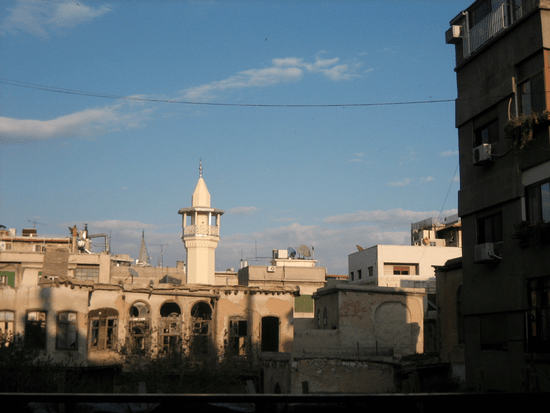
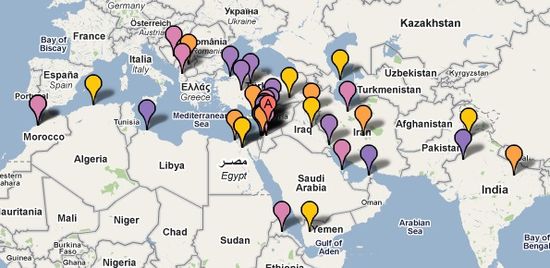
The View From Your Window Contest: Winner #21

Vfyw-contest_10-23

A reader writes:

Tough one!  Just about anyplace, Middle East.  I’m sure people will obsess over the conical steeple in the background and think this is a multi-faith neightborhood, but I think its a red herring.  My guess is somewhere in Iraq (the foreground house looks like its windows are broken).  The buildings look worn but not ancient.  I’ll take a non-traditional guess and say Baghdad, Sadr City.

Another writes:

This picture was taken in Beirut, Lebanon – in the morning, looking west toward Martyr’s Square in an area known as Gemayze.  The minaret with what looks to be a church steeple to the left and the abandoned building coupled with the newer nice looking apartment building seem to give it away.  Great town, wonderful folks.  I hope to go back someday.

Another:

A mosque in cramped quarters, the mixed architectural styles, the cables running from one building to the next (and allowing people to siphon electricity from their neighbours for free), the mixture of dilapidated and fairly new buildings – all this points to Beirut. My only hesitation springs from the fact that I see no bullet holes (remnants from the civil war) on any of the buildings. But there were areas of Beirut that escaped relatively unscathed from the destruction, so let’s assume that this is one of them.

Another:

Switzerland?  Ha ha, no.  I’ll just go with Cairo, Egypt, the city of a thousand minarets.

Another:

Professor Google says that these pencil-type minarets are Ottoman, so that’s something, I guess.  The crumbling building in front has horseshoe (Moorish) arches, but again, they’re too common to be helpful.  The only thing in this picture that I found to be unusual is the small orange satellite dish on the right, but searching “orange satellite dish” led nowhere.  So really, this can be anywhere from Tunisia to India.  My best guess is Amman, Jordan.

Another:

The big clue is the contrasting nature of the mosques in the foreground and background. The minaret of the mosque in the foreground is the typical Arab style. The one in the background is Turkish. There are a couple of ethnic Arab cities in Turkey where you might expect to find both Arab and Turkish-style minarets – Antioch and Alexandretta – but they are relatively clean, prosperous, well kept sorts of cities. In fact, Turkey is generally more prosperous and well kept than the city in these pictures, so instead of looking for Arab pockets in Turkey, I’ll look for Turkish (or Turkmen) pockets in Arab countries.

The general crappiness quotient is high, suggesting that the place has seen its share of conflict, or at least bad fortune. At the same time, the shining new white building toward the right side of the pic indicates a bit of wealth moving into the neighborhood – former emigrants who made good abroad and returned post-conflict, perhaps?

Northern Iraq springs to mind, of course. I’m out of real clues at this point, and it could be anyplace in Northern Iraq as far as I know. So I’ll just choose the city with the largest Turkmen population – Kirkuk. Within Kirkuk, I’ll go for a suburb that is notable for having mixed Arab and Turkmen neighborhoods. Final answer: Al Hawija, Kirkuk, Iraq

Another:

Thank you for the lesson in minarets worldwide. Without really knowing what I’m talking about, and realizing that knowledge by Wikipedia is a dangerous thing, this appears to be a Tatar style of minaret. So, concentrating my Google image and map searches to Northern Africa, I find lots of minarets that look just like this one, only more ornate, in Tunis, Tunisia. This one seems humbler, smaller, and unlikely to attract much tourist attention in this part of a crowded city. I don’t find such minarets in Marrakech, Cairo, Tripoli, Tangiers, or Algiers. So Tunis it is.

Another:

I’ll have to go with Casablanca, Morocco.  Fez is too mountainous, and Rabat isn’t populated enough.  It could be a Lebanon/Turkey city, but I wouldn’t know where to venture a guess.  I’ll go with a known known, Casablanca. (So far, my batting average isn’t bad: East Timor and Krakow, out of around 10.  Here’s hoping I get up to a 300 with Casablanca.)

Another:

I’m going with Bikaner, Rajasthan, India. The spire to the left of the minaret looks like it could be from a simple Hindu temple, so we’re talking India. Architectural screams Rajasthan to me – desert stylings, somewhat cruddy concrete modern buildings. The proximity of wealth (ACs and satellite hookups) to destitution fits as well. The tree isn’t a giveaway, but we’re not talking deep desert. And it’s beautiful weather outside – looks like fall in the Thar desert to me.

Another:

Somewhere near the green line, Nicosia, Cyprus?  The minaret, crumbling concrete building in the foreground and buildings with air conditioning units and water tanks on the roof in the background all fit the bill.  This is where I grew up!

Another:

I’m not a bigot. But when I get off a plane, I got to tell you, if I see buildings that look Muslim, I think, you know, they are identifying themselves first and foremost as Muslim buildings, I get worried. I get nervous.

Another:

The minaret serves a Muslim community.  But where’s the rest of the mosque?  I read on someone’s blog that Ramla (aka Ramle) in Israel was founded by Arabs and minarets are plentiful. Wikipedia says about Ramla:  “…attempts have been made to develop and beautify the city, which has been plagued by neglect…” But this minaret looks relatively new.  Are we somewhere in Europe?

The building in front of the minaret is older and has been abandoned, by the looks of the broken windows.  I thought war zone and investigated Beirut, Lebanon, and Gaza, but there are no bullet holes or evidence of missile attacks.  Just neglect – due to poverty?  The dark building with air-conditioners in the right foreground is common in Cairo.  But minarets have a different style there.  I see hints of red tile roofs, as in Ramla.  So I’ll go with Ramla, even though it could be any of the above places I mentioned or Damascus, Syria, or somewhere in Turkey.

“Hey, what about North Africa?” the VFYW Contest addict in me just asked.  I better send this answer off and go about what’s left of my day.

Another:

It appears as though the photo is somewhere in the Levant, rather than North Africa or a Gulf State.  I also don’t think it’s Iraq, Iran, or Turkey.  Even though the photo offers very few hints about the terrain or climate, the shape of the minaret isn’t characteristic of a Persian/Mughal influence, where they are typically more rounded.  I think it must be a relatively wealthy and big city, judging from the satellite dishes and air conditioning units.  Beirut and Tripoli, Lebanon, Amman, Jordan and Damascus, Syria all just didn’t seem quite right.  Hebron in the West Bank seemed like it could be a candidate, as did Ramallah, but I’m going to go with my gut that it’s not there.  Aleppo, Syria seems to have an abundance of smaller minarets like this and similar buildings.  So that is my guess.

So close. Another:

If I had to guess, I would put this street in Damascus, Syria, where I lived for a year in 2004. If I were to be more specific, I would put it in the Old city of Damascus. And a wild guess would be to put the photographer in a window just outside of the Jewish Quarter of the Old City, otherwise known as the Al-Amin Quarter, not far from the famous Straight Street down the road from Bab Sharqi (the Eastern Gate). If I’m correct, then it is not far from the gallery of the Syrian sculptor Mustafa Ali, and a rare synagogue that is closed and hidden in an alley nearby.

You are correct! From the reader who sent in the photo:

Specifically, it’s in the Shaalan district north-west of the Old City. The minaret glows green at night, of course, and even after months the muezzins still frequently wake me up at 4:30 in the morning, trying futilely to call me to prayer. They’ve refused all my politely-worded suggestions to hold off until at least 6:30.

Six other readers correctly guessed Damascus. But our winner was the first to do so and the most specific, so she gets the Blurb window book.  See everyone else at noon Saturday for the next round.
Map-21

Dissents Of The Day

A reader writes:

Dude, I'm not defending Juan Williams, but you are not making an apples-to-apples comparison when you equate being black with "wearing Muslim garb." Being black is not a choice.  Wearing a hijab (or a yarmulke or a crucifix) most certainly is.  Feeling uncomfortable in the company of people who are demonstrative about their religion may indeed qualify as bias, but it's just not the same as racial bigotry.

Another writes:

I'm basically with you on Juan Williams and his hypocrisy. But I'm surprised to see you so comfortable tossing around the notion of "anti-Muslim bigotry."

Unlike our skin color, say, or our sexual orientation, we get to choose which religion we follow, which by my lights – and I thought yours – frees up other people to disapprove of that choice, and to judge us for it, without being called "bigots." This, surely, is why the anti-gay right is so insistent that homosexuality is a choice, and why the gay-rights movement spends so much of its energy publicizing the fact that it isn't. Because in our society we're allowed to condemn and discriminate against people for their voluntary behavior and for the ideas to which they publicly subscribe. Surely if I'm allowed to look askance at neo-conservatives, or supply-siders, or 9/11 truthers or people with "Fuck" tattooed across their foreheads, I should also allowed to look askance at people who choose to be Muslims, or even Catholics.

Omar Khadr’s “Guilty” Plea

Omar_Khadr_getting_battlefield_first_aid

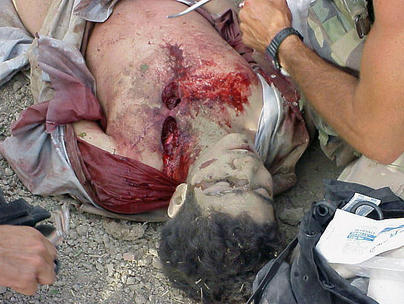
He was the first child soldier to be prosecuted by a Western country since World War II, dragged out from under the rubble of a Jihadist compound bombed by the US in the state you can see above. He was a 15-year old Canadian who was interrogated thus:

During pretrial hearings, Khadr's lead interrogator at Bagram admitted in court that, in addition to yelling, cursing and throwing furniture during interrogations, he had told Khadr a fictitious story about another Afghan teenager captured by U.S. forces who was gang-raped by "big black guys" in prison and likely killed by them, all because he didn't cooperate with interrogators.  This "Interrogator #1" — who was later court-martialled for abusing other prisoners — interviewed Omar Khadr about 25 times. Khadr's lawyers made a motion to suppress Khadr's statements on the grounds that they were elicited by torture and abuse.

Khadr himself has claimed via Wiki:

that he was refused pain medication for his wounds, that he had his hands tied above a door frame for hours, had cold water thrown on him, had a bag placed over his head and was threatened with military dogs, was flatulated upon, forced to carry 5-gallon pails of water to aggravate his shoulder wound. Unallowed to use washrooms, he was forced to urinate on himself.[50][59] His chief interrogator was Joshua Claus, who later pleaded guilty to abusing detainees to extract confessions following the in-custody death of wrongly accused Dilawar that same year.[62]

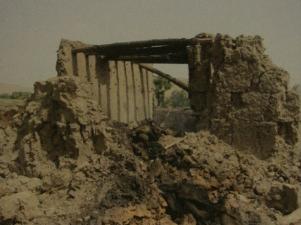
Confessions made under those circumstances were allowed in his trial. He has subsequently confessed to more crimes than he had originally been charged with. It seems he was indeed involved in a firefight in Afghanistan which became very deadly, had been caught up with Jihadists connected with his father, and had prepped explosives. He was not innocent of involvement with al Qaeda; but he was 15 years old, and in the battle that wounded him (whose complicated and contested details you can read about here) he was in a compound blasted with 500 pound bombs, buried under rubble, shot twice in the back, and sustained injuries that left one eye blind and the other with shrapnel still embedded. This is what remained of the building he was in after the bombing, of which he was the lone survivor:

Remains_of_Ab_Kheyl_Compound,_July_2002

Khadr has already spent several years in Gitmo, after brutal treatment at Bagram – and Daphne Eviatar explains the choice he faced:

If Khadr had gone to trial, he faced a potential life sentence from a military jury, who would hear how he "confessed" to the crimes in interrogation. He could have faced many more years in prison. What's more, the U.S. maintains the right to indefinitely detain him even if he was found not guilty.

His plea allows him to be released to a Canadian jail to serve out seven of his eight remaining years. Somehow, I doubt he will remain behind bars once he is remanded to a country that obeys international law about treatment of child soldiers and prohibits abuse, coercion and torture in interrogations. But it remains a source of shame for Canada's government that, for so long, it bowed to US pressure and did so little to rescue this misguided teen from the custody he will now have to endure for only one more year.

I don't know how anyone who cares about the integrity and moral standing of the United States can absorb the full details of this case and not be profoundly ashamed. To prosecute a child soldier, already nearly killed in battle, tortured and abused in custody, and to imprison him for this length of time and even now, convict him of charges for which there is next to no proof but his own coerced confessions … well, words fail.

The Iraq War, As Fought

Steve Coll sees the Wikileaks documents as a moment of clarity:

My own sense is that American understanding of the Iraq war has so far been distorted, in a way, by the heavy scrutiny of American conduct, generalship, politics, and domestic narratives of who won and who lost, who succeeded and who failed. The war we have absorbed much less of, but the one experienced by many Iraqis, is the one Jon Lee Anderson, among others, chronicled in this magazine in 2007. It was, particularly between 2005 and 2007, a war of nihilism, death squads, and elemental sectarian violence. The WikiLeaks archive seems to contain a lot of that war because it is weighted toward the frontline experience of the officers and soldiers sent to try to bring the sectarian violence under some semblance of control.