The Brooks Meme

Today, David tries to undermine the notion that the Republican wave is full of nutcases like O'Donnell or Angle or Miller. Mickey Edwards does the same:

Democrats are not losing to a band of unqualified unknowns. In Indiana, Republican senatorial candidate Dan Coats is a former U.S. representative and senator; Todd Rokita, who seems well poised to win a House seat, is the current Indiana secretary of state. In Illinois, Senate candidate Mark Kirk, who may capture Barack Obama's old seat, is a member of Congress; the Ohio governorship will likely fall to John Kasich, a former Republican congressional leader; Ohio's Senate seat will probably go to Rob Portman, a former House member and administration official; Democrat Tom Perriello appears to be losing his House seat to Robert Hurt, a veteran state legislator; Florida's likely new Senator, Marco Rubio, was speaker of the state House, etc.

Point taken. But one has to ask both Mickey and David: what exactly do they believe voters are repudiating that Obama has actually done?

Do they believe there should have been no stimulus or TARP (begun, of course, by Bush). No auto-bailout (which turns out to have been oddly successful). No financial re-regulation? I think the case comes down to health insurance reform, which included the first ever cuts to Medicare, and according to the CBO will help reduce the deficit. Now, I can see why the – dread word – optics of this might not be politically savvy, since it can be portrayed as "big spending" when, of course, it's carefully budgeted. But given the historical context of first term midterms, the big Democratic victories in 2006 and 2008, and an unemployment rate of almost ten percent, what big thing do Mickey and David think the Dems have done that they really, really shouldn't have?

Or rather: what lesson do Mickey and David want the Dems to learn? If it's a renewed focus on fiscal conservatism, great. I agree. I think Obama does too. But it's hard to tackle the long-term debt without tackling healthcare costs and Medicare, which the health insurance reform, for all its flaws, actually did. And which of the sensible experienced Republicans Brooks and Edwards touts have been candid about the scale of entitlement cuts necessary to address the long term debt without raising any taxes or even allowing the Bush tax cuts to expire?
“Curb-Stomping” Ctd

Drum puts Internet anger in perspective:

I think the blogosphere fools us about this stuff … The big difference isn’t that we’re any more filled with rage than we’ve ever been, it’s just that it’s all so public now. This might very well be a bad thing on its own (or not — who knows, really?), but it’s not because tea partiers are any angrier at Obama than they were at FDR or Bill Clinton. We just have a better view of it these days.

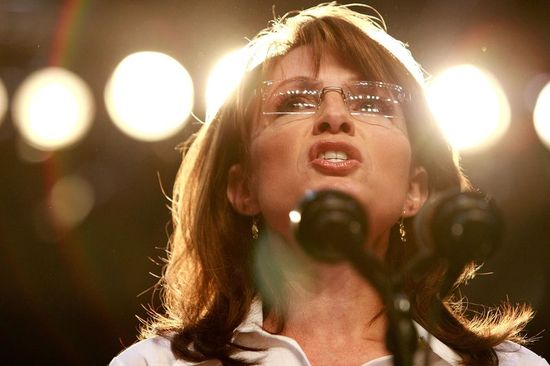
Two Words: President Palin

PalinChipSomodevillaGetty

John Heilemann makes his case:

For many Republicans, a Palin nomination would be a shrieking nightmare—just as for most Democrats, it would be a wet dream. (Asked about the possibility by reporters, David Plouffe, Obama’s 2008 campaign manager, quipped, “Something tells me we won’t get that lucky.”) The emotions here are diametrically opposed but based on a shared conviction: that Palin, whose national approval rating in a CBS News poll this month stood at a lowly 22 percent, is irredeemably unelectable, and thus her nomination would essentially guarantee Obama a second term.

Or would it? In a two-way contest, almost certainly. But what if a Palin nomination provoked a credible independent candidacy? What if the candidacy in question was that of, oh, Michael Rubens Bloomberg? What would happen then?

Doug Mataconis is skeptical:

[W]hile the idea of a Bloomberg for President campaign may excite the crowd that rides the Acela, I don’t see it playing anywhere outside the chattering classes, and without a viable third-party candidate siphoning votes away from Obama, there’s no way Palin becomes President.

There is always the possibility that Palin runs as a 3rd party candidate herself, should she lose the nomination. Her supporters are more cult-members than voters weighing policy options. But I want to note one line from John's piece:

She doles out personal, if possibly fictitious, anecdotes that position her, despite the millions she has pocketed in the past two years, as a defiantly downscale girl: that she and Todd drove their motor home from Wasilla to Los Angeles (distance: 3,375 miles) to watch Bristol on Dancing With the Stars.

Here's what I want to know: what process led both John and New York magazine not to confirm whether that 3,375 motor home drive was actually, rather than "possibly", fictitious? With most politicians, journalists actually try to check factual claims with, you know, reporting. But it seems that one of the best reporters I know, has not, in this case. Why? Why is Palin – alone of all national figures – allowed to tell the tallest, most implausible stories in public and never get quizzed on them by the press? Why is she treated differently? Why are the claims of a candidate who is, say, a veteran vetted, but Palin's manifold empirically dubious assertions left hanging as if truth didn't matter any more?

(Image: Chip Somodevilla/Getty)

“Why It Is Vitally Necessary To Prevent The Extinction Of The Final Serial Comma” Ctd

Grammar nerd alert. A reader writes:

I'm a longtime copy editor recently retired from the San Francisco Chronicle. The Chronicle doesn't believe in the serial comma, but I personally don't have an opinion about it. (There are more important concerns in style and punctuation.) However, the caption that Weintraub presents as an example hardly makes his case; the copy editor who handled it was clearly out to lunch.

To avoid the confusion Weintraub points to, the cap should have been rewritten to say, "The documentary was filmed over three years. Among those interviewed were Kris Kristofferson, Robert Duvall and Haggard's two ex-wives." Note that it now works fine without the serial comma.

Another writes:

Here's another good example that I always use with my students: "The $1 million was divided between Mary, John and Frank," is a lot different than "The $1 million was split between Mary, John, and Frank." The former means that Mary would get $500,000, and John and Frank (since they are grouped together as one entity in the list) would have to split the other half ($500,000 split into $250,000 and $250,000). The latter means that Mary, John, and Frank would each get $333,333.33.

If I were either John or Frank, I think that final serial comma is pretty damn important.  In fact, that comma would be worth exactly $83,333.33!

Another:

A similar example is the famous, but probably apocryphal, book dedication, "To my parents, Ayn Rand and God." It still cracks me up.

Another:

The original reason the serial comma (a.k.a. Oxford comma or Harvard comma) was "avoided" was to save space in printed materials, particularly newspapers where every bit of space saved meant more room for ads.

I believe that the rules that require punctuation to go inside double quotes, even when it's not part of the text being quoted are for the same reason. For example:

Richard Nixon was nicknamed "Tricky Dick."

vs

Richard Nixon was nicknamed "Tricky Dick".

The former is technically correct, but I think the second makes more sense logically.  Also, when the quoted text DOES have punctuation and it comes at the end of the sentence, you omit the final punctuation:

The small child asked, "Where's my mommy?"

vs

The small child asked, "Where's my mommy?".

I think the second one seems more correct.  The question mark is part of the quote, the period ends my sentence.

There are lots of archaic little rules like this that all derive from the old typesetting days.  I don't see the harm in adding extra punctuation to make a sentence more clear.  Isn't English confusing enough?

Apology Of The Day

“I’m sorry I gave offense. It was a headline I wrote quickly, and I thought the image of Mike Kinsley engaged in an act of violence was kind of funny because Mike is not really the violent sort, to say the least. Anyway, one person’s little joke is another person’s “rage of people who cannot bear to see their sacred ideals profaned,” to quote McArdle… So I will hereby endeavor to avoid any future headlines that would seem to celebrate violence or conceivably endanger the physical safety of Arthur Laffer or anybody else,” – Jon Chait, saying sorry for the image of Mike Kinsley “curb-stomping” Greg Mankiw.

On the other hand, here is what happened outside the Rand Paul-Jack Conway debate last night:

(Hat tip: Josh)