Bartending With A Bachelor’s

Richard Vedder argues that we are "over-investing" in higher education:

Over 317,000 waiters and waitresses have college degrees (over 8,000 of them have doctoral or professional degrees), along with over 80,000 bartenders, and over 18,000 parking lot attendants. All told, some 17,000,000 Americans with college degrees are doing jobs that the BLS says require less than the skill levels associated with a bachelor’s degree.

The lesson Ben Casnocha draws:

For hundreds of thousands of Americans, spending four years and untold amounts of money (and debt?) gets you a job as a waiter, parking lot attendant, or janitor. Yet everyone from Barack Obama to Bill Gates keep pushing a college education as the way to secure one's economic future. That is a view that should be heavily qualified.

Where’s The Pro-Cannabis Left?

Thoreau wants to know why liberal think tanks write little about marijuana legalization:

I just realized this morning that when I read about legalization, any time I see mention of a pro-legalization think-tanker it’s always, always, ALWAYS a Cato person.  Admittedly, I don’t read every single piece of literature on legalization or every single article on Prop. 19, but I do read non-libertarian stuff on legalization, and even the lefty stuff on legalization seems to quote Cato.  Even Greenwald, when talking about Portugal’s experiment, gave a talk at Cato.

Now, Cato is obviously a well-known institution that has spent a lot of time writing about legalization, so there’s one reason for them to get lots of attention on this.  And I do realize that right-leaning and libertarian-leaning think tanks outnumber lefty think tanks (less so than in the past, admittedly), so statistically any time you see a think tank quoted the odds are that it’s not a lefty think tank.  Finally, I admit that I have not personally checked every position paper ever put out by a lefty think tank, so maybe there’s a whole bunch of legalization sentiment that I’m just missing out on.  But, whatever the reason, and however much individuals in lefty think tanks might have pro-legalization views, it’s Cato that gets all the attention.

The above ad is now running in California.

The Unpopularity Of Uncertainty

A reader at Tyler Cowen's place asks what "are the most important economic ideas that are not popularized, i.e. not accessible to laypeople in books and articles by credible authors." One of Cowen's answers:

… it is hard to popularize "maybe" claims, agnoticism, uncertainties, confidence intervals, and contingencies.  The marketing process encourages excess certainty.

The Rise Of Highbrow TV

Julian Sanchez strokes his chin:

Alex Tabarrok considers some economic explanations for the recent inversion of the traditional dominance of movies over television as “elite entertainment,” primarily the rise of pay-TV and the growing importance of the international market for movies. (Explosions don’t need to be translated, after all.) That’s surely part of it, but I’d be more inclined to emphasize the effect of DVR and the rapid collection of TV seasons on DVD.

It’s much easier to tell a dense, multilayered story with many characters that unfolds over the course of a full season when you know viewers aren’t at any risk of missing an episode and getting lost, and in particular when they can go back and refresh their memories rather than having to keep the whole story cached in memory in the week between episodes.

Yglesias highlights an unusual movie theater selling point:

?To me, at least, the movie theater has become an unusual point of refuge from the ubiquitous connectivity of my laptop, smart phone, iPad, etc.—a place where social convention makes you shut up and watch in a way that’s hard to achieve at home.

Pot’s Coattails, Ctd

In a new California survey PPP asked respondents "what on the ballot they were most excited about voting for …  " Ten percent named Prop 19:

There is no way of knowing for sure whether the voters who say Prop 19 is what they're most interested in would vote this year if it wasn't on the ballot. But we do know that group favors Barbara Boxer by a 34 point margin and Jerry Brown by a 36 point margin. At 10% of the electorate that means the marijuana question could be worth as much as 3.4% for Boxer and 3.6% for Brown. We find both of them ahead by a good deal more than that but if California ends up being closer than we expect Prop 19 could really end up being a difference maker for the Democrats at the top of the ticket. 

The Daily Wrap

Today on the Dish, Andrew continued to delve into the difference between liberals and conservatives. TNC pwned Saletan on the Sherrod analogy, and Fallows eloquently defended NPR. Andrew lent some historical perspective to Silver's predictions, Larison's were here, and Kaus wanted a "none of the above" option on ballots. Reihan corrected the record on his fiscal proposals, Ross put TARP into perspective, the birthers were still at it, and a reader wondered if Obama should pardon Bush.

We tracked Prop 19 and cannabis across the country, Margaret Haney myth-busted addiction rates, and TNC and Cynic mulled over the Culture Of Affluence. President Lincoln slept with a man, a reader defended anti-bullying bracelets, and the Washington Times fear-mongered on DADT. Around the world, we saw drug war torture in Tijuana, David Rieff skewered the status quo on global aid, and microfinance money didn't always end up where we expect. Stephen Walt took us down a notch on Mission Accomplished, the NYT still won't call it torture, and Wikileaks wasn't helping politicians much in Iraq.

Elsewhere, men didn't scoop the poop, airbags might be coming to a bicycle near you, bloggers debated curb-stomping, and hip-hop was down with G.O.P. We looked into whether Google should give up its tax loophole, and Choire Sicha asked what people were doing with their iPads when they aren't reading magazines. Alain de Botton camped out in Heathrow, we guffawed at the economics of Seinfeld, and good luck charms work if you already believed in them. Quote for the day here, VFYW here, FOTD here, Yglesias award here, MHB here, and campaign ad of the day here.

–Z.P.
“Reports Of Possible Elevated Electromagnetic Ultimata”

Greenwald calls out the NYT for white-washing the Wikileaks documents:

 Note … how the NYT in its article on brutal detainee abuse steadfastly avoids using the word "torture" to describe what was done, consistent with its U.S.-Government-serving formal policy of refusing to use that word where U.S. policy is involved.  By stark contrast, virtually every other media account uses that term to describe the heinous abuse of detainees chronicled by this leak, the only term that accurately applies:  see The Guardian ("American military documents that detail torture, summary executions and war crimes"); BBC (US "ignored Iraq torture"); Politico ("a devastating portrait of apparent U.S. indifference to a pattern of murder and torture by the Iraqi army").  BoingBoing appropriately mocks the NYT's increasingly humiliating no-"torture" policy by creating a euphemism-generator.

Cannabis Across America

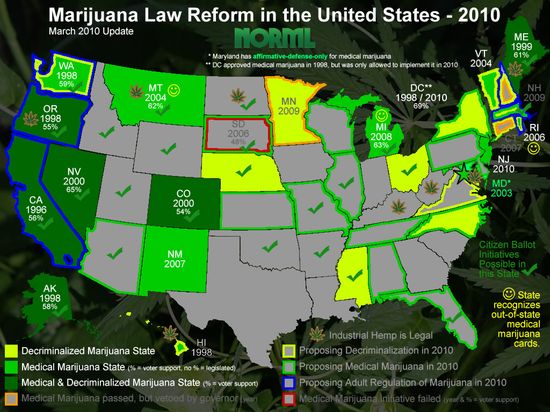
MedicalMarijuanaStates2010

Russ Belville lists 19 reasons to pass Prop 19. The first one:

It might seem counter-intuitive to some, but illegal marijuana is much easier to acquire than regulated marijuana because weed dealers don’t check ID’s.  Four out of five high school seniors, more than three in five sophomores, and two in five middle schoolers (8th grade) say marijuana is “fairly easy” or “very easy” to get.  One third of 16-17-year-olds say marijuana is easiest to buy, not cigarettes, alcohol, or prescription drugs.  Two out of five teens say they can get marijuana in a day; almost one in four can get marijuana in an hour.  Obviously letting unregulated dealers control the marijuana market is not protecting your kids from access to marijuana.  On the other hand, aggressive enforcement of ID carding for minors, combined with public education have led to some of the lowest rates of teen alcohol and tobacco use ever recorded. 

(Above: Map of marijuana laws in America as of March 2010.)

A Bigoted Defense Of DADT

On Friday The Washington Times compared letting gays serve openly in military to letting the elderly and handicapped serve. Adam Serwer wants to tear his hair out:

The idea that homosexuality is akin to a physical disability is self-evidently absurd — the military doesn't prevent gays and lesbians from serving, just serving openly. The question of whether or not gays and lesbians are physically capable of doing so isn't even at issue. It's not just the Times making this silly argument either–Republican Sean Bielat, who is challenging openly gay Massachusetts Democrat Barney Frank using a blatantly homophobic ad campaign, recently said "I don't see anybody protesting" the fact that men under 5'2 aren't allowed to serve. 

… The Washington Times isn't making an empirical or rational argument, it's just counting on the reader being as frightened and hateful as they are.

There's no response to that, other than disgust.

Face Of The Day

MonkGoldSTRAFPGetty Images

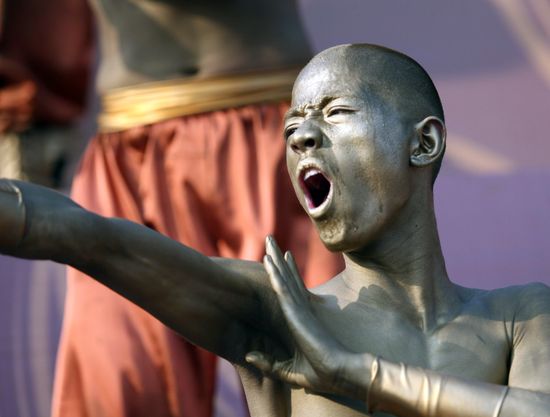
A young Chinese Shaolin monk, with his body painted in gold, performs for visitors during a kungfu festival at the temple in Dengfeng, central China's Henan province, on October 24, 2010. The Shaolin temple – which makes millions every year from entrance fees, online sales of Shaolin items such as spearheads and its travelling performing troupes – has attracted controversy in China over charges of rampant commercialism. By STR/AFP/Getty Images.