The Seniors Behind Bars, Ctd

A reader writes:

Oh what a great idea, to release prisoners with life sentences, just as they are getting old and sick, when they have no marketable skills, no health insurance but Medicaid, no place to live, no real-life experience with today's economy and culture, and quite likely no family to provide a support system, and no track record in getting along peacefully with other people, especially if they were incarcerated for several decades for heinously anti-social crimes. 

What a guaranteed way to increase the homeless population, and throw the care of a new class of elderly indigent men, no longer violent maybe, but quite likely with mental-health, substance abuse, and anger-management issues, onto churches and other private social services. Just exactly as humane and forward-looking as throwing a whole generation of mental patients onto the streets under Reagan. How is "freedom" in that sense — freedom to be set adrift in a complex, competitive society at a point in the life cycle when even the most privileged start to become dependent on one kind or other of safety net — any kind of benefit either to these human beings or to society at large?

Another writes:

Jamelle Bouie may be identifying a solution in search of a problem. 

He excerpts two relevant statistics:  The number of prisoners in Virginia over 50 and the number of prisoners nationally 55 or older.  I’m 57 and, although I’ve never committed a crime, I certainly feel fit enough that, if that was my “career”, I could still be doing this. Let’s assume that the age of 60 represents a dividing line, after which those individuals who aren’t sociopaths generally won’t commit more crimes. (This assumes, of course, that such individuals have other means of supporting themselves, which is questionable.)  What is the number of prisoners who are over 60 and who aren’t considered to be dangerous?  These excerpts don’t say.

It’s also worth noting that the figure given for number of prisoners nationally who are 55 or older – 76,600 – works out to an average of about 1,500 per state.  If you eliminate those who are in the 55-59 group, and those over 59 who are too dangerous to release, you probably have an average of under 1,000 per state.  Frankly, I don’t see that as a problem of national proportions.

Finally, they say that older prisoners have a calming effect on a prison population in general.  If that’s true, then it may not be in the state’s best interests to push older prisoners out the door prematurely.

Another:

While I can see that for those convicted of violent crimes, I think there should be different criteria for white collar criminals, such as Bernie Madoff. White collar crime is much, much less "a game for the young." Indeed, I suspect that hardly any white collar crimes (except maybe the occasional computer hacking scheme) are due to men in their teens and early twenties – just much less opportunity that young. And, more importantly, since no physical abilities are required, the capability to commit further damage lasts a lot longer. So perhaps those criminals ought to be held until a rather later age.
Let The Pundits Play Chess

Spurred on by Andrew Sprung's criticism of Tom Friedman, Jonathan Bernstein argues for another understanding of sacrifice:

[E]veryone understands that a sacrifice in chess is self-interested. There is no moral or character component to sacrificing a piece; it's a good idea if it helps the player win, and a bad idea otherwise. No one analyzes a chess game by saying that the player lost, but at least she was willing to sacrifice her rook, or that he didn't deserve to win because he was unwilling to sacrifice anything.  It seems to me that we'd be better off if pundits talked about sacrifice in that way, rather than in the morally loaded fashion (which I think is similar to the misguided way that sacrifice is discussed in baseball) that Friedman favors.  Oddly enough, I think that the chess model of sacrifice, even though it appears to be cold, calculating, and cynical, would yield a much more healthy view of the collateral costs in human suffering often involved in Friedmanesque calls for sacrifice.

Face Of The Day

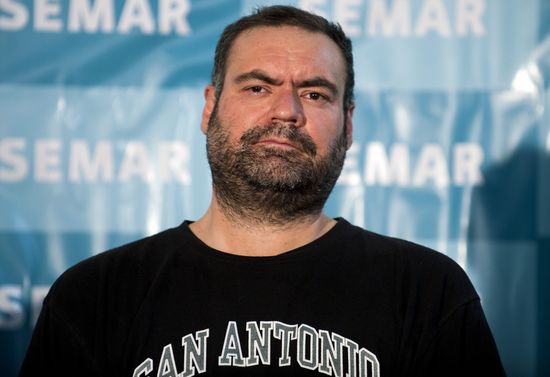
104049015

Sergio Enrique Villarreal (aka "El Grande") of the Beltran Leyva drug cartel, one of Mexico's most wanted men, is presented to the press at the Mexican Navy headquarters in Mexico City, on September 13, 2010. Mexican authorities had offered a reward of up to 30 million pesos (2.2 million dollars) for information leading to his arrest. By Alfredo Estrella/AFP/Getty Images.

The Manufactured Misfit? Ctd

A reader writes:

Paglia’s criticism that Lady Gaga is nothing more than a manufactured misfit echoes a similar complaint she has leveled against Obama in the past, for “trying to act more casual and folksy to appeal to working-class white voters" – a demographic she is forever claiming to speak for (namely by nattering on in her essays about her exposure to the urban proletariat during her childhood in Philadelphia). So, Gaga – and, presumably, Obama – are to be condemned as “manufactured personalities,” while right-wing radio hosts like Rush Limbaugh are heralded by this salt-of-the-earth cultural critic as the “embodiment of the American dream,” and Sarah Palin is fawned over for her “fresh, natural, rapid fire delivery.”

Camille Paglia’s work has devolved into a boring parlor trick consisting of lazy contrarianism, arbitrary administrations of her authenticity sniff-test, and compulsive hymns to another performer – Madonna – whose performances have grown almost as stale as hers. Also, sentences like “Gaga’s fans are marooned in a global technocracy of fancy gadgets but emotional poverty,” just make her sound … well, old. 

The Case For Modesty In Afghanistan, Ctd

Justin Logan, who participated in the Afghanistan Study Group report, defends his work:

I cannot find evidence that either Foust or Exum recognizes strategic thought. Both appear to believe that they are engaging in it by picking nits with various aspects of the report’s analysis, but none of their critiques of the smaller claims does anything to knock down the report’s conclusion: that America has limited interests in Afghanistan; that those interests are actually reasonably easy to achieve; and that our current efforts there are at best wasteful and at worst counterproductive.

(Hat tip: Compass)

Hiker Released

A glimmer of good news from Iran:

Iran freed Sarah Shourd, 32, after a $500,000 bail was paid to win her freedom [following a year-long imprisonment]. However, the case that has deepened strains between the U.S. and Iran was still far from resolved. …

"I want to really offer my thanks to everyone in the world, all of the governments, all of the people, that have been involved, and especially, particularly want to address President Ahmadinejad and all of the Iranian officials, the religious leaders, and thank them for this humanitarian gesture," Shourd told Iran's English-language Press TV at the airport before she boarded her flight out. "I'm grateful and I'm very humbled by this moment," she added.

Iranian President Mahmoud Ahmadinejad has said Shourd was being released on compassionate grounds because of health reasons. Her mother says she has serious medical problems, including a breast lump and precancerous cervical cells.

Her release is bittersweet, however; fiance Shane Bauer and their friend Josh Fattal are still imprisoned. Robert Mackey is all over the story and provides video, statements from the family and officials, and several updates. Rasha Elass fumes:

Shame on Iran for putting Sarah Shourd's family and friends through so much heartache. First it was the ecstatic news of her pending release just a few days ago, only for that to be cancelled and then — surprise — a demand for "bail." Call it what you will, but is it not increasingly beginning to sound like a ransom?

Merely A Copy, Ctd

A reader writes:

As chair of a religious studies department, I can speak with a little authority on this topic. I think Hertzberg's rather romantic statement – like Frances Widdowson's more cynical statement on Canada's national broadcaster this weekend (she called the Qur'an a book just like any other book) – fails to recognize the uniqueness of the Qur'an, theologically speaking.  It is scripture par excellence – the literal word of God (not necessarily subject exclusively to literal interpretation).  And as such, each and every manifestation of it is itself sacred. No one is free to treat as cavalierly as most Christians could treat the Bible if they wished. Nobody was ever offended by the fact that the Bible I used for university courses is dog-eared and dirty, but my many Muslim students treated them with a fair degree of care.

So to burn the Qur'an is to cut deep.

Reaction to the idea could be construed as the insecurity of subaltern and not-so-subaltern Muslims, but it's much more, and I don't think it entails a profound fear of the destruction of Islam by the Great Shaitan.  It's as great an offense as can be imagined. Failure to understand this reveals a basic difference in religiosities.

I suspect Terry Jones planned to burn a stack of Penguin "Korans," ie. translations, which theologically speaking are not Qur'ans at all. The special status of the Qur'an means that it cannot even be translated and retain the same ontological status. I can't say for sure, but while protests in the Islamic world have entailed the burning of effigies of American presidents as well as the flags of the US and Israel, I doubt you'd find any protests where Muslims burned Bibles or Torahs.  They have a passionate understanding of what burning things means, and burning scripture, even corrupted ones for Christians and Jews, is verboten.

An Electoral Pact?

Bagehot keeps tabs on Nick Boles, "founder of the modernisers' favourite think tank, Policy Exchange, and now a freshly-minted Conservative MP":

[T]here are big hitters in both coalition parties who think that the era of one party rule in Britain may well be over, at least for the Tories. It is fair to say that an awful lot of MPs and certainly party members accept nothing of the sort. They would probably accuse Mr Boles of being an outrageous opportunist, seizing his chance to steer the Conservative party onto a centrist, liberal-conservative course that was his dream all along. Perhaps they are right that Mr Boles is an opportunist. I would venture that a more interesting question is whether Mr Boles and his fellow Cameroons are right or wrong that an earthquake and floods are imminent. If they are right, then radical change will not be a question of choice or ideological preference. It will be a matter of survival.

Massie thinks talk of a pact is slightly off the mark:

[W]hether there's a formal pact or simply an informal arrangement (ie, not trying too hard to win in some seats) the fact is that the Lib Dems are lashed to the Conservatives anyway. They cannot run against their own record without looking unusually ridiculous. Whether they like it or not they will stand or fall with the Tories.