Beyond Winning The Round

Matt Yglesias ponders intellectual honesty. This prompts Noah Millman to make a distinction between pundits who make arguments that they think are true and pundits who make arguments according to political affiliation. Julian Sanchez illustrates the difference:

Back when I debated for NYU, I was always honest: I would not knowingly assert factual falsehoods. But I was often intellectually dishonest, because my job in those particular contests was not to engage in an impartial search for Platonic truth; it was to win the damn round… I certainly wouldn’t volunteer my own doubts about my arguments, or acknowledge responses I thought had hit home—unless strategically, as a prelude to a stronger counter.

Sanchez wants writers to give "the full and sincere engagement of their brains, including all the doubts and reservations, rather than the most vigorous defense they can offer of a position." But in my view, that often is the most vigorous defense. If you can include the obvious counter-points, acknowledge their strengths and still argue forcefully against them, you are much more persuasive.

When I was a debater at the Oxford Union – in other words, when it really was a game in some post-adolescent sense – my own decision was often to pick what would likely be the losing side. I enjoyed trying to hone the best case for an unpopular position. In three years of debating, I think I was on the winning side of the debate once.

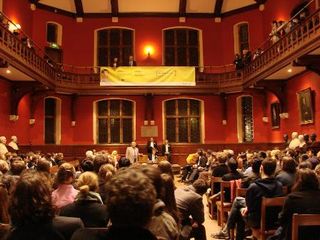
For some reason, I'm feeling nostalgic these days and I was thinking yesterday of exactly one of those 06-the-oxford-union-debating-chamber-pic-courtesy-rajiv-dabas-2 debates when my side lost decisively – and how it resonates in my mind still. The motion was "There is no moral difference between the foreign policies of the United States and the Soviet Union." It was a big event which, as president I had originally set up – between then US defense secretary Caspar Weinberger and E.P. Thompson, the Marxist historian. I picked Thompson's side, which was a little shocking to my Oxford peers given I was a paid-up Thatcherite and Reaganite who actually welcomed the arrival of Pershing missiles in Britain with a bratty champagne party. But it wasn't only perversity and the thrill of making a case I knew would lose that drew me in. Looking back, the argument I made is one that has actually dominated this blog these past few years.
My point was that America's democracy did not exonerate it from moral judgment in its conduct of foreign policy; and that the use of military force, directly or by proxy, had to obey universal moral norms that were not suddenly exempted because one side was a dictatorship and one a democracy. The use of violence was the use of violence; war crimes were war crimes even if the side which committed them was more generally benign than the other; warfare and realpolitik – whether exercized by the US or the UK or the USSR – were to be judged by universal standards. In other words, my speech was a Tory critique of American exceptionalism. I recall looking directly at Weinberger and uttering this neoconservative heresy (I paraphrase from memory):

"You are just another country; just another republic in the history of the world. You are subject to the judgment of history, not exempt by the fact of merely being America."

Later, I interrupted Weinberger's speech at one point with the simple question, decrying his logical dependence on the internal democratic system of the US as the core reason its actions were always morally superior to the Soviets:

"Does an immoral act become less immoral because we have the right to choose to do it or not?"

I have been accused of inconsistency, idiosyncrasy and God knows how many things over the past decade as my revulsion at neoconservative hubris has deepened. But that teenage debater was onto something. And I cling to it still.
Dissents Of The Day

A reader writes:

I saw this story yesterday, and I'm surprised at the uproar (well, not surprised at all in many ways).

1. People act as though Obama himself signed this ban. Highly unlikely. The FBI was the investigating office, and presumably they deal with a lot of abusive/complaining e-mail.

2. Nobody outside the loop – least of all The Sun! – knows exactly what was in the email, and what specific phrases were used. I am not sure why the kid has not published it, unless he was forbidden to by the FBI; or perhaps he was so drunk that he doesn't know where his outbox is.

3. He's not an American citizen who is being exiled for exercising his First Amendment rights; he is a foreign national who apparently made threats to the person or office of the President.

Non-Americans have no protected "right" of travel there that I am aware of: they are generally extended the privilege unless there is a reason to deny it … a line this e-mail seems to have crossed. Everyone has latched on to "prick" as being the worst of the insults, and perhaps it is, but I doubt the FBI goes to these sorts of lengths for that level of insult, somehow. I also doubt that the UK law enforcement would be following up this way for something quite so minor. They have a lot more important things to do than track down teenagers calling people pricks, don't you think?

So, I'm giving some benefit of the doubt to law enforcement in this case, since I know that I don't know all the facts. Whether or not the kid should be held accountable in such a way for his drunken hooliganism is another matter. By the way, the melodramatic Palin allusion was a bit over the top!

Another writes:

Instead of addressing the story, you take shots at Palin.  Let me be clear: I am a fan and I love your blog.  I don't like Palin at all.  But I hate the injection of the ex-governor in this way.

What I really wanted to know is what you thought of this story and those consequences.  There are numerous questions I'd love to read your take on, such as: What does this story say about youth and information technology?  What does this story say about what one can say to the president (any US president) in correspondence as a foreign citizen?  If it is true that the worst thing this kid said in his email was that the president is a "prick," what does that say about protecting the leader of the free world?  Etc.

Instead, I get what you think about Palin. Again.

I know you're trying to keep our eyes on the ball.  But this felt kind of sloppy and I was just slightly disappointed as a humble, loyal reader.

Entitlements, From Scratch

Andrew Biggs, a long-time conservative critic of Social Security, continues to advocate for reform:

[P]olicy makers need to think beyond merely filling Social Security’s multi-trillion-dollar shortfalls, and particularly beyond doing so merely by sticking the bill to high earners. Rather, they should consider reform as if they were designing a system from scratch: if so, how would they decide to spread the burdens and benefits of a national pension program over citizens of various earnings levels? If too progressive, the program begins to resemble “welfare,” with the associated stigma and resentment that implies. If not progressive enough, the program may fail to accomplish its social insurance goals. In either case, though, policy makers need to consider facts and data, not simply overstated claims that high earners are not paying their fair share.

If Bibi Wants Peace

William Galston thinks Abbas will pull out of talks because of new settlements:

[A]t some point Netanyahu will have to acknowledge that if he truly wants peace, he’ll need a different coalition—namely, the one that should have formed two years ago. Otherwise put: The decision that the current coalition must be preserved at all costs would represent the clearest possible evidence that this round of negotiations isn’t serious.

Mitch Daniels, Reality-Based Conservative

51587169

And a desperately needed breath of fresh air:

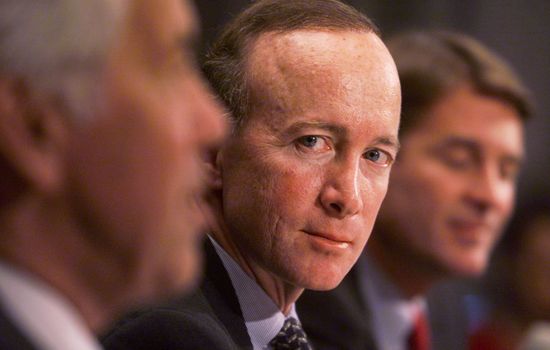
For decades, Republicans have railed against deficits and debt, but they’ve been too afraid of voter backlash to venture beyond marginal measures (“wasteful spending”). Daniels didn’t get the memo.

Let’s raise the retirement age, he says. Let’s reduce Social Security for the rich. And let’s reconsider our military commitments, too. When I ask about taxes—in 2005 Daniels proposed a hike on the $100,000-plus crowd, which his own party promptly torpedoed—he refuses to revert to Republican talking points. “At some stage there could well be a tax increase,” he says with a sigh. “They say we can’t have grown-up conversations anymore. I think we can.”

Know hope.

(Photo: Shawn Thew/AFP/Getty Images)

Quote For The Day

“Even if you’re eating delicious chocolate cake, there are moments you feel like, ‘I’ve had too much.’ Now replace ‘chocolate cake’ with ‘shit taco’ and you know what our day is like every day. But this is not a fragile country. I’m not suggesting we couldn’t find ourselves in deep conflict. But we had slaves, and we fought a civil war; now we’re down to Glenn Beck being hyperbolic with his audience about nostalgia. This too shall pass,” – Jon Stewart.

Republicans Huffing Their Own Glue

Most current Republican positions are actually unpopular (although, alarmingly, the "Terror Babies" amendment to the Constitution is an exception). Repealing universal access to private health insurance is only supported by a third of Americans, which would make a veto a no-brainer. And the GOP third is increasingly white and rural, which means it represents a reactionary throwback, not a constructive move forward. Greater freedom for people to invest their social security in private markets is pretty popular (I support it) but not among the elderly, who will be core to the midterms for the GOP.

All of this suggests to me that whatever mandate the GOP thinks it will get this fall will be very very tricky. They haven't done the hard world to revive their policy agenda, and are riding on some ugly identity politics and recession anger to get back to power. Obama is still remarkably popular in the country given the conditions (doing much better than Reagan was at this point) and his leverage may well be quite acute if the Republicans actually have to exercize responsibility. The Boehner-McConnell divide could widen; and the tea-party/establishment strains intensify.

It's deeply depressing to see the ahistorical and ideological FNC/RNC propaganda doing so well in the country. But it is no cure; it solves none of the deeper problems; it's unserious on the debt; and deeply, deeply dangerous and uber-neocon in foreign policy. You have to have faith that at some point more Americans will acknowledge this and give the president the break he deserves.