Question of the Week

by Conor Friedersdorf

It's the final week before Andrew returns, and I'd like to begin it with another question for readers: What about your profession or field of expertise do most people not know or fail to understand or appreciate? Straightforward answers are fine, as are reflections on what the media gets wrong about your field, or what insights it gives you that others might find helpful as they try to understand the world. And yes, rants from service employees are also okay.

(Send to conor.friedersdorf@gmail.com with "About My Job" in the subject line.)

The Prescient Pope

by Zoe Pollock

John Farrell celebrates the 60th anniversary of "Humani Generis", the papal encyclical (or pastoral letter) that established the Catholic Church's official relationship with Darwinian evolution, written by Pope Pius XII in 1950. While recognizing the Pope's foresight, Farrell also points out a slight problem in the church's position today: 

While Pius was willing to concede that there was reason to believe the human body was the product of evolution, he was adamant that the special status of Adam as the father of the human race should not be a matter of question. "For the faithful," he wrote, "cannot embrace that opinion which maintains either that after Adam there existed on this earth true men who did not take their origin through natural generation from him as from the first parent of all or that Adam represents a certain number of first parents."

Pius declared that it was not apparent how such a theory of a founding population of humans, and not a single couple, could be reconciled with original sin. That Catholic doctrine regards the Fall as an historical rebellion against God; a sin actually committed by an individual and which is passed on through the generations from him to all men and women.

Subsequent research into genomics, however, has settled this question against Pius. It's not that scientists cannot trace human ancestry back far enough to an Adam and Eve; it's that in principle, the level of genetic variation present in the species today rules out a founding population with fewer than several thousand individuals.

Time To Act

by Zoe Pollock

The tragic realities of prison rape continue, as evidenced by a new report. Lovisa Stannow and David Kaiser follow one man's story:

[C]onsider the case of Scott Howard. Scott was a gay, non-violent, first-time inmate in a Colorado prison when he was targeted by members of the “2-11 crew,” a white supremacist gang with over 1,000 members in prisons throughout the state. For two years he was forced into prostitution by the gang’s leaders, repeatedly raped and made to perform oral sex. Even after he told prison staff that he was being raped and needed protection from the gang, Scott was told that nothing could be done unless he named his abusers—even though they had threatened to kill him if he did. Because Scott is openly gay, some officials blamed him for the attacks, saying that as a homosexual he should expect to be targeted by one gang or another. And by his account, even those officers who were not hostile didn’t know how to respond to his reports, because appropriate procedures were not in place. They failed to take even the most basic measures to protect him.

Ultimately, despite his fear, Scott did identify some of the gang members who had raped him. Not only did the prison authorities again fail to respond, they later put Scott in a holding cell with one of his previous assailants on the day he was to be released from state custody. Again, he was beaten and forced to perform oral sex. Scott had a civil lawsuit settled in his favor recently, winning financial damages and seventeen policy changes that will now become mandatory in the Colorado prison system. Otherwise, however, nothing about his story is unusual.

The Big Picture

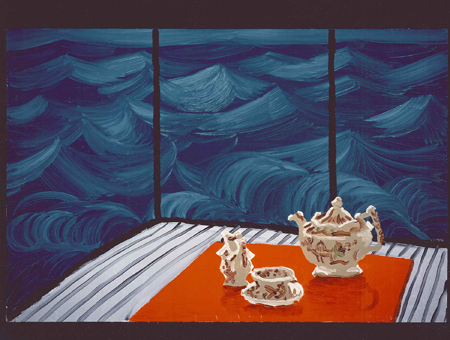
Teacups

by Zoe Pollock

at the height of the AIDS epidemic, as it happens, at a time when Hockney used to have a beach house overlooking the occasionally quite wild surf off Malibu Beach: a dainty porcelain tea set in the foreground against the backdrop of the roiling sea. Where, one is given to wonder, is the true drama?

“Wish The Rent Was Heaven Sent”

by Zoe Pollock

Regina Brett of the Cleveland Plain Dealer debates whether a house Langston Hughes lived in for two years in high school is worth saving:

It's tempting to turn the home of writers into museums to honor the writers, bring in tourists, and preserve the cultural legacy of a neighborhood. But she's visited 55 homes of famous writers in America and found that many of them suffer financially. To do well, they need to be in a good location and have a big operating budget. Last year, foreclosure hit the Edith Wharton House in Lenox, Mass., and the Mark Twain House in Hartford, Conn.

[Anne Trubek, an associate professor at Oberlin College] has a better proposal. Why not honor authors like Hughes by reading their work?

"What if we gave a free copy of his poetry to all kids?" she said.

Her young son was never assigned to read Hughes, so she made him. When she drove him by the house, he wasn't impressed.

"It's just a house," he told her.

While in the house, Hughes wrote the below words, which Brett offers as a fitting coda to a story where the words might matter more than the house:

I couldn't afford to eat in a restaurant, and the only thing I knew how to cook myself in the kitchen of the house where I roomed was rice, which I boiled to a paste. Rice and hot dogs, rice and hot dogs, every night for dinner. Then I read myself to sleep.
The Easy Narrative

by Zoe Pollock

Tom Bissell defends Virginia Quarterly Review editor Ted Genoways and expresses disappointment that a true tragedy, the suicide of managing editor Kevin Morrissey, has been turned into a trend story, which seems to be a popular thing to do these days:

I would like to believe that I know enough about human nature to be able to sense within someone to whom I am close a monstrousness capable of tormenting a colleague into the dark embrace of suicide. What I do sense in the VQR tragedy, unmistakably so, is a far more complicated story about people who grew to despise one another, worked terribly together and had access to too much money and not enough support systems, whether personal or official. But "workplace bullying," like the "ground zero mosque," is a narrative so easy and pleasing it practically fits you for your toga.

Book Biases

by Zoe Pollock

Chris Jackson, subbing in for TNC, has a nice post about our own unintentional literary biases, after he had to make a concerted effort to read more female fiction. As a fiction lover, I just recently vowed to bone up on my foreign policy non-fiction, thanks to some enthusiastic encouragement from my nerd boyfriend. Chris' point is well put and well-taken:

There are ways that our reading is shaped and limited by the biases of the dominant literary gatekeepers–maybe without realizing it, we've only read books by people of a certain race, or who write in a certain language, or who follow the conventions of a certain genre (including the unnamed genre of Anglo-American Serious Fiction). To some people this is the great opportunity in the coming bookquake, the chance to disintermediate some of those gatekeepers and their peculiar, ossified biases. But the real bias may be inside of us, as readers, and we might have to force ourselves out of them to take advantage of these new opportunities. How exciting is it to consider that there are worlds of literature out there that you may not have tapped into, undiscovered countries of books to explore that might yet tell you something new in a new way?

Atomized Individuals

by Zoe Pollock

Mark Lilla explores China's one-child policy and its psychological repercussions, through the story of a father distraught over his only son's breakup with a girl:

It worries him that the popular culture now promotes dating and youthful romantic love, something he feels Chinese young people aren’t psychologically prepared for, especially the breakups. The more he spoke, the more anguished he sounded about losing his son in other ways, too. Even as a youngster the boy would stay in his room glued to his computer avoiding human contact, rarely going out with his few friends. Other Chinese parents I spoke with said similar things about their children, complaining about their remoteness, their social isolation, and their obsession with technology. They seem an alien race of free-floating individuals.

For many Westerners, this is a familiar picture. We have not only accustomed ourselves to the atomizing forces of capitalism and modern culture, we idolize them. They only make us freer (we think), and anything that increases our freedom is good (we think), given that freedom is the highest good (our unquestioned questionable assumption). Q.E.D. But China isn’t there yet. People I spoke with my age or older still think in traditional ways about family and society, even as economic growth and the one-child policy promote individualism, selfishness, and narcissism. They are disturbed by the prospect of atomized individuals facing a powerful state and largely un-regulated market forces without mediating social institutions. Western nations have somewhat adapted to the cultural contradictions of capitalism because they are politically and socially democratic. China hasn’t, and isn’t.