by Chris Bodenner
Meet the most hated woman in Britain right now. They caught her with a combination of CCTV cameras and YouTube, a kind of global Big Brother.
by Chris Bodenner
Meet the most hated woman in Britain right now. They caught her with a combination of CCTV cameras and YouTube, a kind of global Big Brother.
by Conor Friedersdorf
Tim Cavanaugh writes:
Eli Broad’s new agreement to build a downtown Los Angeles art museum gives the capricious billionaire and medieval patron of the arts what may be the sweetest rental deal of the century: a 99-year lease of a large parcel in downtown L.A. for a mere $7.7 million.
If that figure is accurate (more below), this means one of the 100 richest people on the planet is leasing a full block on Grand Avenue for $6,481.48 a month. The owner of the land (in this case, L.A.’s Community Redevelopment Agency) could have gotten more than that with four rental units.
Instead, L.A. taxpayers will be funding the creation of yet another art museum, as part of Broad’s long-term goal of bringing “culture” to a city full of actors, musicians, filmmakers, writers and artists.
Though I've been staying on the west side of Los Angeles, near its border with Venice, I've found myself hanging out in our revitalized downtown far more than I anticipated before moving back to California, and I'd probably go there even more frequently if the expensive subway system the city installed afforded a means of getting back and forth instead of being conspicuously absent from Santa Monica and its surrounding communities.
I can't say I endorse or object to another art museum, but I can attest that Southern California's various redevelopment agencies are rife with idiotic projects.
In Rancho Cucamonga, a prosperous community I used to cover for the Inland Valley Daily Bulletin, city officials were able to game the system by using redevelopment money and tax advantages to develop parcels that weren't blighted by any reasonable standard.
The Los Angeles Times once published published a good piece on redevelopment agency efforts in North Hollywood (can't find it online for some reason):
Two decades and $117 million in public money later, efforts by the city of Los Angeles to rescue suburban North Hollywood from creeping blight have largely struck out, a Times computer analysis has found.
North Hollywood had seemed a promising candidate in 1979 for one of the city's most ambitious redevelopment projects ever. It sits adjacent to enclaves of entertainment industry jobs in the San Fernando Valley and is freeway-close to downtown. Plans called for a Metro Rail subway station, now set to open this June, with the potential to attract thousands of daily commuters and new business to the area.
But the meager results logged so far in North Hollywood offer a cautionary tale to hundreds of other California communities that are investing more than $ 1.5 billion annually in hopes of reviving fading areas.
The number of vacant and deteriorating homes–a key indicator of blight–has doubled in the 20 years that the city's Community Redevelopment Agency has been on the job in North Hollywood. Only a fraction of the new homes and businesses the CRA pledged to build have been erected, and plywood boards still protect shut-down storefronts.
Of perhaps greater significance, North Hollywood's recovery has lagged behind other depressed areas in Los Angeles that improved without any money from the city's CRA, according to the Times analysis of census, property and employment data.
Redevelopment efforts are easily gamed by developers, rife with confounding incentives, frequently complicit in eminent domain abuses, often done in areas that aren't even in need of special development help, and presided over by bodies even less responsive and accountable to the public than usual municipal bureaucracies.
California would be better off without them.
by Chris Bodenner
Evangelical Andrew Marin moved to Chicago's Boystown neighborhood and employed a unique approach to proselytizing to gays:
"I grew up the biggest Bible-banging homophobic kid you ever met," he explained. "I grew up in
a very white, very conservative upper middle class suburb of Chicago." Marin explained when his turning point came. "The summer after my freshman year in college, my three best friends all came out to me in three consecutive months" he said. "And it just ripped my world apart. I had no idea what to do."…
Such an approach has helped to give him credibility with the gay community, said author and researcher Dr. Mark Yarhouse of Regent University. "I think Marin is beginning with a posture of 'I'm Sorry,' we've made mistakes as a Christian community. I'm sorry for the ways you've been hurt by the church'", Yarhouse noted "and that position is one that's disarming."
(Image from Marin's site)
by Conor Friedersdorf
Paige knows what makes no sense to her:
The rat race. Society at large glorifies it, most people engage in it. Those who don't are labeled marginal, antisocial and excluded. It permeates everything. And yet, it is the rat race, in its more extreme manifestations, that is probably responsible for the over-consumption that is resulting in the destruction of the planet. It also dehumanizes people and the way they view other people. It removes principle in favor of advancement, etc., etc. Problem is that it appears to be genetically ingrained, part of the process for determining who is the fittest member of the herd, the alpha dog of the moment, if you will.
A corollary is cars as status signal. I've never understood that one, though at least a luxury automobile has more utilitarian value than a diamond, the ultimate sucker's purchase. (There are competitors. Lots of them.)
Brian has an eccentric pet peeve:
Hula Hooping. Not the standard twirling it around ones waist, mind you. But taking the time for learning to swing one around your neck, arms, or forehead is amazingly irrational, absolutely absurd, closing in on offensive, definitely silly and nonsensical, utterly counterproductive, and, potentially, morally wrong.
This I cannot abide. My friend Anjuli traveled around India paying her way partly by drilling holes in a larger than average hula hoop, pouring in paint, and hooping it out on canvas that surrounded her on three sides. It looked pretty cool, and it paid. (I am terrible at hula hooping.)
An anonymous reader writes:
I enjoy parties, discussion, and raising my wineglass in a toast to friendship and good health, but I can't stand the wine. After trying multitudes of beer and wine, and a bit of the harder stuff, everything that people say about taste still doesn't make a damn bit of sense. I just can't enjoy putting such a nasty taste in my mouth.
And for that matter, why do people willingly ingest a mind-altering substance when they go to an important business or social dinner? It boggles my mind.
Excessive inhibition can hurt your performance in a business meeting.
Patrick somehow manages this one without sounding like The Grinch:
I've got one, and I've felt this way since I was a little kid…and I have honestly never found a kindred soul regarding it: Christmas trees. I'm not a hippie tree-hugger, or anti-religious, or a contrarian hipster, or a hater; I'm really just a regular random person.
Ever since I was a little kid, I thought the idea of chopping down – killing – a tree just to cover it with garish decorations and then unceremoniously dump it a week after Dec 25th just seemed like such an incredible waste of a perfectly nice little tree. It's essentially a very negative act ("treeicide?") perpetuated on the grandest of scales, annually. The site of a brown, discarded Christmas tree just lying on someone's kerb still gives me a pang of sadness.
Wouldn't it be much nicer if instead everybody bought a little tree and kept it alive in a pot, decorated and celebrated it, then after christmas (in the springtime, obviously) they planted that little tree somewhere. Imagine if every community had a tree farm that received hundreds, thousands of little trees every year…or other plants, different species of trees, etc. They obviously don't all have to be the same little evergreens. People could celebrate with all manner of trees, etc.
Imagine if you could return every year to the plot and identify certain trees that represented Christmas' Past. Doesn't that seem like a positive idea? Plus who knows, maybe if we planted 100 million trees and plants every year instead of chopping them down, we might influence the planets bio-sphere in a better way…
Bloody hell: maybe I am a hippie tree-hugger!
by Chris Bodenner
Hopefully not a sign of things to come.
by Patrick Appel
Ambinder draws some lessons from last night:
When it comes to the Tea Party factor, remember: about issues it ain't. Bill McCollum was one of the attorneys general who filed a lawsuit against Obama's health care reform bill. He is as conservative as a Blackberry at an Apple convention. But he has ties to the state's now-discredited Republican establishment (think of the indictment of the former party chairman) and his avuncular, amiable, comfortable-as-a-leather shoe style just doesn't fit with the times. Rick Scott didn't need the money, but the Tea Party Express helped him build a volunteer base. In Alaska, the same group ponied up $500,000 to help Miller (probably) defeat an incumbent U.S. senator.
Weigel watches turnout numbers.
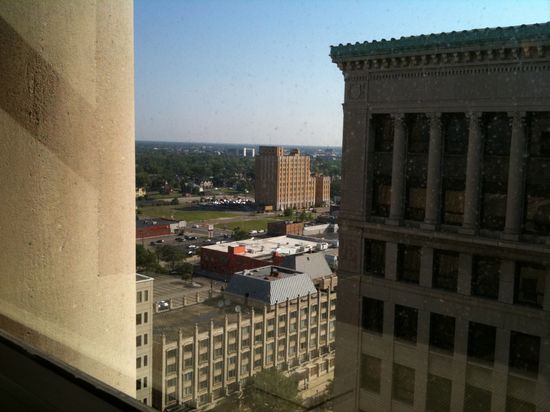
Detroit, Michigan, 9 am
by Conor Friedersdorf
Police and firefighter compensation are the subjects of an excellent piece that Dan Foster has published at National Review. The short version of his argument is that they cost way too much, especially when their pensions are factored into the equation.
Early in my career, I served as beat reporter for a city where the firefighters' union wielded more power than any other lobby (with the possible exception of a commercial and residential real estate company — it was the height of the housing boom). Especially in the years after 9/11, what city councilman was going to stand up to firefighters during contract negotiations when, come election time, the whole crew could go door to door, all clean cut, telling swooning women, "Yeah, we're really concerned about keeping the families of this city safe, and the leaders we have now are making choices that are going to cost innocent lives if they're not overturned. The candidate we're backing served with us for 20 years — in fact, he's the one who saved that baby girl in the Oak Street fire last year. We're not usually very political, ma'am, but we know where this guy's priorities are. Can we count on your support?"
In the piece, Mr. Foster reports that "average total compensation for an officer in Oakland — a city in which the median family earns $47,000 — is $162,000 per year." It must be historically unusual for a police officer to earn more than three times as much as the average family in his jurisdiction.
by Chris Bodenner
A reader writes:
You’ll probably get this a thousand times, but anything by the Mountain Goats is pretty hip religious music. And the brain behind the band, John Darnielle, has described himself as a regular churchgoer. They also count Stephen Colbert as a fan, so not really sure how much more hip you can get. That, and on their most recent album, The Life of the World to Come, all the song names are biblical verses.
Darnielle talked about his faith with the Stranger in 2008:
I consider myself religious—I'm Catholic, both by blood and by tendency, and I mean "religious" in the sense of the word that occasionally makes Protestants uncomfortable: I like ritual and repetitive prayers, and I think a communal relationship with God is many orders of magnitude more important than "a personal relationship with Jesus Christ." I prefer being told what to do and how to pray. I don't think I'm smart enough or eloquent enough to write prayers that are worth God's time.
At the same time, though, I'm in the same boat that everybody else is in: In my heart, I doubt there's a God at all. Most of what most religions teach is utterly ridiculous, and besides, I'm a pro-choice feminist, so the Church that I love and which I'll never fully be able to leave is also my enemy.
I stopped going to church years ago and hardly ever go these days, and I won't take Communion when I do, because those are the rules. I'm as likely to pray the Hare Krishna mahamantra as I am the rosary. But I do pray, as devoutly as I can, even though I suspect we're just animals crawling on the surface of a godless earth. I do it because it gives me comfort and peace, even if that's illusory, and because I think that a prayerful mood is a powerful thing in the world and can be a real force for good.
I'd recommended the song "No Children". (It's not religious, just soul-crushingly beautiful.)
by Conor Friedersdorf
Jessica Belt: "Dear Facebook: I am writing to ask that you stop suggesting I have a baby." It seems that targeted advertising is the new "when are you going to give us some grandkids?"
 The Dish