An Upset In Alaska?

by Patrick Appel

Alaska Sen. Lisa Murkowsk is trailing Joe Miller, a Palin-endorsed Senate candidate with tea party roots. Weigel is all over the story:

The Palin endorsement got him uncritical national media attention. The Tea Party Express bought $500,000 in ads for Miller, which was the largest single buy in the state. Perhaps most importantly, the Measure 2 anti-abortion proposition was bringing out conservative voters.

Bernstein zooms out:

[T]hese primaries are sending a very strong message to GOP pols about the dangers of ever allowing any space to develop between themselves and movement conservatives. … [T]he interpretation everyone's going to hear and believe is that ideological deviation, even very mild deviation, is extremely dangerous to one's electoral health.  Whether it's the New START treaty, or a compromise deal on the budget if the GOP controls at least one House of Congress next year, or any other issue, you can be sure that Republican pols who have to cast tough votes are going to remember Bob Bennett and Lisa Murkowski (and Arlen Specter, for that matter). 

Points of Departure

by Conor Friedersdorf

Over at National Review, David Pryce-Jones recounts the shameful way that Canadian authorities have treated Mark Steyn, a writer whose right to publish whatever he wants without getting hauled before a tribunal ought to be sacrosanct, full stop. (In fact, I wonder if a defense fund could be set up so that anyone brought up on charges in Canada could draw on it.)

This part of the post jumped out at me:

Mark Steyn is a humorous writer, but he has a serious purpose, namely to point out that the Western world has Islamist enemies who wish it ill. We could deal with those Islamists except for one thing: A large segment of our fashionable opinion-makers, so to speak the Burumas of this world, think that Islamists aren’t as bad as all that; and if they are, then we are still worse, and what we stand for isn’t really worth defending. So the public doesn’t know what to think, and a few self-appointed custodians push them into all manner of doubt and guilt by accusing anyone who criticizes, or — horrors! — laughs at Islamists of Islamophobia, racism, fascism, etc. etc.

This doesn't describe America as I observe it. I very much doubt an employee of The New York Times or The Washington Post or The New Yorker can be found who denies the proposition that "the Western world has Islamist enemies who wish it ill." I doubt a single CNN talking head has ever asserted that America isn't superior to al Qaeda or the Taliban, or that our lives, liberty and pursuit of happiness aren't really worth defending. Where does this large segment of fashionable opinion makers write or broadcast? What is the evidence that "the public" doesn't know what to think about radical Islamists? I find it hard to imagine satisfactory answers.

Islamist radicals are a threat. Our values are worth defending against theirs. This is what the vast majority of Americans, including the vast majority of opinion-makers, agree on entirely, and writing as if this consensus doesn't exist merely distracts from the questions that divide Americans. How grave is the Islamist threat? How common is radicalism among the world's Muslims? What does the existence of groups like Al Qaeda imply about our foreign policy? Is it better for American interests to continue the wars in Iraq and Afghanistan? Does the threat of terrorism justify a reduction in civil liberties? What is the fairest way to treat Muslim Americans? These questions, and dozens of others, are what require debate, and it can proceed most productively if it's built upon the common ground we already enjoy as rational citizens in a liberal democratic republic.

Millennials and Their Attitudes About War

by Conor Friedersdorf

Dan Drezner writes:

As I think about it, here are the Millennials' foundational foreign policy experiences: 

1)  An early childhood of peace and prosperity — a.k.a., the Nineties;

2)  The September 11th attacks;

3)  Two Very Long Wars in Afghanistan and Iraq;

4)  One Financial Panic/Great Recession;

5)  The ascent of China under the shadow of U.S. hegemony. 

From these experiences, I would have to conclude that this generation should be anti-interventionist to the point of isolationism. Then again, I'm looking at this through my own irony-drenched Gen-X eyes. 

I'm curious to hear from twentysomethings in the comments — what are the foreign policy lessons that you can draw from your upbringing? I'm also curious what lessons twentysomethings in other countries can draw from their own formative experiences.  

Interesting. I wonder what role, if any, that globalization, changes in media, and the absence of a draft or the threat of one has on these attitudes. For prior generations, war meant a lot more even to people who weren't fighting than it does today.

(Mr. Drezner tells us what he is reading this August here.)

About Face

by Chris Bodenner

Ryan Grim has a fantastic post on Facebook's decision to ban ads promoting pot legalization in California. The site originally agreed to run the ads but reversed itself because the image of a marijuana leaf runs counter to its policy:

Facebook's ad rules, however, only ban promotion of "[t]obacco products," not smoking in general. Since the 1970s, shops selling marijuana paraphernalia have sought ways around the law by disingenuously claiming their products are "for tobacco use only." The Just Say Now Nation-facebook-like-3campaign is arguing the exact opposite: No, really, it's for marijuana, not tobacco. 
The censorship is a blow to the campaign, which is gathering signatures on college campuses calling for legalization and registering young people to vote. "It's like running a campaign and saying you can't show the candidate's face," said Michael Whitney of Firedoglake.com, a blog that is part of the Just Say Now coalition.

Conservative college students condemned the site's restrictions. "Our generation made Facebook successful because it was a community where we could be free and discuss issues like sensible drug policy. If Facebook censorship policies continue to reflect those of our government by suppressing freedom of speech then they won't have to wait until Election Day to be voted obsolete," Jordan Marks, the head of Young Americans for Freedom, told HuffPost in an email.

On the other hand, the controversial cocaine scene in the Facebook movie "The Social Network" won't be censored after all.

(Image via Design Milk)

The Mother of All Traffic Jams

by Conor Friedersdorf

Long haul trucker Dave Carter remarks on it:

A few years back, I got caught in a nasty snow storm on I-84 in New York. A traffic accident, induced by icy roads shut down the west bound side of the interstate for several hours, leaving us all to sit there in the snow. Several of us truckers volunteered to let folks in passenger vehicles spend some time in our cabs and stay warm while we idled our engines so they wouldn’t have to decide between burning all the gas in their cars or freezing. For about five hours, we all made the best of it. But imagine a traffic jam that lasts weeks!!

My daughter alerted me to this story today on the phone, and our Diane Ellis sent the story to me this afternoon. What is currently a 60-mile backup near the Chinese capital of Beijing, stands every chance of lasting until mid-September. The reason? Road construction. Sound familiar? People caught in this colossal case of government subsidized constipation are moving along at, …get this… approximately one third of a mile per day. They should rip out their speedometers and replace them with calendars!

“Cutting” Social Security

Socialsecuritybenefits

by Patrick Appel

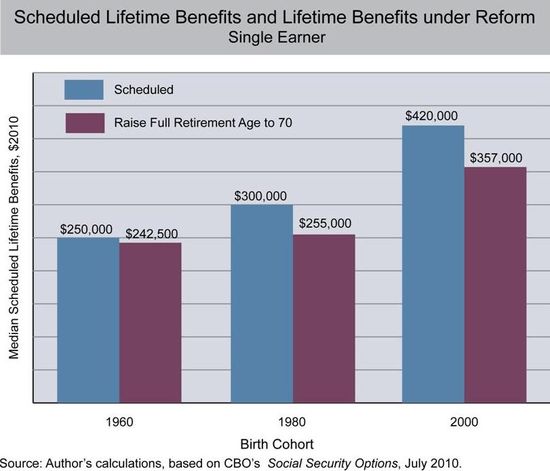
Howard Gleckman Gene Steuerle and Stephanie Rennane make an essential distinction:

Social Security reform, almost no matter how designed, is likely to provide higher levels of lifetime benefits for future cohorts of retirees compared to today’s retirees—just not as much as is scheduled under today’s unsustainable system.

Less Is More

by Patrick Appel

Scott Adams muses:

I recently wrote about my new watch that has GPS for tracking my running. It has so many features that I fail 50% of the time in getting it to do anything at all. I literally don't know what sequence of tapping, holding, and humming gets me to the right mode. When it works, I start yelling "What did I just do?! What did I just do?!" I would pay 50% more for a watch that only tells me the current time and my running distance.

Apple often gets the less features thing right. The iPad didn't add a fast boot-up speed, it subtracted a hard disk. It didn't add a touch screen, it subtracted a keyboard. You want to print? Forget it. The iPad is awesome precisely because it has fewer options. If I want more complexity I can purchase apps.

“The View From My Depression”

by Chris Bodenner

A reader writes:

As a gay man with HIV/AIDS living with the virus, medications, doctors, hospitalizations for 20+ years, HIV is in and of itself a depression.

In 2005, my partner passed away and his father sued for possession of our house.  The court granted the father a lis pendens, which made the property unsellable.  I became ill again in 2006 and was placed on state disability.  Unable to work and unable to continue the court costs, the house was foreclosed upon.  My partner's name was not on the title of the house, but the courts allowed this to stand.  (Gay marriage was not an option.)

I moved to another state to help take care of my elder parents in 2007.  I applied for SSDI and SSI in 2007 and have had one denial, a hearing, a second denial and am awaiting an appeal.  Two doctors have signed paperwork stating that I am disabled according to their examinations in accordance with Social Security Disability criteria.  In three years, nothing has happened for certain. 

I travel 130 miles each way to the doctor.  The state I live in is very large, with a small population, and there are only two cities in the state that specialize in HIV treatment.  If I use the vehicle that I own, a van, it costs 90+ dollars to go round trip to the doctor.  I am not allowed to earn income as I am under consideration for SSDI.

I have been subsisting on funds provided by the Ryan White Act, which helps pay for my rent, subsidizes my medications and medical treatments.  With no income, I qualify for LIEAP Energy assistance program, which covers most of the utilities, IF I keep the house at 65 degrees or less in the winter time. I was just diagnosed with type II diabetes and possibly early stage HIV dementia.  Having been admitted to the hospital with a blood sugar level of 800+, I should have been in a coma.  Surprisingly, I'm still alert, sort of, and functioning, sort of.

I asked my parents for and received money for gas to drive to appointments.  My siblings have decided that using my parents money to go to doctor appointments in a form of elder abuse, so I'm not receiving assistance from them any further.  I'd like to move to the town where I see my doctor, but the Housing Assistance Fund (from Ryan White funding) allows $549 a month for a 1 bedroom rental that includes utilities.  Even in a smaller town in this state, one cannot find a rental for that amount that includes utilities.  Plus I have a dog, which makes it more difficult.

I really don't see how to ever get out of this depression, and suicide is a constant glance over my shoulder.  It's not totally hopeless, but the depression keeps getting deeper and deeper and I have neither the skill, the funds, nor the stamina to climb.