Threatening Rape

by Conor Friedersdorf

Radley Balko has some disturbing video:

An undercover New York City cop threatens a man taking cell phone video with arrest for being disrespectful. He then explains that an arrest means a weekend in jail, where he’ll probably be raped.

The confrontation appears to have occurred during an undercover bust of a suspected “illegal social club,” which judging by its use in other other raids appears to be a law that criminalizes weird artist types who freak out the neighbors.

He's also posted another item on asset forfeiture.

Now Syncing T-Shirt With iPhone

by Patrick Appel

Chris Anderson and Michael Wolff's new article is getting a lot of link love. The thesis:

The Internet is the real revolution, as important as electricity; what we do with it is still evolving. As it moved from your desktop to your pocket, the nature of the Net changed. The delirious chaos of the open Web was an adolescent phase subsidized by industrial giants groping their way in a new world. Now they’re doing what industrialists do best — finding choke points. And by the looks of it, we’re loving it.

Reihan imagines the future internet. I'm not sure that I completely agree with him here:

My guess is that the great driver of appliancization in the years to come will be the rise of ubiquitous computing. Powerful smart phones are just a first steps towards a world in which most of our products, including our clothes and perhaps even sensors embedded in our bodies, will be in constant communication. It is going to take a long time to establish standards and protocols in this space, and there will be a huge first-mover advantage for firms that create reliable, dead-simple applications. The Internet will be the backbone of this new universe of services. But that’s about all we know.

On Backlashes and Avoiding Them

by Conor Friedersdorf

Jonah Goldberg writes:

…there’s one point that I haven’t seen made that I think is really worth reminding people of. Simply: This is an incredibly tolerant country and, it has shown remarkable tolerance since 9/11. There has been no “anti-Muslim” backlash.

It's actually an oft-made argument, but never mind that. In my estimation, the American people have behaved better to its Muslim minority than the citizens of a lot of countries would've after an attack like what we suffered on September 11, 2001, but it is demonstrably inaccurate to say that there has been "no backlash."

Several reports have found an increase in anti-Muslim hate crimes post 9/11. Here's a 2002 brief from the New York Times, reporting from California:

A wave of anti-Arab hate crimes after the Sept. 11 attacks drove hate crimes up 15 percent last year, reversing an otherwise downward trend, a report from the state attorney general's office showed. Hate crimes would have dropped 5 percent if not for assaults and threats against Muslims or those who appeared to be of Middle Eastern descent. Crimes against Middle Easterners quintupled to 501 last year from 99 in 2000. Reports of hate crimes rose to 2,261, up from 1,957.

Here's a longer piece from the San Francisco Chronicle that reports a similar conclusion, citing an FBI report.

Of course, the backlash wasn't limited to full blown hate crimes. Surely Mr. Goldberg remembers Ann Coulter professing a desire to invade Muslim countries, kill their leaders, and convert them to Christianity. It seems fair to count that as an anti-Muslim backlash to 9/11. I won't bother to link a bunch of other anti-Islamic rhetoric that specifically cites the 9/11 attacks and didn't exist prior to them — we all know it's out there and it's ugly.

When an angry crowd mistook this Coptic Christian man for a Muslim, did that count as a backlash? What else explains the Koran burning event this Florida church is planning (guess what day the event is scheduled). Or consider the Temecula, California mosque project that is also apparently too close to Ground Zero.These are all very recent news items. So what can this assertion that "there has been no “anti-Muslim” backlash actually mean? That it hasn't been as bad as some people feared? If that is what Mr. Goldberg means he should say it.

The closest he comes is this later line:

Whatever excesses, real or alleged, that have come from the justice system or from main street, are by any historical standard — including any previous analogous period in American history — trivial.

Perhaps he has forgotten the anti-Muslim backlash at the Abu Ghraib prison, or the Muslims held for years on end as enemy combatants only to be cleared of wrongdoing by our government, or the innocent Muslims tortured by the CIA. Were none of these non-trivial excesses explained at least partly by an anti-Muslim backlash after 9/11?

Later in the same post, Mr. Goldberg writes:

…listening to all of this talk about “crowd” politics from liberals these days, you get the distinct impression that there are a lot of 20-something liberal bloggers, MSNBC talk-show hosts, and newspaper editorial writers who honestly believe that they are not only better than the American public but that they are in fact the duly anointed conscience of this, our embarrassingly backward and bigoted nation. They must stand ever vigilant, lest America's deep reservoirs of hatred and bigotry burst their levees and spill out through the sluices of the Republican Party.

How does this river of hate manifest itself? The supposedly anti-Muslim 70 percent of Americans who don’t like the idea of building the Cordoba House near Ground Zero mostly also believe the owners have the right to do it if they can’t be persuaded otherwise. Wow, that’s some crackdown on Muslims.

As one representative of writers who believe that vigilance against an anti-Muslim backlash is necessary, let me congratulate Mr. Goldberg for demolishing the weakest argument of his least defensible adversaries. Having done so, it's only fair that he get a shot at a stronger contender. It's 5 am as I write this, and being the only one awake, I'll enter the ring: Expressing concern that a religious group might suffer a backlash during an ongoing war against its radical coreligionists isn't tantamount to asserting that America is a backward and bigoted nation. The vast majority of concerned journalists, like President Bush and many others, know that most Americans are going to refrain from outright violence, and are nevertheless prudently aware that within our borders is a fringe of excitable bigots that exist, and will always exist, in every country on earth.

One thing that radicalizes these people is when, for example, magazines with a reputation for good judgment publish credulous articles alleging that the President of the United States himself is allied with Islamist radicals in their grand jihad to destroy America. Mightn't you take extreme action were that actually true?

One needn't be holier-than-thou to observe that sort of scare-mongering hyperbole, or the array of egregiously incendiary propaganda directed at a minority group, and conclude that people of conscience should object (as Mr. Goldberg admirably does on certain occasions himself). Calling on fellow media professionals to exercise more restraint than the average member of the American public doesn't imply that we're better than them, or believe ourselves to be — it merely recognizes that our words are amplified by virtue of the platforms where we write, and that privilege comes with an attendant responsibility that isn't shared by a guy who performs heart surgery or a woman who does TV-DVD repair or death-defying acrobatics for a living. 

Moreover, it is possible to assert that 70 percent of Americans wrongly hold a wrongheaded view grounded partly in prejudice without saying that the United States is a bigoted country, or that all the people who hold that view are themselves bigots. I happen to think that there are many opponents of the Burlington Coat Factory mosque who aren't bigots. But all be damned if I'm going to apologize for being overcautious in warning against — and trying to prevent — further backlash against Muslims because some conservatives are aggrieved by the very idea that it is a possibility.

Disincentivizing Dissent, Ctd

by Chris Bodenner

This post was bound to elicit backlash. A reader writes:

I was extremely disappointed to see this discussion on tenure take such a nasty turn. It's that not that I necessarily disagree with your reader's post about librarians and tenure – I think the burden of proof should be on librarians if they want to receive tenure. (This article from the Chronicle of Higher Education has a more informed and measured take on the subject.) However, in a truly uninformed and citation-less rant about the uselessness of librarians today, your reader really misunderstands the profession.

There are a number of universities that grant tenure, but the vast majority of academic librarians do not receive or achieve tenure. Of the institutions that do grant librarians tenure, most require that a *second* master's degree be held by the candidate for subject specialty. Indeed, at my own mid-sized academic library, I can easily name a half-dozen librarians with PhDs in non-library/information science fields, just off the top of my head. Furthermore, many academic librarians do teach or co-instruct classes.

As far as librarians "struggling to be relevant" or "find something to do," I literally have never met an academic librarian who has time to spare in their jobs. Yes, the work is shifting from the traditional passive model of information assistance – that is, waiting at a desk for the questions to roll in. And yet, it has shifted to a much more intensive and active role coordinating with IT departments and vendors to make the non-findable-through-Google electronic resources easily accessible to faculty and students. This is not to mention that librarians are at the forefront of digital storage issues, in addition to access and collection issues. Any other "free" time is now spent on outreach and collaboration with others.

And finally, the dig about the salary was really uninformed and misleading. Starting pay for the academic librarian positions in the Midwest are currently in the $35,000-45,000 range (max), depending on experience and qualifications. Given that many of these jobs require additional degrees or certifications, I really bristle at the implication that academic librarians are somehow overpaid and irrelevant.

Another writes:

Leaving aside the question of whether librarians should be tenured, I'd like to address some of the inaccuracies and mistakes made by your reader.

First, the only librarians I know who make the salary your reader states are working within corporate libraries or are at a high administrative level within the university (or have 25-30 years of experience).  In addition, many also hold not only the MLS, but PhDs in other disciplines relevant to their work – History, Sociology, English, etc.

And librarians do teach.  True, we don't usually teach semester long courses. But in any week, I teach 2-3 classes on finding information, using evidence-based research methods, using citation managers, complying with governmental mandates regarding open access to taxpayer-funded research, etc.

The tenure process for a librarian is no walk in the park, either.  One must show scholarship within and service to the profession – and that's usually with a professional travel budget of about $1000/year.  A single national conference can easily cost $1500 – between travel, registration, hotel, and meals.  It's awfully hard to perform any meaningful service when you can only pay for one conference, so most librarians I know that are on tenure track end up paying out of pocket for another one or two.  (Oh, and did I mention that the average pay for an entry-level academic librarian position is approximately $40K?)

A sabbatical does, in fact, generally require a research or service project, culminating in a book chapter, book, or peer-reviewed journal article.  True, the publications that come out of these projects may not be read by very many people, but that's sadly true across all academic disciplines.

As for relevance, in a world flooded by information (and colleges populated by students who arrive convinced that they already know how to find anything, but know how to filter nothing), most of my colleagues are busier than they've ever been.  When we're not working with faculty to integrate information management skills into their curricula, we're building research guides, helping our students (at all levels) find the information they need to write decent papers, working with administration to evaluate plagiarism-detection tools, and, yes, showing faculty how to use available tools to find research and data in their disciplines.

I'd advise your reader to find out who the liaison librarian or subject specialist is for his or her department or discipline, make an appointment, and find out what the librarian has to offer.  Yes, it's true that there are some duds out there – like any profession, we have our share of people resistant to change, or who don't want to be pushed beyond their comfort areas – but most have skills and knowledge to spare, and are happy to work with faculty in whatever way they need.

Another:

Your reader really believes that librarians are irrelevant in academia?  Really?  From my perspective as a professor, I really cannot imagine someone in academia making this statement.  Libraries are far from disposable for my work, especially for my research.  Books are still being written, journals are still being published, and electronic resources for academia are multiplying at a rapid rate.  Some fraction of this material is freely available online, to be sure, but the lion's share of it is not, and so the job of the librarian in evaluating new materials and choosing acquisitions and subscriptions is still a substantial one.

Another:

Far from needing to "find something to do with [my] time in this Google age," I find myself stretched almost beyond my limits, as do my colleagues.  Gone are the days when all we did was answer the occasional reference question and sit around looking at lists of titles to add to the collection.  On the contrary, now we are pro-actively involved in collection development, course creation, and digitization projects; creating consortia that leverage the collections of our peer institutions for the benefit of our user community; working with undergrads and grad students to guide them through the thicket of the nearly 1000 databases to which we subscribe so that they need not be dependent on the sketchy, uneven, and un-authoritative content that Google offers; offering reference services in person, as well as via phone, email, IM, and text; training faculty in the use of digital resources for their own teaching and research–and doing all of this while we watch our materials and operations budgets shrinking.  Oh, and we also attend a lot of meetings.

If your reader doesn't realize that this is what's going on at his or her own institution's library, then I question how much time he or she is actually spending there.

Another:

The internet and Google are great, but contrary to popular belief, not everything is on the internet. Also, most people do not know how to use the internet effectively when it comes to doing any sort of research. Libraries and librarians have been embracing technological advances and have been earlier adapters. For examples, libraries use tools like instant messaging for answering reference questions. In fact, MLIS and PhDs have been some of the first academic degree programs to be offered totally online by major accredited universities, because technology is so essential to the profession and because the profession has adapted so well to new technologies. Those “lists” are often essential subject guides that are of great help to students and researchers. Librarians curate libraries – they select what should be in the collection and what shouldn’t, which databases to subscribe to, what volumes should be weeded out. Libraries are an essential part of a successful university, and libraries need to be tended to.

Another:

Many librarians don't even call themselves librarians anymore – their roles are changing so rapidly some are calling themselves "cybrarians".

Yet another:

One reason that tenure for academic librarians may have evolved in the first place is a way to regularize benefits for a class of university employees who are not considered equal to administrators.  My institution likes to class librarians with faculty and claim that we have equal benefits (housing, child education, etc) although we are usually the first to be tossed over the edge when belt-tightening occurs.  We do not make anything even in the neighborhood of faculty salaries, however.

Another:

A 2009 salary survey of mid-level academic librarians (not entry-level, but also not library directors, who tend to earn salaries more similar to administrator than faculty salaries) conducted by the Association of College and Research Libraries found academic librarian salaries running between $38,379 to $58,675.

Perhaps the angry writer needs to learn how to do a better job of checking his or her facts. A librarian could probably help with that.

One more:

Unlike professors, who set their own office hours, most librarians work regular hours with full days. At some universities they also work nights and weekends. Additionally, they do not get summers or other long breaks off like many professors; instead, they get the same holidays and vacation time as staff. After all, most major academic libraries do not close in the summer.

I could write an incredibly long email about how your reader's assertion that academic librarians merely "make lists, answer the occasional reference question, and attend meetings" is incredibly far off the mark and show an ignorance about what goes on in good academic libraries, but I've read the post at the end of my lunch break and I have lots of work to do – in an academic library.
Anarchy Beneath the Border, Cont’d

by Conor Friedersdorf

In response to my post about drug violence in Mexico, an expat American argues that I've given an unduly dire portrait of our southern neighbor. The item is enjoyably evocative of life in a part of the country that isn't wracked by violence. It's a useful read for anyone trying to form an accurate picture of Mexican affairs, and you can read it here.

People As Pack Leaders

by Chris Bodenner

A reader writes:

Your previous reader criticizing Cesar Millan's techniques clearly has no idea about what those techniques are. The ONLY time I have seen Cesar employ anything closely resembling "punishment" is with what he calls "red zone" dogs, who would otherwise be put down without his intervention. Malcolm Gladwell has a great article on his training methods, "What the Dog Saw". Gladwell has a body-language expert analyze a video tape of Cesar handling one of these cases who concludes that his behavior lacks any aggression and is far from punitive.

Much of his training philosophy – like giving off "calm, assertive energy" – sounds more like new-age hokum than a "spare the rod" mentality (I saw one episode where he prescribed regular sessions of acupuncture and meditation to one owner). Like most trainers, he primarily works with dog-owners, identifying what behavioral changes that they – not the dogs – need to make in order to fix problem dogs. His underlying assumption is that dogs instinctively assume themselves to be part of a pack and that if the human isn't in charge (i.e., acting as pack leader), the dog will take on that role. He basically teaches people to be pack leaders.

Another:

This is a hot-button topic in the dog world. I compete in agility with my mixed breed, volunteer as class assistant in dog training classes, and spend a lot of time around dog trainers and dogs people. It is not an understatement to say that Cesar Millan's methods are reviled in the dog training community.

I see people coming into class with their family dogs and their heads full of his simplistic and wrong-headed notions about "dominance" and "energy." The trainers often have to gently and non-judgmentally steer the owners toward more effective methods of training, the easiest and most obvious being positive reinforcement. Dog advocacy groups have tried to pressure National Geographic into dropping the show, as his methods are scientifically unsound. Apparently it's too much of a cash cow for the network, much to their discredit.

The Association of Pet Dog Trainers has issued a position statement on "Dominance and Dog Training" as a direct result of his unfortunate influence.  An excerpt:

The use of techniques such as the "alpha roll" on dogs, which is based on these mistaken beliefs about dogs and wolves, has no place in modern dog training and behavior modification. Dogs often respond to this perceived threat with increased fear and aggression, which may serve to make a behavior problem worse and ruin the dog-owner relationship.

I would encourage your readers to seek out a training facility that uses humane, positive reinforcement training methods that build a bond of trust and understanding between the dog and his/her human family.

Another:

First, any dog trainer's opinion of Cesar has to be taken with a large grain of salt, because he is making them look bad!  People who have a difficult dog, who they have struggled for years to "fix", see an equally difficult dog cured in the space of 30 minutes and expect their local dog trainer to perform the same miracle.  It's not an entirely realistic or fair expectation, but it causes a lot of resentment that makes it difficult for them to acknowledge that he can do anything right at all.  I know this because I have mentioned Cesar to dog trainers I was working with and got a flood of griping in return about how he has ruined their business because people now come to them with impossible expectations.

Second, something that's usually overlooked is that Cesar is not a dog trainer, nor does he call himself one.  I forget what words he actually uses to describe what he does, but I would call him a behaviorist.  When was the last time you saw him teach a dog to sit?  He just doesn't do that sort of thing, so it's an apples to oranges comparison from the start.

Another:

I'm sick of the Cesar-bashing.  The one question I have yet to hear answered is this: If his techniques are so terrible and ineffective, how is his pack of 40+ dogs so well-balanced? And how has he been able to rehabilitate nearly every dog he's taken in at his facility (with the exception of two, according to his book, Cesar's Way)?

The truth is Cesar has nothing but the utmost respect for dogs and does nothing more to them than what an alpha dog would do to his pack in the wild.  He's only more "physical" with the dogs that are acting out of line, just like an alpha would to one of his subordinates if it wasn't following.  He's never abusive and never aggressive. The dogs don't cower in his presence as dogs would around an abusive owner.  There is a big difference between assertiveness and aggressiveness.

Positive reinforcement (i.e., using clickers or treats) basically "tricks" the dog into doing something for a reward.  Using Cesar's techniques, however, your dogs will do what you ask, not for a treat, but out of respect for you, their leader.

Bin Laden vs The Cordoba Mosque, Ctd

by Chris Bodenner

Goldblog continues to go to bat for Rauf:

In 2003, Imam Rauf was invited to speak at a memorial service for Daniel Pearl, the journalist murdered by Islamist terrorists in Pakistan. The service was held at B'nai Jeshurun, a prominent synagogue in Manhattan, and in the audience was Judea Pearl, Daniel Pearl's father. In his remarks, Rauf identified absolutely with Pearl, and identified himself absolutely with the ethical tradition of Judaism. "I am a Jew," he said.

There are those who would argue that these represent mere words, chosen carefully to appease a postentially suspicious audience. I would argue something different: That any Muslim imam who stands before a Jewish congregation and says, "I am a Jew," is placing his life in danger. Remember, Islamists hate the people they consider apostates even more than they hate Christians and Jews. In other words, the man many commentators on the right assert is a terrorist-sympathizer placed himself in mortal peril in order to identify himself with Christians and Jews, and specifically with the most famous Jewish victim of Islamism.

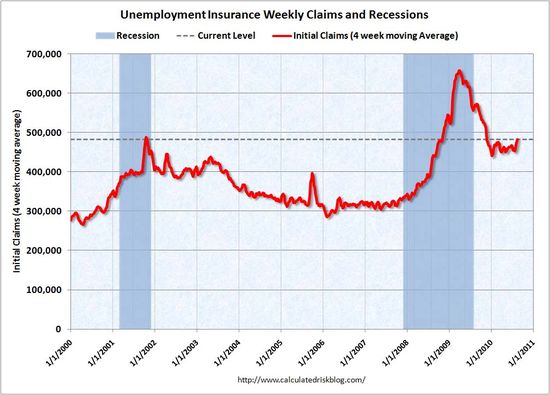
Unemployment Ticks Up

WeeklyClaimsAug19

By Patrick Appel

Bonddad worries:

The lack of underlying data means this could be a temporary increase caused by Census/governmental/construction losses, the reality is the total number could not come at a worse time. We've been seeing weakening numbers from the manufacturing sector for the last few months (see today's -7.7 print from the Philly Fed), indicating this sector — which led us out of the recession — is losing steam. Now we have initial unemployment claims at a big, far round numbers: 500,000. That is terrible news with little to [no] upside in my opinion.

After four quarters of GDP growth, we're seeing clear signs of weakness.

Chart from Calculated Risk.