
Koprivshtitsa, Bulgaria, 1.15 pm
Koprivshtitsa, Bulgaria, 1.15 pm
by Patrick Appel
Elizabeth Weingarten reports on polygamy's decline in Saudi Arabia. Apparently "a group of young Saudi men are launching a campaign to trumpet [polygamy's] benefits, and to encourage other men to take a few more wives":
"Polygamy's time is over," said Thomas Lippman, an adjunct senior fellow at the Council on Foreign Relations. "People can't afford polygamy in Saudi Arabia anymore." While Saudi Arabia is known for its oil riches, many middle class families are living below the poverty line. Per capita income in Saudi Arabia is less than half of what it was in 1980, and the country's housing shortage has made the cost of purchasing a home unaffordable for most. Women, Lippman explains, are expensive. Each wife, for example, requires a private driver who must be paid for and housed.
"Between the resistance of the women, and the economic realities," Lippman says, "I think this campaign is unlikely to get legs."
by Patrick Appel
This is largely true:
The most prominent authors are inundated with such manuscripts, far more than they can ever read, especially if they hope to get on with their real job — which is, of course, writing their own books. Many have adopted a blanket no-blurb policy, and most of these will at least occasionally wind up departing from that policy, usually for personal reasons. They might do it for a good friend or a former student, or as a favor to their editor or agent.
So when publishing people look at the lineup of testimonials on the back of a new hardcover, they don't see hints as to what the book they're holding might be like. Instead, they see evidence of who the author knows, the influence of his or her agent, and which MFA program in creative writing he or she attended. In other words, blurbs are a product of all the stuff people claim to hate about publishing: its cliquishness and insularity.
Stephen Fry's strategy:
I was having lunch with my literary agent yesterday and I said, mostly as a joke, that I had it in mind to blog a confession. I would publicly admit that I read fewer than one in twenty of the books to which I gave approving quotes for dust jackets and blurbs. My agent was shocked. Whether he was shocked that I might plug books I hadn’t read, or shocked that I could contemplate owning up to such a crime, I cannot be entirely sure.
I hasten to add that it isn’t true. The plan, as I told my agent, was to make this confession as a way of getting publishers off my back. It may sound ungracious, but I get asked so many times a week to read book and supply quotes for them that I’m getting a bit fed up. Not because I don’t like reading, nor because I don’t like being sent books, though mostly of course, I am sent proof copies rather than the finished article. No, what I’m fed up with (and it is my contention that I am SO not alone in this) is seeing my name on the fronts, backs and flaps of books saying things like “a beautifully paced, unforgettable thriller”, “a magnificent feat of imagination”, “a delicately realised and vividly felt journey through memory and desire”, etc etc. Yuckety, yuckety, yuck. Pukety, pukety puke.
(Hat tip: Ezra)
by Dave Weigel
Marshall Kirkpatrick's write-up of the strategy behind Old Spice's guerrilla YouTube campaign — one that comes after they hired video comedy dada-ists Tim and Eric to record even crazier videos — leaves you with a less grimy feeling than the usual advertorial. Yes, even after you read this disclaimer:
Disclosure: Wieden + Kennedy is an occasional consulting client of the author's. But this story was too cool to abstain from telling just because of that.
Well, I'm not a consulting client of anyone, and I adore the concept — a handsome, arrogant character answering basically anyone who 1) sends him a question he 2) has time to answer. Simultaneously, the Morlock "I'll click on anything" side of the Internet and the Eloi "I only read Boing Boing on my iPad" side decide that it's funny, and indulge the joke. It churns for a day. It wins a place in meme history. And now that we know the joke, it's over. These concepts are approaching the lifespan of fruit flies while getting us closer and closer to the phony interactivity of Max Headroom. As deodorant concepts go, that's fairly exciting.
by Patrick Appel
Contra Larry Arnhart, who contends that "a Darwinian science of human evolution supports classical liberalism", PZ Myers argues that "to suggest that the science of evolution supports a specific view of the narrowly human domain of politics is meaningless":
Evolution gives us only very general rules for our species. Adapt to the environment, or die. Change is inevitable. No matter what our species does, it will eventually change or die. It’s not necessarily the most uplifting of messages, but there are encouraging lessons within it. Diversity is unavoidable, providing many different avenues our species could follow, and also, that our happiness does not have to descend from our biological limitations; we often work against our predispositions, because the elements of our inheritance that may have worked for a savannah ape must often be expanded upon and redirected to make a modern urban ape thrive. Evolution does not incline us to classical liberalism, it is just one of many options that evolution allows.
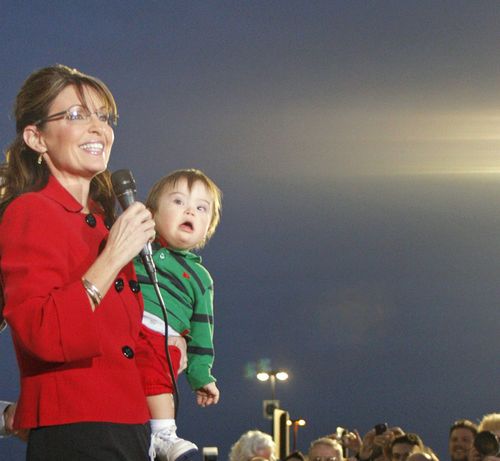
by Chris Bodenner
A reader writes:
Weigel wrote, "Were Sarah Palin to become president and everything the Trig Truthers believed to be proven right, it wouldn't matter at all."
She is a politician, and she has placed her son squarely at the core of her political identity. She makes Trig matter. Think of it this way: remember Al Gore's story about his son's accident – how he looked into his child's lifeless eyes and everything changed that day? Gore told that story many, many times in front of a national audience – as a metaphor for the direction the United States was headed, as a reason to vote for him. You cannot tell me that you wouldn't care if it turned out that that fundamental, life-altering story turned out to be full of lies.
Another writes:
It's about credibility. Sarah Palin is the only candidate from the 2008 presidential election who never released her medical records. She is the only candidate who never gave an open press conference. And the insane story of her son's birth is obviously a lie, and she used this lie repeatedly throughout the campaign, and used her special-needs baby as a stage prop during campaign stops, in order to WIN VOTES.
This woman, who has blocked-out the press entirely, and who has been caught in numerous lies for which the press never holds her accountable, could conceivably become the leader of the Free World. How can you possibly say her credibility isn't important?
Another:
I'm sure you've already had an avalanche of emails regarding Mr. Weigel's posts on Trig Birtherism, but I'd like to add my thoughts to the spectrum of perspective, as it were.
Trig does matter, very much, because of the public identity Sarah Palin constructed for herself during the campaign, one which she seems to be re-outfitting for another run now. The image she is trying to sell to the public is one of a woman who believes so strongly in the pro-life movement that she carried to term a Downs Syndrome child knowing the risks and consequences, and continues to care for him today. This is a woman who is supposed to be a Mama Bear, tough as nails, willing to do anything for her family, and willing to go to bat for the country with the same kind of grit and determination – a candidate with a hunting rifle on one hip and an infant on the other.
Narratives like the story about Trig's birth are what help candidates build empathy with their voters, just as Obama's memories of watching his mother battle with insurance companies even in the hospital bed brought a personal and human element into the Health Care debate. A candidate who goes into labor in the middle of a convention, sticks it out, and flies back home to give birth, gee, she's gotta be really damn tough, right? And any woman who has given birth is supposed to be able to empathize with that, and look up to her because of the personal strength it would take to hold together that long.
The fundamental problem with the story isn't that it's physically improbable, though. It isn't even that it may not be true. It's that either way, it does more to discredit her than help her. It's possible that somehow, someway, she managed to leak amniotic fluid and undergo contractions with enough stealth that the assembled convention-goers and later airline staff did not cotton on that the professedly pregnant governor was in fact giving birth to a high-risk baby. If it's true, though, she was doing herself no favors. It makes no sense to act the way she did if she was in labor, none whatsoever. Does acting stupidly automatically mean the story's false? No. But it does mean she put herself and her unborn child in inexcusable risk, in a situation that demanded that critical decisions be made quickly and calmly.
Was she deliberately choosing to put her unborn child in danger? Was she simply not thinking? Either way, her decisions, as she related them, make her look like a poor person to have making important decisions in a high-stakes environment. If she was indeed so careless and thoughtless with the safety of her own baby, how can we, the voters, believe that she would be any more cautious with the nation?
It almost becomes less damning for her to be lying about her in-labor-jet-setting adventures. I'd rather she was simply exaggerating, trying to spin a tall tale about her nerves of steel to wow the other moms. Even so, if the Republicans ran with Kerry's purple hearts in 2004 and dredged up the swiftboaters to discredit him, for them to cry foul over scrutiny of Palin's flimsy story is about as believable as the Dutch forwards rolling and weeping in the World Cup. Litbrit made an excellent comparison of the Trig Birth Tale to a war story, and I think that's dead-on.
More importantly, if Sarah Palin continues to cite that story, to utilize it to sell her image to voters and build her Mommy Street Cred, then we have every right to examine, prod, and criticize her decisions and the believability of the story. She cannot be afforded the luxury of "I believe because it is absurd" on the grounds that it involves her family or that it doesn't affect her as a potential candidate. She is the one who brings her family into the debate for one thing, and moreover – as a candidate, the Trig story means she's at best an exaggerator, and at worst an outright liar, rash and stubborn to the point that she'd endanger her baby to deliver him where she wanted to, or a wretched decision-maker under considerable pressure. If that doesn't impact her candidacy, I don't know what does. And if anyone thinks she isn't going to make another run at something, they're deluding themselves as much as she is.
That's all, from a future voter. Have a good afternoon, gentlemen, and thank you for staffing the Dish while Mr. Sullivan is on his hilariously ill-timed vacation. Serendipity, indeed.
(Photo: Bill Pugliano/Getty)
by Dave Weigel
Ben Smith points to Gallup's new polling on the current vice president and his two predecessors, which finds that Al Gore — while still more popular than Dick Cheney — is the only one Americans are growing more sour on.
The July 8-11 Gallup poll, finding 44% of Americans viewing Gore favorably and 49% unfavorably, was conducted after the announcement that he and his wife were separating, and amid a police investigation into allegations that he committed sexual assault in 2006. Gallup last measured Gore's image in October 2007, after he was named winner of the Nobel Peace Prize, when 58% of Americans had a favorable view of him.
Two things here. First: Wow, what a victory for the "undernews."* When the news first broke that the Gores were divorcing, the Responsible Media published thoughtful pieces about how the marriage was never going to work anyway. It took the National Enquirer to jumpstart discussion of Gore's alleged assault of masseuse, which jogged the Oregonian into publishing what its reporters knew. (By the way, JournoList fans — one of the final threads there was about the ridiculousness of the press not covering l'affaire Gore, so there goes the "liberal narrative factory" theory.) No National Enquirer story, no attention for this scandal.
Second: Forty-four percent isn't the worst approval rating for a pol in the year 2010, but if you're an environmentalist, and you've spent two decades waiting for comprehensive energy legislation to pass, how much does it hurt to have your most powerful advocate knocked on the mat (by his own punch) with a few short months left to pass that legislation?
*I'll give the credit for this phrase to Mickey Kaus unless someone else wants to take credit.
by David Frum
Important piece in the New Republic by outstanding national security reporter Eli Lake. A glimpse behind the pay wall – but you'll really want to pay to read the whole thing:
[D]o sabotage efforts work? In late 2008 and early 2009, the IAEA began to see a drop in the amount of low-enriched uranium (LEU) being produced at Natanz, the facility that lies at the center of Iran’s known nuclear weapons program. In the fall of 2008, its centrifuges were producing 90 kilograms a month of LEU. By the end of the year, however, the same centrifuges were producing 70 kilograms of LEU. To be sure, that number was back up to 85 kilograms per month at the close of 2009, and it has been climbing since, to around 120 kilograms a month; but those increases came after the installation of more centrifuges—all of which suggests that at least some of the machines were less efficient than they should be.
Ivan Oelrich, a nuclear scientist and the vice president of the strategic security program at the Federation of American Scientists, estimated in a study this year that the centrifuges are operating at 20 percent efficiency. “We know the average efficiency of the centrifuges is dismal. We don’t know whether it is because of the quality of the individual centrifuges or how they are linked together,” he explains. “We can’t rule out sabotage as one factor leading to these inefficiencies.” Greg Jones, a nuclear analyst at the rand Corporation, says the Iranians “are operating just under four thousand machines, but they have installed about eight thousand five hundred. Those nonoperating machines have been installed for many months. Why they are not operating is not clear.”
people I spoke to, there seemed to be a broad consensus that sabotage was, at the very least, slowing Iran’s quest for a nuclear weapon. A senior administration official told me that there was evidence the Iranians are experiencing delays due to “a combination of reasons—some inherent to the nature of the infeasibility of the design and the machines themselves, and some because of actions by the United States and its allies.” Explains David Kay, “History says that these things have done more to slow programs than any sanctions regime has or is likely to do.”
Update: You can read the whole thing here.
by David Frum
Yesterday, just as predicted, the radio host Mark Levin vituperatively exploded on his Facebook page in response to Conor Friedersdorf and me. He called me "FrumBum." Ouch. Ow.
What will happen today?
Yesterday afternoon, Conor tweeted a link to another item on Levin's FB page. An hour before deploying his famous wit against me, Levin had also written the following:
In radio and TV you find hosts who claim to be the first to do this or that. It is an effort to persuade their listeners and viewers that they have had the intelligence and courage to take on Obama and these powers before anyone. The problem is that, for the most part, it's not true. Most radio hosts and cable hosts tend to be followers, or they hope to seize on a concept developed by another, to claim credibility and draw attention to themselves.
In my case, all my commentary, whether on radio or in my books, is original or gives credit to those who generated the thoughts first. I believe it is very important that radio hosts, like writers or even students, have the grace, class, and ethics to play by the rules. Perversely, this sometimes is said to evoke jealousy. It has nothing to do with jealousy and everything to do with integrity. In any event, I have taken lots and lots of heat for characterizing Obama as a socialist and Marxist when I first did so well over a year ago. If you care, here's a clip from my June 15, 2009 radio program:
There are others which date earlier, but this will suffice.
You may wonder: Why would anyone boast of having been the first to introduce a noxious falsehood into American life? Why take credit for ugly and stupid propaganda?
But human vanity is an amazing thing. There is always someone who wishes to be known as the person who ate the most hot dogs. Back in medieval York, I'm sure there was considerable scuffling over who was the first to think of accusing the Jews of grinding up Christian babies to make matzah.
In the Levin case, though, there is at least entertainment potential. Levin's paranoid accusations may be nasty, but at least the thin-skinned host's distinctive combination of vanity and vulnerability offers Conor an unendingly promising hobby. And the next time Levin calls Conor "Friedersdork," Conor should reply with John Cleese of Monty Python: "Be quiet or I shall taunt you some more!"

 The Dish