Obama: Hostage To Petraeus, Ctd

Was I too harsh? It behooves me, I think, to note that the way in which Obama facilitated this military dispatch was pitch-perfect: classy, presidential, resolute. It also behooves me to note that many things can happen in war and politics and that if Petraeus is seen to manifestly fail in Afghanistan – and retrospectively to have failed to leave Iraq in one piece as well – then things might shift dramatically. One reader offers this meep-meep hypothesis:

Maybe the McChrystal fiasco was a gift to Obama.  He installs Petraeus, blunts GOP National Security attacks during the midterms, then in a "Nixon to China" moment in 2011, announces that Petraeus — God of the military — believes we've done all we can do, that Karzai's corrupt government has to stand or fall on its own and switches the strategy to Biden's — drone and special ops attacks on terrorists, leaving nation-building to the Afghans.  That policy will have much more credibility if it comes with Petraeus' imprimatur than it would have with McChrystal's.

Well, we can hope. And look, I do not want to sound churlish. There were no good options in Afghanistan. I believe, as I believed in Iraq, that speedy withdrawal was the better option than surging and staying to save face. But I am not omniscient. I did not foresee the drop in violence in Iraq – although I did foresee the failure of the surge to achieve political reconciliation. From the beginning of Obama's massive gamble in Afghanistan, I have hoped for the best and would still love to be proven wrong. But I also have to give my best judgment now. That judgment is that this is a disaster waiting to unfold. And that sending young men into battle when the plan is this cockamamie is morally dubious in the extreme.

The Madness Of King David Petraeus

A military reader writes:

You say that Petraeus's strategy of COIN is misplaced in Afghanistan because it's missing certain components. I would say that you understate the case. COIN isn't merely the wrong strategy in Afghanistan. It is, in scientific parlance, "not even wrong." It's the sort of wrongness that doesn't even bring you closer to understanding what the right move is. 

As a contrast, Operation Market Garden was the wrong move. It needed more troops, more armor, more logistical support, etc. It was an excellent try, though, and it nearly succeeded in taking the Rhein.

By contrast, to say "we're going to pursue a strategy of counterinsurgency in Afghanistan" makes about as much sense as "We're going to pursue a strategy of de-Nazification in Afghanistan." It's a non-sequitur. I mean, for goodness sakes, an insurgency is a campaign to overthrow, reduce the reach of, delegitimize, or destabilize a local government. There is no government in Afghanistan to be an 'insurgent' against, merely a collection of warlords, drug barons, and theocratic gangsters of whom the Taliban and the Kabul Mayor Karzai are merely two of the most notable.

You can't have a "counterinsurgency" in a country that doesn't have an insurgency, and you can't have an insurgency in a country that doesn't have a government to begin with.

COIN in Afghanistan? What next, building a GOTV operation in Mogadishu? Striving to become an Admiral in the Swiss Imperial Navy? Writing a book on the mating habits of the North American Snipe? It's a non-sequitur!

Having said that, I'll likely be deploying in February, and will do my darnedest to fulfill the mission my commanding officer assigns me, even if I think that his playbook is about as relevant to Afghanistan as would be "The Art of French Cooking." And you can bet I won't be mouthing off about my CO's particular merits to the newsies who occasionally pass by.

That's the core virtue of the US military for you: bravely, competently, relentlessly pursuing wars that cannot be won. May God forgive the idiots who send them into brutal battle under such circumstances. And no, I do not revere David Petraeus. I suspect history will be brutal about his record.

The US Public On The Flotilla

An interesting result from the latest WSJ poll:

Q36 As you may know, Israeli troops recently intercepted some ships carrying supplies to Palestinians in the Gaza Strip, and nine people on board one of the supply ships were killed by Israeli soldiers. Which of the following statements comes closer to your point of view on this situation? If you don’t know enough about the situation to have an opinion, just say so. (ROTATE STATEMENTS)

Statement A: Israel was defending its interests in Gaza and their military actions were justified.

Statement B: Israel went too far and their military actions were NOT justified. 6/10**

Statement A: Defending interests/military actions were justified ………….. 34

Statement B: Too far/military actions were NOT justified ……………………. 29

Don’t know enough ………………………………………………………………………. 32

A little of both (VOL) ……………………………………………………………………. 1

Not sure ……………………………………………………………………………………. 4

So the American public is basically divided three ways. How many ways do you think the US Congress is divided? Like you need to ask. And it's worth noting that the American public can come to this kind of judgment while, in the same poll, overwhelmingly supporting Israel rather than its Arab neighbors by 6 – 1.

The Hawks Win

Reihan suggests that “everyone with an interest in national security policy should keep a close eye on what happens if and when Defense Secretary Gates retires.” Reihan feels that if “Clinton gains influence, it likely means that even with McChrystal himself gone, McChrystalism will be here to stay”:

The fact that Clinton was given such a prominent role in the Obama cabinet suggested that the president was interested in vigorous debate within his cabinet. So far, despite dissatisfaction from hawkish conservatives, one gets the strong impression that the hawkish faction within the administration has been winning argument after argument. During the debate over the surge in Afghanistan, Clinton and Gates saw eye to eye, effectively marginalizing Biden and others who argued for a more limited approach. There are even rumors, in the Michael Hastings Rolling Stone article that set off this extraordinary tumult and elsewhere, that Clinton is interested in serving as Gates’s successor at the Pentagon, a role that would represent a dramatic boost in power and influence.

The Lie Of The July 2011 Withdrawal

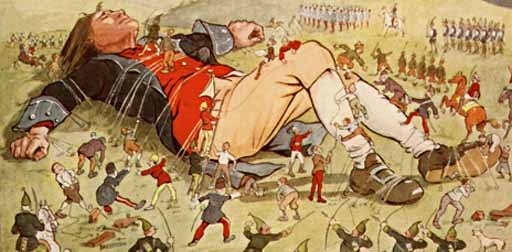
Gullivers-travels

Joe Klein divulges the worst kept secret in Washington:

It seems obvious that Obama is going to have to be less coy with the public about what is really going to happen in July 2011, even if that risks alienating his party's vestigial antiwar base. He is going to have to make it clear that "significant" troop withdrawals — a word bandied about in recent weeks — are not in the cards unless the situation on the ground changes dramatically, for good or ill. And Petraeus is going to have to reconsider whether the crown jewel in his tiara — the counterinsurgency doctrine — is really feasible in Afghanistan and what strategic modifications will have to be made in order to leave the place in the most stable, humane fashion. 

Coy? He wasn't coy. He pledged that withdrawals would start then and used the phrase exit ramps. Joe seems bullish on the new leadership but it merely convinces me that Petraeus' grip on military policy is now complete. The trouble is that his signature contribution – counter-insurgency – is not working in Afghanistan, because it lacks basic components – like a foreign Jihadist interloper, concentrated populations capable of being adequately policed, a credible central government, and an open-ended amount of time.

So my view is that this has made things far worse, that we are trapped there for ever, that Obama simply has not had the balls to get the hell out, and that the military brass – far from being brought to heel by Obama – now has the president by the balls for the war they want. That the brass is the thoughtful, Democratic-style, Petraeus version of neo-imperialism makes it actually more lethal for any chance of returning to limits in US foreign policy.

This is the entrenchment of late Bush, not the change we were promised. The Af-Pak occupation is Washington's latest war-machine, like the war on poverty, the war on drugs and the war on terror. It's a government program that cannot be stopped, cut or removed. It is now a permanent feature of the American state.