The Incumbent Effect

John Sides argues (twice) that the vast majority of Congress will be re-elected in the fall. Taylor Steven agrees:

I would argue that if the re-elect race for the House is 85% or higher, then most of the media narrative that we have been subjected to this year will end up being a lot of sound and fury that will have signified a whole lot of not all that much (and this strikes me as a likely result, to be honest).  Even if we have a result that is “historical” and is in the 80% range, it is hard to make the case that an incumbent re-election rate of that magnitude demonstrates a massive amount of voter anger.  The bottom line is that a substantially large percentage of the current House is returning in January (and in the Senate too, although the numbers under discussion are for the House only).
Defining Merit Down

Edward Glaeser remains a fan of merit pay for teachers but it's easier to defend in theory than practice:

The problem is that any top-down push for incentives is easily subverted at the local level. A paper by Jay Greene and Stuart Buck provides a bevy of examples where schools said they had adopted merit pay, but in reality did anything but.

Professors Buck and Greene write of one instance in Arizona: “Algebra teachers were being rewarded merely for getting students to learn 10 percent more about algebra than they knew before studying that subject at all. This is not a high hurdle to clear.” As a result, they write, “even when a state creates a statewide merit pay program and legally bars spending the money on anything else, local school districts may still end up spending the funding on regular salaries unconnected to merit pay or on so-called merit pay programs with absurdly low standards for what constitutes ‘merit.’ ”

The Landscape Of Crime

  SFside

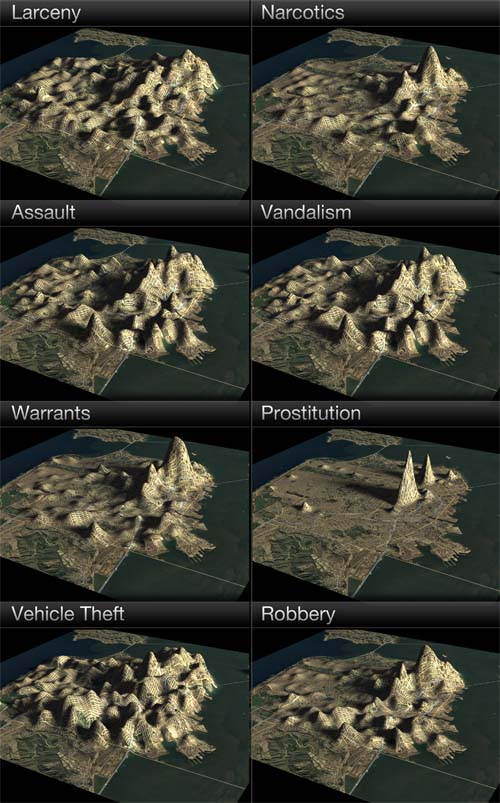
Doug McCune translates San Francisco's crime numbers into geographic peaks and valleys:

I’ve used a full year of crime data for San Francisco from 2009 to create these maps. The full dataset can be download from the city’s DataSF website. …Many of the maps have peaks in the Tenderloin, which is that high area sort of in the north-east center area of the city. Some are extremely concentrated (narcotics) and some are far more spread out (vehicle theft).

My favorite map is the one for prostitution (maybe “favorite” is the wrong choice of words there)…the prostitution arrests are peaking on Shotwell St. at the intersections of 19th and 17th….I love the way the mountain range casts a shadow over much of the city. There’s also a second peak in the Tenderloin (which I’m dubbing Mt. Loin).

(Hat tip: FD)

Counter-Culture As The Engine Of Capitalism

The archives of David McRaney's blog on self delusion are well worth picking though. A post from April:

In the 1960s, it took months before someone figured out they could sell tie-dyed shirts and bell bottoms to anyone who wanted to rebel. In the 1990s, it took weeks to start selling flannel shirts and Doc Martens to people in the Deep South. Now, people are hired by corporations to go to bars and clubs and predict what the counter culture is into and have it on the shelves in the cool stores right as it becomes popular.

The counter-culture, the indie fans and the underground stars – they are the driving force behind capitalism. They are the engine.

This brings us to the point – competition among consumers is the turbine of capitalism.

Thomas Frank tackled this subject in his first book, The Conquest of Cool.  Long excerpt here. Dan Geddes reviews:

Frank’s purpose is to demonstrate that Madison Avenue and consumption-based industries such as soda bottlers and men’s wear welcomed the counterculture, realizing that the cult of instant gratification would make the Baby Boomers better consumers than their thrifty parents. Frank even suggests that the Creative Revolution in advertising anticipated and in some ways precipitated the counterculture. Historians of the Sixties have long described the “co-optation” of the movement by the advertising industry: its use of countercultural symbols. Frank’s thesis that Madison Avenue’s critique of “mass society” predated later critiques of the countercultural can warm the hearts of critics of capitalism: That capitalism could could generate a critique of itself in order to fashion a more turbo-charged consumer becomes as satisfying as any conspiracy theory, especially in light of Frank’s meticulous scholarship.

Our Many Screens

Friedersdorf interviews Alan Jacobs about reading in the digital age and good reasons to memorize poetry:

Tim Bray wrote a fascinating post just the other day in which he pointed out that screen resolution of modern devices is just now approaching the pixel density that approximates print. Once we cross that threshold, many kinds of books, especially those featuring images, will become more plausible candidates for digital presentation.

That said, the paper codex is here to stay — but whether it will remain dominant, well, I'm not so sure about that. And it is being complemented by multiple devices that alter the reading experience. Book-lovers tend to sneer about "the screen" — and some techno-utopians bow down before "the screen" — but in fact there are many different kinds of screens that we respond to, cognitively and emotionally, in very different ways. Reading a novel on a Kindle or a Nook is much closer to the experience of reading it on a paper codex than reading it on your laptop would be: you turn pages rather than scroll, you have no other tabs open, email and Twitter aren't pinging you, there are no (or few) hyperlinks. . . . I actually had the experience of having my reading concentration renewed when I got my Kindle. It helped me to get back to long-form reading, which my online life had made harder for me.

The Daily Wrap

Today on the Dish we looked closely at the supposed al Qaeda-flotilla link, Israelis were found to have strongly supported the raid, Andrew challenged Walter Russell Mead's view of the US-Israel relationship, some Israeli students made a savvy gesture towards Turkey, and Madrid barred gay Israelis from a pride parade. Andrew also dug into a disturbing new report on Gitmo torture and wondered if there is a single anti-Zionist columnist. Dissents of the day here.

In spill coverage, Flowing Data illustrated BP's gross negligence, ProPublica exposed more criminality, and the Onion did its work. Beinart shone a light on American hubris, TNC piled on the White House press corps beach party, Greenwald mocked Limbaugh's fourth marriage, Jim Burroway scrutinized a study of lesbian parents, Jesse Bering studied fag hags, E.D. Kain scrunched his forehead over school choice, and Matt Welch knocked journalist "objectivity."  Foreign Policy commemorated the Green Movement and a rock group dedicated a song to Neda. Word Cup coverage here. Orly Taitz won't go away.

Readers defended atheism, others revolted over male reproductive rights, and another mused over her love for animals. Yeas and Nays scanned the District for gays and the Daily Caller spotted Obama speechwriters shirtless. Beard porn here and creepy ad here. MHB here, Sully MHBs here and here, VFYW here, and FOTD here.

The Dish launched its first installment of the VFYW contest (with only a minor hiccup).

— C.B.