Moral Victories

Julian Sanchez maps the boundaries of science:

I’m glad, of course, that we’ve dispensed with a lot of bogus science that served to rationalize homophobia—that’s a pure scientific victory.  And I’m glad that we no longer classify homosexuality as a disorder—but that’s a choice and, above all, a moral victory. It ultimately stems from the more general recognition that we shouldn’t stigmatize dispositions and behaviors that are neither intrinsically distressing to the subject nor harmful, in the Millian sense, to the rest of us. And that comes across clear as day in the This American Life account: The change in the psychiatric establishment’s bible, the DSM, was partly a function of new scientific information, but it was equally a moral and a political choice.  The test, if we’re trying to keep ourselves honest, is not whether we place some questions beyond the scope of science, but whether we do so in an opportunistic, ad hoc way, depending on whether the science seems to cut for or against our preferred beliefs.
World Cup Approaches

Calendar

This breaks one of the Dish's cardinal rules – that we don't cover anything where a ball is involved – but TNR has revived its excellent World Cup blog. Alex Massie is among the commentators. He's not a big fan of Brazil:

I am, you see and I am afraid, bored of Brazil. Bored too of the requirement that we all tug a forelock when confronted by their genius even when, actually, there's been little evidence of any real genius on the actual playing field. This, of course, is linked to the tedious rhapsodies about joga bonito and samba football and all the rest of it that all are compelled to endure every time the men in yellow stroll onto the pitch.

If this ever used to be true—and, to be fair, it did—then it ceased to be some time ago. The sneaky reality is that this Brazilian football team—highly accomplished though they may be—are boring. They're like a German car, which is fine if you're looking for a German car but not if you're searching for football worthy of the praise that's lavished on Brazil.

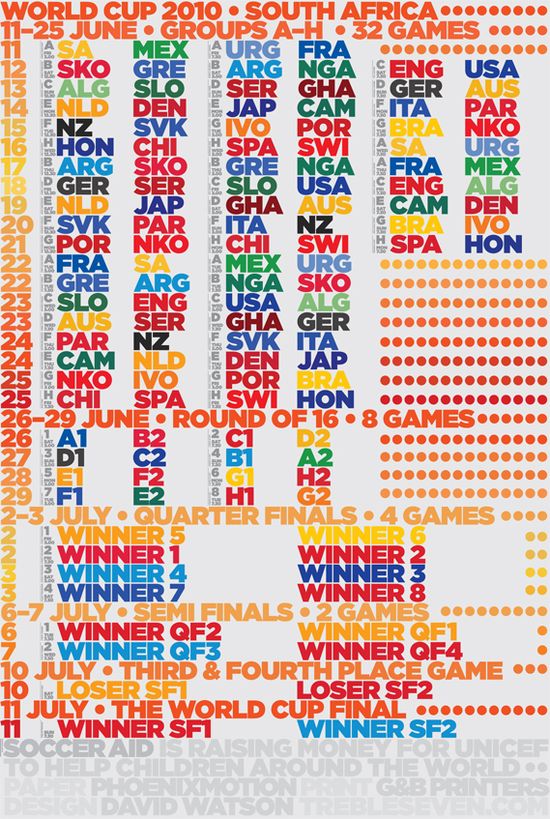
Jack Shephard provides a layman's guide to the tournament. Image from here.

What’s At Stake In California

Scott Morgan's call to arms:

The bottom line is that if this initiative wins, or merely comes close to winning, it will galvanize our movement behind a victory that's surely just over the horizon. It will show politicians and the press that the recently surging marijuana legalization debate is more than just a fad and that our support base penetrates deeply into mainstream society.

On the other hand, a decisive loss will send a message that the apparent march towards legalization in recent years was little more than a vocal minority exploiting the internet to create a false perception of political momentum. Can you even imagine how eager our opponents are to start saying things like that? Our losses are inevitably exaggerated and twisted by our opponents in a desperate defense of the status quo, and in that respect, the political impact of our victories must be considered in addition to the substance of the reforms themselves.

Chart Of The Day

Deficit

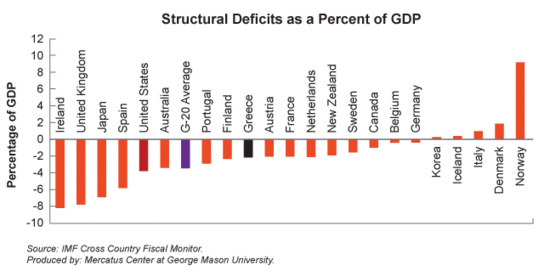
Veronique de Rugy worries:

There is no firm rule on when deficits or public debts are too high relative to an economy’s size. Prior to the crisis, the general consensus was that rich countries could safely have public debts worth 60 percent of GDP. And although Japan’s debt has exceeded 100 percent of GDP for many years, the government has yet to suffer a financing crisis.

However, it doesn’t mean that things won’t change. Investors judge default risks on a curve. They will assess one government against others (for instance, the United States vs. France, Germany, China, and Norway). When the markets do lose confidence in a government’s fiscal rectitude relative to others, a crisis can arise quite quickly, forcing countries into painful political decisions. And this could very well happen to the United States.

And look at the Blair-Brown legacy in Britain!

Dissents Of The Day

A reader writes:

Please read the Wired report you linked to. The classified video of gunships is a distraction: Manning also leaked some 260,000 classified Diplomatic Communications – so much that even a supporter of Wikileaks and a former hacker turned him in to the Army. That's the story. That kind of leakage – damaging, deadly even – is not to be dismissed at all.  Very likely treason.

Another writes:

You simply cannot have analysts who take it upon themselves to decide that videos or documents are being improperly classified and fix it themselves. This is why people like Jonathan Pollard are deservedly behind bars for years to come. This young soldier may have acted morally in your eyes, but his conduct was quite simply illegal, unprofessional, and in violation of all his training and the promises he voluntarily gave to safeguard the nation's secrets.

Another:

No one forces you to apply for a security clearance.  In return for classified access, you take an oath, which has both moral and legal force.  You agree not to disclose the information you are entrusted with.  If you don't believe that you can honor this trust, for what ever reason, you have no business swearing the oath.  The United States trusted this young man to honor his oath and not disclose this material.  He violated this trust.

Daniel Ellsberg understood the weight of the oath and expected to go to jail when he leaked the Pentagon Papers.  I don't agree with what Ellberg did, but at least he believed strongly enough in what he was doing to knowingly risk jail.  The young man who leaked the information to Wikileaks clearly did not take his promise seriously.

How Objectivity Breeds Extremism

Matt Welch has a theory about reporters forced to "submerge or even smother their political and philosophical views in the workplace":

Show me the world's most intractable problems–the Israeli-Palestinian conflict, the inability to produce mass amounts of energy without negatively impacting the environment, the search for a beer that tastes great and is less filling–and I'll show you reporters in bars having conversations worthy of the Alex Jones show. It's not that they're all Helen Thomases–she is truly one of a kind–but that in the absence of subjecting their own beliefs to journalistic rigor, they are more likely than many would expect to quietly nurture beliefs that outsiders would find surprisingly slanted and even extreme. 

Yglesias nods:

When you get in the habit of arguing about politics professionally, you tend to learn something about what the other side’s counterarguments are and hopefully develop some better arguments of your own. If you just kind of sit around in the vicinity of important issues stewing in your own views but never working on articulating them or developing them, then you’ve set the stage to cut loose with some serious nonsense.

Any time people feel required to suppress their real views for whatever reason, untruths fester without the disinfectant of sunlight. That's why I've always tried to raise some difficult issues – racial differences in IQ, or the impact of testosterone on gender, or the sexual orientation of a possible Supreme Court Justice – as a way to get them on the table. In this, I'm a liberal and always have been. Which means I'm against the cult of journalistic objectivity – which often means simply never asking the questions that really do need to be talked about.

Face Of The Day

101871797

A giant red nose adorns the famous Mr Moon Face at the front of Melbourne's Luna Park, as support of SIDS (Sudden Infant Death Syndrome) and Kids Victoria annual Red Nose Day fundraising appeal, on June 8, 2010. SIDS and Kids Victoria is one of Australia's best known not-for-profit organisations, dedicated to saving the lives of babies and children during pregnancy, birth, infancy, and childhood.  By William West/AFP/Getty Images.