The Mural In Prescott

Late last week a mural on the wall of a school in Arizona drew national attention because the artists were asked to lighten the faces of the children depicted. Roger Ebert has a beautiful reflection on the controversy and on the progression of his views on race:

I began up above by imagining I was a student in Prescott, Arizona, with my face being painted over. That was easy for me. What I cannot imagine is what it would be like to be one of those people driving past in their cars day after day and screaming hateful things out of the window. How do you get to that place in your life? Were you raised as a racist, or become one on your own?…The hard-won social struggles of the 1960s and before have fundamentally altered the feelings most of us breathe, and we have evolved, and that is how America will survive. We are all in this together.

But what about the people in those cars? They don't breathe that air. They don't think of the feelings of the kids on the mural. They don't like those kids in the school. It's not as if they have reasons. They simply hate. Why would they do that? What have they shut down inside? Why do they resent the rights of others? Our rights must come first before our fears. And our rights are their rights, whoever "they" are.
Worst Case Scenarios, Ctd

Kinsley weighs risks:

Leonhardt says (borrowing with credit from Robert N. Stavins, a Harvard economist) that we tend to underestimate risks that are hard to imagine and overestimate risks that are easy to imagine.  It is the first problem that worries Leonhardt…

My worry is the opposite of Leonhardt’s. It seems to me that in America, at least, we are much more prone to the second type of error: overestimating small risks of large disasters—and underestimating, by comparison, the smaller, everyday risks of life. Leonhardt himself provides the clearest example: people who, after 9/11, decided to drive rather than fly on long trips. In the next year there was no new terrorist attack on airplanes, but deaths in traffic accidents went up because more people were driving. That was like buying insurance against asteroids. Or, to take a more tendentious example, it’s like nuclear power. For a generation we’ve gone without it to protect ourselves from a catastrophic risk, only to find that perhaps this was a mistake because, without enough reflection, we were increasing the risk of a somewhat smaller catastrophe like the one in the Gulf.

America’s Immigration Edge

Gallup looks at migration wishes:

If all of the adults worldwide who tell Gallup they would like to move to another country actually did so, the United States could see a net population gain of 60%. Several other developed countries, such as Singapore, however, could be even more overwhelmed with migrants because of their smaller relative current population. Mexico, on the other hand, could potentially see net population losses as high as 15%.

The ability to attract immigrants is not all good, of course, but it does speak to the country's capacity to regenerate itself and stave off a decline in population. America's two major great power rivals – China and Russia – can boast of no such attraction.

The Great Inflation/Deflation Debate

Buttonwood searches for consensus:

Last week, we launched our economics channel with a debate on whether inflation or deflation is the greater threat. Scroll through the contributions and you will discover either that "Tough deflationary times lie ahead" or that "Eventual inflation is inevitable".  Since this is the central question of economic policy at the moment, such a discordance of views is rather disturbing; much is made of the debate on global warming but the scientific consensus is overwhelmingly on one side on that issue. On economics, governments are being forced to choose in matters of fiscal austerity, where the debate is almost 50-50. 

“The Weather”

The above ad comes from Carly Fiorina, a Republican running for Senate in California. Andrew Exum watches and sighs:

First Carly Fiorina dismisses climate change as "the weather". Then she pokes fun at Barbara Boxer for thinking climate change might be a national security issue. Ugh. Look, we can have a debate about whether or not climate change is man-made or whether or not it is reversible, I guess, but things like polar ice caps melting and creating new sea lanes is most certainly a national security issue. I cannot wait to watch Parthemore or Rogers tee off on this ad, but I will pre-empt them both by directing you to our Natural Security page, their awesome blog, and the two most recent (and excellent) CNAS reports (here and here) on the impact climate change will have on the security environment and U.S. policy.

The Second Coming Of The Amateur Blogosphere

Yglesias predicts:

I think retirees are going to prove to be the killer app of digital content creation. It’s just that at the moment relatively few retired people are all that comfortable with digital media. Ten, twenty, thirty years from now that’ll be very different. Obviously someone who’s affiliated with a larger institution will always have certain advantages over an amateur, and the blogosphere gives heavy advantages to early adopters, but I think a lot is going to continue to change on the internet as demographic change continues.

Me too. The basic truth is that amateurs are often as good as professionals in journalism, which requires simply basic skills, integrity and practice. In the end, newspapers will be super-advertizing vehicles, searching for the best existing blogs out there and aggregating them. In a way, that's already the Dish model. The sources come to you.

Face Of The Day

101669815

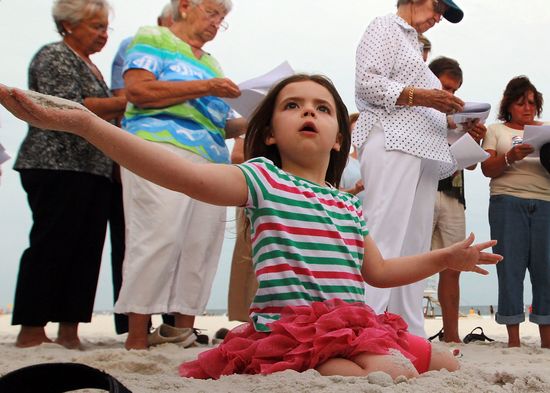
A crowd of people read a prayer together during a vigil for the oil spill along Pensacola Beach where oil globs have come ashore as oil continues to flow from the Deepwater Horizon oil spill on June 6, 2010 in Pensacola, Florida. The vigil was put on by the Pensacola Beach Community Church. Reports indicate that BP's latest plan to stem the flow of oil from the site of the Deepwater Horizon incident may be having some success. By Joe Raedle/Getty Images.

Home Office Win

Laura Vanderkam vouches for telecommuting:

It turns out that not all work hours are the same. The BYU researchers calculated a “break point,” that is, the point where 25 percent of workers reported that work was interfering with family life. Among people who have to log all their hours in an office during certain times, this break point happened at 38 hours. Since many full-time workers log 40-45 hours per week, this means a lot of people are feeling conflict.

If you give employees some flexibility about their schedules, though, and give them the option to work some of the time from home, the break point doesn’t hit until 57 hours. That’s 19 more hours per week — 50 percent more than the office-only workers, and the equivalent of 2.5 full days.

Now that is a lot of time. And the crazy thing is, you probably won’t have to pay people more either for these additional 2.5 days that are on the table.

And less traffic and fewer cars.

(Hat tip: Elizabeth Nolan Brown)