Face Of The Day

AfghanistanMiguelVillagranGetty

A German soldier of the 2nd Infantery Company plays a game with a friend as he waits to depart on a mission on May 25, 2010 at the PRT in Kunduz, Afghanistan. Germany has more than 4,500 military forces in Afghanistan as part of the US-led International Security Assistance Force. Amid growing public resentment towards the prolonged mission in Afghanistan, the German parliament, the Bundestag, voted in February for extension of Germany's military mission in Afghanistan and the deployment of additional 859 troops. By Miguel Villagran/Getty Images.

Khamenei’s Pardons

NIAC is rightly skeptical:

Supreme Leader Ayatollah Ali Khamenei pardoned 81 of some 530 political prisoners jailed in the wake of the 2009 presidential election….Speculation still surrounds today’s pardons with the Associated Press writing that “the pardons were seen as a gesture of good will by Iran’s leaders just days before the anniversary of the June 12 election.” However, some remain skeptical finding it hard to believe that Khamenei would have been motivated by a sudden change of heart to express good will towards a group of people he has spent the last year repressing. A far more likely explanation would be that the pardons are part of an effort to shift domestic and international attention away from the regime’s many human rights violations in the days nearing the anniversary of the 2009 election.

Facebook Is Destroying The Closet

Joshua Alston makes the case:

Social-networking sites like Facebook and Twitter simply don't allow for compartmentalization. A buddy once told me that his gay friends and his straight friends are like light and dark liquor—ideally, they shouldn't be mixed. But social networking forces you to shuffle your decks; friends, family, drunken hookups, and co-workers all get equal treatment—equal weight in a news feed or stream. Presenting a partial portrait of who you are becomes tricky.

That's not to say staying in the closet on Facebook can't be done. It's possible, as long as you're willing to work it like a full-time job.

Keeping an eagle eye on tagged photos, pushing Facebook's customizable privacy options to their capacity, swooping in to delete unapproved comments and wall posts, refraining from posting the new Beyoncé video even though it's so fabulous—all in a day's work. But whereas in the recent past, being in the closet wasn't that much work once you were out of your parents' house, now it requires real effort. Closeted people can't just watch their own behavior anymore: they have to monitor and somehow orchestrate the behavior of others, 24 hours a day, in real time.

Even if you can manage that, you still have to look out for Project Gaydar.

Greenwald’s Inbox

Glenn shares:

I can't express how many emails I've received over the last week, from self-identified Jewish readers (almost exclusively), along the lines of:  I'm a true progressive, agree with you on virtually every issue, but hate your views on Israel.  When it comes to Israel, we see the same mindset from otherwise admirable Jewish progressives such as Anthony Weiner, Jerry Nadler, Eliot Spitzer, Alan Grayson, and (after a brief stint of deviation) Barney Frank.  On this one issue, they magically abandon their opposition to military attacks on civilians, their defense of weaker groups being bullied and occupied by far stronger factions, their belief that unilateral military attacks are unjustified, and suddenly find common cause with Charles Krauthammer, The Weekly Standard, and the Bush administration in justifying even the most heinous Israeli crimes of aggression.

Israel Derangement Syndrome III

A reader writes:

Check out this revolting video that's surging on YouTube.  Apparently this comedy/satire group, Latma, is fully funded by the Center for Security Policy's Middle East Media program.  And who runs the CSP?  Yup, Frank Gaffney.  So we have American neocons celebrating and making fun of the death of nine individuals, including an American citizen.  How is this not a bigger deal?

Kicking Our Oil Habit: Beyond Cars

Oilconsumption

Bradford Plumer searches for low-hanging fruit:

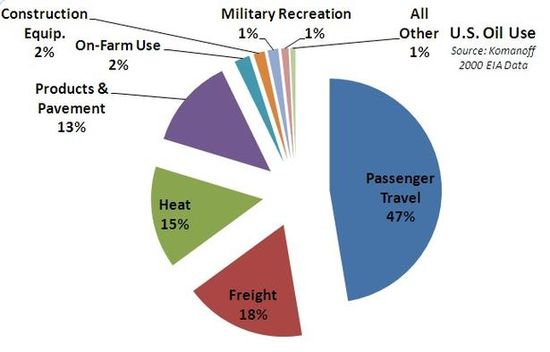
As it turns out, passenger travel—planes and cars, mainly—only accounts for 47 percent of our oil use. This is probably the hardest item to fix in the short run, and requires a very wide array of different policies…There's a lot of other oil use out there that may be easier to tackle in the short run. About eight million buildings, mostly in the Northeast, use oil for heating, and this accounts for about 15 percent of the country's crude consumption. Upgrading these buildings so that they get their heat from natural gas or electricity would be a worthwhile endeavor. Likewise, there's no good reason why we should still be burning oil to generate electricity during peak-demand times—smarter grids or even solar power could help whittle that down.