Badass Israel

RAIDUrielSinai:Getty

A reader writes:

It was not 30 "activists" v. 30 commandos. It was 30 (at least) v. one-at-a-time as the commandos came down off of the ropes from the helicopter. As each commando descended, the "activists" swung his rope (threatening to cause him to fall from the rope to the deck), and they were immediately on top of him, beating him with metal poles, as soon as he was within reach.

The video clearly shows, in at least one instance, several "activists" swinging metal poles multiple times from over their heads, suggesting that they were hitting a commando prone on the ground. They also then employed fire bombs and stun grenades. In another clearly shown instance, several "activists" are seen throwing a commando over the railing to the lower deck. There are also reports, though I haven't seen video confirmation yet, that when one of the first commandos to hit the deck was mobbed by the many "activists", they were able to get his gun, and they used it. Hardly a "30 commando v. 30 unarmed peace activists" massacre.

Calling this a "military attack" by Israel is a wild distortion. These were people purposefully attempting to run a known blockade, knowing that they would be stopped and boarded. They were provoking exactly this type of boarding by israel, planning to start a fight, to get exactly this result. It is classic Gaza strategy.

No, it was not a massacre. There was a fight. But the fact is the boat was in international waters, had committed no crime in Israeli waters, could have been kept away by a variety of other tactics, and was attacked by fully-armed commandos who ended up killing many unarmed civilians. To see Israel as the victim in this is so perverse it borders on unhinged. Another reader writes:

As an Israeli citizen (although I no longer live there) I am appalled at Israel's tactics with the ships bound for Gaza. They could have easily used non-lethal means to accomplish their objective. For example, they could have moved a gunboat in front of the large ship forcing it to stop or slow down. They could have dropped a frogman into the water to disable the propeller and/or rudder with a small explosive. The immobilized ship could then be towed anywhere Israel wanted.

Knowing the Israeli psyche like I do, they took the approach of confrontation to teach "them" a lesson and show "them" who is boss. I see the same thing every time I'm in the West bank, which is twice a year for the Holidays visiting my settler relatives.

What we have just seen is a microcosm of what's killing Israel. Some think it's Israel's only option and want more aggression from the Jewish state. Another reader:

The flotilla "demonstrators" were not civilians.  They are terrorists, seeking to provide aid, comfort, and supplies to the butchers in Gaza known as Hamas.  The Israelis should have sunk the ships.  Most of us out here who have not deluded ourselves into believing that peace can actually be achieved there knew right from the start that this is precisely how these events would evolve.

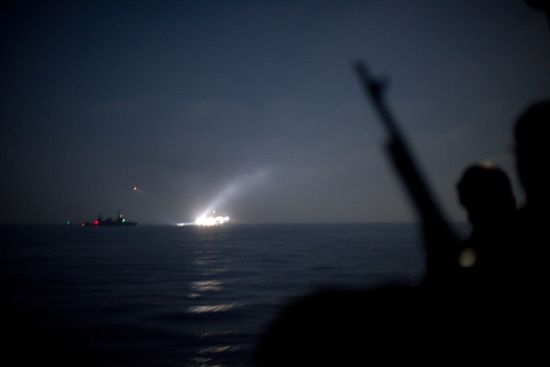
(Photo:  Israeli Navy soldiers stand guard on a missile ship as the Israeli Navy intercepts peace boats bound for Gaza on May 31, 2010 in the Mediterranean sea, 70 miles from the cost of Gaza. More than 10 people were killed after Israeli commandos boarded ships transporting aid to the Gaza Strip. By Uriel Sinai-Pool/Getty Images. NOTE: Image has been reviewed by IDF prior to transmission. )

A Second Mini Cast Lead

Gideon Levy says what must be said about the rogue government in Jerusalem. He's particularly on point with respect to the mindset that sees this kind of aggressive over-kill as somehow part of Israel's existential struggle:

Like in "Mini-Israel," the park where there is everything, but smaller, Israel embarked yesterday on a mini Operation Cast Lead. Like its larger, losing predecessor, this operation had it all: the usual false claim that is was they who had started it – and not the landing of commandos from helicopters on a ship in open sea, away from Israeli territorial waters. There was the claim that the first act of violence came not from the soldiers, but the rioting activists on Mavi Marmara; that the blockade on Gaza is legal and that the flotilla to its shores is against the law – God knows which law.

Again came the claim of self defense, that "they lynched us" and that all the dead are on their side. Once more the use of violence and excessive and lethal force was in play and once more civilians wound up dead.

This action also featured the pathetic focus on "public relations," as if there is something to explain, and again the sick question was asked: Why didn't the soldiers use more force.

The Earth At Night

EarthatNight

Benjamin David Hennig updates a classic:

The night view of the earth has become a very popular depiction of this planet. Although the NASA itself says that “The brightest areas of the Earth are the most urbanized, but not necessarily the most populated” many people mistake this view as a representation of the inhabited places on the globe. Our gridded population cartogram can help to get a better understanding of the relation of people and light. The following map is a reprojection of the earth at night that shows the nightview in relation to the population distribution.

The Fallen: Home And Away

Homeandaway

An interactive map by CNN. Stamen Design spent almost a year on the project.

The project is a sobering look at the human cost of two wars in the Middle East, and as such we've worked within a restrained and sober palette of blacks, whites and greys. CNN has hooked the maps up to CNN iReport and we're hearing stories of people using the map to post memories and share stories about their lost loved ones. It's not been the easiest subject material to work on, but we've come away with a keen sense of the human face of these conflicts and hope you'll take the time to look around a bit at the stories that these kinds of maps can tell.

(Hat tip: Flowing Data)

Cool Ad Watch

This 2 minute global film was shot by multi-award winning director Adam Berg over four weeks in Brazil, France, London and India. Every location is real and they remain transformed by a palette consisting of 120 different colours. The people in the film are not actors, they are real people who rolled up their sleeves to transform their community with colour.

(Hat tip: Nerdcore)

Hitch-Bait In Africa

Graeme Wood's dispatch on Africa's witch trials:

By some estimates, about 40 percent of the cases in the Central African court system are witchcraft prosecutions. (Drug offenses in the U.S., by contrast, account for just 12 percent of arrests.) In Mbaiki—where Pygmies, who are known for bewitching each other, make up about a tenth of the population—witchcraft prosecutions exceed 50 percent of the case load, meaning that most alleged criminals there are suspected of doing things that Westerners generally regard as impossible.

Liquid And Fast

Emanuel Derman, a former Goldman Sachs quant, explains the difference between models and theories. An interesting nugget on how Wall St. has changed:

There's a lot of talk about the role of algorithms and the change in markets. The financial world has changed a lot since I worked in it and the biggest change is more people are playing with more of other people's money. When most of the banks were partnerships, they had to be in it for the long run because people who were partners were playing with their own capital and taking risk with their own assets. Their money was tied up for 10 or 15 years. Even if somebody retired, they still couldn't take their money out of there. They just got paid interest while it was being used and drawn down. 

So there was a certain culture of not taking extreme risks because you didn't really have limited liability. Ultimately you could be broken completely by your company going bankrupt. With trading houses going public, they're playing with other people's money. They're immediately liquid in terms of stock and cash payment. The culture in all of these places has changed in that it's make money liquid and fast. The way this crisis has been treated exacerbates that attitude in that if you do badly, the government bails you out and if you do well, you keep the profits. 

Where Is The Wisdom?

Goldblog:

I'm trying to figure out this story for myself. But I will say this: What I know already makes me worried for the future of Israel, a worry I feel in a deeper way than I think I have ever felt before. The Jewish people have survived this long in part because of the vision of their leaders, men and women who were able to intuit what was possible and what was impossible. Where is this vision today? Israel may face, in the coming year, a threat to its existence the likes of which it has not experienced before: A theologically-motivated regional superpower with a nuclear arsenal. It faces another existential threat as well, from forces arguing that Israel's morally disastrous settlement policy fatally undermines the very idea of a Jewish state. Is Israel ready to deploy seichel in these battles, rather than mere force