But what sort of Jew? A Catholic scholar of the historical Jesus, John P. Meier, explains:
Author: Andrew Sullivan
Watching A Landscape From A Train
A reader dissents:
The Internet is not doing anything to our brains. We may be doing bad things to our brains. But the things that we are doing have been possible as long as there have been libraries.
Any library patron has always been free to read a paragraph, re-shelve the book, grab a new one, skim its preface, re-shelve it, wander to the periodicals section, grab the New York Times magazine, flip to the fancy real estate ads in the back, think of West Egg and East Egg and Jay Gatsby, put down the magazine, head to the fiction section, reach out for Fitzgerald's classic, realize that he's never read anything by Fitzgerald's wife, wonder if this makes him a sexist, decide that it just might, scan the fiction Fitzgeralds until he finds Zelda, grab a copy of Zelda's "Save Me the Waltz," start to read the first paragraph, question his own memory, flip to the author bio to confirm that Zelda was truly married to the Gatsby author, see that Zelda was born in Montgomery, think of the Montgomery bus boycott, remember that he's been meaning to buckle down and read Taylor Branch's MLK biographies, head off for the biography section.
Etc.Etc.Etc.Most of us don't do that in libraries. But we could.If Carr's piece causes people to rethink the choices they make online, I'm all for that. But I'll be upset if Carr's piece causes people to flee the Internet or to resign themselves to an online reading experience that, to use those words of yours, is "more like watching the landscape from a train." It's not just that we can drive our own train. It's that we're free to jump the track, to go where we want at the speed we want with as many or as few distractions, digressions, and deep-thinking dives as we choose.
Why The Closet Must End In Public Life
By all accounts, David Laws is a decent, brilliant, capable and humane public servant, and had been given a critical role in the new coalition government in Britain: cutting spending. Laws is of my generation, but has been caught, as others have been, by the riptides of social change and the pace of his own personal journey. He came out only recently and struggled with being gay and wanting to be in elective politics for a long while. One of many reasons he is a Liberal Democrat and not a Tory is his sexual orientation. And so the new government in Britain was Laws' moment. And yet it was also his undoing.
He has just been forced to resign over an expenses scandal. There is an allowance for members of parliament to get accommodation in London while they live in their constituencies. This allowance went to his partner, for their shared apartment in London. Because of the closet, Laws concealed this relationship and fell foul of the rules. He didn't personally benefit from the money – his partner did – but the rules were indeed broken. And so an extremely promising career has been temporarily derailed.
With any luck, Laws will return to government at some point. Britain needs him. For me, this is just an example of how the closet distorts the ethics of good people, and leaves them open to abuse, blackmail, or simple, forgivable conflicts of interest – because lies about the deepest aspects of ourselves rarely stop there. They require other lies and fibs and white lies … which in time, degrade someone's integrity, and often leads into traps, like the one into which David Laws just fell.
A spouse, for example, who is not publicly a spouse means that the usual full disclosure of conflicts of interest is impossible. And so Law's nine-year relationship – effectively a marriage – made sense in one setting and broke the rules in another.
The way forward, it seems to me, is to ensure that when we are dealing with high level public figures – Treasury ministers, Supreme Court Justices, Cabinet members, et al – the gay question be no longer shrouded in discretion and ambiguity and taboo. As our society evolves, the closet will always remain an option for those too afraid or too conflicted or too uncomfortable to be open. But in public life, especially at its highest reaches, it has to end. And the press must stop enabling it, and start tackling it. Not out of personal vindictiveness and not out of cruelty. But because emotional and sexual orientation is a fact about people. In my view, public figures in national capacities need to be open about this or not seek high office. And if they do seek high office, they need to expect to be asked and to tell. Honestly.
Because lies, even white lies, even understandable lies, cannot last in today's culture and today's media.
Update: Iain Dale has an excellent set of reflections on this here.
The Original Sin Of Bonobo Monkeys
A thoughtful but still Orthodox Christian explains. What's staggering to me is that a couple of verses in the Bible carry more weight for this person than all the evidence in front of him. Rather than adjust his understanding of Biblical literalism and authority, he adjusts his view so that the Fall must apply to monkeys too. They just don't know it.
A small glimpse into modern Christianity's crisis.
Jesus And Christ, Ctd

A reader writes:
Your reader says Paul is is "clear as anything you could want," but then he he cites only example from Paul. The same passage (Philippians 2) was cited by another reader, and I agree that the verses are likely to be some sort of early Christian hymn. However, I don't think it means what people want it to mean.
If one tried to discover a consistent position of the biblical authors (both Old and New Testaments) on the question of divinity, the closest would be the principle of "agency." God's earthly representatives were considered "God," not because they were actually God by nature, but because they were acting on his behalf. It is the point Jesus made when he was questioned about claiming to be God in John 10. We don't think that way today, but it was a rather typical way of looking at things when the bible was written.
Back to Philippians, here is a quote about the passage from scholar William M. Wachtel:
"It suggests that Christ as a Man on earth was functioning in the status, rank, or position of God. Amazing thought! But there had been a famous historical precedent for this. When God called Moses to be his agent to bring Israel out of Egypt, he told him, “See, I have made you like God to Pharaoh, and your brother Aaron will be your prophet” (Exo. 7:1). The Hebrew text is even more startling, because the word “like” is not there at all. Rather, God declares to Moses, “I have given you [to be] Elohim to Pharaoh.” Earlier, God had said that Moses would be “Elohim” to Aaron (4:16). This means that Moses functioned in some ways as though he were God on earth; he was the appointed leader to act for God and as possessing the authority God had conferred on him by designating him to bear Yahweh’s own title, Elohim!"
Those who claim that worshipping Jesus as a member of the Godhead went back to the first Christians also have to account for Jesus' brother James, who was the head of the earliest Jesus movement according to a host of non-Canonical and biblical sources. James was a respected Jewish figure and leading figure in the Jerusalem temple for several decades at the same time he was leader of the early church. His murder caused the Jews to send a delegation to Rome in protest.
If James had been a Trinitarian, there isn't the slightest chance that he would have been able to co-exist peacefully within the temple.
(Painting: The Baptism of Jesus by Fra Angelico.)
Filling A Bathtub With A Thimble
Nick Carr continues to lament how the internet has changed reading:
The depth of our intelligence hinges on our ability to transfer information from working memory, the scratch pad of consciousness, to long-term memory, the mind’s filing system. When facts and experiences enter our long-term memory, we are able to weave them into the complex ideas that give richness to our thought. But the passage from working memory to long-term memory also forms a bottleneck in our brain. Whereas long-term memory has an almost unlimited capacity, working memory can hold only a relatively small amount of information at a time. And that short-term storage is fragile: A break in our attention can sweep its contents from our mind.
Imagine filling a bathtub with a thimble; that’s the challenge involved in moving information from working memory into long-term memory. When we read a book, the information faucet provides a steady drip, which we can control by varying the pace of our reading. Through our single-minded concentration on the text, we can transfer much of the information, thimbleful by thimbleful, into long-term memory and forge the rich associations essential to the creation of knowledge and wisdom.
On the Net, we face many information faucets, all going full blast. Our little thimble overflows as we rush from tap to tap. We transfer only a small jumble of drops from different faucets, not a continuous, coherent stream.
I know Carr is a broken record on this, but I don't doubt he's onto something. Since blogging – and the demands of blogging – has taken over much of my writing and reading life, I find long-form books, which were once a staple of my education, harder to read. And although I seem able to process and retain large amounts of information and facts on this blog on a daily, hourly, basis, soon they have to make way for more. My ability to forget has grown as my consumption of data has increased.
I don't think this is really best described as reading. Reading takes time, especially if you read slowly, as I do. A real book takes longer to absorb. You need to let a great book wander around your mind as you go along. Online, there is no wandering. The journey is so packed, the distances so great, it is more like watching the landscape from a train.
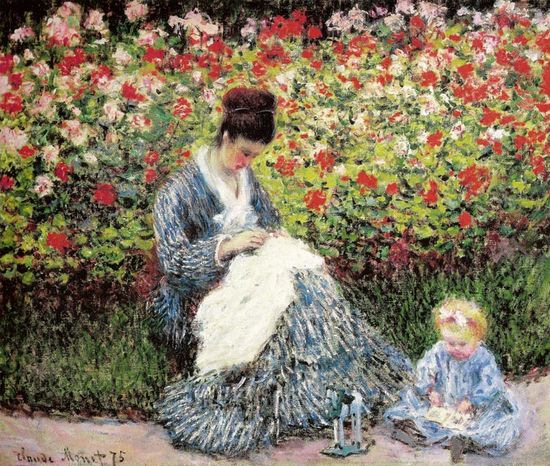
(Painting: “Camille Monet and a Child in a Garden”, 1875, oil on canvas, Museum of Fine Arts, Boston.)
College In The Digital Age
Mike Konczal has mixed feelings about online education:
I think you will see state governments embrace online education. But I don't see them passing on any of those savings on to the students, in the same way that the savings on replacing teachers with adjuncts was captured entirely by the university. A university now envisions itself as a profit-maximizing firm instead of a "public option" of college education. And given that education is our society's only chosen form of social mobility, if only middle-class people can afford college, then only middle-class people are eligible for the benefits of the 21st-century economy.
In fact, online education could fit right into the transition to the hybrid university where it's public in name (and subsidies) but private in terms of tuition.
Inverting The Supermarket

Jason Kottke has a revelation:
FreshDirect is an online grocery store that delivers in the NYC area. I needed to do an order this morning, so I downloaded their iPhone app on my iPad and discovered that grocery shopping is one of those things that the iPad is *perfect* for (an it would be more perfect with a native iPad app). You just take the thing into the kitchen with you, rummage through the cabinets & fridge, and add what you need to your FD shopping cart. Then you take the it with you around the rest of the house (the bathroom, the garage, the pantry in the basement) adding needed supplies as you go. It inverts the usual "wander around the grocery store searching for items" shopping practice; instead you wander about the house looking for what you need.
(Image: The first customer in the shop, Kazuki Miura (R), receives his iPad from fashion model, singer and actress Lena Fujii (L), as they start to go on sale at the shop of Japanese internet service provider Softbank, Apple's exclusive partner in Japan, in central Tokyo on May 28, 2010. Apple's much-hyped iPad went on sale in a swathe of countries from Australia and Japan to Europe at the start of a global rollout tipped to change the face of computing. By Toshifumi Kitamura/AFP/Getty Images.)
Mental Health Break
Apple-cores!
How to join them.
The Language Of Genetics
Olivia Judson marvels at synthetic biology:
What I love about this is that the process of inventing a new genetic language will help us to understand more about the one that actually evolved. Indeed, this has already begun. Early attempts to manufacture DNA alternatives quickly revealed that the “bannisters” of the double helix — the chains that run down the outside of the molecule — are more essential to how the molecule works than anyone had thought.
There are many ways we could use designer organisms, some good and some bad. But the most fundamental aspect of the enterprise is that by trying to build life, we gain a more profound understanding of its evolved nature.
 The Dish