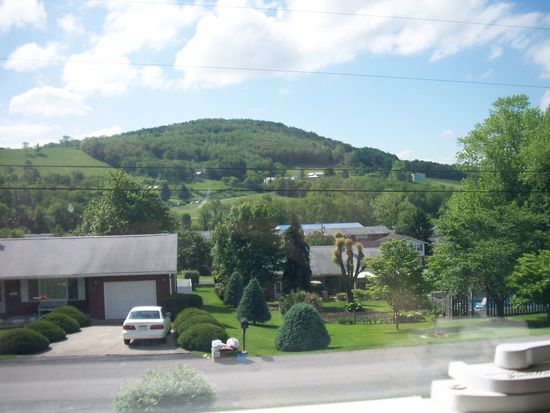
Morgantown, West Virginia, 9.30 am
Morgantown, West Virginia, 9.30 am
A reader writes:
How much do I love this blog? Incisive examination of pressing issues and considered, sideways musings about pig nipples, all on the same page.
Another writes:
ENOUGH with the FUCKING pig already!!
To Weigel. Money quote:
By being here I have learned things, and I've gotten an insight into her character, into her ability to incite hatred, that before I only knew about in the abstract.
A reader after my own heart writes:
Six years ago I got into a heated argument with a group of Iowan evangelicals who were, like me, visiting Northern Ireland (Cushendall, to be precise). Having just graduated from an extremely lefty college with a literature degree, flush with Guinness, and being a burgeoning anti-theist to boot, I got into a spirited debate with them over the use of irony in Frost's poetry. They insisted that I was "thinking too much" about the poem and that I needed to "read it from the heart." Then they formed a prayer circle and asked that I be forgiven for my sins (they didn't enumerate my sins, but I'm guessing hubris and intoxication were among them). No joke.In my years back home in the American South, I have grown increasingly unsurprised at the tendency of evangelicals, nativists, and "true patriots," to read Frost in an unserious manner. We need not make a conclusion if the poem is definitely of the opinion that walls separate neighbors or instead create useful boundaries. At the very least, it is a poem that begs us to question the premise — something which Palin et al. clearly don't understand. Much like a kitschy framed needlepoint "I took the one less traveled by, / And that has made all the difference," a superficial reading of Frost may seem nice — but it is still kitschy. Nothing in "The Road Not Taken" actually allows us to determine which road is, in fact, the one less traveled by, or whether the difference made was a positive one or not. It simply says that we make choices not knowing the future, must make our own decisions, and we cannot know what the alternate future could have been. It is a short poem, easily read as a statement of individuality and independence, but it is fraught with doubt and possible regret.Mending wall is hardly even ironic on it's face. Most of the poem is devoted to questioning the premise — without it the poem wouldn't be anything other than that one line, "Good fences make good neighbors." There is nature that does not love a wall, the neighbor who "will not go behind his father's saying," and the narrator, who says:"Spring is the mischief in me, and I wonderIf I could put a notion in his head:'Why do they make good neighbors? Isn't itWhere there are cows?But here there are no cows.Before I built a wall I'd ask to knowWhat I was walling in or walling out,And to whom I was like to give offence.Something there is that doesn't love a wall,That wants it down.'"What is difficult about this? We don't have to say that Frost or the poem takes a definite stance on the value of a wall, fine — but it is obviously at least about the separations that walls make between relationships, and at least questions the common wisdom of "good fences make good neighbors." It is clearly not a poem that is just about how good fences make good neighbors. Much like the rest of the Christianist mindset, simple and superficial readings of layered meaning prevail. A poem can be simply wrought while not being simple, and that is one of the things that makes Frost's work so beautiful. It's their loss if they choose not to appreciate this, but wholly unsurprising — it is a reflection of how they engage everything about the world.
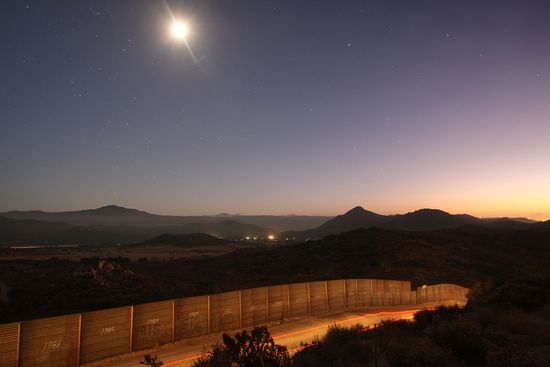
(Photo: A US Border Patrol vehicle is driven along the US-Mexico border fence as agents carry out special operations following the first fatal shooting of a US Border Patrol agent in more than a decade on July 29, 2009 near the rural town of Campo, some 60 miles east of San Diego, California. By David McNew/Getty.)
Joel Wing worries about the plight of Iraqi refugees and the displaced:
Although accurate numbers are hard to come by approximately 2/3 of Iraq’s refugees and displaced are still without their homes. Although the process of return has begun, it has happened at an up and down pace. Those that come back still face difficulties, and the government, United Nations, and NGOs do not have the capabilities to adequately assist them. This has led some to speculate that the majority of Iraq’s refugees and many displaced that left their provinces may never come back.
That means the Iraqi government, aid agencies, and the international community needs to come up with a comprehensive campaign to deal with this large population. The displaced need to get more assistance, and be integrated into their new provinces or countries. The problem is that planning is often shortsighted, and lacks adequate funding because Iraq is a fading issue for many in the world. If things don’t change, Iraqis could become the new Palestinians without the media attention, causing social, political, and economic problems in their host countries, and within Iraq itself.
Today on the Dish, Andrew chewed up Noonan over Obama's response to the spill, Larison seconded, and a reader dissented. Netanyahu gloated over showing up the president, Beinart and Eli Lake discussed settlements, Ron Radosh called the former a commie, and the alleged commie tussled with Foxman. Readers rushed to McGinniss' side, Crowley kicked him in the shin, and Andrew kicked back.
In assorted coverage, Horton kept the heat on the administration, Ackerman saw the bright side of drones, Serwer piled on McCarthy, Friedersdorf sympathized with libertarians, Joe Klein supported a mosque near ground zero, TNC shared some wisdom on journalism, CNN rolled in dough, and Felix Salmon talked internet money. Recession view here.
Aquatic pig coverage piled up here, here, here, and here. Andrew was forced to imagine Bubba in a wet suit. More 24 here and here. Cool app here and two feel-good videos here.

Thursday on the Dish, the House voted to end DADT and a key Senate committee did as well. Joyner questioned the public opposition to it, lesbians harmed by the policy told their stories here and here, and we glanced at the dregs of the debate here and here. The oil leak appeared to be plugged, bloggers debated its similarity to Katrina, more images of the damage emerged, and we looked back at another big spill in the Gulf. The Dish also did due diligence on the Korean crisis.
In Palin coverage, she erected a fence to fend off McGinniss but not convicted criminals, Jack Shafer shielded the journalist, Kate Pickert partially backed Palin, and readers more so. Bernstein insisted on scrutinizing her, Timothy Egan pwned her, Ben Smith reported more juicy details, a reader requested a view from McGinniss' window, Andrew doubted Bristol, and Pareene put it best.
Rand Paul updates here and here. Noah Millman queried the paleocons, Douthat doubted their relevance, Wehner marveled at the lack of crime, Massie covered Clegg, and Friedersdorf manhandled McCarthy. More on the Israel debate here.
Critical Ralph updates here and here. Kaus campaign coverage here. Recession view from a reader here. Early Christian discussion here and Robert Frost in the Atlantic here. More on 24 here and here. Beard-blogging here and metrosexual-blogging here and here.

(By Saeed Khan/AFP/Getty Images)
Wednesday on the Dish, BP was compelled to stream footage of the "top kill," bloggers vented over the dire situation in the Gulf, and John Hudson shone a spotlight on the seediness of regulators. Senator Nelson gave his go-ahead on DADT, Gates sounded circumspect, readers gave their thoughts on the surge of support from Obama, Ben Smith relayed some intriguing details, and Steinglass called out homophobia-phobia.
In other news, McChrystal made Afghanistan sound even worse and Obama revived the line-item veto. Stimulus updates here and here. In Palin coverage, Weigel unloaded on her targeting of McGinniss and readers differed over her interpretation of the Frost poem. More Palin crack here and here. Premium coverage of Ralph the Swimming Pig here, here, and here. Home news here.
Andrew and Chait went another round over Zionism, we spotted an unsettling bit of news out of the West Bank, and we posted a follow-up on that disturbing photo of the taunted Palestinian woman. Horton turned up the heat on the administration over detainees, Scott Morgan divined the their response to legalization in California, Douthat dumped on the paleocons, and Balko bowed before vending machines.
Christ conversation continued here. More discussion of DC here and especially here. Creepy ad here, Malkin Award here, Saddam-sodomy blogging here, and Bruni-sodomy blogging here. Idol-blogging here and 24-blogging here. Especially lovely window here and especially fucked-up face here.
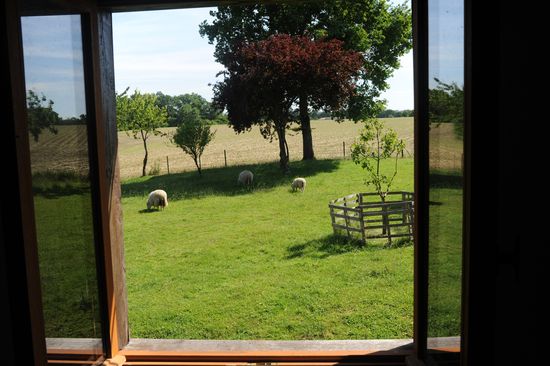
Pau, France, 2.40 pm
Tuesday on the Dish, Andrew was cautiously optimistic about the dramatic developments over DADT and wondered why Obama seemed to shift all of a sudden (clues here and here). Fallows also weighed in. Meanwhile, support for ending the ban was as popular as ever – as was acceptance of gay and lesbian couples.
In spill coverage, BP will try to plug the leak, ABC looked down below, Elizabeth Kolbert glanced at our oil future, readers wrung their hands over Obama's response to the crisis, and we worried about hurricane season. In Palin coverage, Joe McGinniss got a little too close, she responded with another flub, Andrew Sprung tried to make sense of her latest narrative on Obama, and Wendy Kaminer wondered how the Kagan response would be different if she looked more like Palin. In other news, the Church kept misleading its followers over HCR, Julian Glover reviewed the Queen's speech, and a plunge in the stock market popped back up.
In other coverage, Jonah Lehrer gave props to parenting and Tablet and Beinart tried to talk to their kids about Zionism. More discussion of Christianity here and here. Conor-led DC talk here and here (bonus suburbia here). Malkin Award here, creepy ad here, Lost's many jumping sharks here, crappy old postcards here, and butched-up rainbows here.
Monday on the Dish, Pelosi got bolder over ending DADT, we checked in on the size of the oil spill, and Andrew let out a great lament. He also took another long look at the Beinart-led debate on Israel. In the wake of Rand Paul bailing on Meet the Press, Ambers thought he will weather the storm, several bloggers assessed his libertarian cred on foreign policy, Julian Sanchez addressed the conflict between his idealism and the real world, TNC examined the racist baggage plaguing many libertarians, and a reader wrung his hands over the media's treatment of Rand.
In other coverage, a Republican won the seat of Obama's birthplace, Ricks relayed a daunting report on getting stuck in Afghanistan, and a new twist on the Malawi couple surfaced. Palin told another pernicious lie, a former conservative pointed his finger at her, even Pete Wehner couldn't defend her, and Todd, as it turns out, appeared to make most of the decisions.
Bruce Bartlett predicted a political storm over Medicare and slapped conservatives over military spending. John Seabrook sang the praises of adoption while a few readers took exception. More on the origins of Jesus Christ here and here, More on the essence of hippies here. A video version of the Hewitt Award here, a kick-ass nature clip here, and a cool ad for the World Cup here.
— C.B.
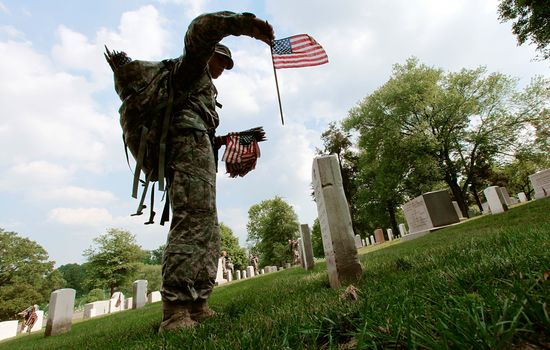
A soldier from the U.S. Army Old Guard places a flag on a grave at Arlington National Cemetery May 27, 2010 in Arlington, Virginia. About 1,300 soldiers, sailors and Marines in about three hours placed a flag at each of the more than 300,000 gravestones at Arlington ahead of the Memorial Day weekend. By Mark Wilson/Getty Images.
Contra Dreher, Joe Klein approves of building a mosque near the site of the World Trade Center:
It is an instant, international symbol that mocks the closed, vicious religious insanity of the terrorists who took the buildings down. Dreher worries about the families of those who lost their lives that day; I would expect that they will accept this, among the many other memorials on the site, as part of their loved ones' legacy–a renewed national sense of what this country stands for, and what it stands against.
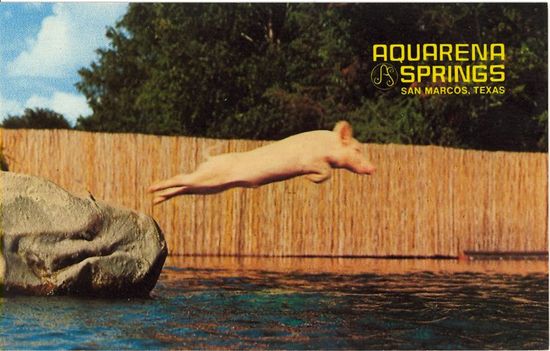
A reader writes:
Anyone who’s ever lived in Texas knows there are many pigs that swim, but only one diving pig, and he’s named Ralph – Ralph the Diving Pig.
Perhaps my best New Year’s Eve ever was spent at a bar in Austin, Texas. Joe Ely was the main musical event (and no matter what anyone else says, Joe Ely was then the best live rock-and-roll show in the world. And he’s still going.) But the centerpiece of the evening was Ralph, who scaled a ladder and plunged from about 20 feet into a pool in the middle of the bar at midnight. It looks like Ralph’s still going, too.
Thanks for all your attention to this important matter.
Our pleasure. Have a great weekend.
Theresa May, a member of the British coalition government, says that she has changed her mind on gay adoption. Burke's Corner applauds:
The social revolutionaries of liberal- and not-so-liberal left and the reactionary Christian Right share a hostility to the temperate, measured modesty of the Burkean tradition. Having observed the love, the domesticity, the ordinariness of same-sex couples, the Burkean will affirm them, recognising in their experience the virtues seen in other manifestations of the little platoon. Theresa May was being authentically conservative in her confession. A conservatism without the means of change, after all, is without the means of its conservation.
 The Dish