Ron Radosh does his bit for the forever war.
Author: Andrew Sullivan
A Different Kind Of Settlement?
Eli Lake tackles Peter Beinart on the failure of the American Jewish Establishment. The whole dialogue is worth watching but here’s a great clip dealing with Netanyahu’s real intentions.
Netanyahu: “I Won”
That was the banner headline in Israel’s Ma’ariv yesterday. The piece was apparently ghost-written by John Mearsheimer:
Netanyahu is pleased by the fact that the Americans failed, so he said, to twist his arm and that ultimately, in the duel between him and the Obama administration, he was the one who emerged with the upper hand. We did not make concessions on our red lines and they failed to make us fold and to drag us to places we didn’t want to go, said Netanyahu, according to people who heard him speak.
And the paper breathlessly predicts total Obama capitulation when Netanyahu visits Washington next week. Why this apparent volte-face by the president? Eli Bardenstein explains:
Political sources in Israel described the planned meeting as “the peak of the campaign for Israel and the Jews that has been pursued by the Obama administration in the past number of weeks.” … Another reason for the administration’s desire to end the crisis is the fear of failure in the upcoming Congressional elections in November. “The Democratic Party’s coffers are empty. Many Democrat members of Congress and Senators have complained that if the hazing of Israel were to continue, they would be unable to obtain donations from Jews and were liable to lose the elections,” said one source in Washington.
Netanyahu understandably denies his gleeful trouncing of Obama. But he did win, triumphantly. Between the Israeli prime minister and the US president, few doubt who has the most clout. What concerns me most of all is that Netanyahu, having defeated the US president so easily on a minimal request, will take this as a green light for war against Iran.
Noonan Unhinged
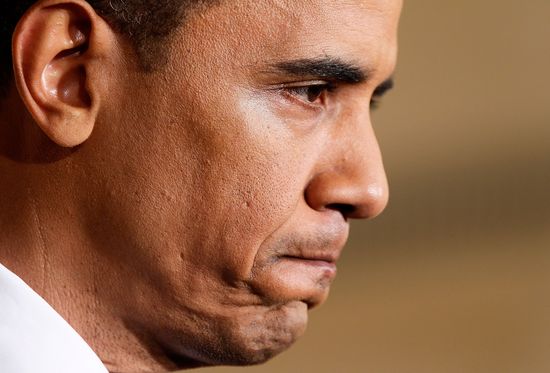
An incoherent tangle of prejudices and feelings wrapped up in hyperbole is the best Peggy Noonan can now muster. How else to describe this morning's column? It heralds nothing less than the end of the Obama presidency just a year and a half in:
The disaster in the Gulf may well spell the political end of the president and his administration …
Seriously? Her evidence for this? She claims the Democrats don't love him. The latest poll of polls shows over 80 percent support. She claims that he is "weakened, polarizing and lacking broad public support." Really? With unemployment at near record highs after a deep recession, Obama's approval ratings are stuck just below 50 percent – and have been remarkably stable for months. At this point in his presidency, Obama is about five points more popular than Reagan, who was poised to drop to 37 percent approval by January of 1983. Clinton was lower than Obama in June 1994. In today's polarized climate and awful economy, Obama is remarkably resilient. He has a favorable rating over 52 percent, and his unfavorable rating is at a six month low of 39 percent. This is Obama's political end?
The premise of Noonan's moronic column is that the federal government, especially the president, should be capable of ending an oil-pipe rupture owned and operated by private companies, using technology that only deep-sea oil companies deploy or understand. And if such a technical issue is not resolved by government immediately, it reveals paralyzing presidential weakness and the failure of an entire branch of political philosophy. Again: seriously? It's Obama's fault that under Bush and Cheney, government regulation of oil exploration was so poor and corrupt, corner cutting appears to have been routine? And this, Peggy, is what governments do, even when run by crazy-ass liberals. Governments do not dig for oil; they merely regulate those who dig for oil. That the government failed to do so under the previous administration does not seem to me to be proof that this administration has failed. (For a blast of common sense on this, see Clive.)
For Noonan, the American public is concerned only with spending, illegal immigration and the federal government's inability to stop an oil leak. For Noonan, the steepest downturn since the 1930s never happened. For Noonan, the flaws of the healthcare system – like, er, millions have none – do not exist. For Noonan, the massive debt – almost all of which Obama either inherited or built in the emergency attempt to stabilize a global economy heading into an abyss – is evidence that government does not work and that Obama is incompetent. For Noonan, actual difficult practical tasks most adults understand are complex to grapple with – how to prevent a Second Great Depression, how to police thousands of miles of border, how to stop an oil leak deep in the ocean floor – are easy. Just do it. Or be labeled incompetent and doomed.
This is utterly unrelated to the reality I have witnessed these past two years, or the slow catastrophe of misgovernment that really did unfold in the last ten. Maybe that says as much about my cocoon as Noonan's. But I doubt it. What I have also learned these past few years is that the right seeks merely a narrative to lead themselves out of the hole they dug for all of us. Reality be damned. The job of the rest of us is to insist that reality matters and that these fools be exposed.
(Photo: the president yesterday by Alex Wong/Getty.)
Let It Rain
Vaughan Bell passes along a study that bucks the conventional wisdom:
There's a common belief that the weather affects our mood, that we tend to become more depressed in the winter and that summer brings an emotional lift. This has been researched before in small studies that have found inconsistent results but a new study published in Psychiatry Research tested the idea on almost 14,500 people and found no link to weather, while the seasonal effects did not follow the common belief: depression was more common in summer and autumn.
The Locus Of Epistemic Closure, Ctd
Serwer tackles McCarthy:
In the deranged, spittle-flecked parallel universe of Andy McCarthy, the fact that there are a few lawyers working in the Justice Department who once advocated for due process for people accused of terrorism is proof that the Obama administration is actively working to aid al-Qaeda. Aside from being detached from reality, McCarthy's thesis is ripe with all the usual right-wing contradictions: Liberals are alternately unstoppable and vicious, but also weak and frightened. They are socially permissive but can't wait for Osama bin Laden to come in and force a burka onto every woman in sight. Liberals seek a "transformation" of the existing constitutional order, while it is McCarthy who dreams of a world where any Muslim accused of terrorism can be locked away forever and waterboarded to the point of insanity without ever seeing a lawyer or the inside of a courtroom.
On Being Wrong
TNC wishes journalists were upfront about it:
[M]edia in general, often confuse accuracy with honesty. I think analysts, reporters, and the people overseeing them, are loath to admit error because they see it as a kind of brand erosion. The question becomes–If I admit to you that I was wrong, why should ever trust me to be right again? My sense is that only a fool actually expects media people to be right all of the time.
What they expect, I think, is for you to be honest and informed…
[Then] there's what my label-mate Andrew calls, "journalism's dirty secret." The dirty secret is this–perhaps more than any other "profession" journalism's barriers to entry are really artificial. It does take a special person to be a great journalist. Curiosity in the extreme is important. A strong desire to see, and thus think, clearly is important. But neither of these can really be taught in a crude classroom environment. Journalism can't be absorbed through a series of lectures and assigned readings. It must be done. No one can teach you how to go up to strangers and ask rude questions. You just have to do it. Repeatedly.
How The Taliban Turn Children Into Suicide Bombers
Sharmeen Obaid-Chinoy reports on the terrorist curriculum:
Internet Money
Felix Salmon contends that social network data is better than a paywall:
[N]ewspapers with a cover price tend to have higher ad rates than free sheets, because their readership is more affluent and is also more likely to actually read the paper (and see its ads).But essentially what’s happening here is that advertisers are using willingness to pay for a newspaper as a proxy for all manner of other desirable traits in newspaper readers, just because there’s no other way of really knowing who’s reading what…
[But the] fact is that if I sign in to a free site using my Twitter login, I’m actually more valuable to advertisers than if I paid to enter that site. That’s because the list of people I follow on Twitter says a huge amount about me, and a smart media-buying organization can target ads at me which are much more narrowly focused than if all they knew about me was that I was paying to read the Times.
Drum is melancholy about the death of privacy.
Frost’s Relationship With Nature
A reader writes:
I've got to agree with your reader that "Mending Wall" is much more complex than it seems initially. As the title suggests, the act of building the wall may provide a kind of healing that
brings the two neighbors together. Frost is tricky because we tend to read his invocations of nature romantically. "Something there is that doesn't love a wall/ That sends the frozen-ground-swell under it,/ And spills the upper boulders in the sun." Nature is the force tearing down this wall, and we like to think that nature is a force for the righteous and the good.
But this isn't the case in the world of Robert Frost. Nature terrifies in "The Hill Wife." It conspires in "Design." It appalls in "Desert Places." We need those fences and walls to make sense of a desolate, bewildering world. Think of the exquisite, painful line a father utters after he has buried his dead child in "Home Burial": "Three foggy mornings and one rainy day/ Will rot the best birch fence a man can build." Those fences, and the work we put into building them, are our "momentary stay against confusion," a metaphor Frost used to describe the work of poetry. One more lovely line in this regard: "The fact is the sweetest dream that labor knows."
 The Dish