TED passes along a wonderful talk about idealism and the potential of the human race:
In this rare clip from 1972, legendary psychiatrist and Holocaust-survivor Viktor Frankl delivers a powerful message about the human search for meaning…
TED passes along a wonderful talk about idealism and the potential of the human race:
In this rare clip from 1972, legendary psychiatrist and Holocaust-survivor Viktor Frankl delivers a powerful message about the human search for meaning…
A reader writes:
Sestak beats back the entire Democratic establishment supported only by the progressive netroots, guts and the people of Pennsylvania. In Kentucky, moderate Conway beats conservadem Mongiardo, netroots cheers. In Arkansas, Blanche Huds… er Lincoln, one of the left's leading villainesses this season, is forced into to a runoff by netroots hero Halter, who pulls off the neat hat trick of winning the conservative counties! In three marquee Senate primaries progressives beat back establishment Democrats, and arguably preferred stronger general election candidates.
And the big message the mainstream media gleans from the night? ,,,,Democrats must rush to the center, based on a race in a congressional district in Pennsylvania where they hand out tickets if you don't have a dead deer strapped to the roof of your car. Meanwhile, three big progressive victories are obscured by a very very shiny object, now setting off a somewhat painful glare.
Speaking of which, one might be tempted to ask Sarah Palin and the Tea Partiers, "How's that Randy Pauly thing working out for ya?"
How David copied Tony (or the enduring triumph of British cynicism):

Aubade, by Philip Larkin
I work all day, and get half-drunk at night.
Waking at four to soundless dark, I stare.
In time the curtain-edges will grow light.
Till then I see what's really always there:
Unresting death, a whole day nearer now,
Making all thought impossible but how
And where and when I shall myself die.
Arid interrogation: yet the dread
Of dying, and being dead,
Flashes afresh to hold and horrify.
The mind blanks at the glare. Not in remorse
– The good not done, the love not given, time
Torn off unused – nor wretchedly because
An only life can take so long to climb
Clear of its wrong beginnings, and may never;
But at the total emptiness for ever,
The sure extinction that we travel to
And shall be lost in always. Not to be here,
Not to be anywhere,
And soon; nothing more terrible, nothing more true.This is a special way of being afraid
No trick dispels.
Continued here.
(Photo: Rain drops fall on a angel statue in Arnos Vale cemetery on April 29, 2010 in Bristol, England. By Matt Cardy/Getty.)
"We shot 60.000 pictures, developed 9.600 prints and shot over 1.800 pictures again."
50th Anniversary (Time Lapse) from Ed Zerati on Vimeo.
A reader writes:
I like what you had to say regarding Rand Paul straying "outside the media and political comfort zone." I guess my problem with Paul isn't what beliefs he holds (I don't think he's completely wrong about the Civil Rights Act, just naive). Rather, it's that, in the end, he went right back to the GOP talking points of Obama being "un-American," as if that's the only way a Republican can say that he disagrees with Obama's intervention in the private sector. An intellectual really ought to know better than that.
That's why Paul annoys me so much: a purportedly intellectual candidacy, one that is supposed to be based on everything that the current Republican leadership is not, still uses the same kind of hate-filled rhetoric to, as Obama himself put it, "put people down instead of raising this country up."
Paul is not immune to this — don't think for a second his calling Obama's BP reaction "un-American" wasn't at least a feint towards the birthers among the Tea Party supporters — and should be properly reamed for it. Additionally, whether or not his brand of libertarianism is ready for prime-time, it does him a great disservice to champion Rachel Maddow when she's being completely favorable to him, only to get all pissy when she stops lobbing softballs at him. I don't think Rand Paul is a racist; I don't even think he wants to re-open the Civil Rights Act for debate. But I do think that, for all the establishment-bucking bullshit that has been fed to us by his campaign, he still looks and sounds very much like a Republican, not an independent voice.
Rick Hertzberg remembers his own Diana Trilling moment (it was with his mom).
A reader writes:
I’m interested in your posts on divinity. I very much enjoyed the article in the New Yorker that you linked to last week. I think it gets to the nub of the issue — that the Orthodox conception of Jesus holds up as long as you don’t think too much or learn too much about it.
I was fairly Orthodox (albeit liberal) christian for most of my nearly five decades, but after reading a host of scholarly literature, including Bart Ehrman and James Tabor, it’s hard to maintain that faith. The fact is that once you delve into the details, you will discover that the widely taught idea that “we believe what has been handed down from the first Christians” is plainly false. One has to seriously twist the meaning of the gospel writers in order to assert that they were teaching Jesus’ divinity. Clearly phrases such as “Son of God,” which we are taught refers to divinity, did not have the same meaning to the authors. Clearly, doctrines such as Jesus’ divinity and the resurrection immediately upon death were developed over long periods of time.
How does that change one’s beliefs? Well, in order to study history and maintain one’s beliefs, you either have to: 1) deny the facts; 2) develop some system of progressive revelation that encompasses God’s guiding hand over history; or 3) revert into some type of mysticism. None of those options are appealing to me.
The last two options are extremely appealing to me, or rather part of what I regard as the hard work that Christians in our time and place need to do if we are to save a faith in crisis.
Christianity is in crisis – and in a deeper crisis, in my view, than many Christians are allowing themselves to believe. I start from a simple premise. There can be no conflict between faith and truth. If what we believe in is not true, it is worth nothing. The idea that one should insincerely support religious faith because it is good for others or for society is, for me, a profound blasphemy if you do not share the faith yourself. I respect atheists and agnostics who reject faith; I find it harder to respect fundamentalists – of total papal or Biblical authority – because of the blindness of their sincerity; but I have no respect for those who cynically praise religion for its social uses, while believing in none of it themselves. Sadly, a critical faction of the Straussian right has been engaged in exactly that kind of cynicism for a while now.
But if religion and truth cannot be in conflict, Christians who believe in a God of logos have an obligation to make sense of those moments when modern learning disproves certain religious preconceptions. No modern Christian, it seems to me, can claim the literal inerrancy of the Bible without abandoning logos. No educated Christian today can deny that the scriptures we have – copies of translations of copies of copies of oral histories – are internally and collectively inconsistent, written by many authors, constructed in specific historical contexts, reflecting human biases, and supplemented by several other gospels that at the time claimed just as much authority as those gospels eventually selected by flawed men centuries later. Anyone who believes that the Holy Spirit automatically guides every church leader to the perfect truth at all times need only look at the current hierarchy to be disabused of such childish wish-fulfillment; or cast an eye on church history for more than a few minutes.
So the solid architecture of the faith we inherited has been exposed more thoroughly in the last few decades than ever before. There is no single authoritative text, written by one God, word for word true. There is a much more complicated series of writings designed by many men, doubtless under the guidance of the Holy Spirit, that help us see some form of the figure Jesus through languages and texts and memories. I think the character and message of Jesus are searingly clear and distinctive even taking into account that daunting veil through which we are asked to see. But we can only begin to see this once we have understood the veil that both obstructs and made possible our view.
The same, I think, is true of the papacy as an alternative to Biblical literalism. This is in some ways a more durable defense against logos than Biblical literalism, but it is just another form of fundamentalism, deploying total obedience to total authority as an alternative to a living faith that can both doubt and yet also practice the love of God and one’s enemies, Jesus’s core instructions. I do not see how the limits and flaws of such total authoritarianism could have been more thoroughly illuminated than in the recent sex abuse scandal. When the man whose authority rests on being the vicar of Christ on earth consigns children to rape rather than tarnish the image of the church, he simply has no moral authority left. Yes, his position deserves respect. But its claims to absolute authority have fallen prey to the human arc of what Lord Acton called “absolute corruption”.
So we are left in search of this Jesus with a fast-burning candle in a constantly receding cave where we know that at some point, the darkness will envelop us entirely. We will catch Him at times; He will elude us at others. We will have to listen to many words he may have spoken before we can each discern the words he may have meant; we will have to keep our eyes and ears open for science’s revelations about the world, while understanding that science is just one way of understanding the world and that poetry, history, and practical perspectives have things to tell us as well. The cathedral at Chartres; the long story of Christian debate and theology; the rituals and daily practices that help us stay trained to intuit the divine we cannot understand and the divine we do not always see in every face around us: these too tell us things that go beyond fact, archeology and hermeneutics.
Yes, this intellectual sifting is hard and troubling to faith; yes, it may end with more mystery than clarity. But if our faith is to be true, it must rest on something more than denial of reality. It must rest on being the greatest experience of reality.
“Be not afraid! Of what should we not be afraid? We should not be afraid of the truth about ourselves.”
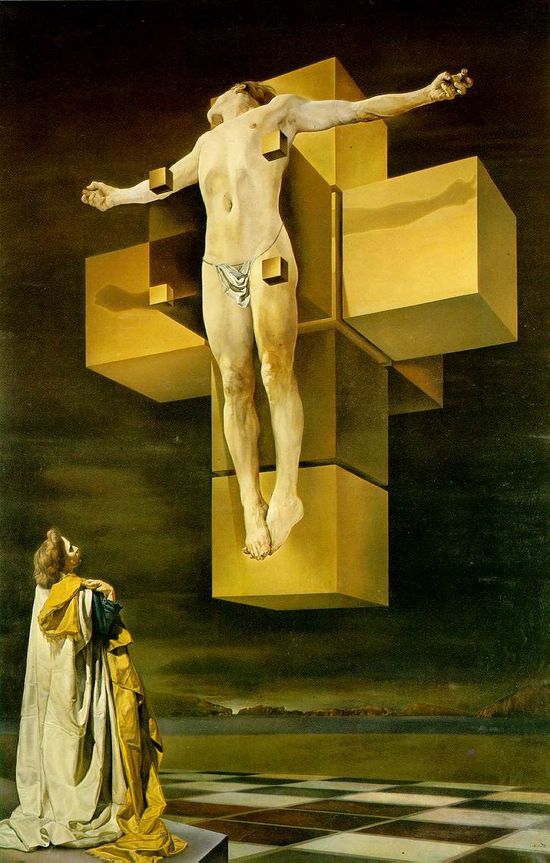
(Painting: Crucifixion (Corpus Hypercubus), 1954, by Salvador Dalí.)
An extract from a 1967 documentary about hippies. What’s interesting to me is the anti-political nature of this “cultural revolution”. This was about shifting personal human values as a way to change society: change without power:
 The Dish