Elena Kagan’s Historical Chops

It cannot be easy having a 1981 thesis being read by professional historians decades later. But there appears to be universal consent that her work holds up remarkably well:

On the whole, Kagan writes without evident bias, analyzing quite evenhandedly the rifts—which at times she suggests were doomed to be insurmountable—between the revolutionary and reformist camps in the Socialist Party as well as in the International Ladies Garment Workers' Union. If anything, Kagan seems to have more sympathy for the centrist "constructivist" leadership than do many historians who write about labor and radicalism. Her overall point, made without stridency, is that sectarianism, caused mainly by misguided revolutionary hopes, should ultimately bear the burden for the party's demise. Socialists, she seemed to say with some sadness and frustration, have often been their own worst enemies. In places, her tone even implies that she may consider this an ongoing characteristic of the American left. "Radicals have often succumbed to the devastating bane of sectarianism," she wrote; "it is easier, after all, to fight one's fellows than it is to battle an entrenched and powerful foe." In any case, there is no question that Kagan wrote not a propagandistic celebration of socialism's heyday but a judicious account of its self-destruction—with the hope that the left might learn from past mistakes.

There can be few doubts about her intellectual abilities.

At The Hour of Their Death, Ctd

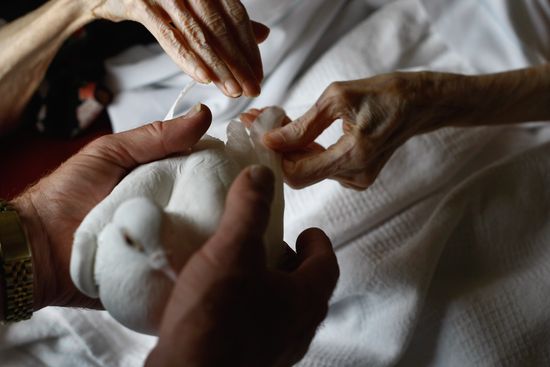
DOVEHANDSJohnMoore:Getty

A reader writes:

I wanted to tack this onto the post "At The Hour of Their Death."

12 years ago my mothers passed away after a 9-month battle with cancer. I was in the room as her body gave up her spirit. It was that clear. Her forced breathing. The tension in her neck and face. The physical energy left inside the very sick and very emaciated body must have been so little, but the change in her appearance at that final moment was vast. Her body gave up her spirit. The air in the room took on a very distinct quality. It seemed a moment when anything could happen. That the air could shimmer and tear apart and I would not have been surprised.

The air was similar at the birth of my three children. When my children were born anything could happen. The air was filled with a remarkable energy. A moment when all laws of nature, all science, all proof, everything man knows about existence and life was so limited. Religion is not all about "fear of death" – it is also because we have all witnessed things that science and learning cannot explain.

Another reader:

Atheists, from my own experience (and I did not always identify myself this way; I still prefer god-free to atheist, as it implies being against something), don’t think about death much at all, except when we ponder its inevitability, our own experiences of loss, and the way it has of telescoping time.

When my partner died in 1991 I’d been mostly an atheist, though I didn’t spend much time defining that for myself.  But when he died, I had an experience similar to the nurse’s.  I was suddenly convinced that he had been a person, a spirit, and now he was gone.  I searched and wondered, and I started going to a church I’m still fond of and will still attend from time to time.  I was most perplexed by where he went.  Many years later, I’m at peace with the whole issue.  I need neither to believe not to disbelieve.

 Your reader's sense that the people who died in her presence were gone is quite accurate and there’s nothing supernatural to it.  But the underlying sense she has, and that I had, that the person had gone somewhere, is at the heart of the matter.  We are indeed gone when we die, but we do not go anywhere.  It is the living we leave behind who grapple with the question of where we have gone, and interpret the experience to mean there is somewhere to go and our spirits have left our bodies en route.  What leaves our bodies is life, and life is energy.  So, yes, we are here and then we are not, and it’s all quite mystical and profound, but it does not require an afterlife of anything but silence.  Why that is not enough for so many, many, many people is something I understand but don’t participate in.  An anecdote has it that when the Buddha was asked if god exists, he remained silent.  I have always loved that.  He did not say yes and he did not say no.  I interpret that to mean that he had no need to answer the question.

A final reader:

Your reader's reference to a "palpable feeling of departure" when someone dies reminded me of a couple of scenes from the movie (and person) "Temple Grandin".  Ms. Grandin is a highly functioning autistic person whose autism seems to have bestowed upon her an unusual ability to observe and recall small details.  In the movie, there is a scene in which she witnesses a cow's instantaneous death in a slaughterhouse.  "Where does it go?", she asks the slaughterhouse manager, who thinks she is asking what the next step is in processing the cow into beef.  But really what she wants to know is, one second there was a cow there, the next second there was only beef – so where did the living, aware cow GO?
 
Later in the movie she asks the same question at the funeral of a teacher who meant a great deal to her.  She is not saddened to see the body, but she still wants to know, where did he GO?  Temple does not experience the emotional loss of death the way most of us do, but she is acutely able to sense that something has left the body.

(Photo: Terminally ill patient Jackie Beattie, 83, touches a dove on October 7, 2009 while at the Hospice of Saint John in Lakewood, Colorado. The dove releases are part of an animal therapy program designed to increase happiness, decrease loneliness and calm terminally ill patients during the last stage of life. The non-profit hospice, which serves on average 200 people at a time, is the second oldest hospice in the United States. The hospice accepts patients regardless of their ability to pay, although most are covered by Medicare or Medicaid. By John Moore/Getty Images.)


She’s Having A Baby

Salon speaks with Amie Klempnauer Miller, author of the parenting memoir, "She Looks Just Like You":

Non-biological lesbian moms, like gay fathers who use surrogates, we're in this weird zone between motherhood and fatherhood. I had tried to get pregnant, but, in the end, it was my partner who carried the baby, and I found myself going, "Wow, so what's my role here?" I was planning on taking maternity leave, but I wasn't pregnant. I was there for the conception, and I was there for the ultrasound but I wasn't going to get to do these things, like childbirth, that are so paradigmatic of what it means to be a mother.

The parents I ended up relating to the most were stay-at-home dads because they are bending the genre categories themselves. It's interesting that some of the criticisms that have been made toward stay-at-home dads are not that different from the criticisms of gay and lesbian families. Is it natural? Will the kids turn out OK?

Yglesias Award Nominee

"[Kagan's] thesis — written from the perspective of an anti-communist scholar who was not in sync with the pro-communist leftism of what by then was a declining New Left — does not reveal that she was an advocate of radical social change. It does reveal an individual who, like the socialists and unionists she was writing about, also wanted to “change America.” It is clear that she found their struggles inspirational and that she empathized with their fight. If she has not changed her views on these issues, it puts her right in the mainstream of what is today’s left-of -center Democratic Party … Some may disagree with the political sympathies that led her to write on this topic, but I believe the thesis itself should serve as no grounds to deny her appointment to the Supreme Court,"- Ron Radosh, Pajamas Media.

The Tyranny Of NYC, Ctd

A reader writes:

Believe it or not, those who have been hating on NYC in the blogosphere recently, and those who have tried to defend NYC, have a lot more in common than they know:  Both groups think that Manhattan is the only part of NYC that matters.  This could not be further from the truth. 

New York is a city of 8.3 million people and five – not one – separate boroughs.  Only 1.6 million of those people live in Manhattan – the rest live in Brooklyn, Queens, The Bronx, and Staten Island.  Eighty percent of New Yorkers lives outside of Manhattan, yet you would never know it because the rest of the world shares a Manhattan-centric view. Did you know that Brooklyn would be the 3rd (!) largest city in the United States if it were independent? (And some experts say that 1/5 Americans can trace their roots back to Brooklyn, someway somehow!)  Did you know that Queens is considered the most diverse county in the United States, with over 140 languages spoken in the borough!?  Did you know that the Bronx is home to one of the greatest inner city resurgences in the country?  Or that Staten Island is the birthplace of celebrities such as Christina Aguilera, Buster Poindexter, and the Wu-Tang Clan?

Criticize Manhattan all you want.  I think some of the criticisms you have aired on the Dish have some validity – Manhattanites can be smug and obnoxious, cold and unfriendly, self-centered and self-absorbed.  But the rest of our great city isn’t like that, and it’s time people stop lumping the rest of the city in with Manhattan.

They Still Don’t Get It, Ctd

A reader writes:

The email from your female reader who identifies as straight but is in her first relationship with a woman reminds me of this scene from Chasing Amy.  In it, Holden has just expressed his love for Alyssa, who is a lesbian, and the scene cuts off right before she runs into his arms to consummate their love.  Though the two situations are reversed – the straight reader makes an exception for one woman while the gay Alysssa makes an exception for one man – I think they both hold the same insights over the complexity and uniqueness of sexual identity.  Perhaps Kagan's is just as, if not more, complex.