
Was Zionism’s Wane Inevitable?

Douthat asks:

What I wonder is whether the trend that Beinart describes — the diminishing bond between secular American Jews and the state of Israel — was more or less inevitable, no matter what policies were pursued in Israel and what kind of attitudes American Zionist organizations struck. Benjamin Netanyahu and Abe Foxman may have accelerated the process, but it’s hard to imagine that the more secular, more assimilated sections of the Jewish-American population wouldn’t have eventually drifted away from an intense connection with Israel anyway, in much the same way and for many of the same reasons that Italian-Americans are less attached to both Italy and Catholicism than they were in 1940 or so, or that Irish-American are far less interested in the politics of Eire and Northern Ireland than they used to be.

The difference, of course, is that Italy and Ireland are not as dependent on US aid as Israel is, or capable of wielding a lobby as powerful and as wealthy and as ruthless as AIPAC. So you end up with a foreign country supported less by its natural ethnic group (they're busy marrying gentiles and enjoying life) than vast numbers of Christianists whose end-times philo-semitism is not something I'd be too thrilled with if I were an Israeli liberal.

I don't think you can extricate Israel's existential crisis as a Western democracy from the rise of religious fundamentalism in both Israel and the United States. There is a danger of a cosmic clash here, prompting even more upping of the eschatological ante by the Iranian and Iraqi Shiites. This is a religious war we must surely do all we can to avoid. But put a president Palin behind a Netanyahu coalition and an Ahmadi Iran and … well, do I have to spell out what's potentially at stake here?

The Cocoons We Live In, Ctd

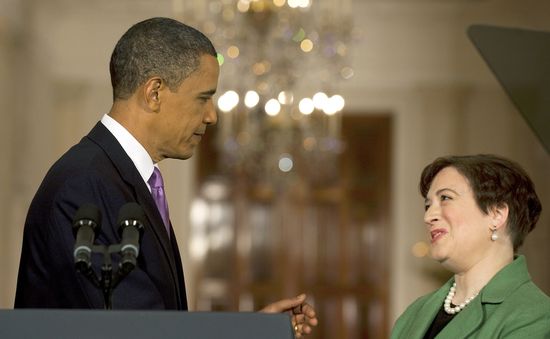
KAGANOBAMAJimWatson:Getty

Drum is confused:

I don't get this. A compulsion not to simply parrot the conventional wisdom or pull your punches I understand. But isn't silence ever an option? There's no rule that says every passing thought has to be memorialized in a blog post, is there?

No (even though the Dish publishes almost 300 posts a week). But when a story is the story of the day and when your own immediate take – and that of almost every gay and lesbian person I know (and every Google searcher on the planet) – is: we have a lesbian! it becomes dishonest to keep pretending you are not thinking this. You think I had an option to spend last week twiddling my thumbs, nervously whistling like bi-curious Butters? Even if I were silent, that would be a statement of sorts. Remember Trig? Yeah, my initial stunned silence really threw people off that scent, didn't it?

The best columnist on this, so far, has been Maureen Dowd. She's able to convey the hapless cluelessness of the Obama Straight Boys' Club when it comes to female sexuality and the closet:

White House officials were so eager to squash any speculation that Elena Kagan was gay that they have ended up in a pre-feminist fugue, going with sad unmarried rather than fun single, spinning that she’s a spinster. You’d think that they could come up with a more inspiring narrative than old maid for a woman who may become the youngest Supreme Court justice on the bench.

At this point, they're just desperate for anything but gay. And it's that maneuver that I find offensive. Axelrod et al. couldn't even come up with a defusing Seinfeldian quip – "She's heterosexual, not that there's anything wrong with that." And, yes, Maureen, they do protest too much:

If roughly one out of nine Americans is gay, why shouldn’t one out of nine Supreme Court justices be?

But I have learned something from the way Emmanuel, Obama, Gibbs et al. have handled this: if a potential judicial nominee were openly gay, they'd have no chance of being on a short-list, let alone selected for SCOTUS.

And the lesson this administration is clearly sending to young lesbian girls is: if you want to be a Supreme Court Justice, just stay in the closet. We wouldn't dream of nominating you if you weren't.

(Photo: Jim Watson/Getty.)

American Idol vs Washington

I’ve been following Idol this year, even through its really dreary mid-season funk. But it has been really encouraging to see the viewers actually select the best trio for the pre-finale vote. I’m a huge Crystal Bowersox fan (and an even bigger fan of her boyfriend). She’s my vote. Casey James is sooo charming, but the poor guy cannot sing outside a very limited, if very commercial, range. Lee Dewyze has been a fave for a long time – great voice, droopy eyes, crooked smile, what’s not to like?

But last night also showed how the issue of sexual orientation can be easily folded into the general conversation. Ellen Degeneres, herself an icon of the “virtually normal” set, was able to point out that many girls and women would love Casey – and then she simply tucked in “and a few boys.” Accurate, inclusive, integrative. And then straight girl Crystal sings a song, “Maybe I’m Amazed”, that requires her to sing as a man. She doesn’t alter the lyrics. She sings “Maybe I’m a man …” with the same conviction and sincerity she has shown throughout the contest. Yes, Ellen picked the song.

A small moment in the transfomation of America into a more inclusive humane place. But on television, not in Washington, where homophobia and homophobia-phobia conspire to keep us all back.

Rand’s Win

DONTTREADBillPugliano:Getty

Josh Green doesn’t think it heralds a “tea party tidal wave”:

Paul’s celebrity dad brought him money, volunteers, name recognition, and media attention, particularly on Fox News. What other Tea Party candidate can match that? … Democratic turnout was much, MUCH higher than Republican turnout.

And Grayson went to Harvard. Did I say that with enough of a tea-party snarl? But I suspect the small-government integrity of Paul won many over in this anti-government moment. Chait says Paul’s win gives the Democrats a chance at the seat:

Democrats will run Jack Conway against Rand Paul. This puts the Kentucky Senate seat in play — Rand is the favorite but Conway has a shot. I have a pet theory that a politician’s name is a major factor — I’d guess being named “Jack Conway” is worth several points more than being named “Daniel Mongiardo.”

Nate Silver:

Because of Paul’s impressive 24-point margin of victory, almost any explanation you might proffer probably contains some element of truth. But for all his libertarian and tea-party dressing, Paul in fact ran on a fairly conventional, conservative platform. He’s pro-life, anti-gay marriage, anti-immigration … there are only the faintest hints of libertarianism here.

Tim Mak has a summary of Paul’s position on national defense, which is where things get interesting. I want Paul to win this seat, so we can get a fiscal conservative Republican in the Senate who can put defense spending on the table. Rand’s position on this is mostly his father’s:

Rand Paul has indicated that the possibility of an Iranian nuke doesn’t bother him; that he supports the shuttering of the Guantanamo Bay detention facility; and that he’s shaky on support for the surge in Afghanistan and the war in Iraq.

While Conway has also been hesitant to support the surge in Afghanistan, he has indicated that he favors increasing terrorism prevention funding and pay for active duty personnel. Kentucky’s 344,000 veterans will take note.

Largely for this reason, Frum is distraught:

How is it that the GOP has lost its antibodies against a candidate like Rand Paul? In the past few months, we have seen GOP conservatives rally against Utah Sen. Bob Bennett. There has been no similar rallying against Rand Paul: no ads by well-funded out-of-state groups. Some senior Republicans, like former VP Dick Cheney, indicated a preference for opponent Trey Grayson. But despite Paul’s self-presentation as “anti-establishment,” the D.C. conservative establishment by and large made its peace with him. It is this acquiescence – even more than Paul’s own nomination – that is the most ominous news from tonight’s vote.

Marshall:

[During his speech, Rand Paul] came off to me as arrogant, bellicose and even a little messianic in his demeanor. To put it baldly, he sounded like a jerk…

In any case, that’s actually quite different from his father. I find Ron Paul’s politics awful and he’s a classic ideologue. But as a person he comes off as pretty humble and even unassuming, which I’ve always thought is the reason he manages to have a certain degree of crossover popularity despite his draconian and often ugly politics. 

Ambinder:

Rand Paul first attracted attention in Kentucky because he was Rand Paul. Then he married his anti-government message to his father’s economic libertarian movement. He parried against an opponent, Secretary of State Trey Grayson, who embodied the establishment. Nevermind that this establishment was doing everything in its power to thwart Barack Obama … politics doesn’t always make sense. But Paul was change. A specific kind of change. He was acceptable enough for frustrated conservative base voters. And he’s going to be a tough candidate for Democrats to beat in the fall. 

Yglesias goes further, labeling Rand Paul a “lunatic”:

The rise of Rand Paul and his securing the GOP nomination for the Kentucky Senate seat is one of the things that will spark divergent reactions in DSCC headquarters and in the minds of responsible liberals. By nominating a lunatic, Republicans have suddenly taken what should be a hopeless Senate race and turned it into something Democrats can win. At the same time, by nominating a lunatic, Republicans have suddenly raised the odds that a lunatic will represent Kentucky in the United States Senate.

Reason profiled Rand Paul earlier this month:

Unlike his father, Rand opposes civilian trials for terror detainees. He would “ultimately” close Gitmo, but not until it is determined what will be done with the prisoners, who he does not want sent to the United States. In their joint interview, when the elder Paul expressed his opposition to trying suspected terrorists before military tribunals, Rand quipped, “Now my father has only been here for 20 minutes, and you’re already making me disagree with him. We haven’t even had a chance to say hello.” Ron Paul responded, “I think Rand just proved that he’s his own man and can think for himself.”

Bernstein:

Paul may well win the general election, but I continue to think there’s a good chance that Republican gains this year will be harmed overall by the nomination of ideologically extreme nominees, and in some cases less capable candidates, and by the pressure in other districts for mainstream conservatives to act as if they were ideologically extreme.  It will be interesting to see how Paul in particular fares in a general election context; Kentucky is a good state for Republicans, and with a mainstream conservative candidate I don’t think it would have been a contest, but now I’d expect a fair amount of uncertainty.  The question is how many districts around the nation are having similar results.  Hey, reporters!  More about 2010 House nominees, please!

(Photo: A tea-party protest by Bill Pugliano/Getty.)
What Rekers Represents

I have not dwelled on the Rekers scandal, because the man is a human wreck. But the wreck is instructive. Sometimes I wonder how much of the most aggressively anti-gay campaigning is done by closeted and tortured gay men, who seek to extirpate from others something they could not banish from themselves. The list of the closeted gay-baiters is long. From Roy Cohn and J Edgar Hoover all the way to Larry Craig and George Rekers. I have no doubt that the primary anti-gay forces in the Vatican are gay themselves, and working out their tortured psyches by demonizing others more honest and principled than they are.

These are men terrified by their own inherent orientation, who equate it with emasculation, and end up, in some cases, raping children and in others, merely abusing them, to keep their own demons at bay. This is one exercize that Rekers imposed on a child who was acting effeminately:

In 1974, Rekers, a leading thinker in the so-called ex-gay movement, was presented with a 4-year-old "effeminate boy" named Kraig, whose parents had enrolled him in the program. Rekers put Kraig in a "play-observation room" with his mother, who was equipped with a listening device. When the boy played with girly toys, the doctors instructed her to avert her eyes from the child. According to a 2001 account in Brain, Child Magazine, "On one such occasion, his distress was such that he began to scream, but his mother just looked away. His anxiety increased, and he did whatever he could to get her to respond to him… Kraig became so hysterical, and his mother so uncomfortable, that one of the clinicians had to enter and take Kraig, screaming, from the room." Rekers's research team continued the experiment in the family's home. Kraig received red chips for feminine behavior and blue chips for masculine behavior.

The blue chips could be cashed in for candy or television time. The red chips earned him a "swat" or spanking from his father. Researchers periodically entered the family's home to ensure proper implementation of the reward-punishment system.

After two years, the boy supposedly manned up. Over the decades, Rekers, who ran countless similar experiments, held Kraig up as "the poster boy for behavioral treatment of boyhood effeminacy."

At age 18, shamed by his childhood diagnosis and treatment, Rekers's poster boy attempted suicide, according to Gender Shock, a book by journalist Phyllis Burke.

This kind of stuff kills people. And it's based on a lie. It's time we took a stand against tortured gay men abusing children to vent their own demons. In saying that, by the Wieseltier rule, I am dangerously propagating anti-gay tropes. But when the tropes are true in some cases, they are simply true.

Marriage, In Better Shape Than We Think?

Salon interviews Tara Parker-Pope, the author of a new book on marriage:

The 50 percent divorce rate is really a myth. The 20-year divorce rate for couples who got married in the 1980s is actually around 19 percent. Everyone thinks marriage is such a struggle and it’s shocking to hear that marriage is actually going strong today. It has to do with how you look at the statistic. If the variables were constant, then a simple equation might work to come up with the divorce rate. But a lot of things are changing. And it is true that there are groups of people who have a 50 percent divorce rate: college dropouts who marry under the age of 25, for example. Couples married in the 1970s have a 30-year divorce rate of about 47 percent. A person who got married in the 1970s had a completely different upbringing and experience in life from someone who got married in the 1990s. It's been very clear that divorce rates peaked in the 1970s and has been going down ever since.