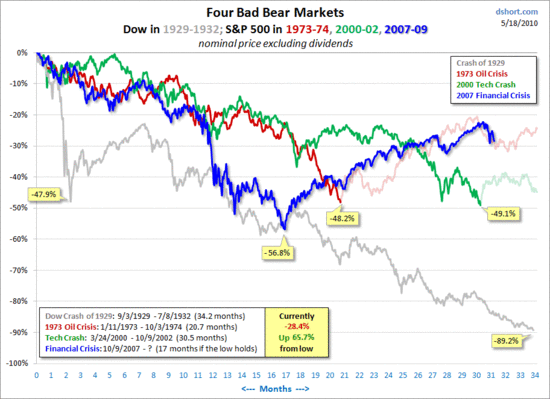
Why We Like Stocks

FourBears

Felix Salmon continues to advise against investing in stocks. He acknowledges that most people won't heed his warning:

My feeling is that people like to invest in stocks because they like knowing that there’s a chance that the stock market will solve all their financial problems when it rises. Think of it as a three-pronged strategy: buy a house, invest in stocks, and work hard. Any one of these three things can pay off with lots of money at retirement, in the way that investing in TIPS won’t.

What’s more, an entire generation of Americans started working and saving and buying a house in the early 1970s — and millions of them hit the trifecta, becoming successful in their careers even as their stocks rose and the value of their real-estate soared. I doubt that particular combination is going to happen again in the U.S., but the experience of that generation is so powerful as to give a lot of people a lot of hope. Even if that hope isn’t particularly rational.

McArdle nods:

Modern retirement planning should probably focus more on putting away an unreasonably large chunk of your income.

Chart from Doug Short.

A Cost Benefit Analysis On Defense

Walker Frost wants to cut military spending:

Over the last decade, an admittedly small but most relevant sample size, any correlation between military spending and the prosperity of Americans, and non-Americans, seems negative. The relative slide in US power has, if anything, been accelerated by excessive military spending and record deficits. Our $900 billion budget is at least six times more than China’s defense spending, which is probably the greatest potential long-term counterbalance to US military dominance.

The opportunity costs are the real killer here. Military spending alone doesn’t necessarily detract from US power, though its irresponsible use probably does. But think about what we could have done with all that money, at time when unemployment hovers around 10%, budget deficits (state and federal) are out of control, high-school graduation rates are below 80%, and the US is ill-prepared for an impending energy and environmental crisis. Like it or not, these are the issues that will probably determine the fate of Americans and our national priorities. Not terrorists. 

He ends the post by asking:

Why hasn’t this become a bigger issue for conservatives? Shouldn’t they be at the forefront challenging self-perpetuating, unnecessary establishment spending that doesn’t empower the people?

Guilty Of Being Gay

6a00d83451c45669e20128768c986d970c-500wi

Malawian couple Steven Monjeza and Tiwonge Chimbalanga are convicted of “unnatural acts." BTB has more:

The Magistrate had denied bail to the couple, which is an extreme rarity for a non-violent crime. The Magistrate also permitted witnesses from the gallery and court personnel to abuse the couple during official court proceedings.

Their sentencing on Thursday could lead to 14 years of hard labor.  Previous Dish coverage here.

Original Green

Kevin Redmon interviews Andres Duany,"the father of New Urbanism":

Our take on environmentalism is what I call the "original green." Which is really about quite simple, economical things. One thing I don't like about the current environmental movement is that it's been captured by a very high tech ethos, which actually turns out to be more expensive. I think its absolutely absurd that people say that LEED-certified buildings might cost two, three, four, five times as much. And I say, "What are you talking about? How did you get there?" This thing about triple glazing and 8 inches of insulation and green roofs, my God it's so expensive. You can't say, "Yeah, I'll do it just to be popular." We have to go back to the original green–not the gold plated green.

Drugs Win Drug War, Ctd

Steven Taylor continues the conservation:

[T]he key metrics that end up being used by the US government (as well as the UN and others focused on the supply side of the equation) are hectares under cultivation, hectares eradicated, amount of drugs seized, the price of the drugs in question, and arrests.  These are not my metrics chosen to make the policy look bad, they are the metrics used by the designers and defenders of the policy.

As such, when I pointed out that from 1990-2007 that the wholesale price of cocaine has declined, the reason for doing so is to demonstrate that despite the considerable expenditure of taxpayer dollars that the policy is not achieving one of its goals.  Price is indicative of supply.  Yes, as some have noted, it is not the only factor.  However, the basic parameters of the black market in drugs (which inflates the price by itself) were well in place by 1990 and there was reason to assume that the pressure placed on producers and traffickers over a sustained period of time would constrict supply.  While there has been some, often temporary, effects on supply, the policy has failed to produce the desired results.  Pay attention next time that there is even a small spike in price, and the likelihood is that the ONDCP or some other organization will cite it as evidence of drug war success.

The Daily Wrap

Today on the Dish, Patrick Winn reported on the violence in Bangkok and readers commented. Andrew sounded off on the new Iranian deal and looked inward over the Kagan controversy. More details on her emerged. Netanyahu did a good deed and the Church not so much. A big dose of Palin gossip here and a close scrutiny here.

In assorted commentary, Larison gave props to Rand Paul, Reihan was bullish on a conservative comeback, Douthat revised his case for decentralization, Ezra prodded him, Aravosis examined Obama's record on gay rights, Gary Wills conversed over his Catholicism, and Dave Barry talked about his craft.  More on the Zionist crisis here and here.

Readers continued the "Treme" thread and bloggers did so for NYC's alleged tyranny. More life-and-death musings here, here, here, and here. A dispatch from the Cannabis Closet here. Cool ads here, here, and here. Stoner-and-bear blogging here.

— C.B.

The Existential Atheist, Ctd

A reader writes:

The full quote from Prem Rawat is as follows:

"Some people say, In this big universe, you're just a speck of dust.
You may be a speck of dust.
But oh, what a speck of dust.
In this speck of dust, the infinite and the finite are fused.
And you are the threshold of the two.
Here, the mortal being comes as close
 as it possibly can to the immortal.
The same power that drives the universe breathes us.
We have been chosen to be the platform for life."

Bell Curve Update, Ctd

Avent's sensible take on over-education:

Who do you suppose is feeling better about job prospects now: the 85% of mail carriers without college degrees or the 15% with them? In a volatile labour market, the flexibility of a credential is of crucial importance.

America's education system could certainly use more flexibility, particularly where adult education and retraining is concerned. But the American economy could use more college graduates, and the pursuit of flexibility shouldn't detract from the goal of increasing overall educational attainment.

He follows up here.

The Decentralization Push, Ctd

Ezra takes issue with Douthat's broad brush:

Douthat doesn't get into specifics here. Instead, he uses a rhetorical move that I've noticed fairly frequently among conservative commentators sympathetic to Obama's agenda but discomfited by the growth in government. "Taken case by case," Douthat writes, "many of these policy choices are perfectly defensible." Or, to put it in David Brooks's words, "Each of these projects may have been defensible in isolation, but in combination they created the impression of a federal onslaught." Taken case-by-case, those lines may be perfectly defensible. But together, I think you're seeing something less defensible.

It's a sentence that absolves the writer of having to say what he or she would've done differently, which makes broad-brush criticism a lot easier. "Centralization" sounds like a bad thing, and maybe it is. So does a "federal onslaught." But maybe not! Just as these decisions were made on a case-by-case basis, they have to be critiqued on one, too.

Faces Of The Day

CygnetsMattCardyGettyImages

Cygnets sit beside their mother who is nesting at Abbotsbury Swannery – the only publicly accessible colony of nesting mute swans in the world – on May 18, 2010 in Dorset, England. The arrival of the cygnets is traditionally seen as the start of summer and local traditions claim the Benedictine Monks who owned the swannery between 1000 AD and the 1540s believed the first cygnet signaled the season's first day. Abbotsbury Swannery's mute swans – up to 1,000 in total – are all free flying, and are not kept in cages. By Matt Cardy/Getty Images.