
Lander, Wyoming, 8.52 am
Lander, Wyoming, 8.52 am
Garry Wills spares no one in his elegant, brief, historically attuned demolition of the claims of the papacy to infallibility and total control. But I found his reason to remain a Catholic all the more powerful because of the simple honesty with which he confronts the appalling record of child-rape and cover-up that is now obviously a universal facet of absolute corruption in the Vatican:
I am asked, if I believe this, why I remain a Catholic. I do that precisely because I do not equate the people of God with the papacy. Well, I am told, other churches honor the Creed and the Gospel without the burden of a papacy as outdated as the medieval costumes it affects. I want to be at one with Anglicans, Lutherans, Presbyterians, and others; but I want all of these communions to come together, and I cannot do that by renouncing the Catholic membership in such an ecumenical Christianity, saying some churches are better than others.
When the disciples of Jesus came back from their first mission away from him, the apostle John reported, “Master, we saw a man driving out evil in our name, and he was not one of us, we tried to stop him.” Jesus asks why they did that: “No one who does a work of divine power in my name will be able the next moment to speak evil of me” (Mark 9:38-39). All of us who honor his name must come together. When a Catholic tells me—often these days, it is a young woman—that she can no longer put up with the male monarchical Church, I tell her, “Stay with us, we need you. The people of God need you.”
This is the ecumenical case for remaining Catholic. I have to say I didn't see that coming.
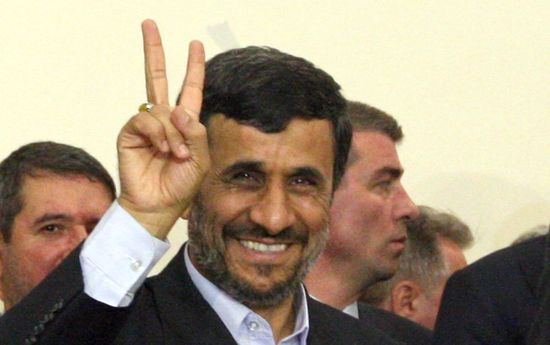
Former weapons inspector David Albright finds that the announcement of a nuclear deal "provides no reason to stop negotiating in the Security Council the imposition of sanctions on Iran." Joshua Keating adds:
Iran's apparent cooperation with the new agreement could make it less likely that Russia and China will support tougher sanctions against Iran in the U.N. security council and puts President Barack Obama in the awkward position of potentially rejecting a deal, nearly identical to one he negotiated months earlier.
And Michael Roston thinks he should reject it:
[B]y negotiating a deal with Brazil and Turkey, Iran is using the old tactic of packing the room with more parties, adding to the complexity of the negotiating process down the road. It’s no longer just the UN Security Council’s permanent members plus Germany jawing over Iran’s nuclear program – now we have to deal with political developments in Brazil and Turkey going forward.
Jeffrey Lewis grows weary:
I always feared the fuel swap was a waste of time — it has too many moving parts and doesn’t get at the real problem of clandestine facilities. This scenario is the perfect illustration of that objection; I only wish I had seen it so clearly at the time. The “fuel swap” was intended to delay an Iranian “breakout” capability by a year or so. But Iran can enrich uranium quicker than we can arrange for it to be sent out of the country. After eight months of haggling, Iran has doubled its stockpile of LEU.
Max Fisher rounds up more reaction. My own view is that it is simply impossible for this kind of thing to be controlled by the major powers, let alone merely the US, any more. Ahmadi and Khameini are deploying asymmetrical diplomacy, along with proxy asymmetrical warfare, to great advantage. Short of military invasion and attack – unthinkable in its consequences for a wider global war, Iran will become a nuclear power soon enough. Our task is to figure how to minimize the damage to the region and to the opposition within Iran. I.e. containment.
(Photo: Atta Kenare/AFP/Getty.)
Michelle Cottle sings the praises of "jungle primaries".
"If, as claimed by humanism, man were born only to be happy, he would not be born to die. Since his body is doomed to death, his task on earth evidently must be more spiritual: not a total engrossment in everyday life, not the search for the best ways to obtain material goods and then their carefree consumption. It has to be the fulfillment of a permanent, earnest duty so that one’s life journey may become above all an experience of moral growth: to leave life a better human being than one started it.
It is imperative to reappraise the scale of the usual human values; its present incorrectness is astounding. It is not possible that assessment of the President’s performance should be reduced to the question of how much money one makes or to the availability of gasoline. Only by the voluntary nurturing in ourselves of freely accepted and serene self-restraint can mankind rise above the world stream of materialism," – Alexander Solzhenitsyn, address to Harvard, 1978.
Colbert-bait and Dish self-parody, all wrapped up in one:
In Hopkins v. Uninsured Employers' Fund, 2010 MTWCC 9, WCC No. 2008-2152 (May 4, 2010), Worker' Compensation Court Judge James Jeremiah Shea found that Hopkins was, indeed, an employee of Kilpatrick, that Hopkins sustained compensable injuries arising out of and in the course of his employment, and that Hopkins' use of marijuana was not a major contributing cause of his injuries.
Hopkins' use of marijuana did not, therefore, disqualify him from receiving an award of benefits.
Judge Shea concluded that "[w]hen it comes to attacking humans, grizzlies are equal opportunity maulers; attacking without regard to race, creed, ethnicity, or marijuana usage." The judge characterized Hopkins use of marijuana to "kick off" a day of working with grizzly bears as "ill-advised" and "mind-bogglingly stupid."
There was no evidence, however, that the pot smoking contributed significantly to Hopkins' injuries.
No, I didn't just make that up.

We have been given the impression that Elena Kagan was a beloved dean at Harvard Law School and that is certainly borne out by many witnesses. Check out this spontaneous celebration of Kagan by students after she missed out being named president of the university. But not all. Inevitably, some found her style of management abrasive and her strong leadership rubbed some people the wrong way:
Law School Professor Mark V. Tushnet ’67 acknowledged that he had heard “that she would lose her temper,” but he added that Kagan led the school with a “firm hand” like a good manager. Kagan was “willing to fire people that needed to be fired,” Tushnet said.
Few faculty members interviewed for this article voiced displeasure with Kagan’s management style, but some staffers and administrators said that the former dean’s high-energy, ambitious agenda placed a strain on their working relationships. Former director of the Law School library Harry S. Martin III ’65 observed that some staff members working under Kagan “didn’t seem to get along with her, didn’t warm to her.”
In the “pursuit of excellence,” Kagan set the bar high for her colleagues and created “a culture of incredibly high expectations and high stakes,” according to former Registrar staff member Leslie Sutton-Smith. “It was not as much a collaborative effort as it was making sure everything was right before it got to Elena,” Sutton-Smith said. “You have to come to the table 150 percent prepared because she will find a hole in whatever your argument is.”
“As a result of that, she could be perceived as someone to be afraid of,” she added.
In pushing for change, Kagan often displayed an insensitivity to the opinions and feelings of others, according to Maura H. Kelley, a faculty assistant who worked at the Law School for over 25 years. “If you go against her, she doesn’t take very kindly to that,” said Kelley, who was familiar with staff assistants that worked under Kagan. “If she presents an idea, she wants everyone to accept it immediately without question, without debate, without input.” …
one professor, who requested to remain anonymous to maintain relations with the Law School, said that Kagan’s tense relations with staff provide clues to how she may conduct herself as a justice.
“The treatment of subordinates is definitely relevant to her values and our assessment of her as a progressive justice,” the professor said, adding that Kagan’s prowess as a “consensus builder” who would be able to sway Justice Anthony Kennedy, for example, is undermined by her temper, which the professor believes may hinder her ability to work well with others on the bench.
“Justice Kennedy would not like that,” the professor said.
(Photo: Tim Sloan/Getty.)
When honesty and not lies are celebrated; when love is placed before power; when the sexual fixation cedes to an understanding of what human relationships can truly be:
In a simple quote, via Burston, from Boaz Okun, Yedioth Ahronot's legal affairs commentator and former Israeli judge:
"The decision to shut up Professor Chomsky is a decision to shut down freedom in the state of Israel. I'm not speaking of the stupidity of supplying ammunition to those who claim that Israel is fascist rather, of our fear that we may actually be turning that way."

Reihan hopes:
Frum has taken the conservative intelligentsia to task for its blind adherence to movement orthodoxy, and he's called on the right to learn from the example of David Cameron's effort to modernize Britain's Conservative Party. But this is necessarily a slow-moving and organic process, one that arguably requires more gentle persuasion than outright confrontation. And indeed, it is possible that electoral success must come first. If large numbers of Republicans outside of the South and the Mountain West win seats in 2010, particularly suburban swing seats, there will be a built-in constituency for a more pragmatic brand of center-right politics. The Tea Party could pave the way for a more inclusive political movement that embraces the same fiscal conservatism while leaving aside more polarizing cultural messages, as seen in the Scott Brown campaign. This would parallel the evolution of the antiwar movement between 2003 to 2008, from a fringe movement that alienated moderates to a tendency that came to embrace a large majority of the public.
This could be wishful thinking on my part. Yet it does reflect the messy, awkward way real-world political movements rise and fall.
(Image by Peter Chin. More photos here.)
 The Dish