A nun is "automatically excommunicated" (and reassigned) because she was part of a medical ethics committee that concluded that a woman had to have an abortion or risk her own death. I always understood the life of the mother to be a reasonable excuse for such a thing, but apparently not:
"I am gravely concerned by the fact that an abortion was performed several months ago in a Catholic hospital in this diocese," Bishop Thomas J. Olmsted said in a statement sent to The Arizona Republic. "I am further concerned by the hospital's statement that the termination of a human life was necessary to treat the mother's underlying medical condition. An unborn child is not a disease. While medical professionals should certainly try to save a pregnant mother's life, the means by which they do it can never be by directly killing her unborn child. The end does not justify the means."
Olmsted added that if a Catholic "formally cooperates" in an abortion, he or she is automatically excommunicated.
Funny how quickly they can act if a woman is deemed to have in good conscience saved a life, and how slowly they move when a man rapes a child.
David Simon doesn't hate his viewers because they're not from here; he's just trying to capture a real side of New Orleans. We love tourism here, but hate tourists (I think this is probably true of most tourist spots). Like Wendell Pierce's character, most of us wouldn't be caught dead on Bourbon, and nothing irks us more than hearing a sports announcer call us New Or-Leens, or New Or-Lee-Uhns. And nothing makes us feel more superior than pointing it out. It's shallow and arrogant, but it's absolutely a New Orleans truth, and I think Simon's doing an awesome job portraying it.
We're all thrilled with the show right now. And this is not an easy audience to please; I don't know a single local who watched more than an episode or two of Hollywood's last attempt (FOX's atrocious "K-Ville") because it was so lazily researched and written. I spent most of a class the next day discussing its stupidity with my students. We couldn't follow the plot for all our cursing and laughter. This one we're talking about every Monday. Simon's obsession with getting his portrayal right is incredible.
Another writes:
I had a similar reaction to certain scenes in the first few episodes: an idealization of New Orleans that deflated the show's narrative power; an indulgent, tinny self-righteousness in spots. But don't sell Simon and his writers short. Not yet. They're playing long ball.
Those false notes are deliberate bait that draw you in. And then the writers start to hit you with complications: the stereotypical gentrifying gay couple turn out not to be colonizers but native New Orleanians who know as much about their neighborhood as the authenticity-obsessed fool/truth-teller Davis McAlary; just when you think the NOLAs are stoic saints, thugs shoot up the first post-flood Mardi Gras; tribalism threatens to divide the Mardi Gras Indians; questions of authenticity and progress – functional music in the parade bands, or the more abstract modern Jazz? – plague the musicians.
This should be the show that a deeply thoughtful conservative like McWhorter prays for, one in which Negroes (yes, I mean Negroes because the terms bespeaks a situational culture and heritage rather than race or color) are depicted in all of their infinite hues and individual selves without any of the reductive linguistic, behavioral, or sartorial trappings of contemporary pop culture. That in itself is a whopping triumph. "American culture is incontestably mulatto," wrote the great essayist Albert Murray. That's what this show is about. My friend McWhorter should be ecstatic; instead he is cranky.
I remember watching "The Wire" in its first season and thought it was pretty bad. It struggled with similar false notes. It patted itself on the back. And then it developed into the most substantial television program that's ever been broadcast. As jazz musicians from New Orleans like to say, goading one another on the bandstand, "Take your your time, now. Take. Your. Time."
Rachael Brown turns over the latest episode. A longer behind-the-scenes video here. Balko compares the show to The Wire:
There was a lot of talk about how Simon wanted to “get New Orleans right” for this show. Seems to me that those efforts have so far come at the expense of likable, relatable characters. The Wire’s appeal came in the depth and appeal of its characters. The show was chock full of flawed heroes and sympathetic villains. More importantly, the characters felt organic. They never came off as punch-outs created to represent specific factions or demographics. (Save for the fifth season newsroom.) I think I’ve had a hard time embracing Treme thus far because few of the characters have that same authenticity. They feel perfunctory. (Though Wendell Pierce’s charm and acting chops bring Antoine Batiste to life, in spite of the character’s caricature-ishness).
The Obama Administration needs to come up with a fast-track plan for resettling the Iraqis who sacrificed the most for the U.S. and will be in greatest danger once we’re gone. The visa-application process will be inadequate to the need and the threat that will accompany American withdrawal. The U.S. government has no idea of the identities and whereabouts of all the Iraqis who work for Americans there, or of which ones feel so insecure that they will want to be resettled here. The List Project has just issued a report that calls attention to this brewing crisis. The report looks at previous cases of occupation armies leaving behind local allies in the wake of their exit (including the British in Basra a couple of years ago), and it’s not an encouraging picture.
Consider the odd concept of asking for autographs. My theory is that the attention of a famous person seems more valuable than the attention of an unknown because the famous person is himself the subject of much attention. It's as though the famous person is a magnifying glass, focusing the sun of attention on the recipient at the moment that the autograph is given. It's like regular attention but supercharged.
[T]he case for decentralization has grown much stronger over the last two years, and my vision of conservative reform has shifted accordingly. Keep in mind that Reihan Salam and I started working on “Grand New Party,” our reformist tome, all the way back in 2005 — a time when TARP, the auto bailout, the stimulus package and Obamacare all lay in the future, and the deficit problem seemed serious in the long run but manageable in the short term. I still stand by most of the policy ideas we floated then, and indeed I think that we were more interested in decentralization than some of our right-wing critics gave us credit for. But it’s fair to say that we would lay a different set of emphases if we were writing the same kind of book today, in the wake of two years of crisis and consolidation, than we did in the halcyon days of the housing bubble and Dow 14,000.
Bangkok is 10 weeks and more than 60 deaths into a stand-off between the military-backed government and a faction of self-proclaimed "commoners" — the Red Shirts — that insists the ruling party must fall. In recent days, the army has resorted to picking off protesters (the top brass calls them "terrorists") with sniper rifles from afar. But the Red Shirts have defended their encampment: two-square miles of Bangkok's priciest real estate, fortified with concertina wire and bamboo staves.
As Bangkok slips further into chaos, it's unclear if even the Red Shirt guiding statesmen can turn back the legions of Thai men (and some women) wading into near suicidal combat. "We must accept death," said Pichet Taweesin, a 40-year-old day laborer tending a flaming wall of truck tires. Nearby, teenagers snapped cell phone photos of their friends, striking hooligan poses while gripping homemade gas bombs.
Max Fisher provides a useful primer on the politics of the crisis. Photo sent by a Dish reader. The Big Picture has many more.
I write very slowly—painfully slowly—and while yes, I really want it to look spontaneous and random, generally I'll spend a lot of time just on the first joke, till it seems right, and then I'll think, OK, what would be a good one to go after that. At that point I'm really not thinking about how it's going to end or how it's going to be structured—only about what the next joke will be. And then the next joke after that. There are exceptions, for instance if you're writing a screenplay or something you have more of an idea of what the structure will be, but most topics I don't. It's just a question of what's the next joke going to be. And I won't go on until I have it.
Today on the Dish, Iran announced a deal over nuclear fuel and Portugal went for gay marriage. Peter Beinart provoked a new wave of commentary over the Zionist crisis, manifested here and here. More evidence to bolster his position here and here.
Andrew tackled Solmonese over the big Kagan question, Bernstein scolded his stance on ambition, and Donna Brazile backed her. Steve Coll showed the lack of sunlight between the Labour and Tory on foreign policy, Lisa Margonelli took in the implications of the oil spill, Balko vented over the drug war to Vice, and Steven Taylor illustrated the futility of the war. Get your Palin fix here.
Elsewhere, Andrew Rice looked at the growing addiction to SEO and pageviews, Suzanne Lenzer sold us on eating alone, and Scott Adams thought about thinking. More life and death talk here, here, here, and here. More NYC debate here and here. Porn follow-up here, insanely sexy CPR here, hathos alert here, and a baby sloth bonanza here.
There, on the darkened deathbed, dies the brain That flared three several times in seventy years; It cannot lift the silly hand again, Nor speak, nor sing, it neither sees nor hears. And muffled mourners put it in the ground And then go home, and in the earth it lies, Too dark for vision and too deep for sound, The million cells that made a good man wise. Yet for a few short years an influence stirs, A sense or wraith or essence of him dead, Which makes insensate things its ministers To those beloved, his spirit's daily bread; Then that, too, fades; in book or deed a spark Lingers, then that, too, fades; then all is dark.
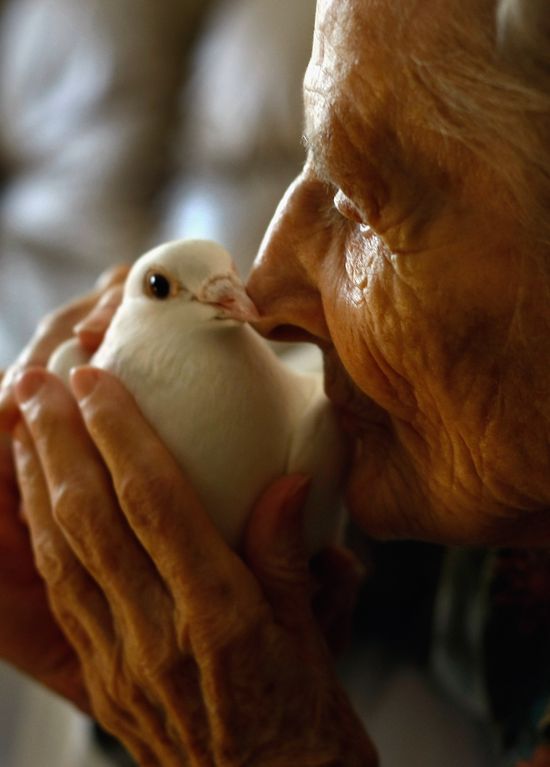
(Photo: Terminally ill patient Jackie Beattie, 83, holds a dove on October 7, 2009 while at the Hospice of Saint John in Lakewood, Colorado. The dove releases are part of an animal therapy program designed to increase happiness, decrease loneliness and calm terminally ill patients during the last stage of life. By John Moore/Getty Images)

 The Dish