Biting The Hands That Feed Us

Sara Rubin looks into the impact of Arizona's immigration law on the nation's lettuce supply:

If [migrant] workers are reluctant to return to Arizona, growers may find themselves short on harvesters, in which case "the crops rot in the field," says Wendy Fink-Weber, director of communications for the Western Growers Association, which represents 90 percent of fruit and vegetable growers in Arizona and California. Greens, which are a finicky crop and demand near-perfect conditions, have only about a five-day harvest window after reaching maturity. Each head of lettuce is cut and packed into boxes by hand. The intensive labor associated with growing lettuce—a $1 billion business for Arizona and the state's highest-value crop—accounts for up to 50 percent of the cost of production.

As Second City (Colbert's old haunt) suggests in the video above, tourism could take a hit as well. Original ad here.

Creepy Ad Watch

A reader writes:

I enjoy your work a lot, particularly the creepy ad watch. Thought I'd send in a suggestion from Saudi Arabia. This is a video condemning terrorists using clowns. Should give people nightmares for years.

That's our job here at the Dish. Al Lisaan provides a translation:

The written lines at the end say “Do not use your silence as a weapon against innocent people” and “Say no to terrorism.” The audio translates to “As you stand idly by terrorists and extremists, you only encourage them to continue the killing and destruction”.

Picturing Disaster, Ctd

800px-Dead_Zone_NASA_NOAA

A reader writes:

Plumer has obviously never heard of the "Dead Zone" in the Gulf of Mexico.  Do you really think the media hasn't been busting their butts to get pictures of dead fish and other sea life covered in oil?  The reason they can't is because those animals don't exist.  The Gulf spill happened in the middle of the Gulf's New Jersey-sized dead zone.  The primary cause is actually Mississippi River runoff (fertilizer products). The spill is a tragedy, but the truth is we already killed all the sea life.  This will change if the spill spreads beyond the Gulf or comes onshore.  But for now, the Gulf of Mexico is only marginally less hospitable to animal life than it was a month ago.

Six dead dolphins recently came ashore, though it's still unclear whether the spill was the direct cause.

The 55 Percent Rule

Conservative home has a helpful summary of the coalition deal. The greatest controversy thus far has surrounded the plan to raise the percentage of votes needed to call a general election. Rather than a bare majority, future parliaments would need 55 percent of the MP’s votes. Here’s Iain Martin:

[T]his fails the fairness test. It is an idea that has been easily and widely grasped for generations inside and outside parliament that if you lose a confidence vote by one then, there’s no way around it, you have lost. Fifty per cent plus one is enough. This seems such an obvious truth that one wonders why it was not apparent to the two parties negotiators that attempting to change the rules might make them look shifty .

Other dissents from Dizzy and Hopi Sen. Massie jumps in:

[U]nless I am hopelessly confused about all this, the provision has nothing to do with confidence votes. The government would still be brought down by losing a confidence motion on a simple majority. But, now that we have fixed-term parliaments, this wouldn’t necessarily trigger a general election. That would only happen if it proved impossible to form a new government and, then, 55% of MPs voted in favour of dissolution and fresh elections.

This is a deeply tricky question – and I have to say my alarm bells go off. I can see how shifting to fixed terms helps this government, but constitutional band-aids for current circumstances, invented under extreme time pressure, have a real tendency to lead to unintended consequences. I’m going to think on this some more.

Outlawing The Burqa, Ctd

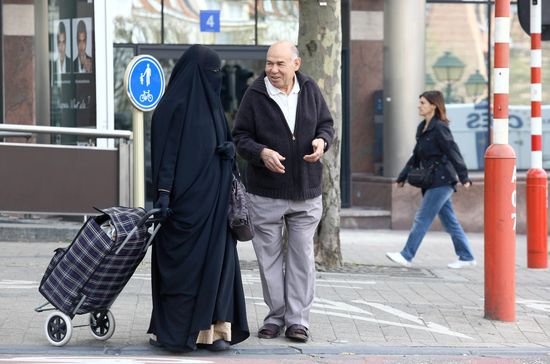
BURQAJulienWarnand:AFP:Getty

This thread has quickly taken off. A reader writes:

I work in a public library in a very large American city and have encountered several women in a burqa at the reference desk.  Immediately I am struck by how our culture is not set up for a woman to be almost completely covered like that. I am a woman, and have found myself several times by myself at the reference desk trying to converse with another woman, who happens to be veiled.  The veil made it difficult to hear these women since it covered their mouths. It occurred to me this burqa is not designed for a free society where women are allowed and actually expected to speak for themselves.  Body language communication was impossible to read from these veiled women which is such a huge part of conversing, almost as big as the words actually said.

Another writes:

Last week I encountered a person in a burqa in my crowded suburban Baltimore supermarket. I hadn't realized how much of our public interactions require "feedback" of one sort or another.  Even the minor "excuse me" requires some sort of feedback to properly "read" the other. When I moved closer, I was able to make eye contact and so complete the social dance.  Ironically, this moving closer required me to invade her social space.

Is all this discomfort important enough to outlaw? Of course not. In time with more interactions like this it will become easier to read the other. I will become fluent in reading "Burqa".  This is however a large problem if there is segregation like with Muslims in France.  However can you become fluent enough in other cultures and so adapt to one another in the public space if you have no experience with one another?

Another:

Let me respectfully disagree with your views. The burqa has nothing to do with religious freedom or a woman's "choice" or any of that crap.  It is a form of subjugation.  It is a way to reinforce the notion that women are dangerous and that they belong to men.  It says "you are allowed out of the house only if no one can see you.  Only if you are invisible." It is akin to wearing chains.  

I invite you, and that idiot who compared banning the burqa to banning Red Sox gear, to wear one.  Drape yourself in long, heavy, dark material from head to toe.  Walk around like that for a full freakin' day.  On a hot day, preferably.  It might help put the whole issue in a bit more perspective.  The burqa is NOT comparable to modest or humble clothing, the way long sleeves or a scarf might be.  It is meant to erase one's personhood, and it is very effective.

Women who "choose" to dress like this are women who have been raised from childhood to accept their second-class status.  They have been raised to believe that they are unacceptable to society, and to god, unless they are dressed like this.  Very few have chosen this belief system; it has been imposed on them.  And if they disobey, they are punished.  With violence.  I fail to see the "choice" in this.

Another:

Religious liberty is not a limitless right. As with civil liberties, it has limits. When the British outlawed Sati and Child Marriage in India, it was an encroachment of religious liberty. But, as an proud Indian who is deeply the damage done by colonial rule and a proud Hindu with deep appreciation for Hindu philosophy, I have no doubt that it was fully warranted, and that we are better off for these particular "liberties" being taken away from us. Burqa may not rise to the same level as Sati or Child Marriage. Or perhaps it does. Whether to outlaw Burqa or not should not be based on the faulty notion that there is limitless religious liberty.

Another:

My significant other lives in Rogers Park, about just slightly northwest of Uptown, and that area is also significantly multi-ethnic; women in burqas are there too, and their daughters.  I've spent a lot of time up there recently, living in the neighborhood and brushing past women with burqas.

Unlike your reader, however, I've invested some time in the course of my education to get to know some Muslim communities in the north, and have spoken with a handful of women who wear burqas.  From the ones I've spoken to, their lives are interesting and rich.  And I have spoken to a few of their daughters as well, and more than one has told me that she intends to wear the burqa when the time comes.  Furthermore, a great many have pointed out the very real truth that the freedom to wear what you want is not always as clear-cut in America: sexualized clothing is increasingly prevalent in America and increasingly moving to younger populations of girls, yet no one stops to think that this might also be a form of gender-policing and enforcement.

It is true that women who are willing to speak with a Christian male involved in interfaith relations are not likely to be a random sample.  I am not claiming that these women even remotely emblematic.  I am claiming, however, that these women represent only themselves, and these women would be significantly impacted in their personal religious decisions should a ban like this go into place.  Yet nobody seems to want to, you know, talk to these women and hear what they have to say. People are only interested in passing laws "for their own good."

(Photo: A Muslim woman dressed in niqab (veil which covers the body and leaves only a small strip for the eyes) walks through the streets of Brussels, on April 27, 2010. By Julien Warnand/AFP/Getty.)

The Politics Of The Smear, Ctd

A reader writes:

Chait finds “Israel distinctly more sympathetic than Hamas”. Comparing a political party to a country in a way that makes a people, the Palestinians, seem like terrorists is a distortion of the first order, in a column supposedly about distortions where Chait criticizes the idea of comparing the United States to Al Qaeda in the same paragraph.

Harvard’s Blank Slate To Rule Over Us


The Colbert Report Mon – Thurs 11:30pm / 10:30c
Kagan Worship – Dahlia Lithwick
www.colbertnation.com
Colbert Report Full Episodes Political Humor Fox News

Dan Froomkin vents legitimate frustration at the pointlessness of it all. Robbie George writes glowingly of Kagan’s “personal integrity” (is there anyone who doesn’t like her?) but rightly asks for more aggressive scrutiny than in the recent past. In Kagan, it seems to me we have reached a new level of utter blankness. Her entire career has been about never taking a stand on anything of any substance – free coffee for students! – while networking in a way to neutralize any conceivable opposition. And she is walking back from her earlier demands for more clarity and transparency in Senate confirmation hearings. Josh notes that liberals are worried about an Obama Souter. I just don’t believe that Obama is that prone to risk. I predict that if confirmed, she’s much more likely to surprise on the left than on the right, in so far as those terms mean much any more. I mean she favors a powerful central government’s power to organize and regulate our lives for our own improvement. And she will not see the court as an obstacle in that government’s way. Libertarian she ain’t.

But I’m guessing. We’re all guessing. None of us has a clue – including those who say they are close to her. There are so many things we don’t know about this person about to get enormous power over us for life. Which is why I have so far found this nomination so disturbing.

Quote For The Day

“Susan B. Anthony would be proud of Governor Palin’s consistent, passionate witness for women and the unborn, and especially her commitment to the families of children with special needs. Governor Palin is the modern personification of the authentic leadership modeled by early women’s rights trailblazers like Susan B. Anthony and Elizabeth Cady Stanton. Our nation’s earliest women leaders understood that women’s rights could never be advanced at the expense of the broken rights of innocent unborn children,” – Susan B. Anthony List President Marjorie Dannenfelser.

The Mid-Terms Cometh

The WSJ finds that Republican support has firmed up and doesn’t look like budging, in large part by anti-incumbent discontent among those older, whiter voters who are most determined to show up:

The voters who said they were most interested in the November elections favor Republican control of Congress by a 20-point margin, with 56% backing the GOP and 36% backing Democrats—the highest gap all year on that question.

Sprung notes how far he is from where public opinion has swung on the actions of this Congress. Me too. But doing difficult but necessary things imperfectly is my idea of political progress. And eighteen months is a very short time in which to judge the impact of any mandate at all.