Yes She Can

Via Ambers, a prediction from Conservatives For Palin:

In both speeches, Palin cited President Ronald Reagan as a driving influence in her life and political career, drawing great attention to the fact Reagan was born and educated in Illinois — the state in which we believe Palin will officially launch her 2012 presidential bid on February 6th, 2011…Reagan's 100th birthday. She'll do it – we betcha – in either Tampica or Eureka, two cities in our state intimately connected to Reagan. And she'll do it in the face of all the naysayers and talking heads in the Lamestream Media who obsessively strive every day to destroy her, to ridicule her, to mock her, and to tear her down. Because the media wants Barack Obama to win a second term, and they know Sarah Palin is the only thing that can stop that.

This creature of News Corp will run against the media – in the name of Reagan, the man from Hollywood and General Electric. Yes, history can repeat itself as farce. And yes, at some point, the Republican party (or what's left of it) will have to choose.

How Kevin Thinks About Death

Drum responds to my query. He thinks that when he dies his "consciousness/ego/soul simply ceases to exist" and it doesn't bother him that is own "existence won't last forever" and it never has:

For what it's worth, my instinct tells me that this is primarily an aspect of temperament you're born with. Either you have a strong emotional reaction to the idea of eventual nonexistence or you don't. If you do, religion is the most common way of dealing with it. The particular religion you choose is obviously mostly cultural, passed down from your parents and peers the same way you learn a particular language as a child, but the motivating fear itself probably isn't.

But either way, does this really reveal something essential about what it means to be human? In one sense, yes: a knowledge that someday we'll die is unique to humans (though fear of death plainly isn't), and our response to that knowledge has been a defining feature of human cultures for millennia. Still, there are hundreds of other things that are unique to humans too, and I don't think there's any special reason to give this one pride of place.

I take the former point entirely. I find Kevin's final statement unpersuasive. To be human is to be aware of our own finitude, and to wonder at that. Montaigne argued that to philosophize is to learn how to die. Camus put it differently: men die and they are not happy. For me, this last thing is our first thing as humans. It is our defining characteristic, even though some animals may experience this in a different way.

And our ability to think about this casts us between angels and beasts. It is our reality. Facing it is our life's task.

“The Manhattan Project For Natural Disasters”

Scott Adams wonders:

I assume some of the best engineers in the solar system are working on [the oil spill clean up]. So what we have here is a pure case of brains against oil spill. It's the Manhattan Project for natural disasters.

The Scott Adams Theory of Predictable Disasters states that any catastrophe that society at large can predict far in advance won't happen, usually because scientists and engineers figure a way to head it off. So while an oil spill of this size wasn't predicted by the general public, the slow motion ecological disaster from this point forward is predictable. Admittedly, this is a grey area for the theory because this particular disaster is happening on a relatively fast schedule. It will be a good test of the robustness of the Scott Adams Theory of Predictable Disasters.

The Overpopulation Truth?

Julia Whitty worries:

Voiced or not, addressed or not, the problem of overpopulation has not gone away. The miracle of the Green Revolution, which fed billions and provided the world a sense of limitless hope, also disguised four ominous truths about Earth's limits. First, the revolution's most effective agents, chemical fertilizers of nitrogen and phosphorus, are destined to run out, along with the natural resources used to produce them. Second, the fertilizers, pesticides, and herbicides that grew the food that enabled our enormous population growth in the 20th century bore expensive downstream costs in the form of polluted land, water, and air that now threaten life. Third, crop yields today are holding stubbornly stable and even beginning to fall in some places, despite increasing fertilizer use, in soils oversaturated with nitrogen. The Green Revolution's duplicitous harvest — giving life with one hand, robbing life-support with the other — also masked a fourth ominous truth. We're running out of topsoil, tossing it to the wind via mechanized agriculture and losing it to runoff and erosion.

A forum on this topic can be found here.

It All Failed

GulfSpill

Lisa Margonelli says there was no proximate cause of oil spill in the gulf:

As people who like simple narratives, the public and policy makers will be tempted to try to find one locus for blame — whether it's BP or BOP's (blow out protectors) — but that may prevent us from figuring out the deeper system of problems that lead to this accident. And we may determine that business as usual doesn't work for offshore drilling — which leaves us unable to count on the 40 percent of domestic oil production we were expecting to get from the offshore industry in the next ten years. Rereading what's been written about offshore oil drilling over the last few years, it's obvious it was thought to be the methadone for our overseas oil addiction. Now what?

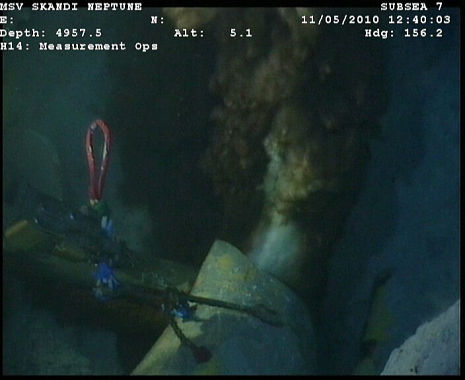
Image of "what it looks like, four thousand nine hundred and fifty-seven feet down, when oil gushes into the Gulf of Mexico at a rate of thousands of barrels a day" from Amy Davidson.

The Politics Of The Smear, Ctd

Yglesias's contribution:

As I noted in my previous post on this controversy, I find it a bit curious that strident defenders of Israeli foreign policy take a harder line on Richard Goldstone’s apartheid-era conduct than does Nelson Mandela and the leadership of the African National Congress. It’s almost enough to make you think that some of these attacks on Goldstone are offered in bad faith, and are more motivated by dislike for his conclusions about Israeli conduct during the Gaza war than genuine concern about his past conduct.

Chait returns fire:

This is a good example of the general phenomenon I'm talking about. Begin with the characterization "strident defenders of Israeli foreign policy." I'm certainly more strident than Yglesias. But I (hesitantly) opposed the Gaza incursion. I blame Netanyahu, not the Obama administration, for the recent Israel-U.S. blow-up. Goldberg made his name authoring a book critical of Israel's occupation, wrote a long op-ed blasting Aipac, and so on. Goldberg and I do find Israel distinctly more sympathetic than Hamas. Yglesias would probably object to somebody who painted the United States as no better than al Qaeda. That wouldn't make him a "strident defender of American foreign policy." At best Yglesias has picked an imprecise description, and at worst he's outright misleading his readers.

Jonathan's basic position:

Accusations of bad faith are both impossible to disprove and an effective tactic for avoiding the substance of the issue. As I've said before, the important question is the truth of Goldstone's findings. He did report evidence of Israeli war crimes in Gaza. He also made a lot of shaky or hard-to-justify claims. Part of the controversy around Goldstone has dipped into questions of his character — supporters paint him as a fearless truth-teller, critics as a man who molds himself to the ideology of whatever institution he's attached to. I think his Apartheid history has some relevance to this small but non-trivial question.

The Daily Wrap

Today on the Dish we rounded up reaction to the Cameron-Clegg alliance. Andrew sized up Cameron and his similarities to Obama, Clive Crook was skeptical of the alliance, Frum addressed its concern over the debt (US version here), LSE looked at voting reform, and Gideon Rachman remembered the new chancellor.

In other coverage, Palin came out with a new book, Laura Bush came out for marriage equality, and another cartoonist was attacked. Greece update here. Andrew updated us on the latest smearing of Goldstone, Fallows investigated the state of online journalism, Ramesh broached the topic of race in the court confirmation, The Economist stood up for burqas, Packer diagnosed Karzai, Lexington learned from the spill, and Balko followed up on the puppycide video.

Readers continued to dissent over Andrew's view of Kagan, one stood strong with him, others loved our recent tribute to mothers, and another confessed from the closet. Stephen Asma grappled with the soul and Drum discussed his lack of faith. A funny new site for parents here

— C.B.