One Of Us?

CAMERONChristopherFurlong:Getty

Michael Wolff assesses David Cameron:

Cameron was the clear winner in this race. Whatever instincts and prejudices he might harbor, he had, with great doggedness and ambition, transformed himself into something recognizable and, nearly, reassuring.

Cameron and I chatted with requisite interest and enthusiasm about Obama, but, like California, Obama actually seemed, I thought, quite foreign to him. Cameron’s interest in the president was more dutiful than natural.

His real interest, the point at which he picked up the story, where the story became about him, was when the conversation turned to Tony Blair and Bill Clinton, those artful dodgers, those all-things-to-as-many-people-as-possible men, those consummate politicians, those yuppies, those salesmen, those deft orchestrators of the modern psyche (stop me, please). Indeed, David Cameron, I’m sure, is utterly convinced he has the unique touch—the charm, the empathy, the savvy—to hold a coalition together.

In this David Cameron is no doubt distasteful to left-wing and right-wing partisans. But to me, and I’ll bet to other no-wingers, he is very familiar and, I am tempted to believe, one of ours, for better or worse.

Oddly, I have never met him, and only heard from those close to him. I believe he has done an immensely difficult thing – he has tried to transcend his social class out of a sense of patriotic duty that is, in many ways, a function of his social class. And this, I think, is a deeply Tory instinct – where the elites take their broader responsibilities seriously, and act out of decency. I was moved by his gracious words yesterday about 13 years of Labour. He said the country had become fairer and he was glad for it.

And here is where he reminds me a little of Obama. Class in Britain is what race is in America. Cameron never denied his past and even engaged in some of its more obnoxious practices. But he loves his country, and endured great prejudice, as well as great privilege, because of his class. Yes, Etonians can be victims too. He both owned his identity – all of it – and yet sought to transcend it.

And his Toryism is also deeply connected to a pragmatic adjustment to modernity, rather than a furious and ignorant reaction to it. He takes climate change seriously; he understands the vital priority of fiscal responsibility; he seeks to limit the state by encouraging personal responsibility and civil society; he has not just talked the talk on inclusion of gay people, he has walked the walk, bringing a whole new generation into Tory politics. He has shown so far no enmity, no nastiness, no mean streak, although, in true British fashion, he has bashed his opponents in the Commons to a nicely-blended pulp.

I think he represents the future of conservatism, as well as the best of the Tory tradition of Disraeli and Butler and Baldwin. I think he is where the GOP will one day have to be, once they slowly find out the sheer depth of the abyss they have hurled themselves into.

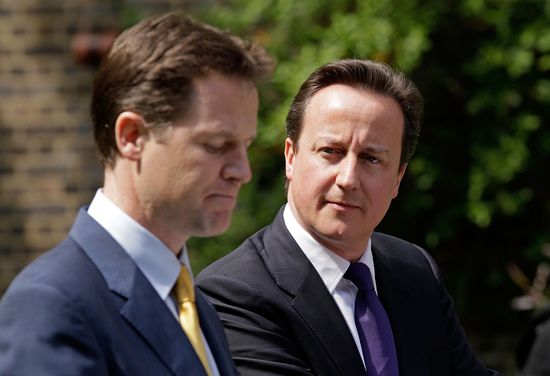
(Photo: Prime Minister David Cameron (R) and Deputy Prime Minister Nick Clegg hold their first joint press conference in the Downing Street garden on May 12, 2010 in London, England. By Christopher Furlong – WPA Pool /Getty Images)
A View From The Closet

A reader writes:

Thanks for reminding us in the closeted world – in my case the world of teaching in a Catholic High School for twenty six years – of the insanity of our positions.  Every single kid knows I am gay.  I'm fifty five and unmarried.  I teach English.  I love plays.  I get along with women.  Of course, I'm gay.

But on the other hand, you came up against the real world, Andrew.  It doesn't matter what the kids know.  The adults don't want me to tell.  They would make a big thing about it if they could.  I've done a world of good for the gay community, except in being out.  It's the world I lived in.  It's not your world.  It's not the world of the kids below you.  But it has been my world.  And it has been a wonderful one, for the most part.  Four more years, and others younger than I can take over.  I wish them well.
 
You, dear sir, are the BEST.  I am not.  Neither are most of us out here. 
 
But we worked hard on it.  For a LONG time.

Lessons From The Spill

Lexington says they are not what they seem:

So long as Americans do not reduce their consumption of oil, refusing to drill at home means importing more of the stuff, often from places with looser environmental standards. The net effect is likely to be more pollution, not less. Nigeria, for example, has had a major oil spill every year since 1969, observes Lisa Margonelli of the New America Foundation, a think-tank. Putting a price on carbon would eventually spur the development of cleaner fuels, and persuade Americans to switch to them. But in the meantime, oil is both useful and precious. Extracting it domestically, with tougher safety rules, would bring a windfall to a Treasury that sorely needs one. When the current crisis is past, Mr Obama may remember this.

Our Karzai Problem

Packer describes it:

Wars that hinge on an unstable, highly personalized relationship seldom come to a satisfying end. This relationship in particular has come to resemble that of an exhausted mental health professional and a beleaguered patient who suffers from chronic delusions. The shrink doesn’t know whether to work with the delusions or puncture them, and he keeps switching between one approach and the other because neither shows any sign of succeeding. For the moment, the Obama Administration has decided to indulge Karzai by bringing out the expensive china, in the slender hope that he can be coaxed into changing his behavior. Unfortunately, this was roughly the approach of the Bush Administration for seven years, and it helped lead to the stunning resurgence of the Taliban in Afghanistan.

Outlawing The Burqa, Ctd

BurqaShahMaraiAFPGetty

The Economist explains why the French left supports the ban. The magazine's final paragraph:

How it would be applied in practice remains unclear. As it is, the

Conseil d’Etat, the highest administrative court, has expressed worries about the legal grounds for a ban. If passed, Mr Copé says that it will apply not only to French Muslims, but to visitors from the Middle East too. Would such women be fined while doing their shopping on the Champs-Elysées? How can the government be sure that a woman is wearing the burqa under orders from her menfolk? Would it not lead to their further isolation, as they felt unable to venture out of the home? If that were indeed the upshot, it would be paradoxical for a law designed in part to ensure equality for women.

I have to say this encroaches too far on religious liberty for me. I find the burqa repulsive for any number of reasons, and the subjugation of women it represents appalling. But freedom for me is a more important value. I do not want to live in a society where such things are banned. It means that other things can be banned for the good of others. And we're not French, are we? A reader puts this a little more colorfully:

I get really pissed when people say a woman in America, or any other western country, should be banned from wearing anything she frickin feels like wearing. When I was a youth I had piercings, a mohawk, I wore doc martens and tried my best to look as scary as possible. I was punk rock, baby, and I loved it. And if anyone told me not to wear what I wanted, well I didn't give a shit. I was expressing my rebellion when I wore those clothes for everyone to see. Woman in burqas, veils or whatever are expressing their relationship with their God, and by extension their society, and accepting whatever harsh treatment they receive because it it, just like me with my punk rock clothes.

So if we are going to ban their clothes, lets start banning piercings, black clothes or other non-mainstream dress. Hell, let's ban Red Sox shirts too. And baggy pants. And tattoos that are dark or scary. And hoodies on black kids. And anything article of clothing that expresses any relationship with any god an any kind. Oh, I can hear the arguments about oppression of women. Yeah right. Who is more oppressed by the norms of society – the little girl wearing the ho clothes or the woman in the burqua? You are intimidated by a burqa clad woman in the grocery aisle? Oh please. That says a lot more about you then it does them. Grow up.

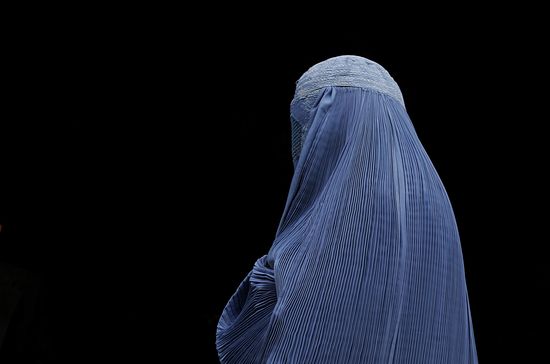
(Image: A burqa-clad Afghan woman on March 20, 2010. By Shah Marai/AFP/Getty Images)

Incomes Go Down

Felix Salmon brushes up on wages:

[R]eal wages in general have been falling, for the first time since the Great Depression. And with unemployment still at 10%, there’s not much hope that they’ll start rising again any time soon. If you want to see incomes go up in your city or region, your best hope is frankly just to get lucky, like [the city of Manhattan, Kansas] did. Because wages in the U.S. as a whole aren’t going anywhere.