What The Internet Hasn’t Changed

TED interviews Nicholas Christakis, who recently gave a talk on how our social networks affect us:

Talk to your grandmother or your great-grandmother and ask her how any best friends she had when she was a girl. And, she might say, “I had one or two really best friends, and three or four close friends — we had a circle of five girls.” Ask a young girl that question today and you’ll get the same answer. Now, the young girl today will also have all kinds of other social interactions, but the fundamental reality of our interest in having close social relationships really hasn’t changed.

What constrains or enables the capacity of human beings to work in groups is not so much the technology, but rather the capacity of the human brain to have and monitor social interactions. So you can make interactions between different pairs of people more efficient, and there’s no doubt modern technologies have done that, but what really limits our abilities to interact with each other and to influence each other is a more fundamental requirement. Social media and the Internet haven’t changed our capacity for social interaction any more than the Internet has changed our ability to be in love or our basic propensity to violence, because those are such fundamental human attributes.

The Daily Wrap

98970373

Today on the Dish we saw Brown resign and Cameron take over as PM. Drama leading up to the dramatic switch here, here, here, here, here, and here. Andrew's thoughts on the developments here, Cameron's speech here, a warning from his right here, and how it could affect the American right here.

In Kagan coverage, Andrew scrutinized her careerism and elitism, readers continued to dissent with him over his outing inquiries, and others commented on her issues with recruitment on campus. Horton examined her views on the executive, Stuart Taylor did the same approvingly, Josh Green assessed the politics of the confirmation, Maggie Gallagher tried to decipher her stance on marriage equality, and a New Yorker commenter challenged Toobin on the closet. Andrew continued to mull over Kagan's identity here and especially here.

Finally, an answer appeared.

— C.B.

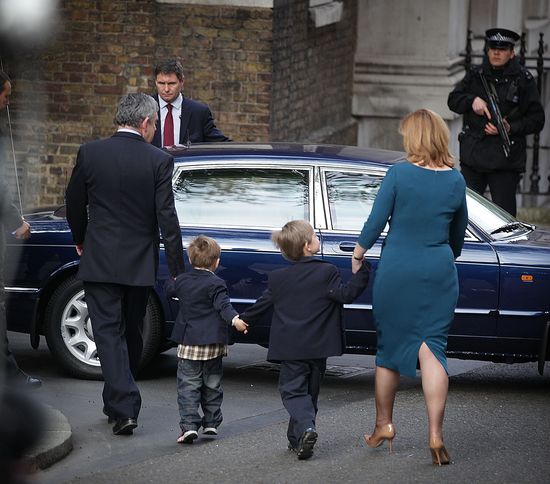
(Prime Minister Gordon Brown leaves Downing Street with his wife Sarah and children James Fraser and John after resigning on May 11, 2010 in London, England. After five days of negotiation a Conservative and Liberal Democrat coalition government has been confirmed. Photo by Peter Macdiarmid/Getty Images.)

The Borking Of Kagan

Will Saletan pens the most penetrating and persuasive critique of my question as to the emotional orientation of Elena Kagan. He puts it better than I, but his argument is essentially that the personal facts of a supreme court nominee can lead to unending and cruel and prejudiced exposure, in a manner that distorts the process and wounds the person. He reminds me of the religious inquisition of the agnostic Robert Bork. It is indeed vile. What was done to Clarence Thomas was, in my view, viler – although I remain convinced that Anita Hill was telling the truth. Will also reminds me of my own words on this matter nineteen years ago, when I witnessed the brutal outing of Dick Cheney's then-spokesman, Pete Williams, on the utterly fraudulent grounds that he was somehow homophobic, because he spoke for a defense secretary who ran a military where openly gay soldiers were banned. I remain proud of the little essay and stand by its core point. The fanatical persecution of a gay man who simply wanted to do his job, was barely a public figure at all, and was in any way out of the closet, appalled me. That this viciousness came from other gay men made it no less, and in some ways much more, despicable. And that this viciousness was in the service of an ideological agenda made it worse.

But here's why I think Will's point falters, and why my argument of twenty years ago is much weaker now. Since 1991, a revolution in attitudes has occurred. Gay couples are legally married in several states. Large majorities of people support ending the military ban on honest homosexuals and enacting some kind of legal relationship status for gay couples. In my home country, there are now over a dozen openly gay Tory members of parliament. In the circles of the Acela corridor, and legal academia, being gay is often a plus. Ten years ago, I wrote another essay noting this amazing change and asking whether the press – in completely benign and empirical ways – was still required to sustain what were in effect glass closets of people who were out in some spheres but wished to remain closeted to the wider public. Things had evolved in such a way that some journalists were required to write things that were not true or avoid things that were obviously true in order to uphold stigmas that no longer existed. The case of the recent Washington Post story illustrates this dilemma perfectly. The job of a writer is to tell the truth first of all.

Ten years later still, we now have a mass media in which no gate-keepers exist, and in which anyone with a Google search on Kagan will immediately retrieve what the public is already trying to find out in massive numbers. We also have countless openly gay men and women in public life. We have an open lesbian judging American Idol and an openly gay minister praying at the president's inauguration. We have a president who is rhetorically committed to gay dignity and inclusion.

We also have a president who has specifically argued that his prime criterion for selecting a nominee for the Supreme Court is biography, and a personal understanding of how the law impacts real human beings. We have the details of that biography laid out in excruciating detail in the New York Times. From a rare and inadvertent inquiry into Bork's agnosticism decades ago, we have now come to the NYT providing details of a young girls' bat mitzvah and teenage smoking. Did Kagan give permission for every aspect of her personal life to be splayed out in the pages of the paper of record? Do the journalists at the NYT feel awful for exposing her cigar habit or her softball games or her deep relationship with her father? Or do they regard these details as part of what the modern world demands, and indeed as a way to allow readers to make the very judgment the president himself has asked us to make: what is this person's life experience? I simply do not know how to measure a person's life experience if I have no idea if she has ever had an emotional life or even if she has always lived alone. We knew this even of David Souter. But we know nothing of this with respect to Ms Kagan. 

Elena Kagan is a human being, with feelings and dignity and a right to choose how she presents herself to the world. But she is also now a very, very public figure, seeking a lifetime appointment, with extraordinary power, in a liberal administration from a liberal university, in the twenty-first century. We all accept that when we enter public life, we surrender certain things. I learned this the brutal way, being out in the mass media before I was in my mid-twenties, all but forced to acknowledge intimate details of my own health and sex life, pummeled for my religious faith or lack of it, analyzed in every personal way imaginable, exposed by right and left depending on the political uses of the time. I wouldn't wish that on anyone. It still stings. I have scar tissue where my heart used to be.

I am not seeking to expose anyone in this way at all, because I know at first hand how brutal it can be. I seek no cruelty at all. I want to know no details or specifics. But I do think a simple answer to a simple question about a core part of someone's identity should be possible. And I think a deliberate avoidance of this question is dangerous to public transparency and to the integrity of the process and potentially more invasive of someone's actual privacy in the long run than a simple, dignified statement that could get us past all of this now. And I think there is a real danger of treating emotional orientation as different from any other aspect of someone's personal life in a manner that is actually deeply complicit in prejudice and injustice. Doing so sustains stigmatization, which sustains discrimination, which perpetuates enormous and enduring human pain. Doing so is actually, in my view, simply wrong. Which is why I stand by my question and the raging debate that has ensued on this page.

But Will has persuaded me of one thing. I will say no more on this subject. I wish Ms Kagan all the best and hope the process is scrupulously fair to her. By all accounts she is a lovely person, a gregarious human being, a great persuader, and a judicial blank slate. I've asked one question I feel is legitimate and utterly without malice and I have received an answer. The answer is that I should not ask. I take it as a final one. I won't any more.

This question is now closed on this blog.
Face Of The Day

98970113

A woman cries at the Fatima's Sanctuary on May 11, 2010, in Fatima. Pope Benedict XVI landed in Lisbon to begin a four-day visit included Fatima and Porto. The pope will celebrate a giant open-air mass Thursday at Fatima, where three shepherd children reported seeing visions of the Virgin Mary in 1917. Photo by Pierre-Philippe Marcou/AFP/Getty Images.

Tragic Atheism

Damon Linker returns to an exchange between David Hart and Kevin Drum:

What’s most disappointing is Drum’s failure to grasp the culminating point of Hart’s essay, which, as I take it, is this: the statements “godlessness is true” and “godlessness is good” are distinct propositions. And yet the new atheists invariably conflate them. But a different kind of atheism is possible, legitimate, and (in Hart’s view) more admirable. Let’s call it catastrophic atheism, in tribute to its first and greatest champion, Friedrich Nietzsche, who wrote in a head-spinning passage of the Genealogy of Morals that “unconditional, honest atheism is … the awe-inspiring catastrophe of two-thousand years of training in truthfulness that finally forbids itself the lie involved in belief in God.” For the catastrophic atheist, godlessness is both true and terrible.

Now of course Hart would prefer that kind of tragic atheism. He’s a believer, after all. But the fact is that a number of atheists themselves have staked out a similar position.

Take the example of physicist Steven Weinberg. In his 1977 book about the earliest origins of the universe (The First Three Minutes), Weinberg stated in passing that “the more the universe seems comprehensible, the more it seems pointless.” When some of his fellow cosmologists objected to the choice of words, accusing him of expressing, if only implicitly, some form of theological nostalgia for a non-scientific view of the world, Weinberg admitted that he is indeed nostalgic—“nostalgic for a world in which the heavens declared the glory of God.” Associating himself with the nineteenth-century poet Matthew Arnold, who likened the retreat of religious faith in the face of scientific progress to the ebbing ocean tide and claimed to detect a “note of sadness” in its “melancholy, long, withdrawing roar,” Weinberg confessed to his own sorrow in doubting that scientists will find “in the laws of nature a plan prepared by a concerned creator in which human beings played some special role.” When it comes to God, what Weinberg believes to be true and what he wishes to be true simply do not coincide.

The whole post is worth a read.

Quote For The Day IV

“Please let the editors and writers of The Post know that if a man or women is openly gay to their family, friends and coworkers (as I am), reporting on their sexual orientation is as benign as reporting on their hair color,” – Chris Tharrington, on the Washington Post's ombudsman page.

It's good to see this being discussed outside of the Supreme Court. These can be tricky issues in a shifting society, but I support Tharrington's position. The Post, of course, remains of the view that someone's orientation – if they are gay – should be mainly concealed by the press. Even when that person was murdered, was out to his peers and reported by the police as gay. It seems you cannot "libel" someone who is dead, but you can "out" him. The WaPo implicitly believes that outing someone as gay is somehow worse than libel. And, yes, this is 2010.

Cameron And The American Right

He’s a problem, isn’t he? A reader writes:

I think it’s going to be really fascinating to see how Southern Conservatives respond to David Cameron.  Southern Conservatives worship C.S. Lewis and Winston Churchill (I can say this because growing up in the South you have no idea how many conservative boomer age men I have heard quoting Lewis and Churchill to me).  So how are they going to respond now when you have this conservative British Prime Minister who talks about fighting a war on poverty, who talks about his faith in God as going “in and out,” who is comfortable with gay people, who is comfortable with evolution?

The American Right has to know that Cameron’s way is the future of conservatism.  This cocoon they have constructed for themselves against the modern world cannot survive much longer.  When we have Republican politicians in the South quoting David Cameron instead of Churchill, that is when we are going to have achieved real progress in this country.

It will get worse before it gets better:

A Warning From Cameron’s Right

Paleocon Simon Heffer thinks the coalition is doomed – because of lefty Liberals and righty conservatives. We'll see. Given the astonishing pace of events these past few weeks, I remain unwilling to make any predictions at all. But we will see how the decent maturity of Cameron as prime minister and the steely idealism of Clegg as his deputy settle in with middle England. I suspect just fine. For a while.

Ignorance As A Luxury Of Power

TNC watches the above video of Andy Rooney admitting he knows very little about contemporary music and reflects:

What I do know is that, like Rooney, I couldn't name a Lady Gaga song if I heard one right now. But I also know that my son knows more of my music, then I know of his. He can recognize Nas, but I can't recognize, say, Drake. In other words, you'd do a lot better banking on my ignorance, than his.

Age, like all power constructs, (race, gender, class) encourages its own ignorance. To not know is a luxury of power. You don't have to know Their Eyes Were Watching God. But I damn sure better know The Scarlet Letter. (It's bad enough I'm slipping on Twain.) Age turns ignorance into a luxury, and worse, if you don't recognize it as a luxury you start to think everyone is as clueless as you. And of course you're clueless that any of this is even going on.