How Many Burqa-Clad Women Brush Past Me?

A reader writes:

A bunch. I live in the extremely multi-ethnic Uptown neighborhood of Chicago. The high-rise across the street from me has a large fundamentalist Muslim community living in it, and there are several dozen fully-veiled women who live in the building. I run into them at the bus stop, the grocery store, McDonald’s – pretty much all over my ‘hood.

And although I’m an uber-liberal urbanite who embraces my multi-culti neighborhood, I have to confess: there is nothing creepier than having a burqa-wearing woman coming at you in the cereal aisle. I’ve lived here for years and see them all the time, but I can’t help but find them spooky. They’re wraith-like and eerie. I know I’m not supposed to admit that, but it’s true.

I understand that it is (theoretically) their choice to wear the veil, but the same is not true of their daughters. I have seen few sadder things in my life than the day I ran into one of my neighbors at the store, and saw that her adorably goofy and energetic little daughter had suddenly been converted into a somber, ghostly, black-clad shadow of herself. That was the first time I felt like a burqa ban might not be such a bad idea….
Kennedy, No Pushover, Ctd

Jonathan Bernstein's read:

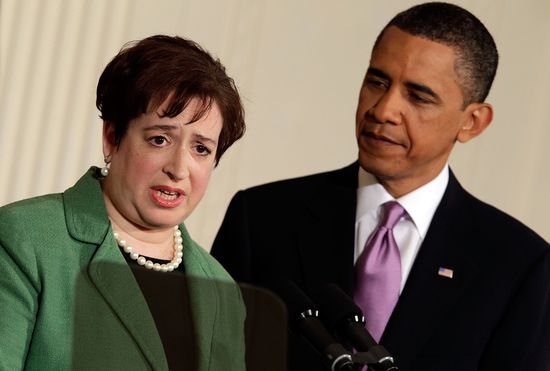
The real thing Kagan — and Obama — need to persuade Kennedy to do is to consider retiring with a Democrat in the White House. For that, it really might pay to avoid a "a full-throated counterweight to the court’s conservative leader, Justice Antonin Scalia."  Kennedy will turn 74 this summer.  I've always said that it's a mug's game to make predictions about politicians and retirements, and that must be even more true about Justices on the Supreme Court.  I would say, however, that if he considers retiring over the next several years, and if he cares about what happens to the Court after he's gone…well, if those things are true, then it's pretty easy to imagine the incentives involved and how Obama's nominees change those incentives.  We can assume that Kennedy would prefer to be replaced by someone similar to himself, and then guess at where he perceives the next Democratic and the next Republican appointments would be.  Presumably, given his voting pattern, he'd prefer to be replaced by a Republican appointee — but relatively moderate picks by Democrats might close that gap somewhat (as might extremist rhetoric from Republican candidates).

This assumes that Kagan is a moderate. But we have no idea whatever what she believes, because she has managed to live a life with no apparent public beliefs. I suspect she's actually very liberal. Why else the long radio silence on everything – along with exquisite careerist strategizing?

The Tao Of Obama: No Fight, No Blame

OBAMAKAGANChipSomodevilla:Getty

The highest good is like water.

Water gives life to the ten thousand things and does not strive.

It flows in places men reject and so is like the Tao.

In dwelling, be close to the land.

In meditation, go deep in the heart.

In dealing with others, be gentle and kind.

In speech, be true.

In ruling, be just.

In daily life, be competent.

In action, watch the timing.

No fight: No blame.

(Photo: Chip Somodevilla/Getty.)

“A Progressive Arrangement”

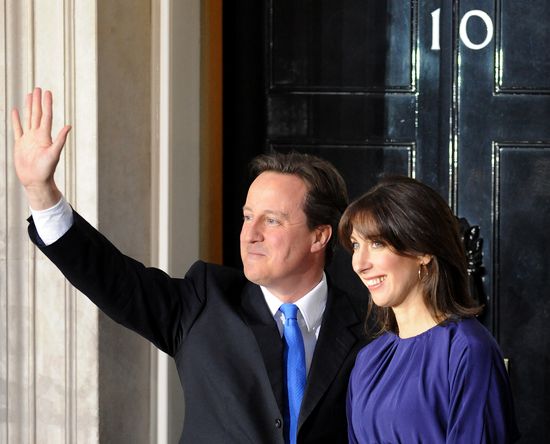
  NUMBER10BenStansall:Getty

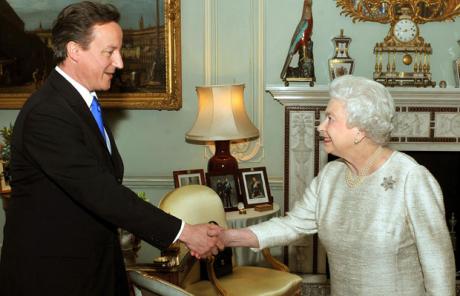
That's how a senior Liberal has described the new deal with the Tories. This is not just a new era for Britain and the Liberal Democrats. It's a new era for conservatism – and reveals just how alien British conservatism now is from its increasingly extremist American cousin. Bonus fact rebutting a previous rumor: George Osborne will be the new chancellor. Still no details on policy – but there does seem to be a deal on fixed four year parliamentary terms, and the Tories appear to have abandoned their proposals to favor married couples in taxation and a cut in the inheritance tax. Huge day in British politics and history.

Cameron's speech:

In terms of the future, our country where no party has an overall majority and we have some deep and pressing problems – a huge deficit, deep social problems, a political system in need of reform. For those reasons, I aim to form a proper and full coalition between the Conservatives and the Liberal Democrats. I believe that is the right way to provide this country with the strong, the stable, the good and decent government that I think we need so badly.

Nick Clegg and I are both political leaders who want to put aside party differences and work hard for the common good and for the national interest. I believe that is the best way to get the strong government that we need, decisive Government that we need today. I came into politics because I love this country, I think its best days still lie ahead and I believe deeply in public service, and I think the service our country needs right now is to face up to our really big challenges, to confront our problems, to take difficult decisions, to lead people through those difficult decisions so that together we can reach better times ahead.

One of the tasks that we clearly have is to rebuild trust in our political system. Yes, that's about cleaning up expenses, yes, that's about reforming parliament, and yes, it's about making sure people are in control and that the politicians are always their servants and never their masters. But I believe it's also something else – it's about being honest about what government can achieve.

Real change is not what government can do on its own, real change is when everyone pulls together, comes together, works together, when we all exercise our responsibilities to ourselves, our families, to our communities and to others. And I want to help try and build a more responsible society here in Britain, one where we don't just ask what are my entitlements but what are my responsibilities, one where we don't ask what am I just owed but more what can I give, and a guide for that society that those that can should and those who can't we will always help. I want to make sure that my Government always looks after the elderly, the frail, the poorest in our country.

We must take everyone through us on some of the difficult decisions that we have ahead. Above all it will be a Government that is built on some clear values, values of freedom, values of fairness and values of responsibility. I want us to build an economy that rewards work, I want us to build a society with stronger families and stronger communities and I want a political system that people can trust and look up to once again. This is going to be hard and difficult work. The coalition will throw up all sorts of challenges, but I believe together we can provide that strong and stable government that our country needs, based on those values, rebuilding family, rebuilding community, above all, rebuilding responsibility in our country. Those are the things I care about, those are the things that this Government will now start work on doing. Thank you very much.

Barring The Military From Campus, Ctd

A reader writes:

Much is misleading in this post.  First, the position that Dean Kagan supported was in no way specific to, or limited to, the Ivy League.  It was the stance of the vast majority of the nation's law schools, and of the Association of American Law Schools.  That policy is to require member law schools to bar any employer that discriminates – it is not specific to the military – from recruiting on campus, because they will not pledge to recruit and hire fairly and equally among the entirety of our student bodies.  In effect, the military has demanded – and, due to the requirements of the Solomon Amendment, received – special rights (oh, the irony) to discriminate in its employment practices and yet still recruit on campus as no other employer, public or private, is entitled to do.

The second thing that is misleading is that the best way to end DADT is "to make the best students available for recruitment."  It is difficult, at best, to see how enabling discrimination and injustice represents the best path to ending it.  The law schools who resisted – until Congress and the Pentagon made it impossible to continue to do so by putting our entire Universities' federal funding at stake if we did not capitulate – were standing for the principle that discrimination by the government is wrong, and that it is wrong to enable such discrimination. The end game that is now being played out by the Obama Administration – to finish off DADT once and for all – proves that Dean Kagan was entirely on the right side of both policy and history in this fight.

Another writes:

Kagan was defending the right of the Harvard Law School to make its own regulations as much as she was fighting discrimination against gays and lesbians.  Here's the policy (as amended after she lost):

The Harvard Law School does not discriminate against any person on the basis of race, color, creed, national or ethnic origin, age, sex, gender identity, sexual orientation, marital or parental status, disability, source of income, or status as a veteran in admission to, access to, treatment in, or employment in its programs and activities.

The Harvard Law School makes one exception to this policy. Under threat of loss of funding to the University resulting from the Solomon Amendment, the Law School has suspended the application of its nondiscrimination policy to military recruiters. This exception to our policy does not in any way reflect acceptance of, or agreement with, discriminatory hiring practices.

Harvard has every right to determine its own regulations and any administrator would be expected to defend that right.  Because of this case, Harvard DOES treat the military differently.  It exempts the military from the requirement every other recruiter on campus must meet.  I fail to see how one would reform the military by conforming to its discriminatory practices without complaint. 

Another:

As is clear in Kagan’s 2005 email to the HLS community, barring the military from recruiting on the Law School campus was primarily a symbolic act and did not meaningfully discourage students from considering the military as a career.  The military arranged for alternate opportunities to recruit.  In any event, I think that there are very few HLS students who go from the school into the military, and those considering such a move are intelligent enough to figure out how to do this even without the military appearing with other on-campus recruiters.

Beinart is wrong to conclude that the action by the Law School was anti-military and denied the legitimacy of the military as a whole.  Rather, the ban was simply HLS’ way of saying that, since the military discriminated, the Law School would not make on-campus space available for recruiting.  This is by no means an indictment of the military as a whole or of its critical role in the nation, and I see nothing incompatible here.

Another:

I am a current law student and a gay veteran.  The substance of Ms. Kagan’s e-mail is virtually identical to the e-mail that the student body at the University of Illinois College of Law receives every year, and I would imagine a large number of law schools follow suit.  While I join in deploring the DADT policy and recognize it a form of discrimination, I cannot fault the school for its decision.  Sacrificing educational funding and impeding the armed forces from recruiting talented attorneys would do nothing to hasten the repeal of DADT.  On the contrary, it would only serve to cast DADT opponents as unpatriotic for failing to support the military.

As a sidebar, if the universities truly wanted to refuse to accommodate discriminatory employers, they would focus on jobs working with Congress, given that they are the body maintaining DADT.

Another:

I think Kagan should be confirmed and the DADT business should not be a hurdle, but I do think she should face some grilling on her decisions to ban military recruiters. Specifically, I would like to hear a senator ask her why she joined the Clinton administration after President Clinton signed the executive order (it was his order, not the military's, after all).  Especially in light her words on the subject: "This action causes me deep distress. I abhor the military's discriminatory recruitment policy." She also wrote that it was "a profound wrong — a moral injustice of the first order."  If your beliefs on a subject were so deeply held, could you imagine working for the man who implemented the policy?

The Kagan Rope-A-Dope?

There are three possibilities, it seems to me, behind the kerfuffle over Elena Kagan's emotional orientation. The first is that her orientation is heterosexual and she is merely a dedicated career person who never had time for a date. The second is that she is lesbian, and she remains in a glass closet, and the Obamaites, revealing their usual tone-deafness on gay issues, never asked and blundered into this. The third is that she is a highly cautious political lesbian who has drawn a line around her real life in order to prevent her orientation being used against her – especially by the Christianist right.

The reason I doubt the first is that the administration had a clear opportunity to say so yesterday and punted. The reason I doubt the second is that the president had a dry run on this a while back in the Domenech incident. He could not have been surprised by the press questions yesterday and he cannot be that politically dumb.

So what if the third option is correct and Obama is actually being extremely shrewd?

If he or Kagan had announced her sexual orientation from the get-go, it would allow the Christianist right to portray her nomination as a "homosexual-lesbian" take-over of the court, enabled by a radical commie/Muslim president. But by remaining silent and ambiguous on this, the Obama peeps can either depend on the whole thing going away – or wait for some kind of outing, and capitalize on the inevitable sympathy that would prompt among senators, and make her confirmation a shoo-in. It would be better for Obama to provoke such an outing from his "left". That would allow senators to rally around the closet their generation cherishes and defend a person from "charges" that invade her "privacy." Win-win, right?

The president can say, appealing to the middle, that he respects privacy and has reluctantly allowed Kagan to come out under despicable pressure from people like me. Then he dares the Christianist right to vote against her merely because she is a discreet lesbian. And so his jujitsu becomes a triumph for gay rights, and his nominee, who I suspect is far more left-liberal than anyone now believes, helps shape the court for a generation.

Where's that rope again?