Thoughts On Kagan

US-POLITICS-MILITARY-OBAMA-WEST POINT

The Atlantic and The New Republic have both been on a roll lately, proving that long-form writing remains a vital part of our now-digital conversation. But I have to say I was underwhelmed by Bob Kagan’s endless piece, “Super-Powers Don’t Get To Retire.” The very title is simply wrong. Super-powers have retired again and again in world history – and it’s usually compulsory retirement. The retirement of both the British super-power in the twentieth and the previous Spanish super-power in the seventeenth came about because of imperial over-reach, in which the fiscal and economic costs of empire bankrupted the imperial motherland. And one of the striking lacunae in Kagan’s worldview is any sense that the US has limits, any awareness of the massive debt under which this country still labors, preventing all sorts of vital investments in education, infrastructure, and the like. The perpetual pattern of super-powers finding themselves hollowed out domestically, while for ever moving forward abroad, is one you would think Kagan would at least nod to. But like the neocons in the Bush administration for whom “deficits didn’t matter,” Kagan simply waves away the crippling cost of maintaining a military power greater than the ten next countries.

You can see this in the gob-smacking way in which some Beltway warriors casually want to the US to stay longer in Afghanistan, already the longest war in the history of the United States, costing the US, by some estimates, $10 million an hour. An argument for the eternal maintenance of American global hegemony that has no real accounting for that cost – in an age when most Americans are themselves struggling to retain their standard of living – is the definition of unserious.

Then, in Kagan’s view, there is the notion that there really isn’t much difference in the US confronting globally expansionist totalitarian empires and dealing with the usual tin-pot autocrats who have littered history for ever. The distinction between authoritarianism and totalitarianism – once made famous by Jeane Kirkpatrick – doesn’t seem to feature in Kagan’s worldview. But the only reason why the United States, after centuries as a Western hemisphere regional power, became the world’s policeman was totalitarianism – of the Nazi and then the Communist variety. Both the Axis powers and the Soviets harbored a universalizing ideology that demanded conquest, mass murder, and a huge modern military machine that reached Hawaii, all of which necessitated an American response. It is simply ludicrous to put Putin’s weak strutting around in his near-abroad in the same category of threat as the decades-long conquest of all of Eastern Europe by a totalitarian state. The uniqueness of the totalitarian threat was once a pillar of neoconservative ideology. Now that it might counsel a policy of prudent retrenchment, it’s suddenly absent from their rhetorical arsenal.

Then there is Kagan’s simply shameful refusal to note the catastrophes of over-reach that we just experienced in the Bush-Cheney era. You can read the essay and find not a scintilla of reckoning with that nightmare that Kagan himself did so much to promote. So we get an essay that deliberately and disingenuously says far more about America in the twentieth century than about America in the 21st. This after close to a hundred thousand dead in a broken, failed state called Iraq, thousands of fatalities of young Americans, and staggering costs. There is also no understanding at all that the United States can no longer argue that it may be a pain in the neck at times – but at least it’s better than the Soviets/Nazis. Growing up in another country, I can assure you this was a rampart of the case Americanophiles (including me) made in Europe for the US alliance for years. It was our logical ace. But that “lesser of two evils” defense of global hegemony has now disappeared, torturebehrouzmehriafpgetty.jpgrendering US hegemony far less legitimate than it only recently was.

Kagan also refuses to acknowledge another key aspect of the Bush administration legacy – and his own. The United States no longer has a leg to stand on when it comes to basic, universal moral norms that undergirded the entire internationalist system the US set up. The US is the only democratic power, apart from Israel, to violate the Geneva Conventions at will. This country perpetuated a regime of brutal torture and has never reckoned with it. This country still detains innocent prisoners of war indefinitely without trial and still subjects them to the torture of foul force-feeding. This country seized and brutally tortured one of its own citizens, without any trial, and with no due process, in the case of Jose Padilla. Its former vice-president and a large chunk of a major party aggressively want to bring back torture as a formal instrument of American democracy. If you think the world sees America as it once did – either as the lesser of two evils or as a paragon of democratic norms – you are deluding yourselves. Kagan did his part in helping destroy that core legitimization of global hegemony. He cannot now pretend it hasn’t happened, even as TNR has shamefully ducked the question of torture for the past decade.

Then there is the simple conservative wisdom that meddling in countries you do not understand is usually a recipe for disaster. Take the one intervention many liberal internationalists liked and argued for – Libya. The solipsistic idea that all that was at stake was preventing a possible massacre in one city has led to a failed state where Islamist terror is now widespread. Today David Brooks waxes lyrical about Kagan, just as he might have before the Iraq War – while completely ignoring the core conservative insight that these foreign and alien cultures and societies are simply beyond our ability to control or direct with any real practical wisdom. No admirer of Oakeshott can possibly believe that the US’ attempt to coax and mold other countries into our political model would lead to anything but tears. What staggers me is that, after Iraq, this point still hasn’t been absorbed by the neocons. There has been no chastening. There is no humility. And there is precious little conservatism.

David also used a really revealing phrase.

He writes of American foreign policy in the 20th Century that “presidents assertively tended the international garden so that small problems didn’t turn into big ones, even when core national interests were not at stake.” America tends the international garden. The world is ours to trim and tweak, plant and grow, mow and cut. The idea that we are actually tending other people’s gardens does not seem to occur to Brooks. The imperial over-hang is that great.

Mercifully, the American people disagree quite strongly and have so far acted as a restraint on the Beltway’s desire for more war, more meddling, and more intervention. Mercifully too, we have had a prudent, conservative president whose vision is both far more in tune with the realities of this interdependent world – far more advanced, wealthy and self-confident than the destroyed vistas of 1945 – and with the American people, whose rock-solid support is still essential for any intervention in the world to have the slightest chance of success. But these are weak constraints against the forces in Washington that still hanker for the hegemon’s swagger. I fear that the wisdom of Obama may not prevail in a future Clinton White House; and I fear that non-interventionists in the GOP will be neutered by the military-industrial complex and the Cheneyites who still drink the Kool-Aid of post-Cold War hubris.

You want American power to regain legitimacy? A prudent retrenchment would help. You want America to retain the option of global military power? Put the US on a path to fiscal balance and economic growth again. You are afraid of autocrats? Why? They will be with us always and they almost always fail. What succeeds is the democratic economic model – which is much more imperiled today by the centrifugal forces of technology and inequality than in a century. What we need to do now is focus on restoring the core economic and democratic health at home before clinging to a role whose legitimacy is in tatters. Restoring our luster as a global model would do far more to encourage democracy around the world than top-down meddling in other people’s business. That is what Obama has done or tried to do. And if you want a sustainable form of prudent, US intervention in global conflicts, it should be your top priority.

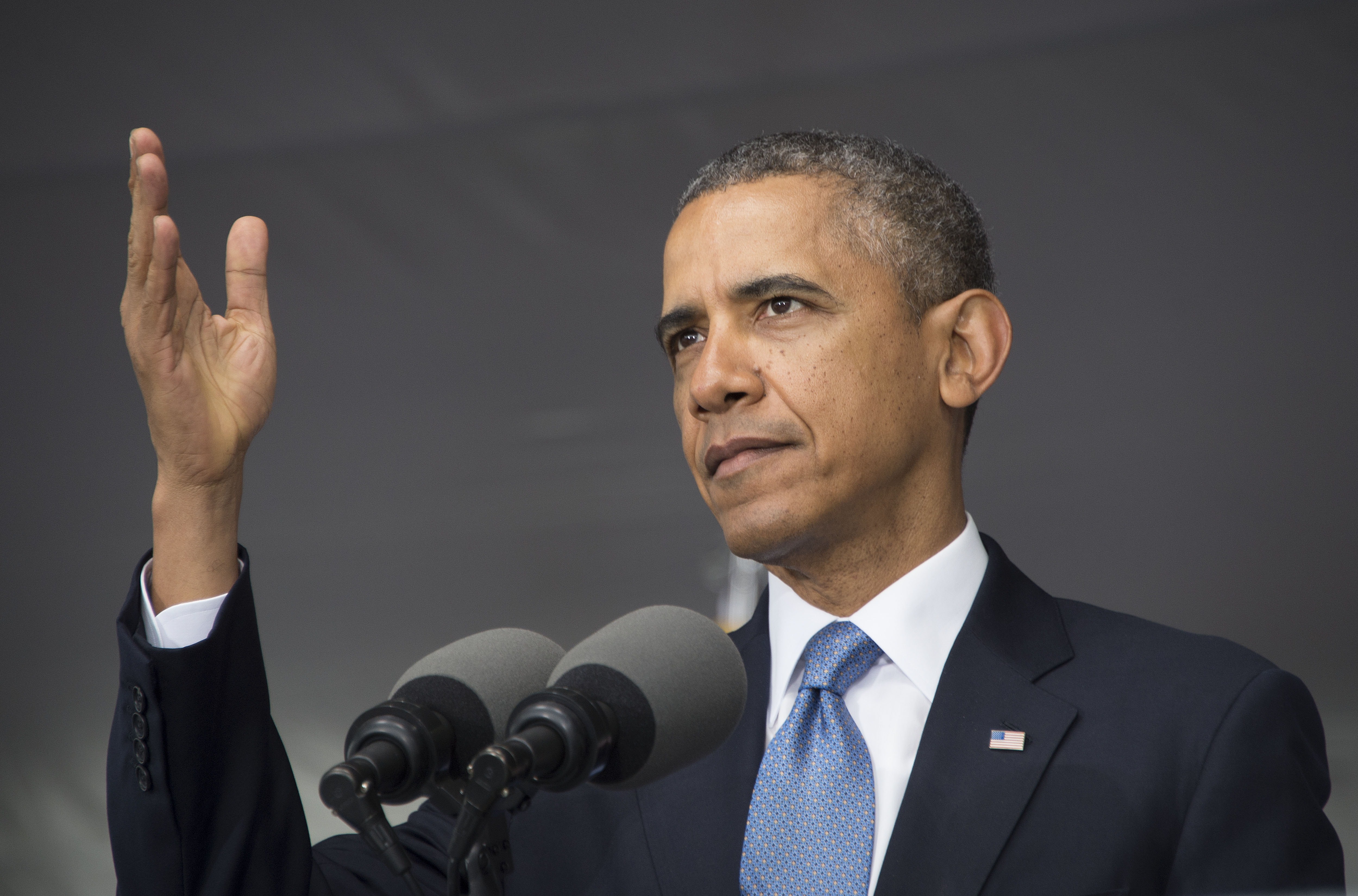
(Photos: President Obama at West Point; Seen through splintered bullet-proof glass, US soldiers from 2-12 Infantry Battalion examine their damaged Humvee after an Improvised Explosive Device (IED) detonated on the vehicle, following a patrol in the predominantly Sunni al-Dora neighborhood of southern Baghdad 19 March 2007; posters on the streets of Iran, after the Abu Ghraib revelations. All by Getty Images.)

Dish Intern Wanted: Last Call For Applications

The deadline is tonight at midnight (EST), so don’t delay if you’re interested in applying. The e-mail address for your resumé and a (max 500-word) cover letter is apply@andrewsullivan.com. Full details below:

Dish Publishing LLC is seeking an all-purpose intern to handle both administrative tasks and contribute to the editorial process. The admin side of the job will include: dealing with press inquiries and permissions, helping with support emails, managing the staff calendar, taking notes during meetings, making travel arrangements, and generally assisting the executive editors and me with sundry tasks. Strong organizational skills and attention to detail are musts. You need to be self-starting and pro-active in getting shit done.howler beagle

The editorial side of the job will consist of ransacking the web for smart and entertaining nuggets, maintaining our social media presence, working on larger research projects, and helping the team guest-blog when yours truly takes a vacation. We prefer individuals who can challenge me and my assumptions, find stuff online we might have missed, and shape the Dish with his or her own personal passions. Reporting experience is also a big plus as we try to deepen our coverage. Someone with a background in web entrepreneurialism could catch our eye too.

The full-time internship pays $10 an hour, includes health insurance, and lasts for six months. The position is based in New York City. Since the Dish doesn’t have an office, most of the work will be done from home, but the staff meets regularly for lunch and coffee meetings and social gatherings.  I want to emphasize that this is an intense job for the intensely motivated, and one that can get a little isolating at times. But it’s a pretty unbeatable chance to learn what independent online journalism can be as an integral part of a close-knit team. We’ve decided to pare down to one intern to keep our lean budget under control, which means the one individual really does have to be special. You have to already know what we do here and care deeply about the Dish. And a sense of humor is a real asset.

The start date is July 7, but we are flexible.

The Economy Shrank Last Quarter

GDP Change

Bummer:

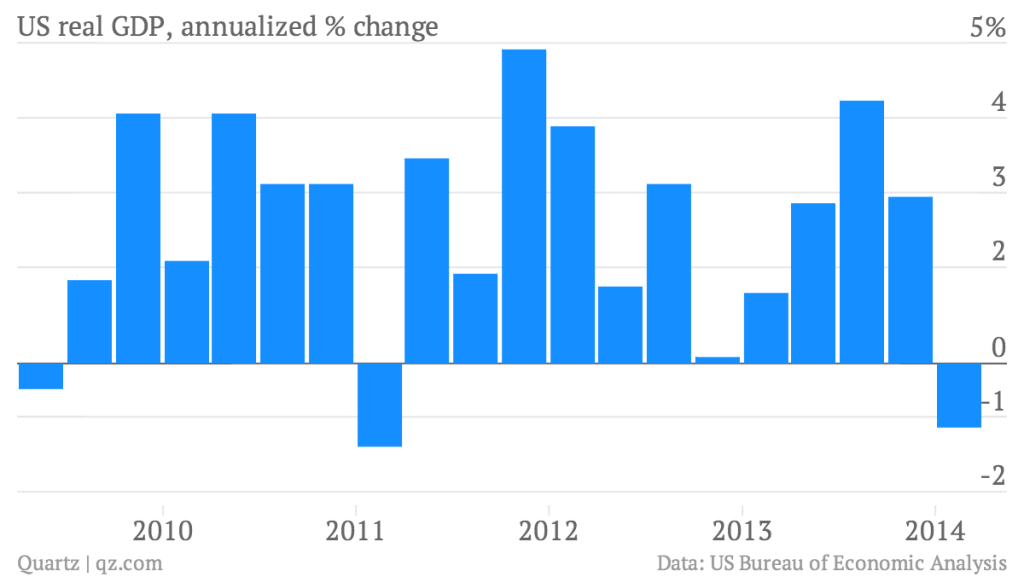
First quarter GDP slowed at an annual rate of -1.0% — worse than the initial estimate of 0.1% growth. It’s the first time since early 2011 that the economy has shrunk, mostly due to business inventories, construction and exports last quarter. Consumer spending actually rose by 3.1%, bolstered by strong health-care spending.

Ylan Q. Mui adds:

Businesses depleted their inventories and cut back on investment in the first three months of the year, while harsh winter weather curtailed construction. … The decline highlights the fragility of the nation’s recovery but is not likely to derail it altogether. Several forecasts for the current quarter show the economy growing at a healthy 3 percent annual rate or faster.

Matt Philips, who provides the above chart, finds that the markets are unfazed:

And that’s as it should be. For one thing, this is old news. Everyone already knew, from a string of previous data, that a brutal stretch of bad weather had hit consumption and other bits of the economy. And the fact that people stayed home to keep warm for the first three months means there’s a bunch of pent-up demand that should bolster the economy going forward. We’re already seeing that play out in the US job market, which has posted employment growth of over 200,000 a month for the last three months. (In April the economy created a particularly peppy 288,000 jobs.)

Ben Casselman puts the report in context:

This kind of contraction isn’t unheard of, but it is unusual. This is just the 10th time since World War II that GDP growth has been negative outside of a recession. Three of those negative quarters immediately preceded recessions. (The National Bureau of Economic Research defines a recession as “a significant decline in economic activity spread across the economy, lasting more than a few months.” A common rule of thumb is that a recession involves two consecutive quarters of economic contraction, although that isn’t part of NBER’s official definition and not all officially recognized recessions have met that test.)

McArdle sees this as “a sign of an economy that is still very weak”:

It has been six years since the financial crisis. Federal government spending is still around 21 percent of GDP, up from 19 percent in 2007, and the Federal Reserve still has a very expansive monetary policy. Under those circumstances, a quarter of negative growth is pretty unsettling.

The most recent jobs numbers are more encouraging — but not all that stellar this far away from the crash. Six years in, employment is barely back to where it was, which means that it hasn’t even kept pace with population growth.

Reihan joins the conversation:

The federal government is not directly responsible for the overall growth rate of the American economy, regardless of what politicians claim. It does, however, play a large role in creating the conditions for business enterprises to invest and grow. And it’s not doing its job well.

Daniel Gross examines the big picture:

We live in an age of long business cycles. The last two economic expansions lasted 73 months and 120 months, respectively. Within those long stretches of growth, there were quarters when the economy grew rapidly and quarters in which it shrank or flat-lined. A bar chart showing quarterly GDP growth resembles the teeth of a saw, not a picket fence. The key is to focus on the long-term. And the long-term trend of growth—unsatisfying, sub-par, sub-optimal, and insufficient growth—is still intact. Next week, the expansion will enter its 59th month since the end of the Great Recession.

Striving While Black

Recent African-American college grads have a harder time finding work than their white counterparts:

In 2013, the most recent period for which unemployment data are available by both race and educational attainment, 12.4 percent of black college graduates between the ages of 22 and 27 were unemployed. For all college graduates in the same age range, the unemployment rate stood at just 5.6 percent. The figures point to an ugly truth: Black college graduates are more than twice as likely to be unemployed. …

[Economist John] Schmitt pointed to a series of studies that have in recent years found that when trained sets of black and white testers with identical resumes are sent on interviews, white men with recent criminal histories are far more likely to receive calls back than black men with no criminal record at all. In fact, the center’s study found that even black students who majored in high-demand fields such as engineering fare only slightly better than those who spent their college years earning liberal arts degrees.

The Kids Are Alright Already!

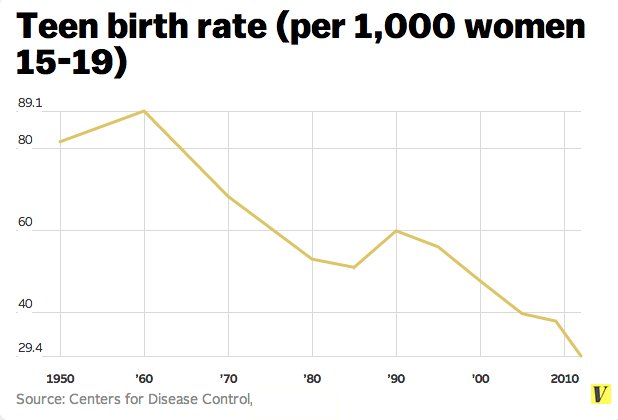
teen_birth_rate

Sarah Kliff voxsplains:

The Centers for Disease Control released a monster report last week on the state of Americans’ health. The 511-page report makes one thing abundantly clear: teens are behaving better right now than pretty much any other time since the federal government began collecting data. The teen birth rate has plummeted in recent decades. Separate data shows this has coincided with dramatic drops in the teen abortion rates. The decline in teen births has also happened at a time when teenagers have gotten better at using contraceptives.

Russell Saunders cheers:

What this says to me is that, despite their reputations as hell raising hedonists with an immortality complex, teenagers are capable of absorbing information about keeping themselves safe and healthy. It speaks to the importance of comprehensive sex education programs, which provide teenagers with the facts they need to take care of themselves.

But he has a bone to pick with Vox:

In presenting those data, they summed it up with the headline “Today’s teenagers are the best-behaved generation on record.” However, the report contains no information about how frequently today’s adolescents call their grandmothers or turn in their homework on time. They haven’t collectively sat through a poetry reading and clapped politely at the end—they’ve demonstrated healthier choices than their parents’ and grandparents’ generations. Presumably health information about those latter age groups wouldn’t be framed in such a condescending manner.

Meanwhile, Drum speculates about the role lead exposure may have played:

What’s happening today isn’t an aberration. Teenagers from the mid-60s through the mid-90s were the aberration. We managed to convince ourselves during that era that something had gone permanently wrong, but it wasn’t so. The ultra-violent gangs and reckless behavior that became so widespread simply wasn’t normal, any more than expecting teenagers to sit around in kumbaya circles would be normal. Nor had anything gone fundamentally wrong with our culture. It was the result of defective brain development caused by early exposure to lead.

I’ll never be able to prove this. No one ever will. The data is simply not rich enough, and it never will be. Nevertheless, what evidence we do have sure points in this direction.

Much more Dish on Drum’s pet issue here.

Ukraine’s Refugee Crisis

Maxim Eristavi shines a light on it:

The death toll in eastern Ukraine, where the vast majority of the fighting has taken place, has climbed to well over 200, making this the most violent crisis Ukraine has seen since World War II. The number of internal refugees also continues to rise rapidly. The United Nations High Commissioner for Refugees (UNHCR) says the crisis has displaced an estimated 10,000 civilians; most are from Crimea, and almost one-third are children. Ukrainian activists in Donetsk say that the amount of internal refugees from their region might also be in the thousands, but it’s harder to measure because unlike Crimeans, internal refugees don’t have to cross a border.

The internally displaced Ukrainians can’t count on the state to help them, either:

The Ukrainian parliament has taken some steps to ensure that refugees have access to basic social services and shelter. For instance, a new law regarding the rights of displaced persons helped thousands of refugees from Crimeathe vast majority of whom are Crimean Tatarssettle in other parts of Ukraine. But those who have fled eastern Ukraine can’t turn to the government for help. If the Rada were to vote on a bill helping displaced persons from within Ukraine’s borders, it might be taken as a sign that Kiev has lost control over eastern Ukraine once and for all. So refugees from the east must count on friends or strangers for help.

Ways The World Is Getting Better

Income Developing World

Here’s one:

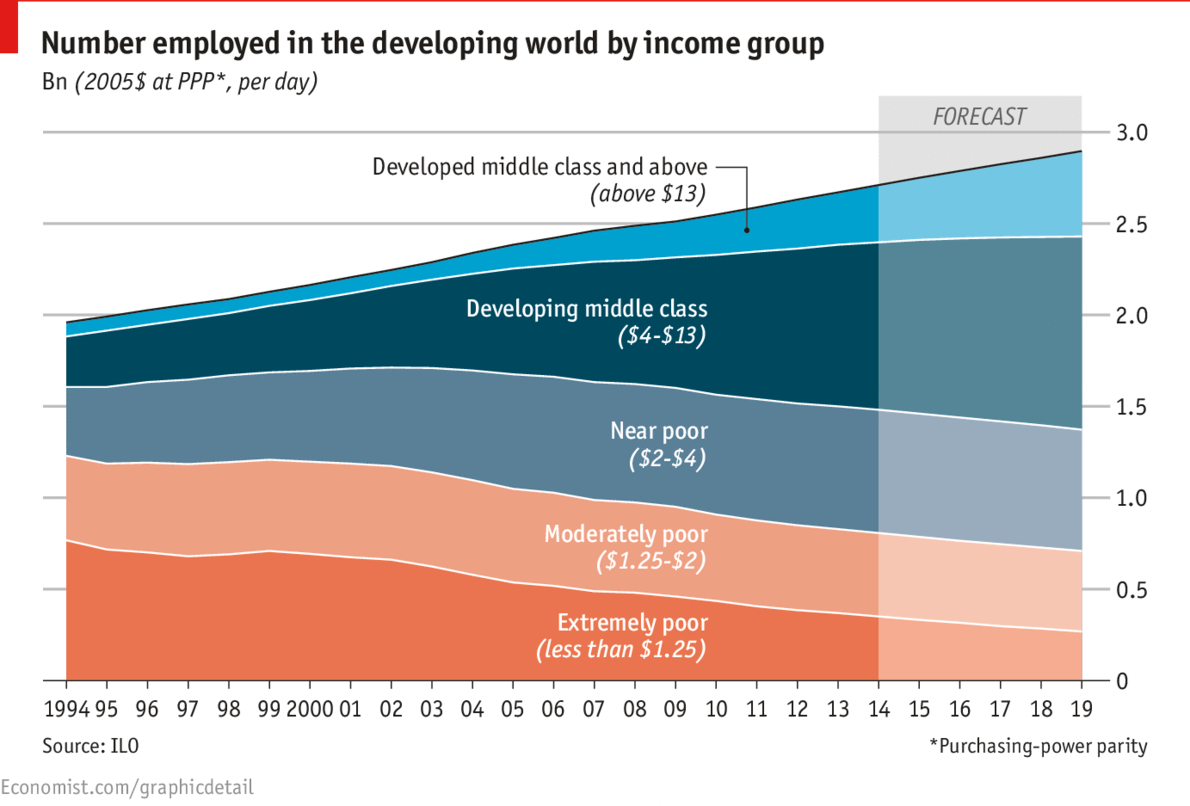
 “For the first time in history, over the next several years, most new jobs in the developing world are likely to be of sufficient quality to allow workers and their families to live above the equivalent of the poverty line in the United States,” states the [International Labour Organisation].

Relatedly, reviewing Bjørn Lomborg’s How Much Have Global Problems Cost The World?: A Scorecard from 1900 to 2050, Yevgeniy Feyman concludes, “There has never been a better time to be alive”:

The doubling of human life expectancy is one of the most remarkable achievements of the past century. Consider, Lomborg writes, that “the twentieth century saw life expectancy rise by about 3 months for every calendar year.” The average child in 1900 could expect to live to just 32 years old; now that same child should make it to 70. This increase came during a century when worldwide economic output, driven by the spread of capitalism and freedom, grew by more than 4,000 percent. These gains occurred in developed and developing countries alike; among men and women; and even in a sense among children, as child mortality plummeted.

Why are we living so much longer? Massive improvements in public health certainly played an important role. The World Health Organization’s global vaccination efforts essentially eradicated smallpox. But this would have been impossible without the innovative methods of vaccine preservation developed in the private sector by British scientist Leslie Collier. Oral rehydration therapies and antibiotics have also been instrumental in reducing child mortality. Simply put, technological progress is the key to these gains – and market economies have liberated, and rewarded, technological innovation.

TMI For Teacher

Adjunct professor Sarah Marshall is struck by her students’ eagerness to share the intimate details of their lives:

In their writings, in our class time, and in their meetings with me, students tell me about their pasts, their aspirations, their medical and mental health emergencies; about family tragedies and abuses they have survived; about their sexualities, their identities, their relationships, and their fears. I do not ask them to tell me any of this, but they offer it freely, as if they have simply been waiting for someone to tell. …

This happens because I am in a position of authority, but I am also deeply non-threatening for being a young, blonde woman who smiles a lot. I can’t strike fear into anyone’s heart, and certainly this has a great deal to do with my age and gender, but it also means that I benefit from a very specific kind of privilege. White male privilege means the gift of easy authority and confidence, among other dubious rewards. White female privilege means being viewed as harmless, innocuous, and safe to confide in.

Hathos Alert

A reader calls it “the Platonic Ideal of a Hathos Alert”:

It’s a music video by a trio of celebrity-inspired plastic surgery addicts (one of which has recently gained some Internet notoriety for turning himself into a sort of grotesque Hieronymus Bosch version of Justin Bieber) crowing about how exceptional they are. This will be one of the artifacts future generations will use to diagnose our civilizational collapse.

China’s And America’s Common Enemy

In the fight against global warming, Jonathan Cohn sees room for cooperation:

In recent years, the Chinese have imposed fuel mileage and appliance efficiency standards, similar in many respects to those in the U.S. Just this week, officials in Beijing announced that the government would be taking another 5 million aging cars off the nation’s road. China has also set up pilot versions of tradable pollution permits—in other words, “cap-and-trade” schemes—for various industries. Officials say they hope to make these nationwide soon. And one reason the Chinese government was so eager to sign that massive new deal with Russia, allowing the import of natural gas, was because it’s desperate to find alternatives to coal. “For a long time, opponents [of new regulations] said we’ll get hoodwinked, because China won’t do anything,” says David Doniger, director of the Climate and Clean Air Program at the Natural Resources Defense Council. “That’s just not true.”

China’s behavior may seem surprising. It shouldn’t. China has a major air pollution problem, causing all kinds of very immediate and very tangible health and economic problems. Efforts to reduce the sources of these noxious particles dovetail naturally with efforts to reduce carbon emissions.

Gwynn Guilford points out that China is already sacrificing economic growth to combat pollution:

[R]ecent analysis of economic data by Wei Yao, an economist at Société Générale, found that “Chinese policymakers are getting serious about air pollution.” So serious, in fact, that those efforts are already hurting GDP performance—something the government has so far shown to be its biggest priority. Yao says GDP will slow 0.35 percentage points cumulatively from 2014 to 2017 because of air pollution mitigation efforts, and she expects the economy to take the biggest blow this year.

Kate Galbraith rattles off reasons why eliminating pollution is such a priority for China:

Beyond individuals’ physical and mental health, the pollution fiasco matters because China wants to transition its cities to modern, service-oriented economies filled with software entrepreneurs, health experts, and international financiers. “Under the old plan, where China’s get-rich plan was based on dirty manufacturing,” environmental concerns didn’t matter, says Matthew Kahn, a professor at UCLA’s Institute of the Environment and Sustainability.

Now, China wants to send manufacturing inland and lure Davos and Silicon Valley types to its big coastal cities. But such people have choices, says Kahn, and Beijing’s allures of cuisine and culture, universities and government, will matter far less if people are afraid for themselves and their children. Even Shanghai, thought to be cleaner than Beijing, suffered its own Airpocalypse in December, a few months after the government grandly established a Shanghai Free Trade Zone to woo the foreign financial sector.