“A Herd Of Unicorns”

ReligiousDifferences
 

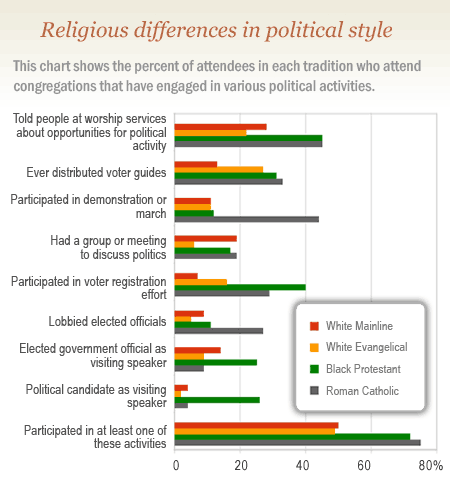
Douthat points me to this post by Mark Chaves, Professor of Sociology, Religion, and Divinity at Duke University. Chaves claims conservative white Protestant churches are less politically active than black Protestants or Catholics. This inspires Joe Carter to quip that political Evangelicals are "a herd of unicorns: powerful and abundant in the imagination while not actually existing in the real world." Chaves:

[N]otwithstanding extensive media coverage of political mobilization within conservative churches, conservative white Protestant churches do not stand out in their level of political activity. Catholic and black Protestant churches, overall, are more politically active than either liberal or conservative white Protestants. About three-quarters of Catholics and black Protestants attend churches that engaged in at least one of these eight political activities, compared to about half of white Protestants, either conservative or liberal (Synagogues’ political activity rates, by the way, are as high as the Catholic and black Protestant rates).

He continues:

It is difficult to say why religious groups have such different political styles. Congregations in highly centralized denominations may do politics differently than independent congregations or congregations in decentralized denominations. Religious groups also focus on different issues, and perhaps different issues elicit different political strategies and tactics. More broadly, religious groups differ in the kinds of church-based political actions they consider appropriate. All of these factors probably shape a religious group’s political style.

In any event, differences among religious groups in how they do politics seem more important than differences in how much politics they do.

Carter adds:

[W]e evangelicals still haven’t caught up on issues of the sanctity of life. Come to the annual March for Life held in Washington, D.C. every January and you’ll find fifty Catholics for every evangelical. For Catholics it is a moral, spiritual, and political issue. For evangelicals it nothing more than an emotional issue that we aren’t really dedicated to doing much about. I suspect that there were more evangelicals that participated in the recent Tea Party protests than have every participated in the March for Life. (And speaking of the Tea Party movement, could any evangelical group or groups ever muster that level of support about anything.)

The Case For Pardoning Bush

Bernstein repeats his position:

[R]egulars know that I believe the least costly way out of it is pardon-plus-commission.  Maybe that's not the answer; maybe someone else has a better idea.  As appealing as patience and muddling through might seem, however (and we know the president's instincts are often for just that, and in many areas those instincts serve him well), I just don't see it working in this area.  I don't see how you can run a foreign policy when stories such as this one are in newspapers around the world, and the President of the United States isn't doing anything about it — and the loudest voices in the out-party are applauding torture and kidnapping.   Really, I'd love for someone to show me a path in which benign neglect works — not morally, since it obviously doesn't, but pragmatically. 

The iReligious Wars

APPLESTORECameronSpencer:Getty

Edward Tenner sees the closed architecture of the new Apple to be unsurprising given its history:

Over 15 years ago, at the dawn of the Web, Umberto Eco observed that the Mac was Catholic in its gentle, aesthetically "sumptuous" guidance, DOS Protestant in its burdens on the individual, and Windows a kind of Anglican compromise. (Linux and open source, which appeared after this essay, might be compared to the more radically democratic Reformation movements.) So perhaps the early Mac enthusiasts misunderstood the deepest foundations of Apple's culture. Wasn't Mr. Johnson's preferred metaphor, the enclosed garden, a theme of the Song of Songs that became one of the most beautiful literary and visual images of (and sometimes metaphors for) the medieval Church?

In my utopian vision of a living Catholicism, our new churches would look like Apple Stores.

(Photo: Cameron Spencer/Getty.)

The WikiLeaks Agenda, Ctd

Freddie DeBoer takes issue with Colbert breaking character while interviewing the Wikileaks founder:

It's a funny world we live in. Colbert has an opinion on whether or not what is revealed in that video is murder. He's entitled to it. Strange to see him step out of character; this, I take it, was a bridge too far, a crime too great to ignore: calling soldiers who fired round after round onto people attempting to load the wounded into a van and get them medical attention "murderers," well, that's past irony and shtick. That requires open and unequivocal condemnation.

It's funny– I consulted older videos of Colbert, online. He has spoken to members of Congress who voted for the war in Iraq several times. He has interview many who were involved in the apparatus of enacting the Iraq war, or who lent their considerable influence to the war effort. He has interview, that is to say, the people who created the material conditions where the victims of this attack were placed in harms way, where the soldiers involved were placed in danger of losing both their lives and their moral integrity. That's war, I'm told; you shouldn't wage it without being willing to risk atrocity.

UK Reality Check

The Tories need 326 seats to win a majority. The current polling suggests they're close to 333, but the impact of the Tories' lazer-focus on marginal seats makes this a guess. Meanwhile, the Liberal Democrats have unveiled their manifesto. Check it out here. When I filled out this questionnaire on policy positions, it turned out that I was regarded as 45 percent Lib Dem and 44 percent Tory, with 37 percent Labour. I suspect that's my civil liberties bent and fiscal conservatism coming through.

I'll be live-blogging the first Prime Minister's Debate in British history tomorrow afternoon – and commenting on BBC America's World News (my only non-Comedy Central TV news source) tomorrow evening.

What Cameron And Brown Share

It is, actually, a rather striking coincidence: two men vying to be prime minister of Britain have both lost children. Cameron lost his six-year-old disabled son only a year ago; Brown's wife gave birth to a severely premature child who lived only ten days. The two men have expressed emotion in public about their loss and the world-weary Brits have rolled their eyes. Not Wife In The North:

My child (stillborn at term) would be 10 if I hadn't lost him. Lost him like a sock or glove or pair of spectacles for reading. Just like that. But worse. And what these pundits don't understand is Brown and Cameron don't have a choice to talk or not to talk, to weep or not to weep, because the life and death of their children runs right through them.

Tragedy defines them more than any manifesto ever could. Whatever power each man holds or chases, he would abandon it all, without hesitation, for just one more day with his lost child.

He would sell his own soul for his lovely political wife never to have had her heart broken up into ugly pieces that no policy or strategic thinking – however clever and well-meaning – could ever mend. These party leaders may day-dream of glory, but at night they dream of sons and daughters they can no longer hold.

They are not wrong to talk about it, they are right. Unspoken griefs twist and turn and do not grow smaller for darkness and a lack of air. They speak their children's names and they tell of their sorrows because to do otherwise would be to deny those children, it would be to say those children came and went, and that coming and that going did not matter in the scheme of things. Honesty in politicians – isn't that a good thing?

Hope For The MSM

If they try, they can print the truth. It just takes one word – "incorrectly":

U.S. military officials tell NBC News that the U.S. Army will court martial a lieutenant colonel who refuses to deploy to Afghanistan because he considers orders from President Obama to be "illegal." Army doctor Lt. Col. Terry Lakin believes Obama does not meet the constitutional requirements to be president and commander-in-chief, because he believes (incorrectly) that Obama wasn't born in the United States.

It had to go in parentheses, but it's a start.

Congress, Americans, And Israel

AIPAC gets 76 Senators and 333 Congressmen and women to back Netanyahu's far-right coalition in its public fight with the president of the United States. Now, take a look at Jewish-American public opinion:

[Obama] also scores 55 percent approval on how he handles U.S.-Israel relations, which is virtually unchanged since last September, when his handling of the relationship scored 54 percent approval.

General American opinion on how to handle the regional conflict shows solid support for president Obama's insistence that Israel stop building settlements in East Jerusalem and the West Bank:

52% of Americans support, and 31% oppose, the Obama administration’s demand that Israel stop all settlement-building. 62% of those polled said the growth of Israeli settlements in occupied Palestinian territory will only lead to greater hostilities. 52% of respondents support, and 31% oppose, the Obama administration’s demand that Israel stop all settlement-building. 53% thought the US should be ready to get tough with both sides in peace negotiations if necessary, while only 33% disagreed.

So 31 percent of Americans oppose their president's handling of Israel, but 75 percent of Senators and Congressmembers do. 52 percent of Americans back their president in a tough negotiation with a foreign leader, but 75 percent of the Congress back the foreign leader against the president.

What explains this remarkable discrepancy?