Map Of The Day

system_1972

A giant of the design world died today:

An avowed modernist, [Massimo] Vignelli is also famous for having said, “If you can design one thing, you can design everything.” And even if you aren’t a design nerd, you’ve been looking at Massimo’s work for decades now, especially if you live or lived in New York: together with his wife Lella, he branded American Airlines, Ford, and Bloomingdales with the logos we know them for today. They also designed Fodor’s travel guides, furniture you’ve probably sat on, and plastic housewares you’ve probably used. The two were recently featured in the documentary Design Is One, which if you can get a hold of, is delightful.

Graphic designer Michael Bierut was a young mentee of Vignelli:

Today there is an entire building in Rochester, New York, dedicated to preserving the Vignelli legacy. But in those days, it seemed to me that the whole city of New York was a permanent Vignelli exhibition. To get to the office, I rode in a subway with Vignelli-designed signage, shared the sidewalk with people holding Vignelli-designed Bloomingdale’s shopping bags, walked by St. Peter’s Church with its Vignelli-designed pipe organ visible through the window. At Vignelli Associates, at 23 years old, I felt I was at the center of the universe.

Joe Cascarelli, quoting from the NYT writeup of Vignelli’s death, provides background on the iconic map seen above:

[W]hen the Metropolitan Transportation Authority released his new subway map in 1972, many riders found it the opposite of understandable.

Rather than represent the subway lines as the spaghetti tangle they are, it showed them as uniform stripes of various colors running straight up and down or across at 45-degree angles — not unlike an engineer’s schematic diagram of the movement of electricity.

What upset many riders even more was that the map ignored much of the city above ground. It reduced the boroughs to white geometric shapes and eliminated many streets, parks and other familiar features of the cityscape.

It was replaced by 1979. “Look what these barbarians have done,” Vignelli said of the map in 2006. “All these curves, all this whispering-in-the-ear of balloons. It’s half-naturalist and half-abstract. It’s a mongrel.”

Examining the 2008 update, he added, “We belong to a culture of balloons. [The designers] grow up with comic books, and this is what happens. There’s balloons all over the place. It’s ridiculous.”

But of his 1972 creation — a “diagram,” he called it, because maps are for geography — Vignelli said, “Of course I know Central Park is rectangular and not square. Of course I know the park is green, and not gray. Who cares? You want to go from Point A to Point B, period. The only thing you are interested in is the spaghetti.”

For more Vignelli quotes, Popova plucked many from interviews he gave to Debbie Millman for her book, How to Think Like a Great Graphic Designeras well as her podcast, Design Matters.

The Turning Tide Against Male Turtles

Mike Pearl points to it:

A study published on Sunday in Nature Climate Change gave us the news that climate Israeli Ecologists Struggle To Protect Mediterranean?s Turtleschange is bringing about a higher proportion of female sea turtles to males, thanks to a seemingly idiotic genetic quirk called temperature-dependent sex determination (TSD), also found in a few other species. Essentially TSD gives the turtles a baseline temperature of 84.2 degrees, at which there are 50/50 odds of being male or female. Beyond a certain threshold of heat, too few males will exist [to] the sustain the population. …

The authors of the study found that in the short term, turtle numbers are actually going to increase. The study looked at one species: loggerheads, on the island chain of Cape Verde off Africa’s west coast, and modeled what’s going to happen to them during 150 years of irrevocable temperature increase. The good news is that the increasing number of female turtles—who do the risky work of carrying the eggs to the island of their birth and laying them in hidden nests—will increase the overall number of turtles for the next 30 years.

(Photo: A Loggerhead turtle hatchling begins its life-long sojourn in the Mediterranean Sea soon after it was freed by Israeli ecologists after being trapped in its 40 cm deep nest at a protected hatchery on Betzet beach, at first light near the northern Israel town of Nahariya on August 24, 2006 . By David Silverman/Getty Images)

Can Pakistan And India Make Nice?

Yesterday’s inauguration of India’s new prime minister Narendra Modi was marked by the surprising appearance of his Pakistani counterpart Nawaz Sharif. Isaac Chotiner isn’t sold on the theory that “someone like Modi, known for his nationalist views and aggressive posture, might find it easier to negotiate peace with Pakistan”:

Modi is surrounded by extreme hardliners; he has used Pakistan in the past to make alternately silly and demagogic remarks; and his constant nationalistic rhetoric is the type that often goes hand-in-hand with aggression on the world stage. As for the invitation to Sharif, it isn’t clear whether it was made because Modi genuinely wants peace and increased ties, or because he wanted to cause Sharif political difficulties. (Sharif’s decision to accept Modi’s invitation was controversial in Pakistan.) If there is another Pakistani-supported terrorist attack, such as the one on Bombay in 2008, Modi would likely respond very forcefully, as the previous government did not.

The mention of Pakistani aggression against India recalls the greatest barrier to peace, and it isn’t Modi. Pakistan’s powerful military has already halted Prime Minister Sharif’s moves toward establishing closer ties with India.

Bruce Riedel notes the challenges Sharif faces from Pakistan’s “deep state”:

Modi has pledged to seek better relations with Islamabad but only if it cracks down seriously on the deep state’s patronship of terror. He has significant potential economic carrots and sticks to use with Sharif, who knows Pakistan needs to dramatically improve trade with India if it is to get its own economy moving.

But Sharif is also very aware that the last time he was prime minister, he tried to get peace talks moving with India—only to be sabotaged by the deep state.  Early in 1999 Sharif invited then-Prime Minister Atal Vajpayee to Lahore to talk about reducing tensions. Less than six months later Sharif’s army chief, Pervez Musharraf, broke the cease-fire in Kashmir and started a small war around the town of Kargil.  The small war threatened to escalate into a full-scale catastrophe with nuclear weapons until Sharif bravely came to Washington on July 4th and was persuaded by President Bill Clinton to unilaterally pull back the Pakistani army behind the cease-fire line. By the end of 1999 Sharif had been overthrown in a coup by Musharraf. The deep state had triumphed.

Pointing to an attack on the Indian consulate in Herat, Afghanistan, last Friday, Paul Staniland weighs Modi’s “limited” options for dealing with Pakistani terrorism:

Modi can try to reach out to Pakistani civilian leaders in hopes of splitting them from a skeptical military, but this has been India’s strategy in the past with little success. “Spoilers” like the Haqqani network and Lashkar-e-Taiba have repeatedly undermined India-Pakistan rapprochement. Pakistan’s powerful army seems to be in no mood for a deal with New Delhi, viewing India as a rising power now run by a Hindu chauvinist, and regularly alleging that India is supporting militant groups along the Afghan-Pakistan border. Simmering civil-military tensions over media freedom and policy toward the TTP have limited Sharif’s ability to deliver on policy change.

India cannot credibly threaten military retaliation. As Vipin Narang has shown, Pakistan’s mixture of conventional and nuclear forces is intended to rapidly escalate any conflict, making Indian ground or even air strikes extremely risky. … In the face of these constraints, we are likely to see a two-pronged Indian strategy. First, outreach to Pakistan’s civilians will continue. Modi has a commanding majority and hard-liner credibility that limit his vulnerability to domestic criticism. Sharif is believed to be interested in improving ties with India, and there is always a chance that he and Modi can craft some forward progress. Second, India is likely to expand its overseas intelligence operations in Afghanistan and Pakistan.

Documenting Density

dish_megacities

The megacities in China captured by German photographer Michael Wolf are “as surreal as they are kinda terrifying,” states Tom Hawking. Wolf describes his project in an interview with Vice:

First off, what’s a megacity?

Cities that have a population with more than 5 million. I wouldn’t really consider any European city a megacity. Paris has a population of 2 million, whereas in China, for instance, a city with 3 million is considered small. I’m talking about populations of 5, 10, 20 million—up to 25 million.

Why do they look so depressing in your photos?

Well, some things about megacities have a lot of downsides. These are profit centers. The people who run them are not really concerned about the populations that live in them. They are concerned about making money. So on the one hand they are very intimidating and frightening but on the other hand they are extremely beautiful. In The Architecture of Density (his photo series featuring an extremely dense Hong Kong high-rise), you can almost see them as a tapestry.

How he describes the message of his work:

I’ve always been a social liberal. I’ve always been for the underclass. For example, I did a project called 100×100 where I photographed 100 apartments in a Hong Kong building that was about to be demolished, all measuring ten feet by ten feet. I am showing the living conditions of the city—but again, I’m looking at the vitality and resourcefulness of the people. They are everyday human beings and that’s what I am trying to document.

Previous Dish on Wolf’s work here.

Did Slavery Make Whites Poorer?

In a response to TNC’s reparations essay, Tyler Cowen suspects so:

I would suggest that most living white Americans would be wealthier had this nation not enslaved African-Americans and thus most whites have lost from slavery too, albeit much much less than blacks have lost.  For instance it is generally recognized that freer and fairer polities tend to be wealthier for most of their citizens.  (We may disagree about what “fair” means for many issues, but slavery and its legacy are obviously unfair.)

More specifically, many American whites benefited from hiring African-American labor at discrimination-laden discounted market prices, but many others lost out because it was more costly to trade with African-Americans.  That meant fewer good customers, fewer eligible employees, fewer possible business partners, fewer innovators, and so on, all because of slavery and subsequent discrimination.

Cowen concedes that there “is still a moral case for reparations even if most American whites have lost from slavery rather than benefited.” But he thinks “this analysis makes slavery out to be all the more destructive, and reparations to be all the more unlikely.” Recent Dish on TNC’s cover-story here and here.

Thailand’s Love Of Coups

THAILAND-POLITICS

General Prayuth Chan-Ocha, the leader of last week’s coup d’etat in Thailand, announced yesterday that the coup had received the blessing of King Bhumibol Adulyadej. Ritika Singh considers the “convoluted” relationship between the monarch and the military a big part of the country’s problem:

The ailing King, who enjoys prestige in Thailand that is hard for Westerners to understand, has been largely absent from this recent political crisis. There has been speculation about his role behind the scenes, but his lack of open involvement—unlike in previous crises—could actually have exacerbated this situation. The monarchy and the military have been intricately tied together for decades, and the King has supported many of the coups that have plagued Thailand. At the end of the day, what the King wants, goes. Thais who believe that the King’s playing puppet master to the country is preferable to the machinations of inept politicians, again, do not see the long-term erosion of democratic institutions that this induces.

The Thai military’s adventurism in its country’s politics—and the popular support for it—demonstrates how complicated the problem of extricating the military from politics still is in many developing countries. Thailand is not alone here. It is one of the biggest hurdles to a democratic transition in Pakistan, Egypt, and other countries as well. If the role of the military and people’s attitudes toward it don’t change, the endless cycle of coups won’t change either.

Recalibrating his prognosis for Thailand, Jay Ulfelder expects that the “risk of yet another coup will remain elevated for several years.” Furthermore:

Thailand’s risk of state-led mass killing has nearly tripled… but remains modest.

The risk and occurrence of coups and the character of a country’s national political regime feature prominently in the multimodel ensemble we’re using in our atrocities early-warning project to assess risks of onsets of state-led mass killing. When I recently updated those assessments using data from year-end 2013—coming soon to a blog near you!—Thailand remained toward the bottom of the global distribution: 100th of 162 countries, with a predicted probability of just 0.3%. If I alter the inputs to that ensemble to capture the occurrence of this week’s coup and its effect on Thailand’s regime type, the predicted probability jumps to about 0.8%.

That’s a big change in relative risk, but it’s not enough of a change in absolute risk to push the country into the end of the global distribution where the vast majority of these events occur.

Uri Friedman sees Thailand as an example of a new trend, in which the middle class chooses stability through military rule over democracy with less certain outcomes:

[T]he Thai military’s express goal in seizing power this week was to restore political stability and economic growth. And the move followed massive anti-government protests, just like the coup in Egypt that overthrew Mohammed Morsi last year. In both Egypt and Thailand, the protest movements that prompted military intervention enjoyed support from middle- and upper-class citizens. These aren’t isolated cases. Joshua Kurlantzick, a fellow at the Council on Foreign Relations, has argued that around the world, a growing middle class “is choosing stability over all else,” and embracing “the military as a bulwark against popular democracy.”

The idea of a popular, “middle-class military coup” isn’t necessarily new—it has echoes in Latin America in the 1960s and 70s—but it’s making a comeback in the few coups we’re still seeing today, with troubling implications for democracy in the countries where they take place.

Jessica Schulberg contemplates the US response:

That the U.S. is now legally bound to do something that would be contrary to its interestsand not necessarily beneficial to the Thai peopleraises doubts about the utility of Section 508 of the Foreign Assistance Act [which requires cutting aid to countries that experience military coups]. “Laws that don’t have escape clauses, like national interest waivers or national security waivers, almost never work,” said a former State Department official. “All that happens is that the government will either deny the obvioussay it’s not a coupor if the government allows itself to be bound by it, it is deprived of the necessary flexibility in coping with each unique circumstance.”

(Photo: Roses given by coup-supporters decorate a military vehicle as Thai army soldiers stand guard at the Victory Monument in Bangkok on May 27, 2014. By Manan Vatsyayana/AFP/Getty Images)

How Germans Buy Drugs

Olga Khazan explains how Germany’s healthcare system has kept drug costs in check by refusing to pay extra for new medicines that don’t actually work any better than the old ones:

Almost every German belongs to one of some 160 nonprofit “sickness funds,” or nonprofit insurance collectives. The sickness funds cover both medical visits and prescription drugs. Drug prices there are already lower than in the U.S. because sickness funds negotiate with both physician groups and drug manufacturers to set costs of all treatments across the board. In the U.S., Medicare isn’t even allowed to negotiate lower drug prices. …

Enter 2010′s Pharmaceutical Market Restructuring Act, or Arzneimittelmarkt-Neuordnungsgesetz, abbreviated in German as AMNOG. As in “AMNOGonna pay drug companies for new meds that are more expensive but not any better than the old ones.”

Under AMNOG, as soon as a new drug enters the market, manufacturers must submit a series of studies that prove it heals patients better than whatever was previously available. If the new drugs don’t seem any better than their predecessors, the sickness funds will only pay for the price of the earlier version. Patients can still buy the newer medicine, but it’s up to them to make up the price difference out of pocket.

A Capital Cock-Up?

wealthinequalityinbritain590x378_1.jpg.CROP.promovar-mediumlarge

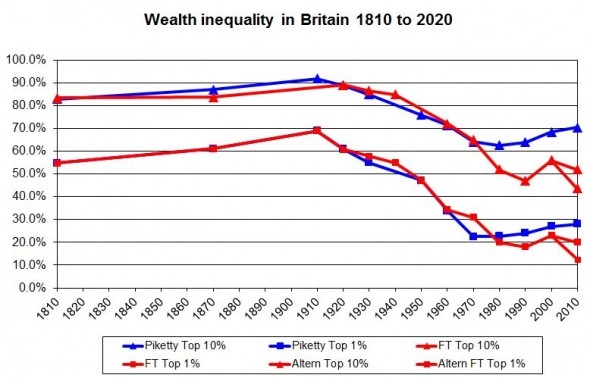
Last Friday, Chris Giles alleged on the pages of the Financial Times that Thomas Piketty’s Capital in the 21st Century contains major data errors that undermine his entire theory. Jordan Weissmann outlines Giles’ accusations:

First, it says Piketty has covered up a giant gap in America’s historical records on wealth concentration. “There is simply no data between 1870 and 1960,” the newspaper states. “Yet, Prof. Piketty chooses to derive a trend.” This charge is neutered a bit by the fact that Gabriel Zucman and Emmanuel Saez recently released a detailed analysis of U.S. wealth inequality dating back to 1913 that shows an even more dramatic increase than what Piketty found. But Piketty will nonetheless need to spell out how he reached his own conclusions in a bit more detail.

The much more important point of contention is Great Britain. The FT argues that Piketty’s graphs simply “do not match” his underlying data on the UK, and that official estimates show no significant increase in the country’s concentration of wealth since the 1970s. Once Britain’s corrected data is included in the picture, the FT argues, the evidence that wealth inequality is growing across Europe disappears.

“But,” Tim Fernholz interjects, “it’s not clear that Piketty’s analysis is entirely doomed”:


Giles says that he has refuted two of Piketty’s notions: That wealth inequality has begun to increase in the last 30 years, and that the US has a more unequal distribution than Europe. But Giles’ final chart, comparing US and European inequality, is ambiguous on this score. The chart is a mix of different datasets, some of which show wealth inequality appearing to increase—albeit so slightly that it might be a statistical error—after 1980. And some show that US inequality is higher than in Europe—even without including the Saez-Zucman data [here], where the effect is more pronounced …

By that reading, Piketty’s ideas could still be plausible, even though problems need to be rectified and further work is needed. No doubt many eager economics grad students are licking their chops.

Krugman is incredulous over Giles’ contention that there is “no obvious upward trend” in inequality:

I don’t know the European evidence too well, but the notion of stable wealth concentration in the United States is at odds with many sources of evidence. Take, for example, the landmark CBO study on the distribution of income; it shows the distribution of income by type, and capital income has become much more concentrated over time:

It’s just not plausible that this increase in the concentration of income from capital doesn’t reflect a more or less comparable increase in the concentration of capital itself. Beyond that, we have, as Piketty stresses, evidence from Forbes-type surveys, which show soaring wealth at the very top. And we have other estimates of wealth concentration, like Saez-Zucman, that use completely different methods but point to the same conclusion.

“Even if you believe that Giles’s findings dramatically change Piketty’s results,” Danny Vinik argues, “they have little bearing on his economic theory”:

Giles makes a passing comparison to economists Carmen Reinhart and Ken Rogoff (R&R), who drove a significant part of Republican austerity agenda, but saw their findings disproven in 2013. Liberals celebrated when Thomas Herndon, a graduate student from UMass Amherst, discovered a spreadsheet error in R&R’s results that invalidated their main finding. But unlike Piketty, Reinhart and Rogoff largely had no economic theory to ground their argument that national debt crises occur when a country’s debt level surpasses 90 percent of GDP. Once their data fell apart, their theory had no legs to stand on. On the other hand, Piketty fits data to this theory, but does not depend on it. Piketty’s theoryright or wrongis largely unaffected by these results.

Ryan Avent makes a similar point:

First, the book rests on much more than wealth-inequality figures. Second, the differences in the wealth-inequality figures are, with the exception of Britain, too minor to alter the picture. And third, as Mr Piketty notes in his response, Chapter 10 is not the only analysis of wealth inequality out there, and forthcoming work by other economists (some conclusions of which can be seen here) suggests that Mr Piketty’s figures actually understate the true extent of growth in the concentration of wealth.

Mike Konczal piles on, saying Giles misconstrues Piketty’s argument:

[R]ising inequality in the ownership of capital is not the necessary, major driver of the worries of the book. It isn’t that the 1% will own a larger share of capital going forward. It’s that the size and importance of capital is going to go big. If the 1% own a consistent amount of the capital stock, they have more income and power as the size of the capital stock increases relative to the economy, and as it takes home a larger slice. However, obviously, if inequality in wealth ownership goes up, it will make the situation worse. (It’s noteworthy that these numbers Giles is analyzing aren’t introduced until Chapter 10, after Piketty has gone through the growth of capital stock and the returns to capital at length in previous chapters.)

The way that Giles could put a serious dent into Piketty’s theory through this analysis is by showing that inequality of wealth ownership is falling in the recent past. This is not what Giles finds. He mostly finds what Piketty finds, except in England, where it’s flat instead of slightly growing in the recent past.

But Cowen takes the data problems seriously:

Now, when you cut through the small stuff, the new empirical problem seems to be that UK revisions, combined with a population-weighted series for Europe, contradicts Piketty’s claim of rising wealth inequality for Europe.  I would call that a serious problem.  I am not impressed by the “downplaying” responses which focus on coding errors, Swedish data points, and the other small stuff.  Let’s face up to the real (new) problem, namely that robustness suddenly seems much weaker.

In any case, Patrick Brennan believes that Piketty never made a convincing case for his general thesis:

Piketty set out to do something much more audacious than prove that income inequality is rising in the United States and in most wealthy countries — that’s relatively easy to prove, even if the increase has been substantially overstated. Rather, he wanted to show that this plays into a loop with increasing wealth that needs to be arrested by huge global interventions. One common objection to Giles’s skepticism tonight has been that increasing wealth inequality is simply an obvious fact of this world — why do we need the data to back it up? Well, Piketty needs the data to back up the arguments he made with it — he needs wealth inequality not just to appear high or to be rising, but to be returning to 19th-century levels as a matter of economic inevitability. The errors he made may not be devastating to the work he’s done to prove this so far, but even without taking them into account, he hasn’t yet justified his dramatic conclusions.

Lastly, noting that data errors are a fact of life in the social sciences, Nate Silver encourages skepticism of both Piketty’s argument and Giles’ critique:

The closest thing to a solution is to remain appropriately skeptical, perhaps especially when the research finding is agreeable to you. A lot of apparently damning critiques prove to be less so when you assume from the start that data analysis and empirical research, like other forms of intellectual endeavor, are not free from human error. Nonetheless, once the dust settles, it seems likely that both Piketty and Giles will have moved us toward an improved understanding of wealth inequality and its implications.

Previous Dish on Capital here.

What’s The Truth About Gluten?

A gastroenterologist well known for a 2011 study that “served as as one of the strongest pieces of evidence to date that [gluten intolerance] is a genuine condition” has backed down from that position:

A study [Peter] Gibson published last summer suggests that, when it comes to gut distress, gluten is getting a bad rap. The study focussed on thirty-seven people who identified themselves as having both NCGS [non-celiac gluten sensitivity] and irritable bowel syndrome (IBS), an ailment characterized by a range of gut issues, including diarrhea or constipation, bloating, and stomach pain. The subjects all said that they felt better when they avoided gluten. To test whether the protein was really to blame, Gibson put them on one of three diets: gluten-free, low-gluten, and high-gluten. Each diet consisted of the same foods; the only difference was the amount of gluten. … It turned out that gluten seemed to have no measurable harmful effects.

What gives? As Robert T. Gonzalez puts it, “it is the pursuit of more definitive scientific evidence that makes Gibson’s research so noteworthy”:

That Gibson’s team found no specific response to gluten is not surprising in and of itself. (News flash: Scientific research often appears to contradict itself. For more on this reality as it pertains to health research, see this timely NatGeo piece by Virginia Hughes on the ongoing effort to determine whether resveretrol – a compound found in red wine – is or is not good for you.) Rather, it was Gibson’s willingness to call his own research into question – his readiness to double back and reevaluate his previous research on more rigorous terms – that we found not only striking, but encouraging for the future of research in this area.

Which suggests that headlines like “Researchers Who Provided Key Evidence For Gluten Sensitivity Have Now Thoroughly Shown That It Doesn’t Exist” and “Being Gluten-Free is Dumb” may be oversimplifying matters a bit. As gastroenterologist William Chey says:

It’s really hard to design and execute studies that really separate out constituent effects of food. … We’ve still got a long ways to go.

So I’ll keep avoiding the wheat. Update from a reader I can definitely relate to:

As one of those reviled gluten-sensitive folks, those terrible headlines you mention are truly annoying, but I’m definitely all for more research on this topic! After years of extremely annoying and embarrassing rashes and hives, and then a negative test for celiacs, my doctor (who has celiacs) recommended I try a gluten-free diet for a month anyway, just to see. I went (mostly) gluten free in June 2013 and haven’t had a major rash since. The occasional beer or sandwich with real bread doesn’t seem to bother me, but when I go overboard (as I definitely did on a recent trip to Napa) I get the faint beginnings of hives and eczema-like rashes, which then go away after I’m good for a few days.

Is it all in my head? Is it something else in gluten-containing foods doing this to me? I’d love to find out, but in the meantime this works!

Another reader:

I thought I would write because anyone who read the reader comments might have got the wrong idea about celiac disease. Your reader referred to a negative test for celiac disease – presumably he/she meant the anti-transglutaminase antibody test. While that is a typical test done for celiac disease, it is not conclusive on its own. This link is from Dr. Fasano naming the 4-out-5-rule criteria. The gold standard test for celiac disease is the small bowel enteroscopy. I would also note that many patients with celiac disease think they are fine with a bit of gluten here and there based on symptoms, but that is actually very dangerous; it could lead to EATL – Enteropathy-associated T-cell lymphoma.

I have celiac disease as well as three generations of my family including my grandfather who died of cancer because of untreated celiac disease. Anyone who thinks they may have celiac disease should NOT go on a gluten-free diet before seeing their doctor. Please see any of the national celiac associations for more advice.