Are You A Multitasker? Probably Not.

Maria Konnikova explores psychologist David Strayer’s research on multitasking, which finds that only a small minority of people can really do it:

Strayer believes that there is a tiny but persistent subset of the population—about two per cent—whose performance does not deteriorate, and can even improve, when multiple demands are placed on their attention. The supertaskers are true outliers. According to Strayer, multitasking isn’t part of a normal distribution akin to birth weight, where even the lightest and heaviest babies fall within a relatively tight range around an average size. Instead, it is more like I.Q.: most people cluster in an average range, but there is a long tail where only a tiny fraction—single digits among thousands—will ever find themselves. …

The irony of Strayer’s work is that when people hear that supertaskers exist—even though they know they’re rare—they seem to take it as proof that they, naturally, are an exception. “You’re not,” Strayer told me bluntly. “The ninety-eight per cent of us, we deceive ourselves. And we tend to overrate our ability to multitask.” In fact, when he and his University of Utah colleague, the social psychologist David Sanbomnatsu, asked more than three hundred students to rate their ability to multitask and then compared those ratings to the students’ actual multitasking performances, they found a strong relationship: an inverse one. The better someone thought she was, the more likely it was that her performance was well below par.

A Disaster Written In Dirt

AFGHANISTAN-LANDSLIDE

With Afghanistan still reeling from the impact of last week’s devastating landslide, Joshua Keating notes that such calamities are on the rise:

According to research by David Petley, a geographer at Durham University, the number of casualties caused by landslides has been massively underestimated. In a 2012 paper for the journal Geology, he calculated that between 2004 and 2010, there were 2,620 fatal landslides around the world, killing a total of 32,322 people. As Nature points out, that means landslides kill far more people than wildfire and about half as many as floods. … Petley’s data seems to indicate that the number of landslides around the world is increasing, likely due to “increases in population, precipitation intensity, and environmental degradation.” In the case of Abi Barak, photos show that the slope near the town was likely unstable for some time, which means that this disaster was likely a foreseeable event that could have been avoided through management and monitoring.

(Photo: Villagers search through dirt at the site of a landslide in northern Afghanistan on May 5, days after the sudden earthfall trapped some 2,000 people underground. By Farshad Usyan/AFP/Getty Images)

Drug Tests Reduce Racism

That’s what a new study suggests:

Drug tests do disproportionately impact people of color, but not in the way the ACLU implies. Rather, economist Abigail K. Wozniak finds, drug testing is actually boosting employment for blacks, particularly those who who are relatively unskilled.

How’s that? To put it simply: In the absence of information, it seems that employers are susceptible to making racist assumptions about who uses drugs and who doesn’t. This suppresses black employment. But in places where drug testing is more common, black employment rises, seemingly given a bit of a lift by the opportunity to prove against stereotype that one is not a drug user.

Maxwell Strachan spoke with the study’s author:

[I]n a phone interview with The Huffington Post, Wozniak cautioned against interpreting the study as proof that employers are explicitly discriminating against black applicants.

“The results don’t look like what you would call typical old-school racism,” Wozniak told HuffPost. “The research in the paper suggest that the bias is coming in more subtle ways.”

“Instead of looking really hard at every applicant, they [employers] have these impressions that they go by,” she continued. “Testing gives them a rule of thumb that avoids this bias.”

That “rule of thumb” appears to help. A lot. In fact, Wozniak found pro-testing laws increase the share of low-skilled, black men working in high-testing industries by up to 30 percent and raise their wages by 12 percent compared to anti-testing states.

Will 2016 Be A Change Election?

Change

Brendan Nyhan finds reason to believe so:

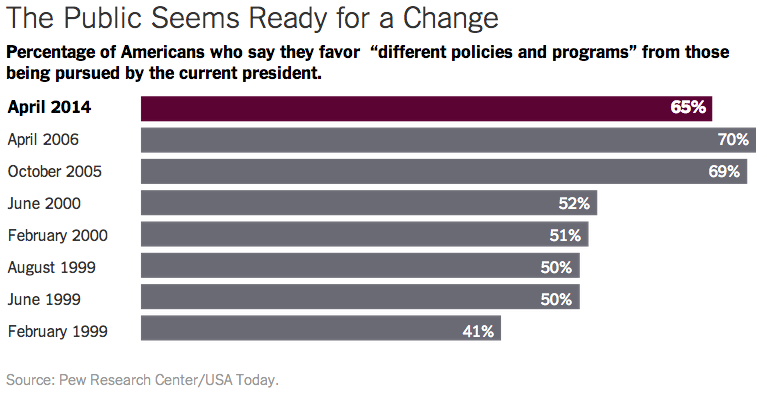
As [political scientist Alan] Abramowitz has shown, the incumbent party has typically fared worse in “time for change” elections like 2016 during the post-World War II era. When the incumbent party has held the White House for two or more terms, it has won only two of nine elections since 1948. When the incumbent party has held the presidency for only one term, it has won seven of eight.

Moreover, historical data suggests that the public’s attitude today is similar to the run-up to a previous “time for change” election that didn’t go well for the incumbent party. As the chart indicates, the percentage of Americans who currently favor “different policies and programs” is closer to levels from the 2005-2006 period under George W. Bush, another relatively unpopular second-term president presiding over a weak economic recovery, than from 1999-2000, when Bill Clinton was president and the economy was much stronger.

Dissents Of The Day

A reader writes:

I’m a long-time Dishhead and a subscriber, but I am frequently exasperated by your coverage of Israeli and American Jews.

Jews are not a monolith, and I worry when you appear to paint them with a broad brush (right-wing, hard-line, hawkish). I know you’re not an anti-Semite, but your one-sided coverage gives fuel to people who are. In fact, there is a huge contingent of Jews, both in America and in Israel, that is both pro-Israel and pro-peace – not that you get that impression from reading the Dish. There’s more to the pro-Israel lobby than AIPAC, just as there’s more to the Knesset than Netanyahu. I would appreciate more coverage on the Dish of the pro-Israel, pro-peace lobbies that most of the American public hasn’t heard about.

That said, I was very happy to see J Street merit a mention on the Dish. Unfortunately, the context you provided for that story was abysmal.

The vote of the Presidents’ Conference (CPOMJAO) excluding J Street does not mean that American Jews are more hawkish than Israelis. However, that’s the frame you put around the story by giving Michel Scherer the first and Jonathan Tobin the last word. In that context, your own commentary appears to accuse American Jews – as a class – of resisting a “re-think with respect to blind support of anything Israel does.”

The idea that the CPOMJAO presents the “unified Jewish voice” is laughable. The phrase is absurd on its face: you’ve heard the old expression, “two Jews, three opinions.” The problem is, the Presidents’ Conference voting structure is not at all reflective of Jewish community demographics – it’s worse than the US Senate in terms of proportional representation – which has led to calls for reform.

In fact, the largest Jewish groups with the most members – the Reform movement and Conservative movement – overwhelmingly supported J Street’s inclusion. US Jews overwhelmingly support an active US role in resolving Israeli-Palestinian conflict. US Jews even oppose the expansion of settlements.

Finding these links took less than 10 minutes of Google searching. The Dish often reports on American Jews’ opinions on Israel, but rarely presents articles from the Jewish press to show what Jews themselves actually have to say. It’s like conducting extensive reporting on immigration (with a strong anti-reform stance) without ever turning on Univision or reading a Spanish-language newspaper. It’s irresponsible, especially when staking out such a strong position on the issue.

So what does J Street itself have to say about their exclusion? They posted this thank-you note to CPOMJAO for shattering the myth of the monolithic Jewish voice.

I think they were talking to you, too.

Another reader:

One thing I’ve learned after many years in the law and on the peripheries of politics and government is that there is never one reason that a decision is made. Like you, I’m no fan of Mr. Netanyahu. To my mind, he has an overblown sense of self-import aided and abetted by a lack of imagination a sense of entitlement. But that doesn’t mean that Israeli policy was designed to preoccupy the US with Iranian nukes while Israel integrates the West Bank into the state. Of course there are those who seek that outcome. You and I know exactly who they are, and Bibi may be one of them.

But to assert that Israeli security issues with Iran are a “useful distraction” while Israel “finishes off” the Palestinians is really too much. And that is exactly what you are saying when you warn of a “second 1948.” There is just so much there to unpack. As I recall, 1948 was when the Arab states invaded Israel and tried to drive the Jews into the sea. And I also have read my Benny Morris. No one’s hands are clean – including the Palmachs and the young IDFs. But please. You use terms that overtly and covertly put the moral onus squarely on the Israelis for the Palestinian’s current predicament and you seem to assert that the only reason for Israel’s alarm about Iranian nukes is to veil an annexation plot.

You are smart enough to know that every decision ultimately stems from myriad choices by many actors. If you really believe that Israel’s alarm over Iran is simply a bait-and-switch, please point to the evidence. You can’t. There is no question Iran has been pursuing nuclear weapons and that it has used chemical weapons. It had a president who was a Holocaust denier who spoke about wiping Israel off the map. Understandably, these facts alarmed Israelis of all stripes, including my lefty friends who live there – the same ones who do NOT want to annex the West Bank.

That is not to deny that it’s a useful crisis for those who do. But your writing lacks the nuance and understanding of human decision-making and frailty that I know you possess. You have written eloquently about the very human nature of a variety of decisions, including the (lack) of moral justification for outing gays and on gay marriage as a civil rights issue. Please think about applying the same nuance to the Israeli predicament.

Another also calls for more nuance:

What’s so maddening and fascinating about me reading you on Israel and Palestine is that I suspect if we boiled down the issues to their core, we would be in total agreement. We agree what a deal should look like, we think Palestine is inevitable and a just solution to the status quo, we hope for Israel’s future prosperity and security, we wish neither side ill will, etc., etc.

And yet something is missing in your analyses. It’s hard to put my finger on it, but my best guess is that I am viscerally turned off by your sheer lack of empathy for the Israeli context. Settlements are terrible, but they are reversible; a rocket falling on a kindergarten is not. The paranoia that mainstream, non-extremist Israelis live with on a daily basis is beyond understandable. But it never seems to register to you that the “peace process” effectively puts Israeli lives in the hands of Palestinians. That has not worked out so well in the past.

Your refusal to acknowledge the complete failure of the Gaza experiment (withdrawal of settlements yields a fanatical terror state, hellbent on its own destruction for the sake of killing a few Jews here and there) undermines so much of what you write. Not because you (or Kerry) are wrong to predict an apartheid-ish situation down the line, but because you don’t even acknowledge that creating an autonomous Palestinian entity raises serious security concerns and requires serious trust from the Israeli public.

I would argue that what is being asked of Israel, in fact, is something no other Western country has been asked to even contemplate: help us create a state that has a good chance of at least occasionally attacking you across its new borders, run by people who celebrate jihadists and refuse to acknowledge your existence. Would the US ever agree to such a situation? Would Canada or England or France?

They would not, and Israel must. That is simply the world we live in – but let’s acknowledge that world, maybe? When you pontificate as if Palestinian movement is restricted in a vacuum, you lose credibility and make many wonder why your anger is so one-sided. I lived in the West Bank for a year. Security checkpoints are terrible. But I saw, with my own eyes, that they would be loosened – because the army hates having to staff them – and then, within days, a bomb would go off and they would be tightened again. There is a vicious cycle here – with blame to go around – that you seem to ignore in favor of a Greater-Israel-colonialism narrative which is part, but not all, of the picture.

More nuance, not less, on this issue please.

Update from a reader:

I am a dual citizen of Israel and the U.S. I have lived there, and to this day all my relatives still reside in Israel. My time in Israel dates back to my bar mitzvah in Haifa in 1956. My own grandfather was Irgun. As a longtime Dish reader and subscriber I have to respond to those who are critical of you for lacking nuance on the subject.

What you have been writing about is Israeli policy. It matters not what liberal Zionists might think and feel about the current Netanyahu government policy. The liberals have NO POWER, either here in the U.S. or in Israel. The same could be said about the controversy surrounding the Council of Presidents rejecting JStreet. Sure many American Jews recoil at that rejection but so what. The hard-line Jewish groups are the ones the media respond to. I am a member of JStreet, but let’s face it; we have no power when compared with AIPAC. When the media asks for Jewish input regarding Israel, Ben Ami’s voice is either never heard or buried.

The lack of a peace agreement will be a disaster for Israel. Yet the forces in Israel are dead set against a Palestinian state. Even Israelis who favor a peace agreement are unwilling to make Palestine a viable state. Just ask the average Israeli which West Bank town or settlement they are willing to give up. Give them a list and it’s always – not that one, or that one, on and on through the list. The average Israeli is thinking more like autonomous Palestinian zones rather than a real state. The political party HaBayit HaYehudi and the bulk of Likud are part of the government and they are as dead set against a two state agreement as is Hamas.

The reader who complains about Palestinians just wanting to get rid of the Jews is regurgitating an old myth. Sure there are Palestinians who feel that way, but most West Bank Palestinians just want to lead an honorable and dignified existence. Your readers should visit the Israeli West Bank towns of Bat Ayin, Kiryat Arba, Itamar etc. and they can hear the ugliest Jewish hate imaginable, even at shul.

Andrew, your voice on this subject is clear and definitely needed. Codling Israel does them no favors. In fact, the lack of pressure from the U.S. and its Jews means there will never be a solution. Keep the pressure on – many of us support you.

Mental Health Break

Lori Dorn gives it new life:

In this 2011 video posted by Stegmeier53, a little bird in the street dances in perfect time to the Daft Punk song “Something About Us”.

I saw this bird ,a snipe, on the road and stopped to take a picture. I had music playing in my car and the bird danced across the street to the music.

Update from a reader:

That’s no snipe! It’s a woodcock. I am 100% sure of this. Maybe you shouldn’t print why I’m sure (if you print this at all) but here it is: I’m an upland bird hunter. I’ve spent countless autumn days in alder, aspen, and swamps with my spaniels trying to flush the little buggers out. Some will say hunting woodcock is some of most challenging wing shooting out there. Anyway, that’s a woodcock, not a snipe.

I didn’t get a picture, but I once saw a mom woodcock and four chicks crossing a road once. They all walked just like that. In unison. A sight to behold.

Competing In A Whole Market

Daniel Gross notes that Whole Foods is losing its edge, pointing to how “in places where it has been established for a decade or more, [it] seems to be losing market share”:

We are becoming the United States of Ameri-kale. Local food cultures are rising up everywhere, not just in yuppified suburbs and chi-chi cities. And Whole Foods’ success is inviting others into the increasingly crowded aisles. Small chains are gaining scale and resources. Sprouts Farmers Markets, which went public last summer. It has 150 stores, concentrated in Arizona, California, and Colorado. Fresh Market, had 151 stores in January and opened 25 in the last fiscal year. While Fresh Market doesn’t rival Whole Foods across the board, it is a reasonable alternative—especially for bulk items like nuts, and its fruits and vegetables are much more reasonable. Trader Joe’s, a quirky competitor, opened its 400th store last year.

Meanwhile, the higher standards being set by Whole Foods, restaurants, locavores, food blogs, farm stands, and CSAs, are causing mass retailers to up their collective game.

In response, Whole Foods is lowering prices. Alison Griswold wonders whether that will work:

Pricey, high-end brands that were once available only on the shelves of Whole Foods and other boutique stores can now be found in many mainstream supermarkets. Even Walmart announced last month that it would begin offering organic food products from Wild Oats at a fraction of competitors’ costs.

In short, Whole Foods’ grip on the organic market is slipping. The company cut its 2014 same-store sales and earnings outlook for the third consecutive time when it reported second-quarter results on Tuesday. Executives said the growing popularity of organic foods represented a huge opportunity for Whole Foods and that some of the recent gap in sales could be chalked up to the harsh winter. But those hedges didn’t reassure investors. Shares of Whole Foods plunged 18.8 percent to $38.93 when trading reopened on Wednesday and several analysts lowered their ratings on the stock.

Beard Of The Week

His name is Ricki Hall – or on Twitter, RickiFuckinHall – and he’s a 27-year old former mechanic from Wolverhampton in northern England. Esquire Weekly has now crowned him with “the most influential haircut in Britain.” So happy he’s supplanted follicularly-challenged DavidFuckinBeckham.

HIV Of The Mind

Jill Neimark considers the barriers to widespread PrEP use:

The stigma around anal sex plays out in the doctor’s office, where acceptance and compassionate care are necessary to stem the epidemic. An anonymous college student told his story on a site called My PrEP Experience. After two boyfriends had cheated on truvadahim, and one had snuck a condom off during sex, the student wanted a pharmaceutical brand of protection. He wanted PrEP. ‘We don’t prescribe this to people like you,’ he was told by a physician. ‘I felt like she [the doctor] had already labelled me as whore and, as far as she was concerned, the appointment was over.’ Eventually, the prescription was written by the doctor’s boss and, after jumping through some administrative and insurance hoops for a few weeks, the student went to receive his pills. He was the first in his town of 130,000 to be given PrEP. It takes a confident young man to persist in spite of that kind of humiliation. …

There aren’t many primary care doctors who feel confident opening up a conversation with a gay man about barebacking, online apps, anal chlamydia, and a treatment plan for protection. And how many gay men walk into their primary physician’s office comfortably prepared to discuss all those concerns?

And so, in 2014, in the developed world, HIV infections continue unabated at crushing expense to society because of HIV of the mind. I do not mean to imply the existence of a scarlet H unique to gay male psychology. No, I mean the incredible complexity around being gay in 2014 – when HIV is treatable and preventable, but profound vulnerability to infection remains. I refer to the whole welter of confusing feelings and polarised messages that gay men still shoulder, often invisibly, and that the straight world still struggles with, too. Silence equals death. That was the brilliant mantra coined by the original AIDS activists, the ones who mobilised all of us to action. But there is still a penumbra of silence around gay life, even in the most ‘out’ gay man’s heart.

The recent Dish thread on Truvada is here.

Putin’s Euro-Nightmare

The Eurovision Song Contest – climaxing this weekend – has an incipient star and possible winner in Austria’s Conchita Wurst, which is almost a drag name. Her familiar style is a classic ballad belter, which often does well in the strange but compelling spectacle of high camp and low pop an entire continent soaks up once a year. Somehow, I don’t know how well she’d do on American Idol:

I have to say I am unsurprised by reactionary cultural and populist movements on the right in Europe and Russia these days. A bearded drag queen as a finalist in a continent-wide song contest is something many will find bewildering, and not a little unsettling. But what’s just as striking is the fearlessness and fierceness of the new cultural order.