A Case Study In Suburban Poverty

Rebecca Burns examines Atlanta’s Cobb County:

Long considered the epitome of red-state suburban comfort, a quintessentially middle-class kind of place where the median income is $65,000 and people pride themselves on owning their own homes, Cobb County now has other superlatives attached to its name. Between 2000 and 2010, the county’s poverty rate doubled to 12 percent. Just last month, the Urban Institute reported that of all counties in the United States, Cobb is where low-income people have the least chance of finding affordable places to live.

This is not an indictment of Cobb County in particular.

Rather, what’s happening in Cobb is a microcosm of the dilemma facing suburbs nationwide: a rapid spike in the number of poor people in what once were the sprawling beacons of American prosperity. Think of it as the flip side of the national urban boom: The poverty rate across all U.S. suburbs doubled in the first decade of the millennium—even as America’s cities are transforming in the other direction, toward rising affluence and hipster reinvention.

“As with just about every Atlanta story,” she adds, traffic is a big part of the problem:

That literal lack of mobility contributes to a bigger problem: Atlanta has one of the lowest rates of economic mobility in the country. … [T]oday in greater Atlanta, the odds of a poor kid making it to the top rung of the economic ladder are lower than any other major metropolitan area in the country—in part because residential segregation, which keeps metro Atlantans separated not only by race but also by class, has created widely disparate public school districts, further immobilizing the poor.

Previous Dish on suburban poverty here and here.

Science, Climate And Skepticism

I have to say that one of the most depressing features of the decline of conservative thinking in the US has been the resistance to the overwhelming data behind carbon and climate change. I don’t get it, however much I try. Check out Jon Chait’s takedown of George Will’s and Charles Krauthammer’s “arguments” on the subject. It’s deeply dispiriting. And it helps explain why the GOP is such an extreme outlier among right-of-center parties in the Western world on this issue.

greenpower.jpgThere is an obvious role for conservatism here at every stage. I favor maximal skepticism toward scientific theories that might prompt us to change our lives and societies in radical ways. If there were any use for a conservatism of doubt, it would be to counter such over-reach. The calls for skepticism in this field are absolutely legitimate, given the scale of the consequences. I also favor maximal skepticism in figuring out the best way to deal with such change – a debate well worth having, but which has languished because the US right won’t even agree to the premise.

But the truth is: on this question, scientific skepticism has been abundant, while the data on the core reality continues to mount. In many ways, the skeptics have garnered more media attention than the climate-change consensus-mongers. And of course there’s always a chance that we’ll stumble upon some new evidence or theory that would throw this entire edifice into doubt (it happens). And it would be awesome. But, at this point, the overwhelming scientific consensus is clear enough, and the argument behind it powerful. The world’s climate is changing; and it will mean huge challenges for humanity’s habitat. I simply cannot see why any sane person would not wish to try and mitigate that change or prepare for such an eventuality. It’s not about ideology so much as simple prudence. Even if you view the likelihood of a much warmer planet as small, its huge potential impact still makes it worth confronting. Low-probability-high-impact events are like that. And conservatives, properly understood, attend to such contingent problems prudently; only ideologues or fools decide it would be better to do nothing and hope for the best.

More to the point, the efforts to counter climate change are mainly win-win. If solar power could run the planet, wouldn’t that be great?

So why all the mockery? If we managed to discover a new low-carbon fuel that would provide us with energy at minimal environmental cost, why wouldn’t that also be a wonderful thing? Ditto wind power or carbon capture technologies. Sure there will be waste and dead ends in a green economy. We should be attuned to that as well as the need to mitigate change for the fossil fuel industries, and the people who work in them, as best we can. But there will be lots of technological and economic gains as well. So I just don’t see the core reason for conservative resistance. (Cue the groan chorus from Corey Robin, et al.)

Then there is the fashionable tendency among conservatives to describe the habits of mind of environmentalists as alien or weird: i.e. the Greens are like the early Nazis in their love of nature; enviros treat the planet as a God; it’s all about therapy; or some secular version of sin. These observations can carry some insight, of course (the Nazis were pretty green), as well as some cheap points. Here’s what Krauthammer came up with on that theme:

And you always see that no matter what happens, whether it’s a flood or it’s a drought, whether it’s one — it’s warming or cooling, it’s always a result of what is ultimately what we’re talking about here, human sin with the pollution of carbon. It’s the oldest superstition around. It was in the Old Testament. It’s in the rain dance of the Native Americans. If you sin, the skies will not cooperate. This is quite superstitious, and I’m waiting for science which doesn’t declare itself definitive but is otherwise convincing.

Okaaay. Sure, there may well be patterns of thought among climate change scientists that echo or mimic other social movements. It’s a meme-ridden world. I’m sure some climate change scientists have beards and smoke weed and like “Orange Is The New Black”. Others may love classical music or be crypto-socialists. But that’s not an argument about the data. It’s an argument about style and culture and habits of thought behind the data. The data exist independently of all of that. And no set of evidence declares itself “definitive” either, as Krauthammer asserts. All of the evidence is obviously ongoing and more data will emerge, and more reports will be published and better understanding will result. That’s how science works. And over time, theories that work better prevail. That’s called the scientific method – and skepticism is embedded in it at almost every stage.

And that’s where we are. No amount of denial or distraction can change that fact. Either we adjust or we face the consequences. Or both. But pretending we live on another planet in another era does not seem to me to be a conservative position. It is, in Chait’s words, “absolutely bonkers.”


Why Can’t You Remember Your Early Years?

Susannah Locke summarizes new research on the question:

The paper concludes that the new cells that are constantly being formed in very young brains may be messing up the circuits that hold memories. The brain makes new cells throughout life — a process called neurogenesis — but young people produce new neurons at a much higher rate. And this process is particularly active in the hippocampus, which deals with memories and learning. Most of the time, neurogenesis leads to better learning and improved memory. But there’s a catch. According to the Science paper, the extremely high rates of neurogenesis seen in very young children can actually increase forgetfulness. These new neurons could be crowding out the old circuits that hold memories.

Clare Wilson explains how the study was conducted:

[Katherine Akers] and her team taught mice of different ages to associate a particular environment with a mild electric shock. They then got some of the adult mice to run on a wheel, because this has been shown to promote the growth of new neurons.

When mice were placed back in the threatening environment, adult mice that had boosted their neuron numbers by running were less likely to freeze to the spot – a sure sign of fear – than a control group with no access to an exercise wheel.

This suggests that forming brain cells caused the mice to forget the electric shocks. Akers’s team then gave a group of mice just a few weeks old a drug that inhibits neurogenesis. These mice were more likely to remember the electric shock than a control group.

Will #BringBackOurGirls Bring Back The Girls?

Keating is skeptical:

The return of the girls will likely require either a risky military operation or controversial negotiations, neither of which international attention seems likely to hasten. But it’s clear that the Nigerian government, which also happens to be hosting a meeting of the World Economic Forum and is clearly looking to present itself as an emerging economic powerhouse, is already feeling the pressure to prevent this from happening again. An international plan backed by Nigerian business leaders to secure the country’s schools was unveiled at this week’s conference, for instance.

#BringBackOurGirls—either the hashtag itself or the larger campaign behind it—may not end this particular crisis, but if it puts some pressure on the government to address the root causes of the country’s violence and make it safer for girls to attend school, it may yet do some good. Ultimately, however, experience tells us that international attention will fade quickly. The question is whether this crisis will be a turning point within Nigeria, and whether the country’s outraged citizens can keep the pressure on.

Laura Seay outlines what the US is doing to help with the search, and why she thinks it’s right to get involved:

The U.S. team will involve fewer than 10 soldiers and will likely be focused primarily on providing intelligence and negotiation support. This is a small effort, but it points to the United States’ quiet, but growing engagement across dozens of African countries facing a metastasizing terrorist threat. Nigeria is especially important: It’s by far the most populous country in Africa and one of its three biggest economies. Each year, America sends Nigeria $5 billion in private investment and around $700 million in aid, and it’s the 5th largest oil exporter to the United States. A million and a half Nigerians live here, sending millions of dollars in remittances across the Atlantic and maintaining close business and personal ties to home.

U.S. security assistance in the region is not charity; it generally aims to bolster African militaries, and for two main reasons. First, the United States wants African militaries to staff peacekeeping missions on the continent. Second, the United States wants regional governments to suppress militant groups like Boko Haram. Both of these objectives serve the U.S. interest in avoiding putting boots on the ground in Africa (a prospect for which the American public has had no appetite since the failed intervention in Somalia under President George H.W. Bush) while still addressing security threats and humanitarian crises—each of which the continent has in spades.

Canada is sending assistance as well, Ben Makuch reports, in the form of surveillance technology.

Malkin Award Nominee

“He’s been leading the charge and not telling the truth about [NSA surveillance policies]. He’s been fanning the flames, and it gets to the point where my assessment is this is a guy willing to work with San Francisco Democrats to protect bait fish, and at the same time he’s Al Qaeda’s best friend in the Congress,” – Congressman Devin Nunes (R-CA) on Congressman Justin Amash (R-MI), a Tea Party Republican facing a primary challenge from the establishment.

The Closed Mind Of Neil DeGrasse Tyson, Ctd

Not all readers are defending NdGT:

Did Tyson actually say, “I don’t have a problem with these philosophical questions, just give me a way to test it.”? An interesting statement, given that theoretical physics has drifted quite far from that ideal. I saw Tyson once on Colbert, enthusiastically advocating theories of “string theory”, the “multiverse”, and the existence of uncountable parallel universes. All of these are notable for their lack of experimental validation, even more so for their lack of possibility of experimental validation. They are philosophical positions, but such weak ones that for anyone to take them seriously, it must be made to appear that they have the full weight of “science” behind them. I fully support the testability criterion for scientific questions. It is quite a contradiction to invoke this criterion to dismiss philosophical (and religious) questions, while at the same time degrading science by ignoring it.

A few more:

As a professor of philosophy (for 20 years now), I have found Tyson’s point of view to be depressingly common amongst my colleagues in the sciences and in the general scientific culture.

When I have taken the time to engage scientific colleagues, I have generally found the problem to be a lack of knowledge of what it is philosophy does – and to what a degree we are rooted in logic and argument (argument being viewed as a joint good-faith attempt to get at the truth in question rather than a debate we seek to win). Most scientists seem blissfully unaware of how many metaphysical and epistemological assumptions they have, and it leads to a curious naiveté about science and its limits.

However, I am reminded of Einstein, who took a different view: “Science without epistemology is – insofar as it is thinkable at all – primitive and muddled” (quoted in Rebecca Goldstein, Incompleteness (Norton: 2005), p. 29). It’s strange, really. I have the most profound admiration for scientists and the work that they do. I think science is indeed one of the human race’s most beautiful and profound achievements, and I will never fail to celebrate it. But damn … scientists can be so insular and incurious sometimes about anything that escapes their net of method. And it’s tiresome to have this popular spokesman encouraging it.

Another delves deep:

I share your apprehensions about Neil DeGrasse Tyson’s scientific monism: his smug, incurious assumption that only scientific approaches to questions of truth are worth our time and energy. That’s a not even a genuine scientific approach; it’s an engineering and technological approach to life. Real science is grounded in philosophy, and not merely practical problem-solving. But even more so, a truly scientific approach to life is one that is endlessly curious about the whole spectrum of life and philosophy, not just the narrow one of the problems that material science itself can address.

But this does reveal one of my primary criticisms of modern agnostic-atheistic scientism, which try as it might to separate itself from the Judeo-Christian tradition that gave birth to it, remains stuck in its primary philosophical assumption, which is the monotheistic view that there can only be one authentic God, and that all other Gods are false idols. The problem is that if the only tool one has is a hammer, not only do all problems begin to look like nails, but those that don’t are deemed unworthy of one’s attention and ignored.

Substitute “truth” for “God”, and the equation becomes clear. Advocates for scientism like Tyson are as convinced as any fundamentalist Christian that there can be only one true Way to find the Truth, and it just so happens to be theirs. All other ways are false, and pointless, and a waste of time. It does not occur to them, just as it doesn’t occur to a lot of traditional Christians, Jews, or Muslims, that the world we live in may in reality be polytheistic, with many truths, and many paths to these truths, each with their own relative value. That would be blasphemy to fundamentalist advocates of both scientism and monotheistic religion. And despite their many differences, both scientism and the Abrahamic religions have much in common at the philosophical level: a blind, cult-like certainty that theirs is the one true God, and all other Gods are false, graven images that must not be held in any esteem whatsoever.

This comes out in the most annoying aspect of Tyson’s version of Cosmos (and Sagan’s original one as well), which is the smug sense of certainty Tyson radiates as he presents the history and triumph of science. There is no room in his public presentation of science for what truly makes it valuable: its inherent attitude of doubt and skepticism, even about itself and its findings. Instead, we are presented with science as another form of certainty about how the world really works, and its own methods as the one true way of knowing and understanding that emerges from the failures of all other approaches to life’s difficulties. As if the world secular science has created were some kind of paradise, when even the most cursory look around would empirically show otherwise.

Don’t get me wrong; science is wonderful, but it simply isn’t the answer to most of life’s problems. Making it so becomes a problem in itself, and distorts the fundamental philosophical wisdom from which science sprang: an unbounded curiosity about reality. Those amateurish attempts of college freshmen to understand the paradoxes of consciousness and self are not worthless foolishness, any more than are those of a child wondering why the sky is blue. They are simply uneducated and in need of a rigorous, disciplined approach. And there are more important matters to address in life than merely working out the problems of why the sky is blue, that science has a very hard time even formulating the questions for, much less coming up with answers.

Tyson is right in the narrow sense: there are many questions that are rather worthless for scientists to address, but not because they are worthless questions with no way to find meaningful answers, but because science is not the right tool for addressing them. A whole body of religious, spiritual, artistic, literary, cultural and philosophical approaches remain better ways to approach such matters. And there, too, there is no one right and true way either. Monotheism has created a massive distortion in the western mind that requires the pluralism of the modern secularism as a counterpoint. But science cannot be that counterpoint if it, too, insists on being the only game in town.

Sponsored Content Watch

Screen Shot 2014-05-08 at 3.54.40 PM

Dish readers remain vigilant:

It’s official: the New York Times takes sponsored posts on its regular website. Screenshot attached. Same typeface – pretty sneaky!

How long does it take you to spot it? Update from a reader:

Umm no, it’s not the same typeface for either header or blurb. The font size is about the same but the “PAID POST” is slightly bolder, and the blurb is sans serif whereas blurbs for non-sponsored content is with serifs. That being said, however, due to the font size being the same size and the presentation on the page itself, it does lend itself to deception, despite the slight differences. The sneakiness is putting just enough differences that eagle-eyed readers would spot it but to the casual reader, the difference isn’t enough to highlight that it’s sponsored.

Nah, He’s Not 5’9″

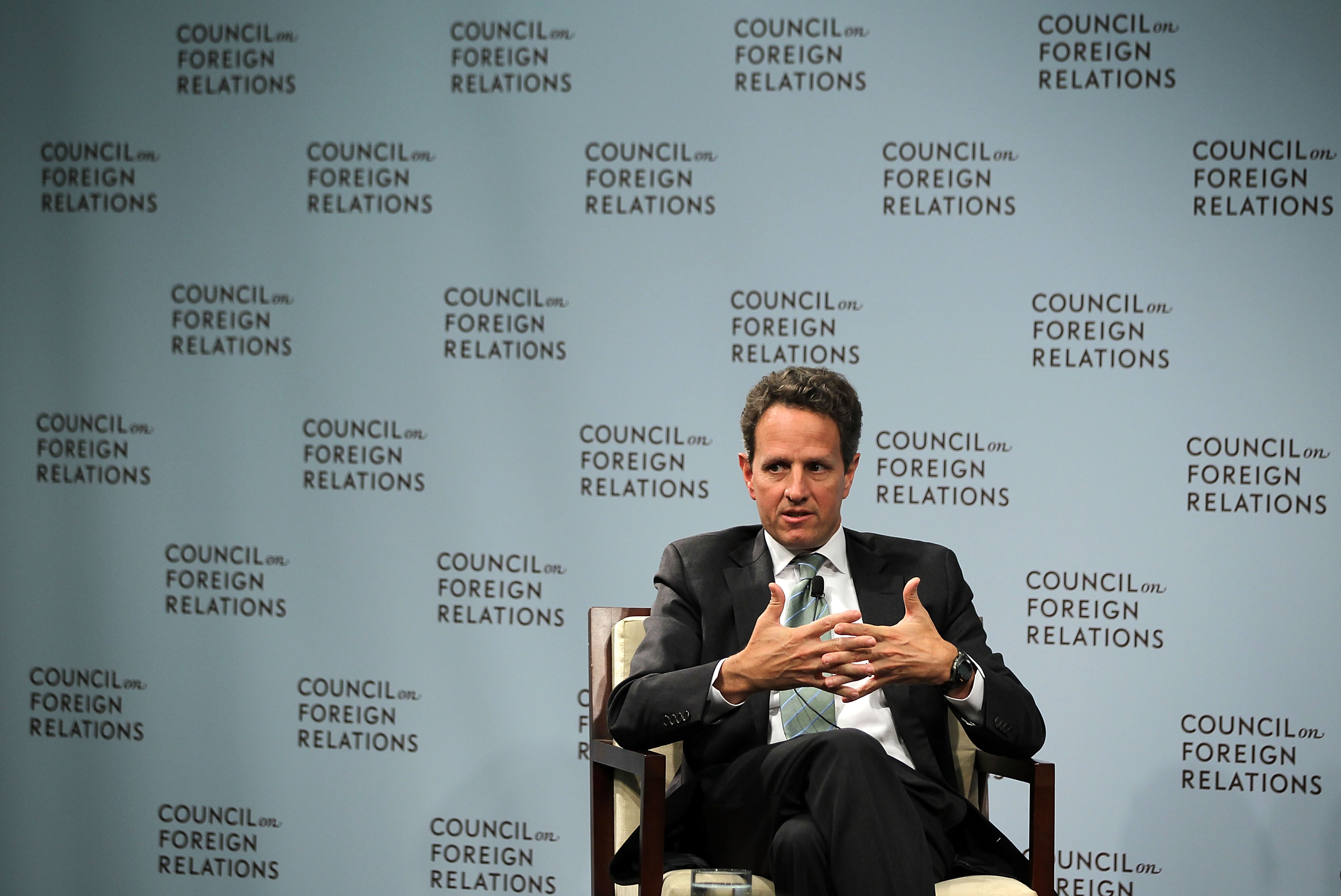
Geithner Discusses Global, U.S. Economy At Council On Foreign Relations

Well, Tim Geithner is shorter than me, anyway. Not that he’s that worried about it:

I’m almost 5-9, just below 5-9. 5-8-and-¾, something like that. You can round down, you can say 5-8. I’m relatively secure in my height.

But for me, the main take-away from Andrew Ross Sorkin’s profile is the bottom line of TARP. Whatever else you can say about it, it wasn’t a total bath for the taz-payers. Au contraire:

While there is some debate over how to calculate the proceeds from the various bailouts — TARP, the auto companies, the F.D.I.C. programs and Fannie and Freddie, among others — the evidence is persuasive. ProPublica, the nonprofit investigative organization, which keeps a tally of the bailout, puts the current profit at $32 billion. The White House Office of Management and Budget estimates that Fannie and Freddie will turn a profit of $179 billion over the next decade.

I tend to see that as an almost perfect coda to the Obama administration: maligned, battered but ultimately deeply, quietly successful.

(Photo: Alex Wong/Getty)

The Technology Of Marijuana Legalization

Matt Honan tests out a new vaporizer, the Firefly:

A personal disclosure: I’ve smoked a lot of pot. I’m no stoner, but I’ve been smoking it for more than 25 years, and in that time I’ve used all sorts of vaporizers. They’ve evolved a great deal over the years, from giant complex tabletop devices to today’s generation of e-cig-style vapes that deliver brain-hammering doses of butane-extracted cannabis oil. The Firefly does those devices one better, magically and almost instantly vaporizing actual plant material at the touch of a button. It is just wonderful.

It offers all the convenience of a pipe—it’s portable and downright stealthy; you can slip it in your pocket, carry it loaded up with marijuana—but it’s less harmful than a conventional pipe, because you are inhaling vapor, not smoke. The Firefly uses a lithium-ion battery to power a convection heating element that reaches 400 degrees Fahrenheit. The chamber is insulated by air, which means the Firefly’s housing doesn’t get hot enough to burn your fingers, or anything else, when you slide it back into your pocket.

He looks more broadly at how legalization is spurring innovation:

For the science and technology set, it’s a classic opportunity to disrupt an industry historically run by hippies and gangsters. And the entire tech-industrial complex is getting in on the action: investors, entrepreneurs, biotechnologists, scientists, industrial designers, electrical engineers, data analysts, software developers. Industry types with experience at Apple and Juniper and Silicon Valley Bank and Zynga and all manner of other companies are flocking to cannabis with the hopes of creating a breakout product for a burgeoning legitimate industry. Maybe it’s the Firefly. Maybe it’s something still being developed in someone’s living room. There’s a truism about the gold rush days of San Francisco: It wasn’t the miners who got rich; it was the people selling picks and shovels. As the legalization trend picks up steam, Silicon Valley thinks it can make a better shovel.

Update from a reader:

There are all sorts of good stuff being produced out there since the legalization of medicinal marijuana. For Oregon patients, it’s now even available in beverage form: drinkvitonic.com. Their manufacturing process is quite precise, taking a lot of the uncertainty out of the actual dose that the consumer gets. Plus it’s delicious.

(Full disclosure: the producers are friends of mine)