Something Is Picking Off The Pollinators

As we freak out about our collapsing colonies of honeybees, Brandon Keim shares the bad news that their wild cousins are also in trouble, along with other insects that plants depend on for pollination:

According to a recent survey organized by the Xerces Society, an invertebrate conservation group, nearly one-third of North American bumblebee species are declining. Other studies have reported similar trends, documenting dramatic declines in once-common species such as the American bumblebee. If that’s happening to bumblebees, says Xerces Society executive director Scott Black, it’s quite possible, even likely, that others are hurting, too.

“There’s very little information status on most of the bees other than bumblebees, but if you look at the life histories of these groups, many are likely even more sensitive to the disturbances leading to the declines, such as pesticides and habitat loss,” Black said. “Although we don’t know what’s going on with all bees, I think we could be seeing real problems.”

Among other pollinators, iconic monarch butterfly declines are well documented: Their numbers are now at a small fraction of historical levels. And entomologist Art Shapiro of the University of California, Davis spent most of the last four decades counting butterflies across central California, and found declines in every region. These declines don’t just involve butterflies that require very specific habitats or food sources, and might be expected to be fragile, but so-called generalist species thought to be highly adaptable. Many other entomologists have told Black the same thing.

Independent Journalism

Screen Shot 2014-05-07 at 3.51.53 PM

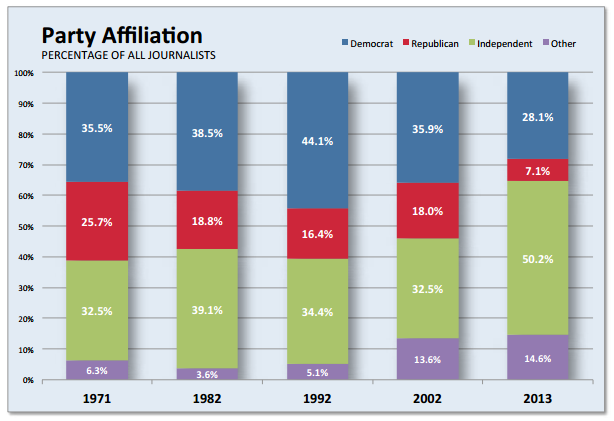
The Indiana University survey of journalists the Dish flagged earlier this week asked respondents about their political affiliations. Mollie Hemingway, echoing several commentators on the right, worries about the dearth of self-identified Republicans:

So what we see is that the percentage of journalists who identify as Democrat is roughly the same as what you see in the general population. And the percentage who identify as independent is even greater than the general population. But whoa check out that GOP figure. Only 7 percent self-identify as Republican, nowhere near what you might expect from the general population.

Let’s first pause to just note the danger of having a corps of journalists so far removed and even hostile to the views of the general population. If a newsroom has a good chance of not even having someone of the Republican variety within its confines, it’s a newsroom that probably struggles to even come close to understanding the perspective of GOP voters. It’s a newsroom that might struggle to fairly cover or might completely ignore stories about tax burdens on families, systemic failures of the welfare state, the benefits of gun ownership, or the evils of a serial-murdering abortion doctor in Philadelphia (just speaking hypothetically here).

Cillizza isn’t so sure that response is justified:

These numbers will likely affirm the belief in conservative circles that “all” reporters are secretly Democrats. (The study was conducted via online interviews with 1,080 reporters.)  While I am not in the business of disputing the study’s finding, I would note two caveats:

1. This is among all reporters not just political reporters. While that may seem like a minor issue, it’s worth noting that assuming these party ID numbers are true for those of us — like me — who cover politics day in and day out may not be entirely accurate.

2. The movement toward independent status among reporters is in keeping with a similar move in the broader electorate as they find the two parties increasingly rigid and, therefore, less welcoming.

Mankiw examines other research on the political slant of newspapers. What it found:

If a paper serves a liberal community, it is likely to lean left, and if it serves a conservative community, it is likely to lean right. In addition, once its political slant is set, a paper is more likely to be read by households who share its perspective.

Religiosity also plays a role in the story, and it helps [economist Mathew] Gentzkow and [co-author Jesse] Shapiro sort out cause and effect. They find that in regions where a high percentage of the population attends church regularly, there are more conservatives, and newspapers have a conservative slant. They argue that because newspapers probably don’t influence how religious a community is, the best explanation is that causation runs from the community’s politics to the newspaper’s slant, rather than the other way around.

The bottom line is simple: Media owners generally do not try to mold the population to their own brand of politics. Instead, like other business owners, they maximize profit by giving customers what they want.

Fat That Might Be Good For Us

Jalees Rehman discusses the implications of human fat cells being used to repair or regenerate damaged organs and tissues:

The discovery of regenerative cells within our fat has opened up new doors. As adult stem cells, they can be converted into tissues such as bone and cartilage and might provide long-sought relief for debilitating diseases such as chronic joint pain. As stromal cells, they are able to build and regenerate blood vessels, and could provide relief for millions of patients affected by poor blood flow to their vital organs. With scientists starting to engineer organs such as the heart, lungs, pancreas and liver from scratch, they are realising that ensuring blood supply to newly engineered organs is critical. The ability of cells derived from fat to grow blood vessels might make them central players in the future of organ engineering.

Discovering the regenerative power of human fat also begs a bigger question: how much more therapeutic potential resides within our bodies, just waiting to be discovered by scientists of the future? Stem cell research and regenerative medicine are providing humankind with an unprecedented array of opportunities to realise the age-old human quest for rejuvenation and longevity. But just like our predecessors – those physicians of centuries past who rubbed patients’ limbs with the fat of the dead – we can be seduced by false hopes and hypes. Stem cell biology has had more than its share of setbacks, often because it inspires dreams and promises that outpace the capacity of the science. Yet, propelled by those dreams and gigantic aspirations, we should be able to overcome obstacles, turn our back on false science, and engineer the transformative medicine to come.

A Hispanic Exodus From Catholicism?

New research indicates (NYT) that Hispanic American Catholics are moving away from the church:

There are positive findings: Mass attendance in parishes with Hispanic ministries is 22 percent higher than in the average parish, a promising sign in a church that has seen attendance at Masses dropping over the last few decades. Rates of Hispanicsbaptism and first communions are also higher.
But attendance rates at weekday Mass are quite low, participation in non-sacramental activities like youth groups is low, and contributions to collection are also low, often reflecting economic hardship. Parishes serving Hispanics often have fewer staffers per parishioner than other parishes, according to the study; parishes with high numbers of Hispanic parishioners are also less likely to have a parish school.

A Pew study released Wednesday also shows the Hispanic Catholic community is shrinking:

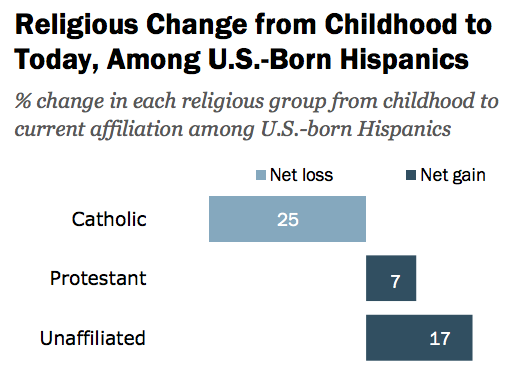
Most Hispanics in the United States continue to belong to the Roman Catholic Church. But the Catholic share of the Hispanic population is declining, while rising numbers of Hispanics are Protestant or unaffiliated with any religion. Indeed, nearly one-in-four Hispanic adults (24%) are now former Catholics, according to a major, nationwide survey of more than 5,000 Hispanics by the Pew Research Center. Together, these trends suggest that some religious polarization is taking place in the Hispanic community, with the shrinking majority of Hispanic Catholics holding the middle ground between two growing groups (evangelical Protestants and the unaffiliated) that are at opposite ends of the U.S. religious spectrum.

Elizabeth Dias comments on the Pew study, writing that the findings “are groundbreaking, but not surprising for anyone following the community closely”:

Latinos are joining Protestant churches, the report confirms, for socio-economic reason and not just religious ones. Half of Protestant converts say they left their childhood religion because evangelical churches reach out and help their members more. (Note: “Protestant” in most Latino communities tends to be synonymous with both evangelical and Pentecostal charismatic—Latino communities in the mainline Protestant churches are much smaller by comparison.) The social service priority of these congregations is significant draw. Evangelical Latino churches often act as a social safety network for their members, especially when it comes to basic needs like food, clothing, and health care.

Emma Green sees the findings as “a bad sign for the Church.” Mano Singham observes that the Pew survey suggests “Hispanics are not that different from the rest of the population”:

For example, they support same-sex marriage by 46-34% and 40% say abortion should be legal or mostly legal, as opposed to 53% who think it should be illegal. Hispanics also solidly reject traditional gender roles in marriage, saying that “a marriage in which both husband and wife hold jobs and help take care of the children (79%) is preferable to a traditional arrangement where the husband is the financial provider and the wife takes care of the house and children (18%).”

Meanwhile, Aaron Blake refutes the idea that changes in Hispanic religious affiliation will necessarily translate to success for the GOP:

Among the Hispanics who continue to affiliate with a church, just 22 percent are Protestant — compared to more than half of the United States population. Why is that important? Because Protestants — and especially evangelicals — are much more likely to be Republicans than Catholics are. In fact, the only Christian group that skews heavily GOP is evangelicals, and only 16 percent of Hispanics affiliate with evangelicals.

(For more on the differences between Christian groups, see this recent Pew study, which found that about half of white Catholics and mainline Protestants were Republicans, compared to 70 percent of white evangelicals.) The fact that the Hispanic population is still dominated by Catholics —and increasingly unaffiliateds — means it’s much less likely to swing to the GOP.
The End Of The American Entrepreneur? Ctd

A reader relates to the topic:

I am an entrepreneur, and I can tell you that in my experience, the biggest problem facing new business formation today is the explosion of consumer debt – especially student debt. If you did the overlay on the Brookings graph of new firm formation with student debt, one would be the inverse of the other.

Having debt makes you less risk-tolerant. Period. It’s bad enough to fail, but failing and having the bank up your ass and a bankruptcy hanging over your head really blows.

Another is on the same page:

Contrary to persistent belief on the right, people take risks when they have something to fall back on. In recent years, with college becoming so ridiculously expensive (along with healthcare), people are much safer as small cogs in large bureaucracies that make their money by rent-seeking. The great examples of such behavior would be the oil companies, Microsoft, and other large conglomerates.

The counterexample would be Google. It is not a surprising that Google’s workforce consists disproportionately of people whose parents held teaching jobs in universities (both in India and abroad) – jobs which that largely remained immune to the vicious debt cycles that pervade the workforce in the outside world.

Another turns to healthcare costs:

The long-term downtrend reflects people trapped in jobs in order to get affordable healthcare. As health insurance costs have gone up, the entrepreneurial spirit has been suppressed. My guess is that the recent uptick represents people who can now try to implement their entrepreneurial ideas.

Here’s a personal example. I recently wrote you about plans a former coworker and I have for starting a business. Both of us had been self-employed entrepreneurs for many years before seeking a corporate position with insurance. He and I have talked for years about the possibility, but neither of us was willing to give up our employer-based healthcare and take the risk of having no insurance, since we both had pre-existing conditions that no insurer would accept. Now we can proceed.

Related experiences from readers here and here. Meanwhile, an American in Canada offers a view from abroad:

Expats tend to shy from starting businesses because of the tax compliance issues. Tax law in resident countries contradicts US rules and results in double-taxation. And from a funding standpoint, very few non-US citizens who understand the IRS’s odd way of determining who falls under its jurisdiction are willing to partner with Americans in business. Americans are viewed as financial liabilities.

I’ve looked into opening my own business where I live in Canada, but it’s simply not worth the effort when I calculate the double accounting costs and the fact that the FEIE (Foreign Earned Income Exclusion) credit that’s often cited as being “unfair” is unavailable to those who work for themselves. Throw in FATCA and new compliance rules, which require a person to document and submit to the IRS annually every aspect of one’s financial life, and it’s a wonder anyone burdened with American citizenship – inside or outside of the country – would start a business at all.

Welcome To Droneworld

dronemap2

Patrick Tucker reports that it’s likely that nearly every country will have armed drones within 10 years:

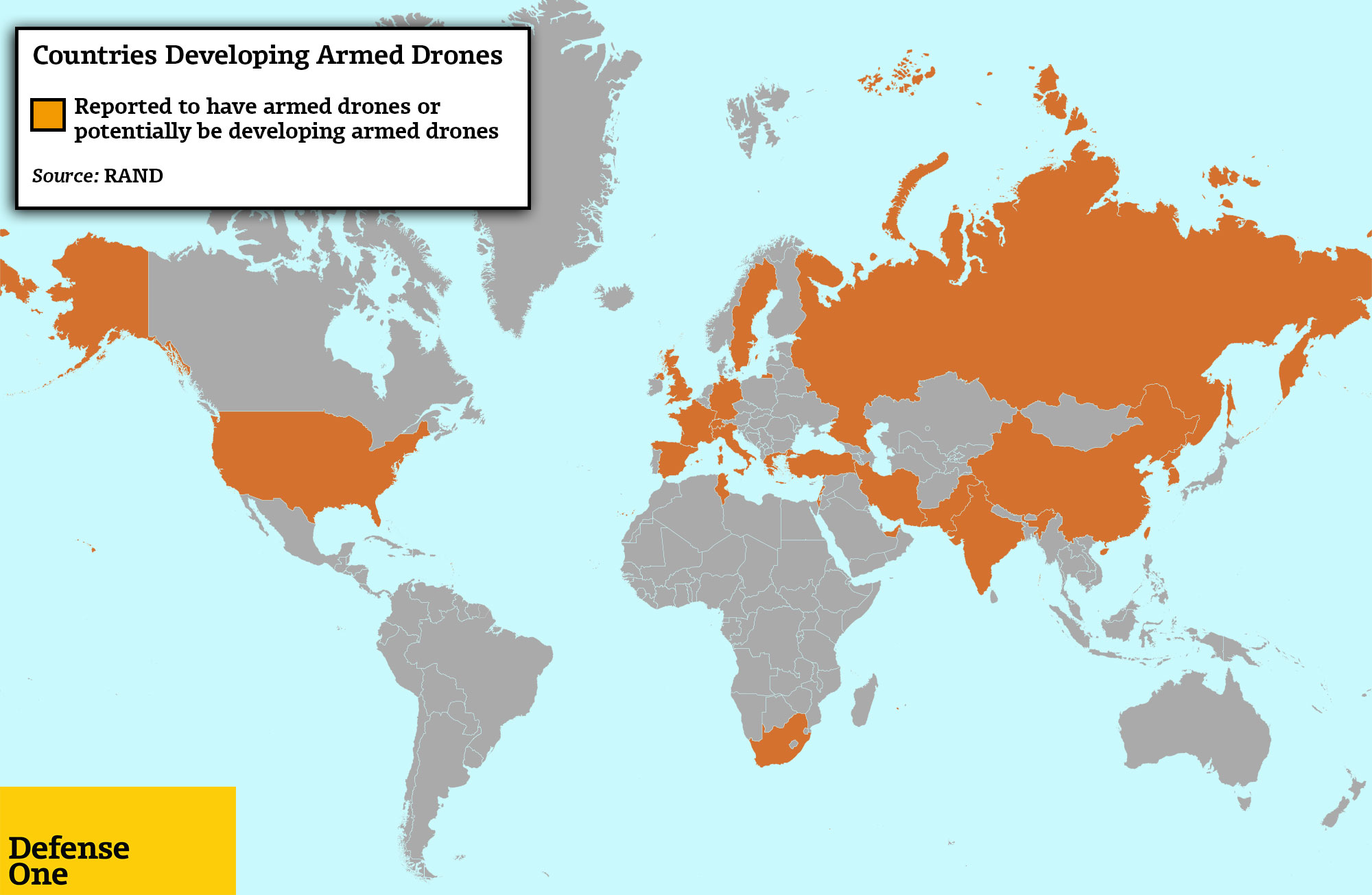
After the past decade’s explosive growth, it may seem that the U.S. is the only country with missile-carrying drones. In fact, the U.S. is losing interest in further developing armed drone technology. The military plans to spend $2.4 billion on unmanned aerial vehicles, or UAVs, in 2015. That’s down considerably from the $5.7 billion that the military requested in the 2013 budget. Other countries, conversely, have shown growing interest in making unmanned robot technology as deadly as possible. Only a handful of countries have armed flying drones today, including the U.S., United Kingdom, Israel, China and (possibly) Iran, Pakistan and Russia. Other countries want them, including South Africa and India. So far, 23 countries have developed or are developing armed drones, according to a recent report from the RAND organization.  It’s only a matter of time before the lethal technology spreads, several experts say.

Friedersdorf blames the US for not setting norms for drone use while we still had a virtual monopoly on the technology:

There’s no way to go back and undo what we’ve done. But it remains the case that the sooner we start thinking farsightedly about the international drone norms that we want, the more we can do to bring them about. The best chance for future success would require us to put constraints on American behavior before other countries match our technology. That would create a short-term disadvantage, but it could pay huge long-term dividends.

Instead, the United States seems intent on developing weaponized drones that also operate autonomously. By the time an article can be written about how every country will have that technology available to them, it will be too late to stop it.

Meanwhile, Michael Horowitz fears that the Pentagon may be squandering our advantage:

As military robots shift from filling niche capabilities like bomb disposal to performing essential tasks throughout the military, they will challenge existing status hierarchies in the services. Likewise, as these devices become more capable of working with manned systems to multiply the effectiveness of U.S. forces or replace manned forces in some instances, they will require changes not only in the way the services fight, but also in the way they have thought about recruiting, training, and promoting since the creation of the modern American defense establishment in 1947. Those are threats to the military’s very identity — and they will provoke bureaucratic pushback.

Zack Beauchamp examines what can be done to change that:

[CSIS drone expert Sam] Brannen wants to create a new office in the Pentagon: the Defense Unmanned Systems Office (DUSO), with a whole staff dedicated to streamlining drone spending and thinking creatively about which systems could help the US innovate strategically and tactically.

This central drone office, DUSO, would coordinate “the cross-[Department of Defense] research, development, testing and evaluation” budget. It would also “conduct a review across existing DoD roles and missions to determine potential areas where unmanned systems technology could create military advantage” in order to “energize the use and development of unmanned systems beyond” surveillance and counterterrorism.

Every year, Washington’s think tank community produces countless reports with policy recommendations; most of them go nowhere. But, much to Brannen’s surprise, DUSO somehow ended up in congressional legislation.

Debating Republican Debates

The GOP wants to reduce the number of presidential primary debates:

At the RNC’s spring meeting, it will announce the formation of a standing committee on debates. The committee will select moderators, evaluate rules, and determine the number of debates. The total number is likely to be half of the previous cycle, and the committee will likely agree to remove delegates from any candidate who participates in a debate outside the party structure.

Ron Klaim thinks this a mistake. He argues that “GOP debates in 2012 saved the party from what surely would have led to a 50-state Obama landslide: nominating Rick Perry”:

[A] year prior to Election Day 2012 the Perry juggernaut was so strong that even the Great and Powerful Oz (aka Nate Silver) wrote a New York Times Sunday magazine piece forecasting a 55 percent chance that Perry would beat Obama in the general election. What stopped Perry, and saved the Republican Party from nominating a hopeless, hapless candidate?  Those much reviled debates, where Perry blew—not one, not two—but three debate appearances. And what finally did Perry in? One of those much maligned “media sponsored” debates, where CNBC journalist John Harwood called Perry out for being unable to name the three federal agencies he proposed to abolish. It took multiple debates to expose Perry’s weakness, and sharp questioning by a savvy reporter to make that weakness fatal. Absent those, the GOP might have nominated an atrocious candidate and left the dissection work to President Obama in the fall. Rather than trying to cut back the number of debates and wrest control of them from media types, the Republican Party should send Harwood and CNBC a bouquet and beg them to hold 20 more debates in 2016 to weed out any empty suit candidates.

Letting The Air Out Of Party Balloons

Kelly Jane Torrance notes that the US government, the world’s number-one supplier of helium, “has been selling it at a cut-rate price that has no connection to its actual value.” Now a shortage is affecting a wide range of industries:

Worldwide, cryogenics—the fancy word for the field in which liquid helium is used as a coolant—accounts for 29 percent of helium use. That includes pharmaceutical research and MRIs. Welding uses 17 percent, while 5 percent is used to detect leaks, mostly in industrial manufacturing—a critical component of safety for those employed in the sector. Party balloons use up more—8 percent worldwide. “You have to take a look at your market. If you look at the priorities of that particular gas, the number-one priority is medical,” [executive at industrial gas supplier Air Liquide Martin] Lovas says. “With one cylinder of, say, 300 cubic feet, you can do nine MRIs. Or you can fill 1,000 balloons.” …

The Federal Helium Reserve currently holds about a third of the world’s total reserves. Might American users—research laboratories, medical institutions, the Department of Defense, NASA—just buy it elsewhere once that reserve is gone? That depends on a lot of things, of course, including one very uncertain factor: the state of global geopolitics. Almost all of the remaining helium reserves are located in two areas not currently known for their willingness to do favors for America: the Middle East and Russia.