Rasmussen-free data on Independents:
Author: Andrew Sullivan
A Bleg, Ctd
A reader points to Michael Gerson's denunciation of the Uganda bill published at Town Hall last month. Gerson wrote:
Republican Sen. Tom Coburn calls the law "absurd." GOP Sen. Chuck Grassley describes it as an "un-Christian and unjust proposal." Pastor Rick Warren concludes it is "unjust, extreme and un-Christian toward homosexuals." All three are right. And the prospect of pastors and counselors as informants for the state is particularly offensive — the calling of Judas instead of Jesus.
It was, of course, first published in the Washington Post. But it was very encouraging, and most welcome, especially for this statement:
[Americans] refused to be a "Christian nation" precisely because the founders held a broadly Christian view of human beings, who are subject to God and their conscience, not to the state. Pluralism is not a temporary or tragic compromise; it is the proper way to treat men and women created free and autonomous in God's image.
But I notice that the column ascribed the law to Ugandans, not Christianist Americans, including close allies of Rick Warren and of the GOP. And Gerson criticizes no one on his partisan team, merely citing leading American Christianist condemnation of the law. It's as if he realizes the anti-gay right has gone too far this time, i bold enough to say so, but not bold enough to actually take these people in his own ranks on. But it's a start for more sanity and less sectarianism on the right.
The View From Your Window

Chicago, Illinois, 8.45 am
Chait vs Manzi, Ctd
It has turned into one of the more fascinating debates online in quite a while. Why? Because both sides are civil, smart as whips and intellectually honest. And because the deeper issues they are tackling – the balance between defense and welfare – are tectonic matters beneath our political discourse that merit being unearthed and examined. And what's striking to me is that when bloggers set this tone, even comments sections get the message. Here's an illuminating to and fro between Manzi and a reader. The reader first:
[You wrote]:
“From 1980 through today, America’s share of global output has been constant at about 21%. Europe’s share, meanwhile, has been collapsing in the face of global competition — going from a little less than 40% of global production in the 1970s to about 25% today. Opting for social democracy instead of innovative capitalism, Europe has ceded this share to China (predominantly), India, and the rest of the developing world.”
How do you know this drop in productivity was due to adopting the welfare state? That’s just a huge assumption. Why couldn’t it be the industrialization of countries with pools of cheap labor?
And if you are comparing the US to Europe it seems to me that, even if the drop was tied to adding a welfare state, that Europe comes out ahead. They equal our global productivity AND they have a welfare state. Or to look at it another way, we spend all this money to ensure global dominance, the main purpose of which is to promote our economic interests—but we can only equal Europe in output, who spend way less on global dominance.
And we can’t afford a welfare state.
It seems to me we are underachieving considering how much we invest in global dominance. I mean, we control the sea lanes, our military protects countries all over the world, we have the biggest and most influential economy, the world’s currency is based on the dollar, our culture is fast becoming the worlds culture… All that and we can’t even equal Europe.
— cw · Jan 6, 01:54 PM · #
Manzi's response:
I agree with a lot of what you say here. Probably the central point of the article was that we face a tragic choice. Europe’s (of Western Europe, or the “social market” economies, or whatever definition we want) have employed a package of responses to deal with the fundamental problems created by a market. This has created many advantages for them. One of things they have not been able to do, however, has been to maintain their share of the world economy. Over the long-term a civilization needs aggregate power to protect itself in an inherently hostile world. In this respect (though certainly not in all ways) Europe is free-riding on the US, and following a non-sustainable strategy in a world that (IMHO) will always turn violent.
My italics. I hope to return to that core debate soon, because, in my view, it really does affect a whole array of choices America has in front of it.
Dissent Of The Day
A reader writes:
“What the Jews were to the right in the 1920s, the gays are in the 2010s. Unpleasant, dispensable, and if possible, wiped out.” This comment should put you in a position for today’s Moore Award. Come off it, Andrew, you are once again stereotyping everyone on the Right based on the truly deplorable legal actions going on Uganda. You truly believe that there is a majority of people and Christians on the right side of the political spectrum who want nothing more than to literally round up gays and kill them? Really?
I go to a very fundamentalist bible church where the word is taken literally, one of my best friends is a New Testament Greek scholar. For you to suggest that I, or my Christian friends would condone such a law and desire to exterminate gay people makes me wonder if you even know or have ever associated with a true Christian. We can disagree about the politics of gay marriage without having to refer to our political opponent as fanatical, death-seeking hatemongers such as the German Nazis, surely.
I’d urge readers to check out the full post, review its context and make up their own minds. And perhaps I engaged in a tired bit of hyperbole (it happens). So let me restate what I was trying to say: The campaigners for the anti-gay pogrom in Uganda are extremely well known in the anti-gay Christianist movement in the US, and the institutional and cultural clout they have in that country has been deeply affected by the Bush administration’s use of PEPFAR money to subsidize Christianist political movements in Africa. The rhetoric used by Lively and his colleagues is no different in Africa than it is in America. It’s just that in Africa, there is no real gay rights movement, no constitutional protections for a tiny, already persecuted minority, and thereby we have a revelation of what the eliminationist rhetoric around evil homosexual plots would aim for in America if it could.
Do I believe that a majority of those who oppose marriage equality are similarly eliminationist with respect to gays? Not at all. Do I believe that many are nonetheless naive about the radicalism of many in the anti-gay movement, whose virulent rhetoric against homosexuals is almost never countered by defenses of homosexuals within the GOP? You bet I do. Do I think that the long-term rhetorical imbalance has helped shift the GOP to a more radically anti-gay stance than almost anywhere else in the Western world? You bet I do. These eliminationists are not typical; but Republican tolerance and appeasement of them is.
Fact-Checking Getty
A reader writes:
Just a few clarifications on the caption you provided via Getty Images with the Face of the Day photo.
The caption as cited reads:
"Orthodox follower Ouzinos Panaiotis kisses the wooden cross thrown by Fener Orthodox Patriarch Bartholomew in the Golden Horn after a mass as part of celebrations of the Epiphany day at the Church of Fener Orthodox Patriarchiate in Istanbul, on January 6, 2010.The Orthodox faith uses the old Julian calendar in which Christmas falls 13 days after its more widespread Gregorian calendar counterpart on December 25. By Mustafa Ozer/AFP/Getty."
No one in the Orthodox Church refers to the Patriarchate as the "Fener Orthodox Patriarchate", nor do we refer to Patriarch Bartholomew I as "Fener Orthodox Patriarch Bartholomew". These are politicized Turkish designations that reflect the Turkish government's refusal to acknowledge him as Ecumenical Patriarch Bartholomew I, and his See as the Ecumenical Patriarchate of Constantinople, the Orthodox equivalent to the Vatican. To denote what was cited not only affirms the controversial sentiments of the Turkish government, but it also associates Bartholomew's jurisdiction with only a small neighborhood of Istanbul/Constantinople.
Additionally, the caption reference to the Julian Calendar is all mixed up. While some Orthodox Churches still adhere to the old Julian Calandar, this photo has nothing to do with Christmas. The Ecumenical Patriarchate now follows the Gregorian Calendar, and so this photo reflects the Feast of Epiphany, the Baptism of Jesus. For those Orthodox Christians adhering to the Julian Calendar, January 6 – 7 is Christmas. The last sentence was a bit confusing.
God bless Dish readers.
Quotes For The Day II

"To do evil a human being must first of all believe that what he’s doing is good . . . Ideology—that is what gives evildoing its long-sought justification and gives the evildoer the necessary steadfastness and determination. That is the social theory which helps to make his acts seem good instead of bad in his own and others’ eyes, so that he won’t hear reproaches and curses but will receive praise and honors. That was how the agents of the Inquisition fortified their wills: by invoking Christianity; the conquerors of foreign lands, by extolling the grandeur of their Motherland; the colonizers, by civilization; the Nazis, by race, and the Jacobins (early and late), by equality, brotherhood, and the happiness of future generations. — Alexandr Solzhenitsyn, The Gulag Archipelago.
“Military necessity does not admit of cruelty–that is, the infliction of suffering for the sake of suffering or for revenge, nor of maiming or wounding except in fight, nor of torture to extort confessions.” – Abraham Lincoln's General Orders, 100 Instructions for the government of the armies of the United States in the field.
The Lost Hikers, Ctd
A reader writes:
I guess it’s left to me to say what everyone else is thinking. How many kinds of stupid does one have to be to go hiking on the Iraqi-Iranian border in 2009? I’m sure they’re not spies, I’m sure that they’re good people, and I’m also sure they’re smarter today than they were the day they were captured. I feel sorry for their families. But I’m not sure why the American government should spend any political capital to bail their reckless/dumb asses out.
The Leveretts Have A Point II
Kevin Sullivan thinks that the following three questions, posed by the Leveretts, deserve answering:
First, what does this opposition want? Second, who leads it? Third, through what process will this opposition displace the government in Tehran?
Perhaps the best response to this is from a historian reader:
The Leveretts understand nothing about revolutions. This is important. They suggest that there can't be another revolution in Iran unless the opposition knows exactly what it wants, it has a visible leader in control, and it has a "process" for replacing the current government. How many modern revolutions have ever satisfied those conditions,
beginning with the French Revolution?
Those that were really coups d'état did — Russia 1917, Iran 1979 — but the most important revolutions in our lifetime have been the velvet ones; they were viral before the internet, succeeded in different and unforeseeable ways, and many were acephalic (word for the day). Thousands of leaderless East Germans climbed the wall of the Hungarian embassy, then walked across the border when a government official made a slip of the tongue. The wall fell. One day Romanians cowered before Ceausescu's Securitate, the next day they booed one of his speeches, and four days later he was dead. Game over.
The odds, the guns, the truncheons, and the will to brutality are all against the Iranian opposition today. They have to live with that, and so do we. The Leveretts for some bizarre reason, want to embrace it. The title of their June piece in Politico was "Ahmadinejad won. Get over it." Well, revolutions happen. Wake up.
It's a funny thing. Some neocons seem almost ambivalent about a revolution in Iran because it might lead to a nuclear-armed Iran not led by theo-fascists – which would complicate Israel's diplomatic and military position in the region. And many realists don't see a revolution because they remain wedded to the idea of the Iranian red staters rallying to their fundies the way Southerners rally to Cheney and Palin. Or perhaps because there's some kind of realist super-frisson in negotiating with the likes of Khamenei. I don't know. Skepticism is totally valid; but the measure of assurance that nothing has changed strikes me as off-base.
For what it's worth,I believe that a democratic revolution in Iran is both possible and would be the single most transformative event in global politics since the end of the Cold War. Especially for the US. I sure don't believe we should take it for granted; but I also see what is in front of us.
What's in front of us is a regime divided against itself, reliant on raw violence – and nothing else – to stay in control, a regime that has failed to crush massive resistance to a stolen election, and has, if anything, discredited itself further by over-reaction. State violence will have to keep increasing in intensity as state legitimacy keeps eroding. That's not a positive pattern for those in power. And if the only way out of that is some kind of deal with Mousavi and Karroubi, then we have a Gorbachev to deal with.
Another Stoner; Another Loser
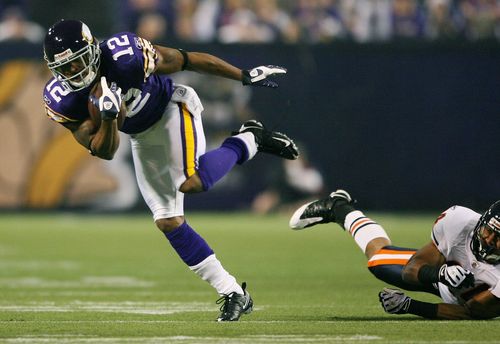
Percy Harvin won the Offensive Rookie of the Year Award:
Harvin was a controversial draft pick after he tested positive for marijuana use at the February scouting combine. But as it turned out, the biggest problem he encountered was an intensification of migraine headaches that has plagued him for much of his life. Migraines caused him to miss the Vikings’ rookie minicamp, the NFL’s rookie symposium and a game against Cincinnati last month.
(Percy Harvin #12 of the Minnesota Vikings breaks away from Al Afalava #24 of the Chicago Bears on November 29, 2009 at Hubert H. Humphrey Metrodome in Minneapolis, Minnesota. By Elsa/Getty Images)
 The Dish