The Leveretts Have A Point?

TUAFP:Getty

Larison agrees with the Leveretts and defends them against my critique:

As expected, Andrew didn’t like the Leveretts’ op-ed, which he calls part of “their campaign to diminish the significance of the Iranian uprising.” They might say that they are interested in correctly assessing the significance of any uprising in order to make their policy recommendations as realistic as possible. After all, if Western policymakers start banking on domestic political unrest to undermine the Iranian government in a major way, they will pursue policies that would be very different than if they assume that the current Iranian government is not changing and not going anywhere.

Well: sure. I don’t know the future, but the evidence in front of me suggests a huge shift in the distribution of power within the Iranian polity. Of course we shouldn’t anticipate the imminent demise of the regime, but we shouldn’t be in any doubt as to its completely collapsed legitimacy. More to the point, if US policymakers had taken the Leveretts’ analysis as accurate directly after the rigged election, they would have had no idea what was coming over the next several months. It seems to me that when analysts have a proven track record of being wrong, their next statement – in line with their previous demonstrably false take – should be viewed skeptically. Of course, in the MSM, it guarantees them a spot in the NYT. Larison’s bottom line:

The government’s rallies may be fake and the opposition protests may be heartfelt and courageous, but so long as an authoritarian state can limit and divide its opposition and retains the loyalty of its security forces none of that matters.

Really? Well, today we hear that one of the most hated men in the repressive architecture of the Khamenei regime, and one of Ahmadi’s key henchmen, Saeed Mortazavi, has been cited by the Iranian parliament for torture and abuse and murder of prisoners under his authority. That makes Iran’s parliament not only a good deal more active in pursuing torturers in the executive branch than the US Congress, but also another fracture in the junta’s control. Then comes another interesting story today about leaks of unrest and dissent among the … Revolutionary Guards:

“Since June, there has been much anecdotal evidence that suggests deep divisions between the hard-line commanders of the Guards and between the Guards and members of the regular armed forces who are dissatisfied with the election and its aftermath,” said Alireza Nader, an analyst with the RAND Corporation. “The extent of these divisions are hard to gauge, but they have the potential to weaken Khamenei’s grip at a critical juncture.” …

Mr. Milani, for example, pointed to what he said was a credible report based on information from the Military Command for Greater Tehran that the authorities have used criminals and prostitutes to intimidate protesters and fill the ranks of pro-government demonstrations…

On Jan. 2, the Rouydad News Web site said that an opposition supporter within the Guards, or I.R.G.C., provided a detailed account of the funeral for Ali Moussavi, the assassinated nephew of the opposition leader, which was controlled by the Guards’ internal intelligence service.

Who knows what to make of this? I don’t. But after the death of Montazeri, after Ashura, after clear signs that Mousavi feels confident enough to offer the junta a lifeline, is it “realist” to believe that the regime is as secure as ever? Regimes such as Khamenei’s are secure … until they aren’t.

February 11. That should be the next serious data point.

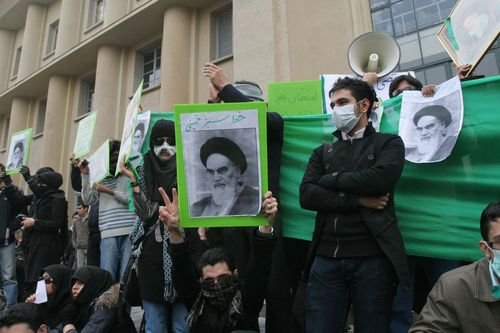
(Photo: Iranian opposition supporters hold pictures of the late founder of the Islamic republic Ayatollah Ruhollah Khomeini as they protest with the green symbolic color of the opposition at Tehran University’s campus on December 13, 2009 to condemn any insults against Khomeini. Iran’s supreme leader Ayatollah Ali Khamenei warned opposition leaders to distance themselves from protesters whom he accused of acting ‘against Islam’ and the late Ayatollah Khomeini. The protests were triggered by state television airing footage of a torn poster of Khomeini, which opposition leaders condemned, rebuking the state television. AFP/Getty Images)

Chait vs Manzi, Ctd

Douthat wades into the debate:

Manzi makes the sensible point that his essay (like my column, which quoted from it) was focusing on America’s position on the global stage as well as our domestic situation, and when it comes to global politics the sheer size of your economy — and not just your per capita wealth — matters a great deal.

On a per capita basis, after all, the richest countries in the world include Singapore, Qatar and Brunei, which nobody would confuse with great powers capable of playing a significant role in promoting stability, liberty and growth — or exerting significant cultural influence, for that matter — on the world stage. (Taiwan’s impressive per person G.D.P., Manzi points out, does not prevent it from being swallowed by mainland China; that job is the left to the U.S. Navy.)

Obviously, Western Europe is considerably more powerful and secure than Singapore and Taiwan. But just as obviously, Europe, too, is a beneficiary of the Pax Americana, and the outsize military spending that our overall economic size makes possible. And a world in which America’s economy had grown at European rates since the 1970s would be a very different place — less congenial to our own interests, and probably less stable and prosperous overall — even if our per capita G.D.P. had continued to rise smartly across that period.

Quote For The Day

"Let's do a brief thought experiment. I tell you the following: On New Year's Eve, a man in his mid-seventies is having his granddaughter over for a sleep-over, his five-year old granddaughter. He is attacked in his own home by an axe-wielding maniac with homicidal intent. Your mammalian reaction, your reaction as a primate, is one of revulsion – I'm trusting you on this.

Then you pick up yesterday's Guardian, one of the most liberal newspapers in the Western world, and there's a long article that says, ah, that picture, that moral picture, that instinct to protect the old and the young doesn't apply in this case. The man asked for it. He drew a cartoon that upset some people. We aren't at all entitled to use our moral instincts in the correct way. This is a sort of cultural and moral suicide, in my opinion," – Christopher Hitchens.

A Libertarian Litmus Test, Ctd

Megan takes issue with the framing of this post linking to Mike Konczal's thought experiment about how credit card companies could rip off senior citizens battling dementia:

[It's] pretty much standard libertarian theory that you shouldn't take advantage of people who do not have the cognitive ability to make contracts.  Marginal cases are hard not because we think it's okay, but because there is disagreement over what constitutes impairment, and the more forcefully you act to protect marginal cases, the more you start treating perfectly able-minded adults like children.The elderly are a challenge precisely because there's no obvious point at which you can say:  now this previously able adult should be treated like a child.  Either you let some people get ripped off, or you infringe the liberty, and the dignity, of people who are still capable of making their own decisions.

So Much For The Supermajority?, Ctd

Nate Silver's early reading of the 2010 senate races:

I don't think it can be taken for granted that Democrats won't keep their "filibuster-proof" majority, or even expand upon it; I might put this possibility at something like 25-30 percent, following the Dorgan/Dodd retirements. On the other hand, the Democrats might also lose five, six, seven seats … or perhaps more. I don't think the possibility of their losing their majority rates as higher than a small, single-digit number, although it cannot totally be ruled out if unexpected events (incapacitation of Robert Byrd and/or Daniel Inouye, a party switch from Joe Lieberman and/or Ben Nelson) come into play.

The Long Road Through The Wilderness

Michael Barone wonders why one-party rule tends to last longer in Britain than in the United States:

There are two obvious negative consequences of the infrequency of shifts in party control in Britain. One is that the governing party in its later years in the majority grows tired, stale, corrupt, and fractious—as anyone familiar with the later Major years or the current Brown years knows. Of course this happens in America too, after even shorter periods in power, as denizens of Capitol Hill in 1994 or 2006 could easily observe.

The other consequence is that if an opposition party does win, its leaders typically have little if any experience holding executive office. This was true of New Labour: Blair and Brown had both first been elected to the Commons in 1983, and never were part of a majority. It will be true, or largely true, of a Cameron government if Conservatives win this year.

A Transgender “Quota”

The Obama administration recently hired a transgender bureaucrat. Chait analyzes the Christianist right's response:

The interesting thing is that there's no attempt to show that the administration employed any sort of quota or affirmative action program. It just hired a person who's transgendered. The religious right obviously opposes that, but they can't say so. Thus they have come to employ words like "quota" to mean something entirely different than their literal meaning.

The Daily Wrap

Today on the Dish we watched Dem dominance waver and saw hopeful signs that Obama will demand accountability for the undie-bomber. Yglesias talked sense on profiling and Michael Yon got a taste of TSA firsthand.

The Leveretts continued to downplay the protest movement in Iran – a critique that was picked apart by Scott Lucas, Dan Drezner, and a Dish reader. The newly-unleashed Chait went after Manzi's National Affairs piece, forcing Manzi to backtrack a bit. Andrew tackled marriage equality in Britain but later amended his argument. He also got fed up with the Palestinians and Israelis, triggering reader responses here and here.

Greenwald and Sullivan continued to pound on Politico, Frum pummeled Rubin over Palin, Mary Kate Cary wondered about the silence from the bloggy right on Iranian protestors and the Dish blegged for writings from conservatives condemning the Uganda bill. Also, we spotlighted a particularly scary Christianist and highlighted the missing hikers in Iran.

Rooting around the internet, the Dish watched a slut spillage, looked at Limbaugh's silver lining, and aired an enema. We featured views from Yemen and Jew Town, India. The latest Recession View update here.

— C.B.