
Posts Of The Year: They Tortured A Man They Knew To Be Innocent, October 1, 2009

Gitmo-tube

The permanent danger of torture through human history is that it can be used by the torturers to manufacture or "create" evidence through confession. In fact, this has always been the prime function of torture: not to discover something that the torturers did not know beforehand, but to force a victim to tell the torturers what they were already convinced was true. If there is no evidence of a crime, or if the evidence is flawed or tainted, one sure way to convict someone is getting the suspect to confess. This is how an honorable man like John McCain came to sit in front of a camera and say things that were untrue and that incriminated him and his country. The confession then retroactively justifies the torture. See: he admitted it! He was a spy/traitor/heretic/terrorist/conspirator! Just watch the tape.

When neoconservatives, at the peak of their hubris, bragged that they could create reality, they weren't kidding. Torture is the most effective means of creating reality because of this dynamic. What better evidence is there that someone was an al Qaeda member than that he confessed to it? And torture can get victims to confess to anything if they are tormented enough.

And so when Rumsfeld and Cheney And Bush repeated that all the inmates at Guantanamo Bay were "the worst of the worst", they were merely telling us what they were intent on proving. There was no way independently to confirm this lie – because no one else could see inside their circle of torture and abuse. No one else could subject their claims to independent scrutiny at the time. And if it were not for the Supreme Court, we might never have been able to do anything but take Bush's word for it.

I voiced this fear a while back, in a post called "Imaginationland." This was my fear:

It is perfectly conceivable that the torture regime – combined with panic and paranoia – created an imaginationland of untruth and half-truth that has guided US policy for this entire war. It may well have led to the president being informed of any number of plots that never existed, and any number of threats that are pure imagination. And once torture has entered the system, you can never find out the real truth. You are lost in a vortex of lies and fears. In this vortex, the actual threats that we face may well be overlooked or ignored, as we chase false leads and pursue non-existent WMDs.

This is how totalitarian regimes justify themselves: by inventing enemies and proving their guilt through torture. The parallel dynamic in such regimes is that torture itself needs to be concealed, and errors of judgment, which could discredit the regime, need to be covered up. The techniques used by Cheney were, after all, once used by the Gestapo precisely to avoid the public embarrassment of clearly physically destroyed human beings, to present the appearance of normality, while behind that screen the psychological warfare of torture could proceed unimpeded. And if an error were made, if someone totally innocent were captured or tortured, the regime could then torture the victim to say he was guilty after all. In this closed loop, there are no loose ends. The executive is always right and its victims are always wrong – and torture provides all the evidence you need to prove it.

Mercifully, America under Bush and Cheney was not a totalitarian regime.

It had an executive branch that embraced the ethic of tyranny in warfare, and a legislative branch so supine it was a toothless adjunct, but it retained a judiciary that began, too late, of course, to push back against the hermetically sealed war-and-torture cycle. The Founders were wise to add such a check. Without it, we would have no way out of the maze that Cheney pushed us in.

Last week we discovered, thanks to the judiciary, a clear example of this tyrannical impulse occurring under Bush and Cheney. We now know that torturing a human being to get proof that he deserved to be tortured was not just a theoretical fear of mine. It happened. If it happened once, it almost certainly happened more often. The temptations are just too great; and when you have clear evidence that Bush and Cheney knew some inmates to be innocent but tortured them anyway to manufacture evidence of their guilt, we know that there was nothing in the character of those two men to restrain the true nightmare scenario.

Go here and read Andy Worthington's vital account of what the case of Fouad al-Rabiah tells us about the abyss the last administration threw us into. Here is the actual judgment, which provides a meticulous and unanswerable account of the extent to which the torture power corrupted the American government in ways usually found in totalitarian regimes. Read too how the Obama administration – far from turning the page on this matter, as it openly pledged to do – is up to its neck in the same disgrace, pursuing charges against a man they also knew was plainly innocent of all charges, simply to prevent embarrassing the government.

Obama had a chance to draw a line between his administration and the last. While he deserves credit for ending the torture going forward, he has essentially embraced and defended the torture of the past. Which makes him and Eric Holder complicit in it as well. May God and history forgive them. I sure won't.
How Cheney Made America A Torture Nation, Ctd

A reader writes:

Torture really is a slippery slope.  First it was the 'ticking timebomb' where torture was OK.  Now it's an ordinary 'panty bomber'.  It's only a short hop skip and a jump to use torture on US citizens suspected of 'heinous' crimes such as multiple murders or child kidnappers. From there what about torturing those who smoke pot to find their suppliers.

Once we are used to it and accept it it will be used whenever we feel like it.

One question no one, that I've seen, has ever asked those who advocate torture.  What happens if you torture an innocent person by mistake?

Well, we have tortured people by mistake. And what happens when you do is that you are tempted to find a way to hide that mistake. And since you have the power to torture, and torture can coerce evidence of guilt, you simply torture some more to get the right answer, or you torture someone else to get corroborating evidence. This has already happened in America.

This is why the naivete in this debate is not with those of us who oppose all torture. Au contraire.

The truly naive are the Krauthammers and Thiessens and McCarthys who seem to believe – against all history and human nature – that torture can be controlled, that it can be sealed within a very tight box, used only by good people, never abused, never allowed to spread. But this has never happened. We know very well from brutal historical experience that the power to torture even one person always metastasizes. And we have seen it with our naked eyes in America. What was Abu Ghraib if it wasn't proof that orders to torture from the very top instantly spread through the system so that a handful of torture victims becomes hundreds in a matter of weeks; when torture is allowed the CIA and the military, it instantly spreads, as we have seen, to every theater of war, to every branch of the armed services, from Navy SEALS to special ops guys openly torturing mere suspects under the watch of Stanley McChrystal.

And yet the noecon response to this horror is to urge more of it, as routine, past ticking time bombs scenarios, past imminent threats … on and on to waterboarding a suspect whom even the Bush administration, in an identical setting, decided to prosecute using criminal law.

The F-Word

A reader writes:

I do wish you'd stop using the terms neo-fascism and neo-fascistic to describe the advocates of torture and an extra-legal, unaccountable national security state.  Fascism and fascistic are perfectly apt, and need no neo.  The worship of state power, the organization of politics as a fight against foreign enemies are classically fascist.  So, too, is Sarah Palin's appeal as a defender of a pure and virtuous volk, exploited by comopolitan elites.  Fascist does just fine. 

And you don't have to worry you're equating Cheney his ilk with Hitler.  Mussolini and Franco were fascists, too.

Since these advocates of fascist tactics still support at least an open political system, obey the results of elections (even while behaving as if they are illegitimate when they go against them), submit eventually to the rulings of the Supreme Court, evacuate office when voted out, I think the term neo-fascist is preferable.

The themes are indeed classic ones of the far right, and the far right has essentially gobbled up the rest of conservatism in Republican America this past decade. Under Bush and Cheney, we did live under a law-free protectorate for a while, with the executive claiming indefinite, unlimited powers to seize and torture anyone without due process, but the system slowly pushed back against it, even if full accountability for this interlude in democratic norms has yet to be fully taken.

Mousavi Anticipates His Own Death, Ctd

A reader writes:

Mir-Hossein Mousavi's explicit statement that he was willing to die along side other Green activists is a big deal.

Compare it to a similar historic statement in early 1960s when Mehdi Bazargan, Iran's first 4(44) prime minister after the Iranian Revolution of 1979, told the Shah's military court: "We are the last people who will speak with you with words and encourage you to reform" – meaning that if you follow through the path of closing all doors to peaceful opposition and reform, the new generation will use other means to bring change: violence, revolution etc.

Mousavi's letter pretty much does the same. He propose that the leadership take 5 steps to avoid a catastrophe: restore freedom of press, release all prisoners, pass a law that guarantees fair and free elections, allows the opposition the right of peaceful protest as it's granted in the constitution and for the supreme leader to stop supporting the Ahamdi Nejad government so it's held accountable for its massive failures. He says this is the only way the country survives this turmoil. He provides the leader one last chance to undo the damage

and return to civility. 

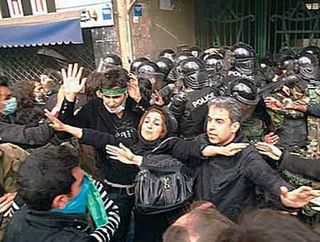
But if they don't, which is likely the case, he has resolved any doubt that he is in this till the end and will not sell out even when his own nephew is killed. He also reminded the Greens of the importance of avoiding violence as that goes against what this movement is about. He also responded to the State TV's non-stop propaganda that the Greens are bunch of violent kids working for the West. He refers to the picture above and says: "If the state TV had a shred of honesty and sanity left in its leadership, it would air the images of those brave souls that despite being beat up by police and Basij, they still see them as their own brothers [who are also a victim of this situation] and try to protect them from being seriously harmed."

His message was loud and clear: We are still reformists, we want to bring change peacefully, we despise violence, the leader must understand that if he destroys this one last bridge behind him, then we are headed towards a collision that we did all we could to avoid.

This is a man that cares deeply for Iran's well being more than he does for his own political future.

The Miracle Of Marijuana

In Washington DC, there's considerable anticipation of the medical marijuana initiative finally being allowed to take effect. DC voters backed Initiative 59 with 69 percent support in 1998, but, of course, American citizens have less self-rule in Washington than Iraqis have in Baghdad, and so a bunch of congressmen from far far away decided that we needed their rule rather than democracy and voided the whole thing. But that ended last month with an appropriations bill and a Congressional majority that believes in democracy at home as well as abroad.

Good timing. New research suggests that marijuana acts in the opposite fashion to legal and taxed alcohol and nicotine, and fr from destroying brain cells, actually helps them re-grow:

Xia Zhang, an associate professor in the U of S neuropsychiatry research unit, led the team that tested the effects of HU-210, a potent synthetic cannabinoid similar to a group of compounds found in marijuana. The synthetic version is about 100 times as powerful as THC, the compound responsible for the high experienced by recreational users.

The team found that rats treated with HU-210 on a regular basis showed neurogenesis – the growth of new brain cells in the hippocampus. This region of the brain is associated with learning and memory, as well as anxiety and depression.

The effect is the opposite of most legal and illicit drugs such as alcohol, nicotine, heroin, and cocaine.

“Most ‘drugs of abuse’ suppress neurogenesis,” Zhang says. “Only marijuana promotes neurogenesis.”

Of course these tests need to be done in humans. Maybe soon America will be sufficiently adult to start following reason rather than fear.

Touching A Raw Nerve

Passive-aggressive partisan tool Glenn Reynolds fires back:

NO, ANDREW, it’s that you’re a preening, hectoring, self-centered, unpersuasive bad writer.

So Glenn's point is that bad writing is responsible for the US becoming a torturing nation under Cheney. If I had been able to be a good writer, I might have made a difference in the fight against torture. Reynolds, in stark contrast, waged a far more effective campaign against torture by writing and saying almost nothing, except for occasional credentializing statements that he is against it, while remaining in favor of everyone who is for it.

Yes, that sounds about right. Of course we are all imperfect writers. But that's a subjective judgment and so I refer readers to my single attempt this past year to make the case as best I could in a single essay directed to the man ultimately responsible for the torture of countless prisoners, George W. Bush.

Make your own mind up. I'd also link to some writing Reynolds has produced making the case against torture for comparison but can't find anything more than a phrase here and there. Happy to post some if I missed one of his cris de coeur, and then you can make your own mind up as to who has been more effective in conveying the case against torture, me or Insta.