Touching A Raw Nerve, Ctd

A reader writes:

Following Glenn's link in his post I read,

"YEAH, BUT WITHOUT ANDREW SULLIVAN’S ANTI-TORTURE BLOGGING IT WOULD HAVE BEEN 56%: 58% Favor Waterboarding of Plane Terrorist To Get Information."

And I immediately got confused.

Who cares what the favorability rating of torture is? Our laws are based upon principle not passion, it's what keeps us from taking "justice" into our own hands and devolving into a mob. It may be deemed self-righteous to write of things like principles and the rule of law, and true, your bad writing and your lack of persuasion might be junking up the internets, but at least you read like a man of conscience and not someone trying to win a fucking contest.

A Late Victorian

A reader writes:

My brother-in-law John was a Late Victorian, lost in the Castro on 7/25/90 at 34.

I have been wanting to write the perfect message since I listened to the great recording of Mark Adamo's work, featuring your work. But there is no such thing so I'll just do it.

I bought the CD as a gift for my son the musician who, sadly, has no actual memories of John. What he has is John's work as an artist. John was a prolific painter, sculptor,  lithographer and, in collaboration with my wife, a doll artist. He would sculpt in porcelain clay 
6a00d83451c45669e201287647fea9970c-500wi the heads, hands, and feet of the dolls while my wife would do the rest. After he died, his mother taught herself how to sculpt so as to keep the family business alive.

Twenty years later mother and daughter are still making dolls. In time she developed her own style. But in those early days she felt John's guidance in her hands as she worked in the wet clay.

Among some of my Facebook friends in the days leading up to Thanksgiving Day last year we tried to post each day something for which we were thankful. The task reminded me of what John had said in the months before he died. He spoke of how vivid the world had become. How he was continuously dazzled by the world's color. Simple things. The sky, leaves, the earth. You could just stand back whenever you wanted and let it all in. I remain very grateful that he told us that.
 
Anyway, the recording was very moving and I appreciate your effort and the efforts of your brilliant collaborators. My wife hasn't listened to the CD yet. I'm not pushing it. But I told his mother about it today and she looking forward to hearing it. She has shared excerpts from John's journals and I will close with an entry from age 15.

"Laughter is when the top of your head is gone and sunshine and happiness pour out because you understand yourself…

Crying is when the top of your head is gone and pain pours out because you are confused and alone…

Creating is when the top of your head is gone and ideas and love come out…

Work is when someone glues your head back on and you have to take out the trash."

The Lonely Journey Through The Night

Tony Judt movingly describes his experience of  Lou Gehrig's disease. By this point he is "effectively quadriplegic." Judt dreads going to bed:

Ask yourself how often you move in the night. I don't mean change location altogether (e.g., to go to the bathroom, though that too): merely how often you shift a hand, a foot; how frequently you scratch assorted body parts before dropping off; how unselfconsciously you alter position very slightly to find the most comfortable one. Imagine for a moment that you had been obliged instead to lie absolutely motionless on your back—by no means the best sleeping position, but the only one I can tolerate—for seven unbroken hours and constrained to come up with ways to render this Calvary tolerable not just for one night but for the rest of your life.

My solution has been to scroll through my life, my thoughts, my fantasies, my memories, mis-memories, and the like until I have chanced upon events, people, or narratives that I can employ to divert my mind from the body in which it is encased.

Quote For The Day

Glenn Greenwald finds where he agrees with David Brooks:

Ever since I began writing in late 2005 about this fear-addicted dynamic, the point on which David Brooks focused yesterday is the one I've thought most important. What matters most about this blinding fear of Terrorism is not the specific policies that are implemented as a result. Policies can always be changed. What matters most is the radical transformation of the national character of the United States.

Reducing the citizenry to a frightened puddle of passivity, hysteria and a child-like expectation of Absolute Safety is irrevocable and far more consequential than any specific new laws. Fear is always the enabling force of authoritarianism: the desire to vest unlimited power in political authority in exchange for promises of protection. This is what I wrote about that back in early 2006 in How Would a Patriot Act?:

"The president's embrace of radical theories of presidential power threatens to change the system of government we have. But worse still, his administration's relentless, never-ending attempts to keep the nation in a state of fear can also change the kind of nation we are."

Torture Will Stay With Us

A reader writes:

I am reading your torture posts again with great dismay. America has gone through periods of torture in the past but has come out of it as the system has slowly pushed back when the “enemy” was defeated, when the fear of the other subsided. This time though we face a problem – terrorism – which may never end. So I wonder will this time be different. Won’t the next, inevitable terrorism attack simply crush the current fragile push back? Isn’t the greater likelihood that Cheney and the terrorists define our torturous future?

Yes, it is. Which is why Obama’s refusal to tackle it head-on, though politically understandable, may come back to haunt us. And that’s why it’s essential that the rest of us keep our focus on this and not let it slide and rebut it each and every time the far right uses an incident to whip up the fear that leads to abuse again. Another writes:

Don’t forget the simple fact that it actually lets truly guilty people stay safe and warm in order to attempt yet further attacks against soldiers and civilians.  Beyond the sheer terror of learning that a Police Commander in Chicago habitually and institutionally tortured suspects into making false confessions (which prompted then State Senator Obama and numerous others in Springfield to require taping everything that happens inside a jail and interrogation) there is the utter depravity in knowing that countless criminals have been walking the streets thanks to these barbaric methods causing innocent men being locked up in their stead.

The injustice of this is two-fold. First to the innocent man who was tortured and then wrongly incarcerated for years, and second to the victim of the crime that was committed whose perpetrator had managed to stay free for all that time rather than caught and held to account.

Granted prisoners of war and conditions on the battlefield are rather different from Chicago’s South Side, but the principles undergirding this travesty of justice remain the same.

How many insurgents and terrorists are free in the Khyber Pass because we grabbed the wrong man and tortured him until he admitted guilt? How many attacks and bomb blasts have occurred because we were too busy chasing the fevered dreams of shepherds whom we had reinvented as criminal masterminds?

How much American blood is on our torturer’s hands’, hidden under the stain of an Arab’s?

Email Of The Year: October 2, 2009

A reader writes:

As a trial attorney with the Department of Justice, I am

familiar with the al-Rabiah case (however, to be clear, I am not a trial attorney who worked on the case).  My opinions stated GITMOmarkwilsongetty herein, of course, are not the opinions of the Department.  I write for myself and myself alone.
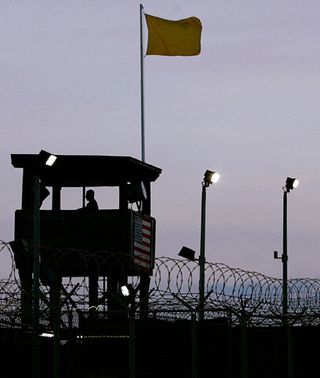
I had a long conversation regarding the al-Rabiah case with colleagues when the decision came down.  Our expertise and experiences are varied, but we all work on matters ranging from criminal matters to civil habeas cases.  We are litigators, and we know what makes a case, and when a case is weak. 

The conclusion drawn by each of my colleagues – some of whom are liberal Democrats, some of whom are conservative, law-and-order Republicans – is, to a person, that the detention and interrogation programs the United States implemented in the months and years following 9/11 is not only a complete abrogation and violation of international law and, in many cases, federal law – it is also fundamentally immoral.  We also agree that the al-Rabiah case is by far the most egregious yet to come to light.  To repeat: yet to come to light.  I can only guess that there are other, far worse cases. 

That said, I am surprised you did not highlight what me and my colleagues agreed was the single most horrifying passage from the Court’s decision.  It was the Court’s quotation of something an interrogator said to al-Rabiah during his interrogation.  The interrogator told al-Rabiah:

“There is nothing against you. But there is no innocent person here. So, you should confess to something so you can be charged and sentenced and serve your sentence and then go back to your family and country, because you will not leave this place innocent.”

Court Memorandum and Order, p. 41 (emphasis mine). 

This was an agent of the United States saying this.

This was not a statement pulled from the transcripts of the Nuremburg trials, nor archival evidence taken from reports smuggled out of one of Stalin’s gulags.  This was a statement made by an agent of this government less than 7 years ago to a detainee.  The enormity of that is nearly incomprehensible. 

But even worse – far worse – is the fact that the government would nevertheless still seek to convict based on the resulting confession.    

To those of us who read that passage and who vowed and make it our vocation to serve and protect the Constitution of the United States, that fact is a gut-punch.  For me and my colleagues, it literally took our breath away.  It makes one wonder how far down into the abyss we have allowed ourselves to drop.  And whether there is the political will to find our way out. 

It took my breath away as well. I used to wonder how democracies became tyrannies. I know now. Because good men like Obama do nothing.