The Cost Of Conspiracy Theories

Linda Besner considers how extreme or unorthodox viewpoints reshape mainstream culture:

Recent research suggests that the current prevalence of Enemy Above conspiracy theories [in which the threat comes from our own government and institutions] has a direct social consequence—lower voter turnout and public engagement. A study by psychologists Daniel Jolley and Karen M. Douglas, published in the February 2014 issue of the British Journal of Psychology, found that exposing subjects to conspiracy theories about the death of Princess Diana or climate change decreased participants’ self-reported likelihood to vote, donate money to political groups, or wear campaign stickers.

These conspiracy theories can take a while to kick in:

In the immediate aftermath of President Kennedy’s assassination, people were inclined to believe the official story. In 1963, a poll showed that 29 per cent of Americans trusted the accuracy of the Warren Commission’s report; in 2001, only 13 per cent believed the official narrative. Similarly, the Joint Inquiry that compiled the government’s take on the events of 9/11 was initially well received, but by 2004 polls showed a growing disbelief in its findings. A polling company found that in April of 2013, 11 per cent of American voters believed the U.S. government let the attacks on the World Trade Center happen. The “truther” movement has been actively organizing lectures and tours to tout their point of view, and while mainstream audiences may not be attending these events … [exposure] to the doubts of others has a psychological effect, even when we consciously dismiss their objections.

Map Of The Day

per-sq-mile-night-heat-map

Tim De Chant explains:

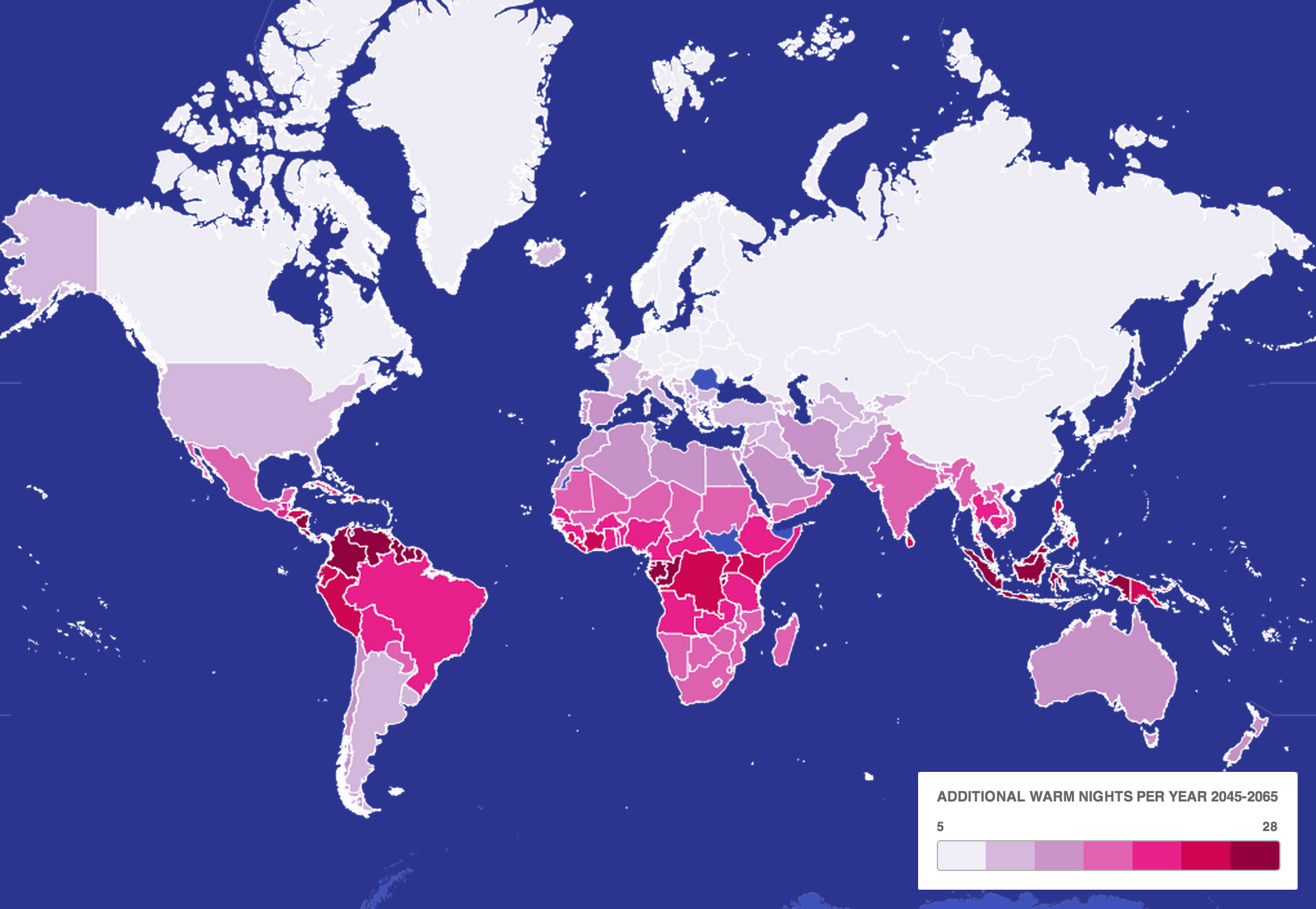
Worldwide, [climate change will lead to] somewhere around two weeks of higher nighttime low temperatures. In some places, winter nights may be unseasonable warm, or in others summer nights could grow more sweltering and sleepless.

But it’s not just our comfort that’s at stake. Plants are uniquely sensitive to nighttime low temperatures. If they’re too high, plant respiration rates tend to increase. (Yes, plants respire just like us. Unlike us, they’re able to grow without eating because, during a typical day, the rate of photosynthesis greatly outpaces the rate of respiration, meaning they’re making more food than they are consuming.) When respiration rates rise in plants, they consume more of the carbohydrates they made through photosynthesis during the day. With less energy available, they might grow more slowly or put less energy into producing seeds. It happens that many staple crops, like rice and corn, are seeds, so warm nights are one way climate change could slash crop harvests.

Getting Schooled On Inequality

Leonhardt discusses the role of education in fighting inequality:

The great income gains for the American middle class and poor in the mid-to-late 20th century came after this country made high school universal and turned itself into the most educated nation in the world. As the economists Claudia Goldin and Lawrence Katz have written, “The 20th century was the American century because it was the human-capital century.”

Education continues to pay today, despite the scare stories to the contrary. The pay gap between college graduates and everyone else in this country is near its all-time high. The countries that have done a better job increasing their educational attainment, like Canada and Sweden, have also seen bigger broad-based income gains than the United States.

Yet the debate over our schools and colleges tends to exist in a separate political universe from our debate over inequality. Liberals often shy away from making the connection because they worry it holds the struggling middle class and poor responsible for their plight and distracts from income redistribution. Many conservatives fear the implicit government spending involved. And so, our once-large international lead in educational attainment has vanished, and our lead in inequality has grown.

Screened Out?

dish_subwayreading

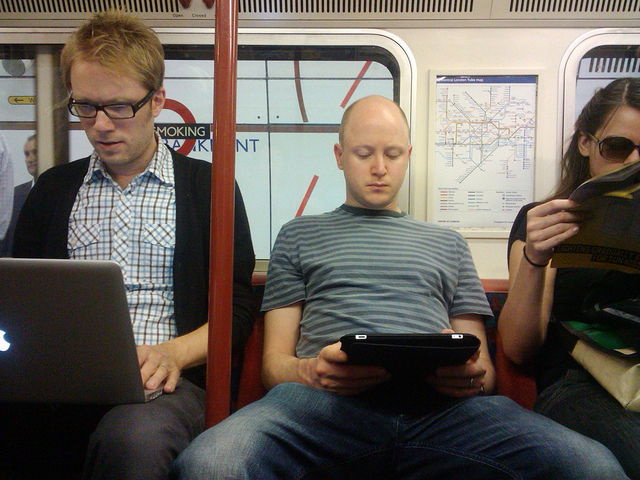
New Yorker Michael Bourne worries about what the disappearance of print books on the subway suggests about today’s reading culture:

When we talk about books, we tend to think in terms of great works of art and forget that for most people books, like newspapers and magazines, are merely a handy thing to have around for that idle moment when there isn’t something else better to do. Now, more and more often, those idle moments – on subway cars, on airplanes, in dentist’s offices – are being filled by games and movies and social media. By screens.

This doesn’t necessarily mean the end is nigh for literature as we know it. The golden age of American theater came in the 1940s and 1950s, a generation after radio and talking pictures seemingly outmoded live theater. Arguably, some of the greatest movies American directors have ever produced debuted in the 1970s, a generation after television seemingly outmoded movies. Still, a vibrant art form has to serve a utilitarian function in ordinary people’s lives or it gradually becomes relegated to the museum and the specialist viewer, as has happened to visual art and, more recently, to live theater. And if the printed page can’t survive on a New York City subway car, that once-great rolling library, where else can it survive?

(Photo: “Evolution of reading on a subway” in London, 2010, by Alfred Lui)

What Helmets Can’t Prevent

Concussions:

There’s no question that helmets save lives by preventing skull fractures and other lethal brain injuries. But according to a 2013 report on youth sports-related concussions by the Institute of Medicine and the National Research Council, “there is limited evidence that current helmet designs reduce the risk of sports-related concussions”—minor traumatic head injuries that have been tied, at least in adults, to long-term neurological problems including depression, chronic traumatic encephalopathy (a neurodegenerative disease) and chronic cognitive impairment.

Look, I’m no fan of alarmist parenting info. But the fact that helmets don’t protect against concussions might influence the choices we make as parents, so I think it’s important to know.

That’s an essential point made in our long-running thread on brain injuries in professional sports. A related sub-thread here. Update from a reader:

Perhaps the biggest misnomer perpetrated by Ms. Moyer in her Slate article is that a “better designed” helmet would prevent concussions.

The repetitive types of concussions that are beings studied as causal links to long-term brain injury are not necessarily caused by outside impacts but the forward moving brain, itself, slamming into the now-stopped skull. Lots of activities can cause these types of micro-concussions where no helmet would or could prevent that.

The only way to prevent such micro-concussions is to avoid activities where those situations can arise. Of course that’s nearly impossible unless you want to live inside an actual bubble. The same would apply to your children.

In particular Ms. Moyer (and I suspect a vast majority of people) falsely believe that bicycle helmets in particular are designed like motorcycle or football helmets, failing to realize that cycling helmets in particular are designed for one major impact. Not repeated impacts. The intent of cycling helmets are to help prevent major brain injuries and skull fractures.

As an avid cyclists, I can attest to that. When I lived in the D.C./MD area, I used to mountain bike out in Cedarville State Park in Maryland after work. Nothing technical but a fast, fun trail. During one such ride, I slid of a trial bridge and flipped into the creek, landing on my head and right shoulder. After checking to be sure the bike was ok first (every cyclist will attest to this) I brushed myself off and checked for injuries. Nothing visible but the headache and blurred vision.

With seven miles to ride back to the trial head to my car, no cell service and no one knew I was riding that day, I’m glad my helmet worked because it cracked in half on that ride where I landed on the creek rocks. After I made it home, I took some Advil and drank a beer and took a nap. I only realized after the fact when checking my symptoms did I realize I had suffered a concussion.

Having been hit by a car, crashing mountain and road riding, and mastering the multitude of ways to fall off of a bike, I’ve only had that one bad concussion on a bike. But I’ve replaced my helmets several times over the years. By the way, this why you should pay good money for a helmet because reputable companies like Bell offer crash replacement.

I think the underlying issue is that sports activities have gotten safer over the years with regards to equipment, techniques and awareness to brain injury but we need to get over the idea of 100% safe activities. As human animals such activities are the last vestiges we have to our baser instincts and the need to move and be alive. I’ll put my kids in soccer or on a bike before I put them in football. But I also know that without the ability to play and self-assess for risks children will never avail themselves of those skills when they get older.

The Best Of The Dish Today

Lexington 2

The story of how Mitt Romney helped Barack Obama is now no longer restricted to his terrible 2012 campaign and tone-deaf rhetoric. It also includes Romneycare – the state model for the federal ACA. And a new study on the impact of that reform on mortality is one that deserves to be taken seriously:

The study tallied deaths in Massachusetts from 2001 to 2010 and found that the mortality rate — the number of deaths per 100,000 people — fell by about 3 percent in the four years after the law went into effect. The decline was steepest in counties with the highest proportions of poor and previously uninsured people. In contrast, the mortality rate in a control group of counties similar to Massachusetts in other states was largely unchanged. A national 3 percent decline in mortality among adults under 65 would mean about 17,000 fewer deaths a year.

It’s not the most efficient way to reduce mortality. Harold Pollack argues that “some other interventions such as targeted prenatal care interventions to poor women or evidence-based therapies to help people quit smoking are probably more cost-effective.” But it’s real and suggests a bigger impact on the quality of people’s health than was suggested in the recent Oregon study (and one of the authors was involved in both). Jon Cohn writes it up here; Adrianna McIntyre here. Money quote from McIntyre:

If you think the study’s primary findings are impressive, consider their implications: “mortality amenable to health care” does not just magically decline. If fewer people are dying, that is almost certainly because diseases are being better treated, managed, or prevented—because of improved health. It’s hard to come by data on objective measures of health at the state level, but the “improved health” story is consistent with other findings in the paper: individuals had better self-reported health, were more likely to have a usual source of care, received more preventive services, and had fewer cost-related delays in care.

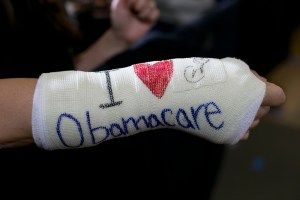
Since I spent part of today at the doctor’s and at a radiology center, and was using my Obamacare insurance, it was hard not to reflect on this. (I’m on the mend.) I don’t have an ideological position on healthcare – I can see the great benefits of the American private sector, but also its staggering inefficiencies – but I do hold as a pretty core belief that healthcare is not like other goods. It is the condition that allows us to enjoy all other President Obama Visits Boston To Talk About Health Caregoods. And we live in a golden age of medicine, in which my chronic HIV, a death sentence when I was diagnosed, can now be managed, my chronic asthma treated, and my apnea kept at bay. I seriously believe that a wealthy society that allows people to be sick and not have access to care is a disgrace to humanity. And so I believe that the ACA’s signal achievement already in reducing the numbers of the uninsured is a crucial step in the right direction.
Politically, this leads me to a simple conclusion. The GOP offers nothing that can achieve anything like this. They are content that working Americans have to suffer sickness on a regular basis, without care and with health problems metastasizing until they are both far more expensive and far more intractable. They have lied, distorted and confused millions with their propaganda on this. And it should sicken anyone. So, yes, at this point there is a moral difference here between the two parties – a glaring moral difference. And of all this president’s considerable achievements over the last six years, this one we will remember for decades to come. You want to call me an Obama sap for that? Make my fucking day.

Four posts worth revisiting: the rise of a new/old Russophile Germany; how to persuade creationists that global warming is real; a new paradigm in sponsored content (a documentary/advertisement – an adumentary?); and some dogs to make you happy!

The most popular post of the day was my latest takedown of Peggy Noonan’s mindless drivel, followed by the podcast with Hitch on Deep Dish (subscribe for full access!). I’ve been really moved by some of your reflections on that. One reader reaction:

This is me screaming like a prepubescent fagboy.

Another:

There are two voices in my head, vis–à–vis religion. One speaks through a manly beard, in tones decidedly not gay-sounding, but pleasantly transatlantic. The other is whisky-cured, and occasionally has a fire beneath it that would not, I sometimes think, sound out of place in the mouth of John the Baptist, or any of the old-school prophets (it’s funny Hitch railed so against tongues of flame, as he had one himself.)

One more:

There is a great hole in the universe where Hitch used to be and I’m very grateful for you and other intelligent, thoughtful, and talented souls (pardon the expression, Christopher) who continue to celebrate him.

I miss him as much as you do. Can you imagine him on Putin? I think he’d probably be in Donetsk as we speak, scribbling and drinking and finding new comrades through the night.

See you in the morning.

(Window view: Lexington, Massachusetts, 8.54 am.)
Women Like Manly Men. Period.

Amanda Hess flags new research debunking the idea that straight women’s preferences in male companions fluctuate with their menstrual cycles:

Last month, psychologists at the University of Southern California published a meta-analysis of 58 research experiments that tested whether a woman’s preferences for masculinity, dominance, symmetry, health, kindness, and testosterone levels in her male romantic partners actually fluctuate across her menstrual cycle. The answer: They do not.

hairytriangle.jpgThe analysis, published in the appropriately titled journal Emotion Review, looked at studies that used a variety of sociological tools to examine women’s preferences for a host of masculine cues, such as a man’s gait, body hair, chin length, facial symmetry, or social interactivity, all through the prism of their menstrual cycles. They looked at studies that were focused on testing women’s preferences in short-term relationships (like one-night stands) and long-term commitments (like marriages), and at studies that didn’t specify a relationship type at all. They included experiments that charted a woman’s menstrual cycle and fertility using hormonal tests and self-reports, ones that included women on hormonal contraception, and those that did not. All in all, they found that both fertile and nonfertile women preferred men who were more masculine, dominant, symmetric, and healthy; that those preferences remained relatively constant across their menstrual cycles; and that they applied to women’s feelings about both short-term and long-term relationships. Meanwhile, women who were at the nonfertile stage of their cycles—where they experience similar hormones to pregnant women—didn’t suddenly prefer kinder, gentler men.

And people think the steroid craze will diminish. Not when there’s sex to be had and partners to be won.

Anticipating The End

Jenny Diski, age 66, pens a thoughtful essay about growing old:

[One] definitive non-sexual way of knowing you’re old is the moment when your doctor tells you that ‘you’ll have to learn to live with it,’ or that whatever ails or pains you is ‘the result of wear and tear’. You wait for the suggestion of a procedure, the next appointment, and then realise that you aren’t going to be considered for it. You see a virtual shrug that says you are no longer young enough for a resource-strapped institution to be overly concerned with getting you back to full health. There are higher priorities, and they are higher because the patients are younger.

It comes to you that whatever ailment you’ve got at this point is decay inflected by decay, in one form or another, and, to people who aren’t you, only to be expected. It is, to put it simply, which they won’t, a recognition of the beginnings of the approach of death. … None of the gung-ho books on ageing has more than a brief mention of the proximity of death as one of the symptoms of old age to be dealt with. ‘Acceptance’, they say, without much elaboration, and then move rapidly on. Even if it won’t kill you imminently, the degeneration of the body will alter and limit how you can live, whether you can get out, continue to work and travel. I can’t think of anything about the reality of ageing which improves a person’s life. The wisdom people speak of that is supposed to come to us in old age seems to be in much shorter supply than I imagined, and apart from that, it’s a matter of how self-deceptively, or stoically, you are able or prepared to put up with the depletions, dependency and indignities of getting old.

Whale Watching

Last week, Svati Kirsten Narula covered the Internet’s infatuation with a dead whale:

A dead blue whale washed up on the shore of a small fishing town in Newfoundland last week. A bloated, beached, blubbery bomb of a blue whale. As of 3:30 pm Eastern Time [April 30th], the carcass is still intact, but onlookers are worried that it might soon explode. Literally.

The concerned marine science communicators at Upwell and Southern Fried Science have created a website devoted to monitoring this situation:

HasTheWhaleExplodedYet.com. I kid you not.

Ian Crouch reviews the history of exploding whales:

The idea of spontaneous combustion is certainly compelling, but the truth of the matter is that history’s famous exploding whales had a little help from humans.

A whale blew up last year in the Faroe Islands, but only after a seam had been cut by a researcher, who just managed to dodge the gooey shrapnel. Another whale, which showered the streets of the Tawainese city of Tainan in a mess of innards in 2004, was being transported on the back of a truck when it burst. And the most famous exploding whale in history went sky-high thanks to some inventive, if ill-considered, meddling. In 1970, members of the Oregon Highway Division rigged up a dead beached whale with dynamite in an attempt to obliterate it. But it turned out that they were low on firepower, and so, rather than blasting the body into tiny bits of seagull food, they instead sprayed huge chunks of whale over a crowd of people across a wide radius. Thankfully, there was a television crew on hand to capture the full arc of the scene—from hopeful preparation to grim postmortem. Onlookers fled the dunes. An Oldsmobile was flattened. Nobody died.

The Whiteness Of Writing Workshops

Two decades ago, when Junot Diaz arrived at Cornell to pursue his MFA in creative writing, he confronted “the standard problem of MFA programs”: “That shit was too white.” He notes that, in his experience, not much has changed:

It’s been twenty years since my workshop days and yet from what I gather a lot of shit remains more or less the same. I’ve worked in two MFA programs and visited at least 30 others and the signs are all there. The lack of diversity of the faculty. Many of the students’ lack of awareness of the lens of race, the vast silence on these matters in many workshop. I can’t tell you how often students of color seek me out during my visits or approach me after readings in order to share with me the racist nonsense they’re facing in their programs, from both their peers and their professors. In the last 17 years I must have had at least three hundred of these conversations, minimum. I remember one young MFA’r describing how a fellow writer (white) went through his story and erased all the ‘big’ words because, said the peer, that’s not the way ‘Spanish’ people talk. This white peer, of course, had never lived in Latin America or Spain or in any US Latino community—he just knew. The workshop professor never corrected or even questioned said peer either. Just let the idiocy ride.

Another young sister told me that in the entire two years of her workshop the only time people of color showed up in her white peer’s stories was when crime or drugs were somehow involved. And when she tried to bring up the issue in class, tried to suggest readings that might illuminate the madness, her peers shut her down, saying Our workshop is about writing, not political correctness. As always race was the student of color’s problem, not the white class’s. Many of the writers I’ve talked to often finish up by telling me they’re considering quitting their programs. Of course I tell them not to. If you can, please hang in there. We need your work. Desperately.

Eric Nelson sees a diversity deficit in publishing, too:

I have frequently presented books as an editor to a room full of only white people. And even from the sixteen books I’ve sold in the past twelve months, less than a third were by women, and only two were by non-white writers. The lack of diversity really is that bad.

But he also finds cause for hope:

[T]oday the market is already demanding a wider variety of books, and with the rise of electronic publishing, self-publishing, and so many websites that provide traffic and social media metrics, it’s harder than ever to ignore what the market is saying. … [I]t only makes sense for so long to promote exclusively books by and about white men, when clearly there is a huge appetite for a much wider range of material. My point, ultimately, is that—in publishing, at least—the camp for diversity and the market are now pulling in the same direction.

And what will be the argument when, sans gate-keepers, the diversity problem remains? Another definition of racism?