
Park Slope, Brooklyn, 2 pm. “Spring is (finally) here!”
Park Slope, Brooklyn, 2 pm. “Spring is (finally) here!”
“It was notable that the panel offered not one example of something they thought Obama should do now to respond to the crises in Ukraine, Syria, Libya, Egypt or lots of other places. They were full of examples of what he should have done in the past, and absolutely certain he would not do the right things in the future, including decisive military action against the Iranian nuclear program,” – Daniel Serwer, listening to Robert Kagan, Walter Russell Mead and Leon Wieseltier, all now arguing for what they argued for in 2003 – a US-initiated war in the Middle East.
In response to Matt K. Lewis’ “conservative case” for the death penalty we posted yesterday, Balko points out that the practice is “susceptible to the same problems Lewis points out when criticizing the things governments do that he believes aren’t legitimate”:
When it comes to the trappings of public choice and political economy, the corruption of power and tunnel-visioned public officials, the criminal justice system is no different than, say, the Environmental Protection Agency, the Department of Education or the Occupational Safety and Health Administration. Actually, there is one important difference: The consequences of government error in the criminal justice system are far more profound. …
Lewis makes clear that he only supports the death penalty for the most heinous of crimes, and only for those crimes for which the defendant’s guilt is certain. At first blush, it’s hard to quarrel with that position. The rub is that we’ll always need to draw that line somewhere. How heinous must the crime be? And how certain of guilt must we be? There have been more than a few exonorations in cases in which it seemed unimaginable that the accused people could possibly have been innocent. And yet they were. We now know that prosecutors and police are capable of fabricating and planting evidence. Not that it’s necessarily common, but it happens. That means that even DNA cases aren’t necessarily iron-clad. The science behind the testing may be certain, but the gathering and testing of evidence will always be done by humans and be subject to all the biases, imperfections and temptations to corruption that come with them.
Meanwhile, Max Ehrenfreund finds little reason to think the death penalty acts as a deterrent:
In fact, research suggests than criminals are mainly concerned about whether they’ll be caught, not what might happen to them afterward. “It’s the certainty of apprehension that’s been demonstrated consistently to be an effective deterrent, not the severity of the ensuing consequences,” said Daniel Nagin, a professor at Carnegie Mellon University. Nagin led a committee at the National Research Council that reviewed the evidence on executions and crime and concluded that the existing research is inconclusive. In any case, he argues, effective law enforcement is most important in preventing crime. People are more likely to break the law when they feel they can get away with it. “The police are really at the center of the action in terms of deterrence,” Nagin said.
Readers turn their gaydar on:
Yes, you definitely sound gay. But not super gay, if that makes sense. Somewhere between Neil Patrick Harris and Dan Savage on a scale of zero to George Takei.
Another:
You don’t sound “stereotypically” gay. You sound … British. Which to American ears is a touch fey.
One way of testing this was to ask my old high school friends whether they knew I was gay in my teens. I reunited with a few dear old friends last year. They all told me they had no idea. But I think for them, my nerdiness obscured my gayness. Another reader:
“Poohsticks”! That isn’t gay so much as just twee as fuck. The biggest straight creepers I knew in the ’80s were indie boys who would wear their cardies to cakewalks and go on the pull.
Ah, yes, those were the days … Another reader:
You don’t sound gay; you sound European. Yes, I realize this might be even worse for a Brit.
It is. Another shifts focus:
Yep, I have a gay voice. And I hate it, but I don’t worry about it too much, unless I’m watching video of myself. Straight people have acknowledged my voice sounds gay. When I worked for a French oilfield services company, I met a woman who had me figured out, though she didn’t realize it, when she commented that I sounded gay when I spoke French. I was startled, given that I wasn’t really out then. It dawned on me that my voice simply sounded Southern and American to her when I spoke English, but the gay came out when I spoke French. So apparently my voice is definitely gay in any language.
Many others sound off:
Thanks for starting this discussion! I’m straight, but I’m a musician/artist and tend to move among gay circles a bit more frequently than others at my day-job or in my family. As a singer, and a vocal pedagogist, this topic has always fascinated me.
I know gay men with no perceptible lilts or lisps, and others that are ostentatious caricatures of that type of diction. The well-trained gay singers I know don’t tend to bring their accents into sung music in their native language (almost exclusively English, since I’m in the Midwest), possibly because in voice study, diction is part of the regimen. During the course of an art song or choral piece, you often have a long time to plan how that “s” is going to sound, and the melodic line obscures any lilt. Even with those who maintain sibilant s’s in sung English language music, it will often disappear when they’re singing in a non-native language.
I hope you get input from speech pathologists or other singers on this thread. As I said, I’ve long been fascinated by why sexual orientation in men leads to this unique set of accents/dialects.
Something else that occurred to me: there’s no “lesbian” accent, and few women sound anything like the effeminate-ish brogue of some gay men like Tim Gunn. So these men are not affecting a female cadence; it’s something else.
Another is on the same page:
I know your post was focused on the voices of gay men, but I believe that many lesbians have a unique tone, timbre, or whatever you call it to their voice as well. I would love to see someone do a study that does a technical analysis of the voices of straight and gay women to see if there’s a quantifiable difference.
And another:
The “gay voice” issue is utterly fascinating to me. I’m a (straight, female) bankruptcy attorney and part of my job involves meeting with a fairly large number of new clients each week for consultations. It’s an interesting and unusual interaction because I get to ask complete strangers about some pretty intimate details of their personal lives, including a lot of things people generally don’t tell their family members and best friends, within a few minutes of meeting them. One of the things I’ve discovered is that I always, ALWAYS know that a guy is gay before we get to the section of the questionnaire where I ask for the names of any “spouses or significant others” residing in his household. I usually know it within about a second of the time he walks through the door. It’s both something in the voice and also something in the whole way gay guys move that is different from straight guys. I’ve never been able to pinpoint exactly what it is, but I instantly know it when I see it.
But ironically, I have absolutely no clue when it comes to lesbians. I went to lunch three times with an attorney friend who talked nonstop about her “partner” Susan and I honestly thought she was talking about her law partner (who she oddly seemed to really enjoy taking cooking classes with), until she actually posted something on Facebook starting with “As a lesbian…” So much for my A+ gaydar.
One more:
Thank you for addressing the issue of gay voice. Growing up gay and full of shame, I realized early on that I could consciously avoid overtly acting like a sissy. At age three my aunt, when I asked her to paint my toenails red like hers, informed me that “little boys don’t do that, only little girls.” So I never asked again. It was a bit like a conscious and successful attempt to improve my left-handed handwriting after getting bad marks in penmanship.
After hearing my own recorded voice for the first time, however, I was stunned. It not only sounded like a sissy but, to my ultimate horror, it sounded like Liberace. I don’t mean to bash poor Lee, but realizing that I could only grow up to be like him moved me to suicidal ideation at age 11. I did try hard to sound less queer, even acting in high school plays so I could be someone else, but with only partial success. I knew my voice gave me away.
Since I hated and feared this type of voice, when I matured sexually I found it a total sexual turn-off in others. I didn’t know that there were gay men with a “normal” voice and for years limited myself to anonymous casual sex with no tell-tale speaking. Ultimately, some sort of inner strength I didn’t know was there, coupled with changing times, enabled me to come out and seek a relationship with a man. (And I share your experience of the universe shifting with that first kiss – it felt like falling backward through infinite bliss.) But it had to be someone who sounded straight. And I did find someone. I entered a relationship with him because I liked him and because of his boring, straight-sounding, Midwestern voice. He was not my “type” physically and the sex was never the greatest, but we’ve been together for 35 years and, partially thanks to lovely you, we were married in New York in November.
I know this may sound rather sad and pathetic and self-loathing coming from a 66-year-old retired physician, but there it is. By the way, I don’t think you sound gay, but it may just be the residual British accent that obscures deeper indications. Patrick in “Looking” has total gay voice, but his British boss (with the delectable ears) does not. The mysteries of sexuality are infinite and fascinating.

The World Health Organization has issued a lengthy report (pdf) rounding up the best available international data on drug-resistant bacteria and warning that the post-antibiotic era of our nightmares could be coming soon:
The WHO report, “Antimicrobial resistance: global report on surveillance”, collates data from 114 countries, looking at the seven most common bacteria responsible for serious disease and regional levels of resistance. … Avoiding the proliferation of antibiotics resistance should have been easy. WHO’s recommendations are, as ever, for people to use their prescriptions as instructed by their physician and to not share antibiotics. We know that not finishing a course of antibiotics can leave bacteria in the body and help it towards building a resistance. It should be avoidable. But there are other issues, such as overuse with livestock. In all cases, WHO is urging for “harmonised global standards”.
Another problem is that drug companies don’t put much effort into developing new antibiotics:
[R]esearch in this area has largely stalled, and only a handful of new antibiotics have been created over the past decade. That’s partly because it isn’t as profitable for pharmaceutical companies to invest in creating new drugs. Last year, the U.S. government formed a partnership with a pharma giant in the hopes of spurring innovation. Some infectious disease experts are urging Congress to pass tax credits to encourage the development of new antibiotics.
Susannah Locke reminds us why this is a really, really big problem:
It’s easy to forget what the world was like before the first antibiotic was discovered in 1928. Diseases like pneumonia and simple scrapes and infections could often cause death. Today, antibiotics have become indispensable for modern medicine — they’re used for surgeries, transplants, kidney dialysis. Without antibiotics, giving birth would be much more dangerous. Without antibiotics, an estimated one in six hip replacement patients would die.
The short story is that we really, really don’t want this to happen. You can read more about what the post-antibiotic world would look like in Maryn McKenna’s story here.
Russell Saunders, a pediatrician, can’t imagine “what it would be like to practice medicine without recourse to antibiotics”:
I get immensely frustrated when I encounter lazy medical providers who scribble out a prescription for a Z-Pak for every patient who smiles the right way. Even though I know it makes some people happy to leave my office with a script, I am professionally obligated to be parsimonious with a resource as precious as effective antibiotics. Hopefully, with increasing awareness of the antibiotic-resistance problem will come less pressure on providers to err on the side of treating disgruntled patients.
Amazing but true. I really want to support Rand Paul. It gets harder all the time.
Brian Doherty praises William Easterly’s Tyranny of Experts for how it tackles the follies of the international development industry:
Easterly is particularly sharp on the looseness of much of the “data” that development experts rely on. He mocks Bill Gates, the Uncle Pennybags of modern development econ, for crowing about a five-year improvement in Ethiopian child mortality rates. Easterly convincingly describes a confusing data landscape, marred by lack of well-kept vital records in shoddy states, and wildly varying estimates from different independent sources doing the best they can with the bad source material they have to deal with. In fact, we have no way to get an accurate picture about infant and child death in the Third World. Our macro data on the economies of the poorer parts of the world are too unreliable and inconsistent to use as much of a measure of anything.
But he sees flaws with the book:
[F]or a book trying to make the case that poor, autocratic governments harm their citizens’ rights with the connivance of western development experts, Tyranny of Experts lacks sufficient specifics of how and why that is so, or enough vivid stories demonstrating the specific human costs of development hubris. It’s almost as if Easterly thinks his claims are so obviously true that he doesn’t have to get bogged down in the details of proving them.
The Economist is not so sure about Easterly’s big-picture ideas:
Mr Easterly is at his trenchant best when demolishing various bits of received wisdom about development, whether about the role of strong leaders or the idea that policymakers actually know how to choose the right policies. Often they do not; nor do economists. This makes it harder to share his confidence that securing individual rights will do the trick. Rights clearly matter, but there is also a lot of evidence that individuals, like policymakers, do not make efficient use of all the information available. Instead they often rely on quick, flawed rules of thumb to guide their decisions. Securing rights may be necessary, but it is unlikely to be sufficient.
Mr Easterly claims that the “difference between individualist and collectivist values” is one of the great divides that explains why Western Europe prospered in the early modern age as the rest of the old world fell behind. True, Westerners today stress things like self-reliance, where East Asians might value group loyalty. Yet history surely matters here.
Eric Posner came to similar conclusions in a review he wrote last month:
Which rights should we advocate? How should we insist that they be implemented? What should we do to governments that refuse to take our advice? I suspect that if he gave these questions some thought, he would realize that any serious effort to compel or bribe poor countries to recognize rights would look like the development activities that he criticizes. Indeed, his bête noir, the World Bank, famously tried to implement “rule of law” projects that were supposed to enhance rights. These projects failed for all the reasons that all the other development projects failed.
In March, the Dish highlighted an excerpt from Easterly’s book.
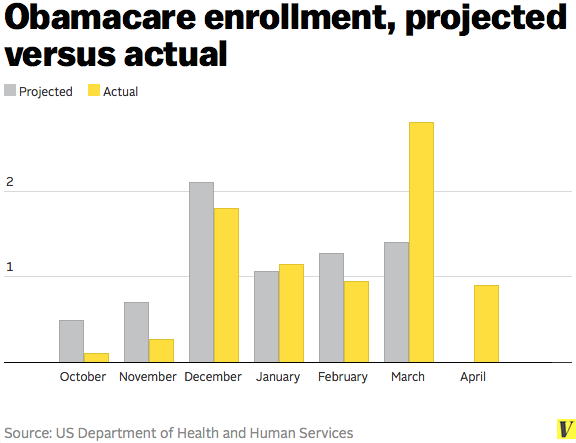
German Lopez charts the Obamacare open enrollment tally (pdf) released yesterday:
Health and Human Services found that, of the 5.2 million people required to answer a question about whether they had insurance at time of signing up, 13 percent (695,000 people) said they already had coverage. That suggests a high proportion of people seeking coverage on the exchanges weren’t replacing an old plan, and, instead, they were without health insurance when they signed up. (The White House, however, cautioned that this data is unreliable.)
This would be a much higher proportion of newly-insured enrollees on the exchange than other analyses have suggested.
Drum was surprised by this welcome news:
In other words, in total, the exchanges signed up about 6.5 million people who were previously uninsured. This is far, far higher than previous estimates of about 3 million or so. I’m not sure what to make of this given the amount of survey data that produced the smaller figure. Perhaps it’s a difference in what counts as uninsured? Or a difference in how people respond to pollsters vs. how they respond to an official question on an application. Hard to say. The full HHS report is here, and it acknowledges the different estimates but provides no guesses about why they vary so widely.
For now, just take this as a bit of a mystery. In a month or two we’ll probably have much firmer data on all this stuff.
Suderman digs into the numbers:
[I]t’s still not clear how many of these sign-ups have actually paid—or will pay—their first month’s premium, and are therefore completely enrolled in coverage. Not that this uncertainty is hampering the administration’s boasts. On Twitter, HHS Secretary Sebelius has posted HealthCare.gov-branded graphics saying that 8 million are enrolled through the exchanges. Sebelius should read her own agency’s report. It states quite clearly that “it is important to note that the Marketplace plan selection data as of the end of the open enrollment period do not represent effectuated enrollment (e.g., those who have paid their premium).”
Cohn examines the demographic breakdowns:
According to HHS, 28 percent of people selecting private plans are between the ages of 18 and 34. That’s almost exactly the same as it was inMassachusetts, when that state introduced its version of the same reforms.
But there isn’t one, unified national insurance market. There are 51 separate markets, for the states and the District of Columbia, and the numbers vary a lot from market to market. Some states, including several in the Deep South, have even higher precentages of young adults between 18 and 34. (The District has by far the most, with 45 percent, but that’s for idiosyncratic reasons.) But in other states it’s much, much lower—18 percent in West Virginia, for example, and 22 percent in Ohio.
Insurers in those states might end up raising rates significantly next year, although it will depend on a bunch of other factors, like what kind of enrollment insurers were expecting.
Kliff zooms out:
Kaiser Family Foundation estimates 28 million people without coverage were eligible to buy coverage on the exchanges. About a quarter of them decided to. That still leaves another 20 million people who didn’t purchase insurance – maybe because they didn’t want to, or were confused, or never even heard there were options to begin with.
“CBO has enrollment ramping up next year to 13 million and that feels like a pretty big leap given how hard it was to hit 8 million,” says [Kaiser Family Foundation’s Larry] Levitt. The people who signed up in 2014 were likely the most motivated, the low hanging fruit for enrollment workers. The people who will be pitched in 2015 sat out the first round of sign-ups and, come next year, could be a tougher sell.
It could happen:
There are many things people do not want to be built in their backyard, and nuclear power stations are high on the list. But what if floating reactors could be moored offshore, out of sight? There is plenty of water to keep them cool and the electricity they produce can easily be carried onshore by undersea cables. Moreover, once the nuclear plant has reached the end of its life it can be towed away to be decommissioned. Unusual as it might seem, such an idea is gaining supporters in America and Russia. …
The American researchers think there is no particular limit to the size of a floating nuclear power station and that even a 1,000MW one—the size of some of today’s largest terrestrial nuclear plants—could be built. They believe the floating versions could be designed to meet all regulatory and security requirements, which would include protecting the structure from underwater attack, says Dr [Neil] Todreas.
A few readers coalesce around a new theme:
My husband and I are both self-employed and work from home, and for the first time, our entire family has health insurance – thanks to Obamacare. My husband was uninsured for years, because he just couldn’t get health
insurance that wasn’t exorbitant. In 2012, he tried to get health insurance from three different health insurance companies and got turned down from each one for minor health issues. The reason for his last rejection was – I kid you not – “impending fatherhood.” When a health insurance company declared that my pregnancy (which was covered under my insurance) somehow became a pre-existing condition for him, we gave up on the whole Kafka-esque scenario and just waited for 2014.
But I mostly want to highlight another Obamacare benefit that hasn’t been mentioned much: mental health coverage. I have PTSD, which my pre-Obamacare policy didn’t cover. As a result, I could get 10 group or individual therapy sessions per calendar year, and I could see a shrink once every two months for ten minutes for medication management, and that was it. I could never switch policies because no one else would cover me. (Put PTSD on a health insurance application and they couldn’t write the denial letter fast enough.)
I spent $18,000 out of pocket to treat my PTSD (and four years after completing therapy, I’m STILL paying off the resulting credit card debt.) EMDR was worth every damn penny, because while I still have some remaining symptoms, I can actually sleep through the night, I don’t have to manage multiple flashbacks a day, and I’m not crawling out of my skin with anxiety twice a day. I’m grateful that my therapist offered a no-interest payment plan and that I had the resource of a high credit limit, but not having health coverage for my PTSD treatment was a huge financial hit at a time when I was already struggling to get by.
Like a lot of people with a mental illness, I don’t broadcast my PTSD diagnosis – mostly because I don’t necessarily want to discuss my abusive childhood in public. But access to mental health treatment is a big deal for a lot of people like me, and I’m grateful that I have options now that I didn’t have before.
Another also touches on mental illness:
I love this thread, and I thought I’d chime in because the policy has meant a lot to me and my family. My mom is very well employed and well insured. However, prior to Obamacare her coverage only covered her 7 children if they were under 18 or in school full time and under 25. This was without a doubt a luxury plan in comparison to the vast majority of Americans.
Cue disaster 1. My brother had to drop out of college after a suicide attempt and diagnosis of bipolar disorder. He was in inpatient care for weeks, and then seeing multiple doctors to find the right treatment plan to manage the illness. For years.
Now, again, my family was in a relatively secure position prior to this. But the fact that the Obamacare clause for children 26 and under came into effect just six months before this disaster means that my mother didn’t have to make a choice between bankruptcy or leaving one of her children to homelessness or death. Because that’s what the options were pre-Obamacare. And I’d like to point out that no matter how well you raise your kids, no matter how much money you have or how hard you work, you can’t prevent bipolar disorder. You don’t get a choice as an individual to have a mental illness (or cancer, or asthma, or allergies …). How can anyone want to go back to a world where your financial security depends on the luck of the genetic draw?
Once that had (mostly) settled down, we hit disaster 2. My other brother graduated from college, unemployed, and came home to work. He was working three jobs to make ends meet when he got in a motorcycle crash that left him inches from death. He was in the hospital for the better part of a day before they were even able to identify my mother and call her. He woke up two days later and but for the grace of god was not just alive but didn’t lose any brain damage. He spent weeks in inpatient rehab, several more in outpatient rehab, and a year later had the final surgery to fix his hip.
To be clear, my brother was working three jobs and none of them offered insurance. He is the epitome of a the “hard working American.” And once again, if it weren’t for Obamacare, he would have spent decades of his life trying to come back from financial ruin. Or my family would have gone bankrupt.
If there’s anything I learned from my family’s story, it’s the crushing economic impact of not having health insurance. Without that one clause, my family would have gone from gone from solidly upper middle class to near-poverty in a single generation. We would have gone from drivers of the economy – spending money on restaurants, vacations, college, homes – to the paycheck to paycheck existence that too many Americans endure. I am aware of just how lucky we are, and I wish other people who think Obamacare is only the rich subsidizing the lazy poor would realize just how much security and wellbeing Obamacare has brought all Americans.
Read the whole thread here.
(Photo by Yoon S. Byun/The Boston Globe via Getty Images)

 The Dish