Woven Wonders

dish_martyrdompaul

In a review of the Met’s exhibition Grand Design, Anthony Grafton extols the virtues of Pieter Coecke van Aelst, the tapesty artist whom “everyone who was anyone in the sixteenth-century art world liked.” He particularly praises Coecke’s depictions of the Apostle Paul:

When Coecke depicted the martyrdom of Saint Paul, he made the setting modern—starting with the castle that bulks large in the background. The artist wanted above all to show the violence that confronted the first Christians and the combination of sorrow, fear, and understanding with which they met. To achieve such effects, he subjected his work to endless revision. For The Martyrdom of Saint Paul, we have both his petit [patron, a small pattern] and his grand patron [the image, or cartoon, that tapestry weavers followed]. Comparing them, we see that his great fluency and facility were accompanied by an equally distinctive and powerful drive for revision and improvement. A young, innocent-looking Roman soldier appears in the sketch, pulling a woman by the wrist. In the cartoon he has turned into an older, battered man who has experienced and inflicted much—and he keeps that character in the final tapestry.

Grafton continues:

Coecke was an artisan—a painter without, so far as we know, an extensive formal education. He collaborated, as artisans did, and played second chair when a monarch placed someone else in the first. And he had what Albrecht Dürer thought the artist’s and artisan’s principal gift, the docta manus (learned hand), with its tacit skills at which words could only hint. But he also looked and read as widely as any scholar. Coecke wrote a neat, scholar-like cursive hand. He read Latin more accurately than the otherwise exemplary authors of the exhibition catalog, who make a hash out of too many of his brief, clear Latin captions, and other languages as well. In fact, he produced his own partial translations of the ancient architectural work of Vitruvius and the modern one of Serlio. … Men like Coecke contained multitudes—Italian as well as northern ones—and it will take an equally capacious mind to do them justice.

The exhibition is open through January 11th.

(Image: The Martrydom of Paul by Pieter Coecke van Aelst, circa 1535, via Wikimedia Commons)

The Way Time Heals

Hilary Mantel revisits C.S. Lewis’s classic meditation on the death of his wife, A Grief Observed, noticing the way it refuses to elide the complexities of loss:

Mechanical efficacy is attributed to the passage of time, but those in mourning know how time doubles and deceives. And though, in Britain, self-restraint is said to have vanished with Princess Diana, sometimes it seems the world still expects the bereaved person to “move on” briskly, and meanwhile behave in a way that does not embarrass the rest of us. In The Year of Magical Thinking, Joan Didion’s memoir of her husband’s death, she writes of our dread of self-pity: Lewis too experienced this. We would rather be harsh to ourselves, harsher than a stranger would be, than be accused of “wallowing”, of “dwelling on it”.

But where else can the bereft person dwell, except in his grief? He is like a vagrant, carrying with him the package of tribulation that is all he owns. As Lewis says, “So many roads once; now so many culs de sac.” It is hard to spot signs of recovery, hard to evaluate them. Lewis asks: “Am I going in circles, or dare I hope I am on a spiral?” The first acute agony cannot last, but the sufferer dreads what will replace it. For Lewis, a lightening of the heart produces, paradoxically, a more vivid impression of his dead wife than he could conjure when he was in a pit of despair. Recovery can seem like a betrayal. Passionately, you desire a way back to the lost object, but the only possible road, the road to life, leads away.

A Short Film For Saturday

This embed is invalid


Bernardo Britto’s film Yearbook imagines the end of the world:

As is usually best when depicting world-shattering events, Britto’s film is insular, the script a narrated monologue (by Britto himself) detailing a single character’s evolving process of cataloguing the history of humanity. It’s a remarkable premise, and Britto thoughtfully explores it within the film’s short 5 minute runtime. The real twist? When the hard drive runs out of space. …

Britto’s dry delivery of the narration, and the character’s placid demeanor combine to undersell the strong emotional effect of the film however. When dealing with such a weighty topic there isn’t a need to cue the violins, the thoughtful carrying out of inquiry will arrive at a pretty devastating place. When our lonely cataloguer reaches his epiphany, we recognize where he’s ended up. We feel for him, we feel for ourselves, we feel for everyone we’ve ever loved.

In an interview back in August, Britto spoke about what inspired the work:

The film poses the question, what if you were tasked with condensing the whole of human history into a single hard drive. What inspired this idea?

The idea came from the obvious realization that everything will be forgotten eventually. And, with that in the front of my mind, it became really hard for me to create something new. The only thing that made sense was for me to make a movie about that feeling and confront it head on. I think the hard drive thing specifically was something left over in brain from the bit in Keanu Reeve’s really great documentary Side By Side where they talk about film preservation. I pretty much just ripped off Keanu for that one.

As part of the narrative concept, you were forced to select your own take on the most important people in history. How did you decide who would be spoken about and who would actively be written off?

It’s actually not my own take; I tried to make it so it was the character’s own take. So it’s very male-centric and also from a pretty American point of view. Initially there were a few more film people and Walt Disney and stuff and I had to sort of step back and think, “Who would this guy think is important?” So the only black people he writes about are the two most obvious Civil Rights leaders. And the only women are Jane Fonda–whom he seems to remember more forBarbarella than for her political activism–and Joan of Arc and Marie Curie–but only because of how they died. And then I snuck a few people in that I just personally think are interesting historical figures like Eugene Debs, Ninoy Aquino, and Tiradentes.

Sexting Just Got Easier

dish_flirtmoji


Flirtmoji is a new “visual language designed to empower people of all sexualities to communicate their desires, concerns, and of course, flirtations”:

The often NSFW icons include anatomically accurate genitalia, whips, chains, fuzzy handcuffs, and even some sexually-suggestive fruit. There are also special, specific collections like BDSMS, Snow Bunny (holiday appropriate), and Safe Sext.

Katy McCarthy, one of the creators of Flirtmoji, discussed the project in an interview in November:

Some of these, like the vulva in particular, are really detailed and surprisingly anatomically correct. Did you have to think about ways to also make them sexy?

Well that’s the meat of the project. That’s where some of the most heated debate came out. To pass our test, the drawings have to be sex-positive. Anyone has to be able to look at them and not feel offended. There’s definitely a ton that didn’t make the cut.

But some people will probably find these offensive anyway.

Well sex-positive and offensive… there’s definitely a judgment call on that. There are people who will be very deeply offended — people who are offended by certain sexualities — but we’re not worried about those people. I mean, get your shit together. People are having sex, and it looks like this. And yes, part of being inclusive is that it’s all sexy. Even if it’s not my thing, necessarily, I wanted the Flirtmoji to be sexy because it’s someone else’s thing and it’s sexy to them.

A Poem For Saturday

Dish poetry editor Alice Quinn writes:

In April 1985, what was eventually to become a hugely popular anthology, Lifelines: Letters from Famous People About Their Favourite Poem, was Thomasportrait launched at Wesley College in Dublin as the first in a series of stapled pamphlets to raise funds “in aid of the Developing World.” Together those pamphlets comprised the first of three popular anthologies, each introduced by a famous Irish poet. For Christmas, a friend gave me the omnibus volume put together in 2006, a selection made from those heralded books.

In his introduction to the first, Seamus Heaney wrote, “This anthology was a magnificent idea from the start… a book in which poems re-enter the world refreshed rather than jaded by their long confinement inside people’s heads, a book that is surprisingly various and compulsively readable.”

The actress Judi Dench chose Edward Thomas’s poem “Adlestrop,” writing, “I love it because of its essential Englishness and because it reminds me of the time of steam trains and that special hiss that announced their arrivals and departures.”

“Adlestrop” by Edward Thomas (1878-1917):

Yes, I remember Adlestrop—
The name, because one afternoon
Of heat the express-train drew up there
Unwontedly. It was late June.
The steam hissed. Someone cleared his throat.
No one left and no one came
On the bare platform. What I saw
Was Adlestrop—only the name
And willows, willow-herb, and grass,
And meadowsweet, and haycocks dry,
No whit less still and lonely fair
Than the high cloudlets in the sky.
And for that minute a blackbird sang
Close by, and round him, mistier,
Farther and farther, all the birds
Of Oxfordshire and Gloucestershire.

(Photo of Edward Thomas in 1905, via Wikimedia Commons)

Talking Dirty

Jonathon Green, who has compiled 1,750 slang terms for sex, ponders how the tally got so high:

[W]hen a piece of slang escapes into the wider world, it leaves a gap that must be filled. So while the slang of the 16th century has mainly vanished, its descendants march on. We lose wap and get bumbaste, lose that and get trounce, lose that and get strum. And on it goes, until we have 1,750 terms for sex.

You might expect this lineage to die off. In an era of surveillance and social media, of confessionalism and dwindling taboos, why bother generating secret new words for old preoccupations? And yet take a look at the latest batch of slang I’ve compiled. Multicultural London English, as academics call it, blends elements of American rap, British grime music, Jamaican patois, and London Cockney. A vocabulary that cuts across class and color to an unprecedented extent, it’s definitely new. Or is it? Some examples: gash (women), shotting(drug-dealing), wonga (money), merk (murder), lash (intercourse). Here we go again.

A Socialist In The White House?

In his profile of Bernie Sanders, Mark Jacobson asks the senator from Vermont what his administration might look like:

“This is how it is going to be,” Bernie says, as if he were still in his $200 car, back in the Liberty Union days [in the 1970s]. “Suppose you want to raise the minimum wage to a fair level and know that change is not going to come from inside Washington. Not in this climate. So, as president, I’d invite millions of low-income workers to come to the capitol. Like a bonus march. I’d do the same thing about making college affordable. Put out the call, invite a million students. Make sure they’re all registered to vote. Then when these congressmen come by the White House and they’re beholden to the Koch brothers, the super-PACs, or the oil companies, I will say, ‘Do what you want, but first do one thing for me: Look out the window.’

“Look out the window,” Bernie repeats, liking the sound of it, the call to arms, just the sort of phrase that might get the attention of a downtrodden, detached electorate and prompt them to raise a fist in the air. “Look out the window. Because all those people are out there. They’re demanding their fair share and they’re not leaving until they get it.”

Back in October, Andrew Prokop also considered how a hypothetical Sanders presidential campaign might affect 2016:

Essentially, Sanders is calling for the Democratic Party to wage a rhetorical war on the billionaire class, to better mobilize the general public against them, and break their power. He believes the power of the rich is the defining issue of our politics, and wants to elevate it accordingly.

The specifics of how this mobilization happens, and what the public does once it’s mobilized (beyond voting out Republicans), are less clear. Sanders’ generic suggestion tends to be for a march on Washington. “You wanna lower the cost of college? Then you’re gonna have to show up in Washington with a few million of your friends!” he told an audience member in Waterloo. …

But Hillary Clinton is extremely unlikely to take up the banner of class warfare in her presidential campaign. According to a report by Amy Chozick of the New York Times, she is currently exploring, through discussions with donors and friends in business, how her campaign can address inequality “without alienating businesses or castigating the wealthy.” Beyond Clinton’s desire to raise campaign cash, there’s a long-held belief among many Democratic political consultants that messaging critical of the rich simply isn’t effective in US politics. Instead, they argue, much of the American public actually rather admires successful businessmen, and aspires to be like them. And lack of trust in government is a real and consistent force in American politics and public opinion.

Face Of The Day

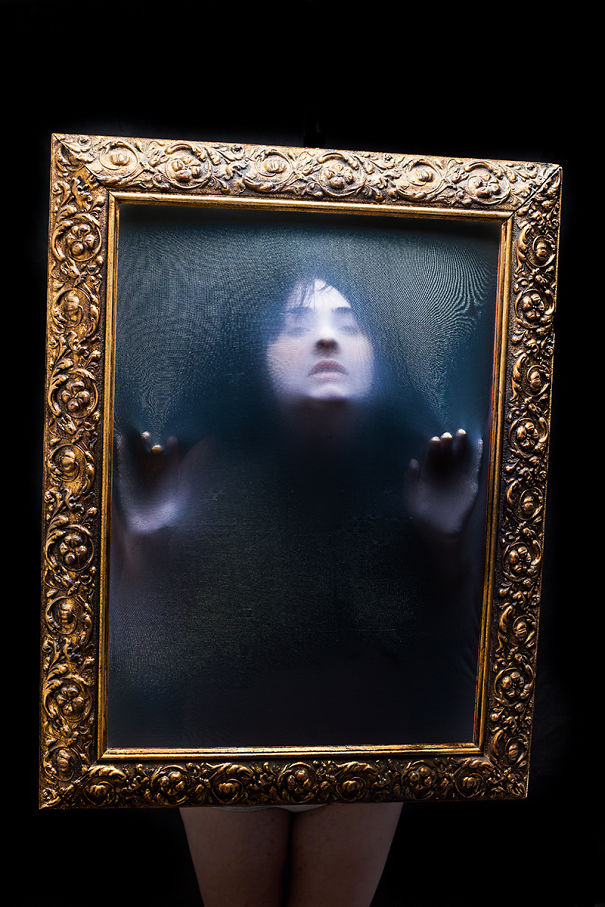
dish_lucapierro

How Luca Pierro describes his series Photographic Portraits Behind The Canvas:

Using a frame and elastic fabric I wanted to create photography that seemed like painted canvas. Once again, I tried to minimize the use of Photoshop. The result is truly amazing. The models look like paintings from the nineteenth century! I did some research and I think that this can be considered as a new technique in the world of photography. The series is still on process.

See more of his work here, here, and here.