Should AGs Ignore Laws They Don’t Like? Ctd

A reader thinks that’s the wrong question:

The header of your post about Eric Holder’s speech to state attorneys general on the issue of defending unconstitutional laws is quite misleading. In addition to saying that an attorney general can demur from defending an unconstitutional law, Holder said that action should be extremely rare. He was not talking about laws that AGs don’t like, but laws that they can find no straight-faced way of defending. It is part of an age-old doctrine in which government attorneys have been known to “confess error” – for example, in an appeal from a lower court decision that was clearly erroneous. Assigning special counsel does not solve the problem. The issue is not that the particular AG does not think the law is unconstitutional, but as the highest legal officer of the state, he holds the opinion that the law cannot be defended under well-established constitutional law. The stand-in would be the AG’s representative.

The issue of defending laws that outlaw same-sex marriage may be too much of a yet unsettled legal issue to justify failing to defend such a law, but imagine if a legislature passed a law similar to the one passed in Uganda. Would anybody question an AG’s refusal to defend such a law?

Another is on the same page:

No, of course an AG should not refuse to enforce a law he does not like simply because he does not like it. But as for the actual question, whether an AG should enforce a law he thinks might very well be unconstitutional, there is no right answer except that the AG has to do what he thinks is the better execution of his sworn duty.

Like pretty much every other official elected to statewide office in this country, an AG takes an oath to support the laws and Constitution of the United States and the laws and constitution of his state. The US Constitution is supreme to a state’s laws; where they conflict, state law loses. It’s an AG’s job to say when he thinks the supremacy of the Constitution has won the day and to protect the state, to the extent he can, from liability for having violated the Constitution. That duty is no different from a corporate lawyer’s job to advise his client what it can and cannot do within the law. An AG who blindly defends a law that he believes in unconstitutional is not protecting his client; he’s doing one of the worst things a lawyer can do: he’s telling his client what it wants to hear.

Another addresses the issue in depth:

As a voter in Virginia, one of those who “hired” Mark Herring to be the lawyer for the state of Virginia, I have no problem with his decision not to defend the commonwealth’s constitutional ban on gay marriage. While I found the comments you presented interesting and thoughtful, there are a few things they did not address.

First, I’ve spent my career as a government attorney. While I represent my agency and am bound to defend its actions zealously, I not only have to follow the rules of professional responsibility and ethics that apply to all attorneys, but also consider the public interest and basic fairness in a way that a private attorney, who is representing only private interests, is not. Just because a government agency can do something does not always mean that it should do it, and that attorneys should, without question, defend it. I think the state AGs who are not defending their states’ gay marriage bans are, in part, following the obligation to be more than just a hired gun. Moreover, to the degree the state has an interest in the ban being defended, parties with standing, such as the state General Assembly, are representing that interest.

Second, state AGs are not, in most states, hired; they are elected. I voted for Mark Herring – knowing full well that he supports gay marriage – so I feel that he is, in fact, properly representing the interests of the constituency he is charged to serve as state AG. A client can change his mind, and the people of Virginia, who are the real clients here, have. The homophobic bigots who pushed this amendment think they represent the people, but the people have abandoned them. I have no problem with my elected AG doing the same.

Third, this is a very unusual situation. The sea change on gay marriage that has emerged over the last several years is one of the great cultural and political shifts in our nation’s history. It is now clear that the bans on gay marriage voted on in many states during the first decade of this century were the last gasp of those opposed to gay marriage, who wanted bans on gay marriage in state constitutions to make it more difficult for ordinary voter and legislative majorities to overturn gay marriage. Indeed, the constitutional prohibitions on gay marriage that exist in a number of states do not play the usual role of constitutional provisions – establishing protections for minorities that can be overcome by transitory majorities – but instead establish publicly sanctioned discrimination against a minority that a growing majority of citizens would now like to eliminate. This is not just a once-in-a-lifetime event; it is a once-in-a-century event. AG Herring himself voted for the ban as a member of the state senate. There are few people who understand as well how rapidly views on this issue have evolved over the last several years. There are very clear limiting principles in play here. No need to worry about a dictatorship of the AGs who refuse to defend laws they don’t “like.”

Fourth, while it is true that there is no Supreme Court decision on point – and there could hardly be any case to defend if there were binding precedent that clearly defined gay marriage bans as unconstitutional. The inexorable logic of the Windsor decision, ironically aided and abetted by Justice Scalia’s over the top dissent, is pointing in one direction. I was living in Virginia in 2006, know one of the sponsors of the ban on gay marriage, and fully understand – as you do much better than I – the bigotry and discriminatory intent behind that and these other state constitutional amendments. In fact, it is entirely possible that the sheer number of these referendums and the animus behind them exposed to the vast majority of straight Americans, who may not have thought that much about their impact on real people. Over time, I think straight Americans who voted against gay marriage came to see that they were aiding and abetting bullies and hurting real people. While it took a while, the basic sense of fair play and decency of the majority was aroused and they have no come to realize that bans on gay marriage, even if they received majority voter support several years, were a mistake.

When you make a mistake, you admit it and try to make amends for it. I view what Mark Herring has done as exactly that. He shouldn’t do it that often, but if ever there was a case for a lawyer not defending his client, this is it.
Read This Post In Under 20 Seconds

word_positioning_blog3

Meghan Neal reviews Spritz, text-streaming technology designed to double or triple your reading speed on a smartphone screen:

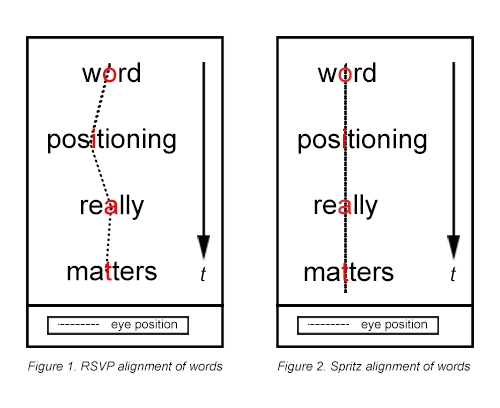
The idea is that traditional reading—scanning a big block of text—takes up too much space on such tiny screens, and is limited by the inefficiency of having to move your eyeball from word to word and line to line. The Spritz app rethinks this by streaming the content one word at a time and highlighting specific letters in red with a marker line above them to tell you exactly where to keep your focused fixed to avoid the precious time lost by having to move your eyeballs around. …

I tried the feature out and frankly it gave me a headache; also, if you look away for a minute you’ll miss whole sentences, so that’s problematic. But, supposedly, it works. The average adult reading level is just below 300 words per minute, and Spritz claims it can get users easily up to 500 wpm and eventually, depending on your skill, up to 1,000 wpm. I mean, who doesn’t want to be able to do that? And it’s not the same as skimming; the company also claims that comprehension actually increased in beta trials.

(Image via Spritz)

A Lot Of Optic Nerve

In the latest revelation from the Snowden docs, Ackerman and James Ball report that Britain’s GCHQ, with help from the NSA, snooped on millions of Yahoo webcam chats between 2008 and 2010 under a program called Optic Nerve:

Yahoo reacted furiously to the webcam interception when approached by the Guardian. The company denied any prior knowledge of the program, accusing the agencies of “a whole new level of violation of our users’ privacy“.

GCHQ does not have the technical means to make sure no images of UK or US citizens are collected and stored by the system, and there are no restrictions under UK law to prevent Americans’ images being accessed by British analysts without an individual warrant.

Here is the, er, money quote:

Sexually explicit webcam material proved to be a particular problem for GCHQ, as one document delicately put it: “Unfortunately … it would appear that a surprising number of people use webcam conversations to show intimate parts of their body to the other person. Also, the fact that the Yahoo software allows more than one person to view a webcam stream without necessarily sending a reciprocal stream means that it appears sometimes to be used for broadcasting pornography.”

Imagine that. John Aravosis wonders how, exactly, this program was supposed to help catch terrorists:

Of course, there are a few problems here.  First of which, one could also search this system for anyone and everyone they wanted to blackmail or destroy.  Got a political opponent who’s being difficult?  See if you can find a Web chat between him and his mistress.

There’s also the question of how well facial recognition is going to work on sexually-oriented Web chat. The spy document notes that, “the best images are ones where the person is facing the camera with their face upright.”  Faces are not always available in such chats.

Especially when other body parts are the primary focus. And Mano Singham notes, “We already knew that NSA operatives were using their snooping powers to spy on their lovers, an operation known as LOVEINT.” But Willard Foxton feels too much is being made of this and other Snowden leaks:

The volume of data collection is what’s scary – but if you read the whole Guardian article, GCHQ come across as an agency terrified of legal consequences. For example “the program saved one image every five minutes from the users’ feeds, partly to comply with human rights legislation.” While the story is disturbing, the agency hardly seems to be the surveillance juggernaut of Glenn Greenwald’s fantasies.

This goes to the heart of the problem with all the Snowden leaks – what we are getting is often a technological perspective of what could be possible, not an operational perspective on what is legally allowed. When Snowden said that if he had wanted to he could have tapped Barack Obama’s phone, he was right; but he failed to mention that if he had done so, he’d have been sent to jail.

Charlie Stross chimes in:

I am still trying to get my head around the implications that the British government’s equivalent of the NSA probably holds the world’s largest collection of pornographic videos, that the stash is probably contaminated with seriously illegal material, and their own personnel can in principle be charged and convicted of a strict liability offence if they try to do their job. It does, however, suggest to me that the savvy Al Qaida conspirators of the next decade will hold their covert meetings in the nude, on Yahoo! video chat, while furiously masturbating.

Dissents Of The Day

68 peoples drug 18'wide

A reader quotes me:

As for the case for allowing fundamentalists to discriminate against anyone associated with what they regard as sin, I’m much more sympathetic. I favor maximal liberty in these cases. The idea that you should respond to a hurtful refusal to bake a wedding cake by suing the bakers is a real stretch to me. Yes, they may simply be homophobic, rather than attached to a coherent religious worldview. But so what? There are plenty of non-homophobic bakers in Arizona. If we decide that our only response to discrimination is a lawsuit, we gays are ratcheting up a culture war we would do better to leave alone. We run the risk of becoming just as intolerant as the anti-gay bigots, if we seek to coerce people into tolerance.

Do you also believe that businesses should be allowed to refuse people service based on their race? If not, please explain why you think that is different.

The public accommodations issue with respect to race is mercifully settled. And it’s pretty much settled with respect to gays, as the collapse of the Arizona bill demonstrates. My point was to note that even if such discrimination should be illegal, it isn’t always advisable, as a prudential matter, to sue. I favor a less drastic approach, and a gentler one. Not just because I think that will help the cause of civil rights in public opinion, but because I think we’re already winning that fight, and can afford some elective magnanimity.

Another reader:

I understand the point you are trying to make about leaving bigoted bakers to their own hated. It is probably a good sign that in Arizona and the US, a gay couple will find any number of bakers or photographers for their wedding. But in 1965 Mississippi, it would have been a brave white hardware store owner who let a black carpenter in the front door and then sold him nails. As long as the bigots are a discredited and a declining minority, ignoring them may be the best option. When they ARE the majority and hold the positions of economic/political and social power, then they can’t be ignored but must be confronted. That was the history of the civil rights movement.

From an Arizonan:

Yes, there are thousands of bakeries here – but NOT in many of our small towns and rural areas.  The same with photographers, florists, etc.  If you live in Patagonia or Cottonwood or Greer or Alpine – it’s not so easy.

Another elaborates on that point:

So, someone is driving through Arizona on I-40 or US-93 or some other road with very little on it and runs low on gas.

They pull up to the only gas station for 30 miles and are refused service because they are gay and you have no problems with that?    Or, it is late at night, and they are getting very tired and falling asleep at the wheel and they pull up to the only hotel for 30 miles and are denied the right to a room because they are gay, and you are OK with that?  What about a grocer in a small town who denies a gay person travelling through, or recently relocated there to buy food?

I realize a cake is not the same as those examples above, but when exactly are you OK with bigots being bigots, and to whom are you OK with them being bigots to?   If I changed gay to black, would you still be OK with a hotel turning away people at night?  Would you be OK with being refused buying gasoline in the desert?  Or buying food?

I think living in that insular little bubble that is Washington DC is blinding you to real world issues that are out there, when someone can’t go just two blocks to find a business that will deal with them and can handle the fact that gay people exist in the world.

Another takes it a step further:

I agree with you that it’s wrong to sue someone who refuses to bake a cake because of their religious beliefs.  You make a fine argument in favor of common decency.  But there’s a more serious side to Arizona’s s.b. 1062. Consider the tragedy of Tyra Hunter, denied emergency care because the EMT’s didn’t like transsexuals.

Sure, if a gay couple is turned down for a wedding cake, it needn’t be a big deal.  But what if a gay couple is turned down for a home mortgage?  What if a condo homeowners association board of directors disapproves of its openly-gay residents?  I  admire your scrupulous fairness to s.b. 1062’s supporters, but let’s not forget, that bill had a dark side.

Another takes issue with me conflating the Arizona bill with the Boy Scouts excluding gay leaders:

Freedom of private association and privately held belief in this country is not in question. Start a club with no gays allowed, a networking group, or a social institution? Fine. Private. Freedom of association applies. Start a business that serves the public, and receives incorporation from our government? Subject to rules and regulations of our government, including non-discrimination against protected classes.

I didn’t mean to draw an exact parallel because my reader’s distinction is right. I was, rather, channeling the spirit of Big Gay Al.

Unfiltered feedback from more readers at our Facebook page.

Peggy Noonan Is Besieged By Balls

I don’t read her for the arguments any more. But she sure is feeling things:

I think a lot of people right now, certainly Republicans and conservatives, feel like a guy in a batting cage taking ball after ball from an automatic pitching machine. He’s hitting the ball and keeping up and suddenly the machine starts going berserk. It’s firing five balls a second, then 10. At first he tries to hit a few. Then he’s just trying to duck, trying not to get hurt.

That’s how people feel about the demands and dictates. The balls keep coming at them politically, locally, culturally. Republicans and conservatives comprise at least half the country. That’s a lot of people.

Ten balls a second! So I ask myself, as one does: what does she mean by balls? I can glean the following:

Rules, regulations, many of them stupid, from all the agencies—local, state, federal—on the building of a house, or the starting of a business. You can only employ so many before the new insurance rules kick in so don’t employ too many, don’t take a chance! Which means: Don’t grow. It takes the utmost commitment to start a school or improve an existing one because you’ll come up against the unions, which own the politicians.

Okay, so Obamacare. And yes, it does add a burden of mandated responsibility for employees’ healthcare and your own. Here at the Dish, we’ve gone through the tedious and time-consuming business of figuring out our new insurance policy in the exchanges, and I’ve found a new policy for myself here in DC. It was a hassle, but it would be hard to argue that it’s that much more burdensome than figuring out our insurance before Obamacare. And, in my case, for the first time in two decades, I feel secure in being able to keep my insurance regardless of what happens to my employment situation. I’d go further and say that Obamacare helped give me the security that allowed me to start a new small business. Has that ever occurred to Noonan? Maybe it takes having a pre-existing condition to see it from one potential employer’s point of view.

As for “local, state, federal” regulations on building a house or starting a business: is Noonan really saying that these only exist because of “angry progressives”? Please.

And she fails to provide any evidence that this kind of regulation has intensified these past few years.

Then there’s the invocation of the poor citizens of Arizona, being pelted with gay balls. I understand and sympathize with a sense of bewilderment, especially among fundamentalists and the older generations, at the advance of gay dignity and equality. But, as Jan Brewer noted, there had not been a single incident of alleged gay aggression in Arizona. If any group could be forgiven for feeling that it was being pummeled with a fusillade of balls, it has been the gay and lesbian community, suddenly confronted across several states with bills that would have decimated any protections against discrimination. Has it ever occurred to Noonan that gay people might feel under siege as well? From Russia to Uganda and Nigeria, aided and abetted by American Christianists, gay people are experiencing a wave of hatred and hostility far surpassing the discomfort of a fundamentalist wedding planner. And yet Noonan can only see things from the perspective of those seeking to keep sinners at arm’s length.

At some point, her editors might ask her to complement her feelings with actual arguments. But one senses she doesn’t really have any. Just a hell of a lot of balls.

Chaotic In Crimea, Ctd

More ominous developments after yesterday’s occupation of parliament by paramilitary forces:

Unidentified armed men have seized two airports in Crimea overnight, causing Ukraine’s new interior minister to talk of “a military invasion and occupation” by Russia. … They wore military fatigues with no insignia and refused to talk, though one told news agencies they were part of a self-defence unit who wanted to ensure that no “fascists” arrived in the region from Kiev.

At Sevastopol airport, a military airport that handles few commercial flights, a man who said he was a captain in the tactical aviation brigade but declined to give his name, told the Guardian there were about 300 people of unknown identity inside the airport. “We don’t consider it any invasion of our territory,” he said without elaborating. He said the men looked like military, were wearing two different types of uniform and were armed with sniper rifles and AK-47s. “We don’t know who they are, nor where they’ve come from.”

The interim Ukrainian president has dismissed the head of the armed forces, while Russia’s parliament “began considering a law that would allow Moscow to add new territories to Russia in a simplified manner”. There was also this incident at the Russian border:

At least 20 men wearing the uniform of Russia’s Black Sea fleet and carrying automatic rifles surrounded a Ukrainian border guard post on Friday, in a tense standoff near the port city of Sevastopol in Ukraine’s Crimea region. A Reuters reporter in the Balaklava district saw Ukrainian border police in helmets and riot gear shut inside the border post, with a metal gate pulled shut and metal riot shields placed behind the windows as protection. A servicemen who identified himself as an officer of the Black Sea Fleet told Reuters: “We are here … so as not to have a repeat of the Maidan.”

Paul Sonne reports that “Crimean special forces and local militiamen with Kalashnikovs and masks have hoisted Russian flags and set up checkpoints on the only two highways that connect the Black Sea peninsula to mainland Ukraine”:

In Chongar, the checkpoint on the highway that connects Crimea to Ukraine’s largely Russian-speaking east, Russian flags flapped in the wind Friday as about a dozen armed Crimea-based riot police, known as berkut, checked cars and trucks. An encampment of roughly 30 mostly Cossack volunteer militiamen set up tents beside the policemen to serve as backup in case pro-Ukrainian forces attempt to enter the territory.

In an overview of Crimean history, Adam Taylor warns against assuming the region’s Russian nationalists will be unified:

While the Russian nationalists in Crimea have been given a lot of attention in the past few days, some say they aren’t a coherent force. Ellie Knott, a doctoral candidate at London School of Economics who conducts research in Crimea, has argued convincingly that the Russian nationalist and Crimean separatists are in practice hindered by their own internal divisions, and that many ethnic Russians in Crimea have a more complicated sense of national identity than might first appear. And while Russia has shown itself willing to get involved in the affairs of post-Soviet states, most recently with Georgia over the breakaway state South Ossetia, few are predicting it will openly get involved in a dispute with Ukraine anytime soon.

Calming nerves, Eli Lake reports that so far the US intelligence community doesn’t think Putin will invade:

The assessment is based in part on the fact that not enough medical units have been ordered to accompany the Russian troops to the Ukrainian border to suggest preparation for war, according to one Congressional staffer who has seen intelligence on Russia. This source also said no signal intercepts have detected plans for an invasion. …

Fiona Hill, the director of the Center on the United States and Europe at the Brookings Institution, said she did not expect Russia to launch a land invasion into Ukraine. She did however say that the Russian Navy’s presence in the Black Sea port of Sevastopol in the Crimea would be a potential flash point. “There is one place where they could indeed do something militarily, Crimea,” Hill said. “If there was any kind of threat to the bases, they could mobilize their forces.”

The Guardian is live-blogging. Meanwhile, at a “surreal” press conference held in the Russian city of Rostov-on-Don, the deposed Ukrainian president spoke defiantly:

[Yanukovych] said Crimea should remain part of Ukraine, and called on Russia to act decisively against the new government in Kiev. “I think Russia should, and is obliged, to act, and knowing the character of Vladimir Vladimirovich Putin, I am surprised he is so restrained and keeping silent,” Yanukovych said. …

He said he believed there should be no military activity in Crimea, but insisted Russia should not “sit in the corner and not act”. Yanukovych, who had not been seen in public for a week since he fled Kiev, denied that he was on the run and that he had been overthrown, and claimed he had been “cynically tricked” by the international community, who had allowed “fascists” to take over. The ousted president said he would not take part in elections scheduled by Ukraine’s parliament because they were illegitimate and he is still the president.

The Huge Cost Of Male Genital Mutilation, Ctd

A reader counters my analysis of these numbers:

On the issue of circumcision, you are biased and unbalanced. You call circumcision “male genital mutilation”. OK, that’s a bias you are entitled to. Attack circumcision as a moral abomination if you must, but eliminating circumcision will do little for healthcare costs. You cite its $1.8 billion cost and italicize it for emphasis. That is unbalanced. The data report you cite says that of the top 20 operating-room procedures, circumcision is the cheapest per procedure by far and is 20th on the list of 20. And the total cost of circumcisions is just 0.069% of total spending of $2.6 trillion on healthcare in 2010 in the US, and less than 1% of total OR procedures.

The biggest source of healthcare costs are in people over 65, of course, and the biggest source of healthcare costs in people over 65 are in the 25% or so of people with chronic diseases such as CHF, COPD or diabetes. The biggest driver of healthcare cost increases is medical technology driving new treatments to market. Circumcision has very little to do with medical costs.

Of course, mutilating infant boys’ genitals is a small factor in the context of the costs my reader cites. And yes, circumcision is itself not that expensive. But its ubiquity means a remarkable use of medical and operating room resources for an elective procedure. And by “elective”, I do not mean, of course, that the boys choose it. Their parents choose it without the patient’s consent. Another reader on the issue in general:

Okay, you win.

For years I’ve been a loyal reader despite the fact that you occasionally hammer on crusades that I can’t get behind – most notably, your war against “male genital mutilation”.  As a parent of two boys, I reflexively had them circumcised at birth; because I was, and because I’d never seen an uncircumcised one in real life, and because I didn’t want my boys to grow up wondering why they looked different than me “down there”.  In that context, I’ve always been annoyed by your relentless stance on this issue.

Until today.  You see, I’m a healthcare actuary by profession, so today you finally hit on an argument that resonates with me – that male circumcision is symptomatic of our society’s over-utilization of healthcare.  Way to keep attacking from different angles until your target finally yields …

Another really took the blogging to heart:

Just thought I’d share that your ongoing coverage reinforced the decision my wife and I made not to circumcise our son. We both come from Southern, conservative, Protestant families where circumcision has been the norm for who-knows-how-long, but our families haven’t made any complaints, and we feel we made the right choice.

Update from another:

I have always rolled my eyes at the term “male genital mutilation.” Same goes for some of the other hysterics of anti-circumcisionists. None of those arguments ever did much for me. (Less sensitivity? Things feel just fine for me down there, thank you. Psychological damage? Please. There are plenty of sources of adult neuroses other than the penis. The anesthetized trimming of a little skin is hardly the worst thing that happened to me in childhood.) And until a month ago I always would have thought that I would have my sons circumcised, like me. I am American, after all, and circumcision is just what we do, right? Why should I make my sons “different”?

But last month, with a newly-pregnant wife, my view changed for a very simple reason: I realized that I don’t have any reason to circumcise. I attended the bris of a friend’s son and saw it all happen. None of it grossed me out. Not the blood, not the scalpel. And the baby didn’t seem to be in any pain. But it struck me quite suddenly that while my Jewish friends have a very good, compelling reason to circumcise – a covenant with their God – I just don’t have one. And as a rational person, it is simply not in my nature to make a permanent and unalterable decision without a good reason.

A rebuttal from a reader:

When discussing what you call male genital mutilation, you keep saying that this is surgery that is done without the patient’s consent. Obviously, a new born can’t consent to anything but circumcision is a very different operation for a newborn than it is for an adult. Ignoring the issue of whether it is necessary surgery, it is a very minor procedure for a baby and a huge deal for an adult. A close friend of mine, born in China, was uncut. He had to be circumcised as an adult (I believe he had the same condition as Louis XVI) and it was as Joe Biden would say, “a big fucking deal.” He was in a lot of pain for a long time and the surgery came with risks of complications and scarring.

You argue that the parent makes the decision to circumcise an infant son without his consent but the parent is also essentially making the decision not to circumcise too. An adult may think/want/believe he is better off circumcised but if his parents did not make that decision for him as a baby, it may not be a realistic choice for him to make as an adult.

The Terror In Uganda Deepens, Ctd

In addition to signing the “kill the gays” law, Ugandan president Yoweri Museveni approved an extraordinarily sweeping “anti-pornography” bill last week. “Pornography,” in this case, includes skimpy summer clothes:

According to Uganda’s Daily Monitor, [the law] bans “behavior or form of communication or speech or information or literature or publication in whole or publication in part or news story or entertainment or stage play or broadcast or music or dance or art or graphic or picture or photography or video recording or leisure activity or show or exhibition.” Ugandan media has largely focused on the possibility that the law would be a de facto ban on revealing clothing and has dubbed it the “miniskirt law.” … [I]f a Ugandan stages a play that includes sexualized, under-clothed thighs, she and the journalist who writes a review could both be locked up. Breaking the law could incur penalties of up to seven years in prison.

One consequence of the new law: women, like gays, now find themselves at increased risk of mob violence. Consider:

More than 40 women have been stripped naked in the different towns of Uganda, including the capital Kampala, in the last three days over misconception that they are breaking the law by wearing miniskirts. …

[A]n association of Ugandan women in parliament has lamented provisions of the new anti-pornography’s law that deals with women’s dressing. Rosemary Nyakikongolo, vice chairperson of the Uganda Women Parliamentary Association, claims “parliament rushed to pass the anti-pornography law.” She said the attacks on women are because “MPs passed the law [without] adequate public consultation.”

Earlier this week, police stopped 200 women from marching in Kampala to protest the law. In fact, if not for women’s earlier activism, the law would have been much worse:

Ever since Simon Lokodo, State Minister for Ethics and Integrity and lead proponent for a ban on miniskirts, announced that the Anti-Pornography Bill had been signed into law, women have faced violence, especially in taxi ranks. According to Lokodo, “If your miniskirt falls within the ambit of this definition then I am afraid you will be caught up by the law.”

Except that, despite Lokodo’s most fervent efforts, the miniskirt ban actually never made it into the final legislation. Women across Uganda shut it down. From #SaveTheMiniSkirt online campaigns to Save the Miniskirt parties to formal lobbying to organizing in the streets and off, women shut it down. Women understood that the issue of their clothing was nothing more or less than an attack on women’s autonomy. For Rita Aciro Lakor, the executive director of Uganda Women’s Network (Uwonet), “It’s about going back to controlling women. They’ll start with clothes. The next time they’re going to remove the little provisions in the law that promote and protect women’s rights.”