Ukraine On The Brink

This video from the protestors has gone viral:

Fisher analyzes the resurgent violence:

As I wrote in late January, the last time that protests reignited, Ukraine’s politics have long been divided into two major factions by the country’s demographics. What’s happening right now is in many ways a product of that division, which has never really been reconciled. Just about every Ukrainian government since independence has been seen as representing one “side” of this divide, with the other hating him or her as a perceived foreign pawn. That’s exacerbated by political corruption and by the fact that Ukraine’s troubled economy does indeed make it reliant on outside countries. Today, Ukraine is still demographically divided, its government is still troubled by corruption, and its economy is still in bad shape. As long as those things are all true, public unrest is likely to continue.

Joshua Tucker wonders what comes next:

Policy makers should not rule out the possibility that the country could split, enter a period of prolonged violence, or even face something approaching a civil war.  This does not mean that any of these outcomes are foreordained, but for anyone looking forward it is no longer unreasonable to speculate about the causes or the consequences of such outcomes.

Mary Dejevsky agrees the government could fall:

This is a potentially revolutionary situation – we are watching violent street protests that could force out a government that was, whether we like it or not, reasonably democratically elected. It is also an emergency in which an ill-informed EU policy played a role. In demanding an all or nothing, now or never, decision from a Ukraine that needed emergency financing more than it needed European promises, it badly misplayed its hand.

Ioffe calls the protests “Putin’s worst nightmare”:

The last time that this many people came out to the Independence Square (the Maidan) in Kiev, nine years ago, protesters undid the election of Victor Yanukovich and brought to power a Western-friendly government. In the process, they scared the living daylights out of Putin. … Ukraine is Slavic. Ukraine speaks Russian, even though the Western part insists on having its own tongue. Kiev is the cradle of Russian civilization. Ukraine, in Putin’s mind, is almost just another province of Russia, one that, by some accident of history and politics, has a different government and a different name. He is said to have said as much to George W. Bush in 2008. “Don’t you see, George, that Ukraine is not even its own state?” he is reported to have smirked.

Update from a reader:

And what must really be causing Putin to tear his chest hair out is the fact that, so long as he is the very public face of the ongoing Winter Olympics in Sochi, he pretty much has to sit on his hands at precisely the time when his allies in the Ukraine most require his support. Hell, it’s entirely possible that before the Games end, things in will be too far gone in “just another province of Russia” for him to rescue the pro-Putin government. How schadenfreude-tastic would it be if, on account of an Olympics whose staging is designed to prop up his image at home and abroad, Putin gets a bloody nose and a black eye?

Meanwhile, Bob Dreyfuss thinks there is little the West can do about the violence in Kiev:

Likely, there will be American and European sanctions against Ukraine now, at least directed at some of its leaders, but sanctions will simply push the country’s leaders even farther from the West, and from any accord with the European Union. In the Cold War-like struggle between the United States and Russia over Ukraine, which many Russians (including Vladimir Putin, Russia’s autocratic, czar-like leader) see as part of Russia’s sphere of influence, Moscow—which urged the Ukrainian government to crack down on protesters—may have won a round. But a bloody, shaky peace, filled with simmering hatreds, is not likely to be the final result of the ongoing crackdown in Kiev.

Gideon Rachman also considers the role of the US and EU:

The West’s instinct in these situations is to call for fresh elections and that is certainly a demand that can be expected to be promoted now. In theory, this should lead to the establishment of a legitimate government, ending the need for violence. But what if elections in Ukraine actually confirm that this is a deeply-divided country with an increasingly incompatible west and east? That is certainly one possible outcome of a poll. At that point, a durable political solution might need something rather more drastic, and difficult, than holding fresh elections.

In Focus has photos from the protests. A startling contrast via Twitter:

The Guardian is live-blogging.

Syria’s Deadly Food Fight, Ctd

Screen Shot 2014-02-19 at 12.00.07 PM

Annia Ciezadlo takes an in-depth look:

Starvation thrives on the confusion and social disruption of war; famines and food shortages tend to have multiple factors. This makes it easy to portray them as unfortunate but inevitable, the outcome of tragic circumstance (potato blight in Ireland) rather than deliberate manipulation (British exports of Irish grain). The hunger in Syria is creating a new class of warlords among rebel commanders—a perfect excuse for the regime to employ its usual passive-aggressive politics of shifting the blame, by promoting the fiction that “both sides” are using siege tactics (a claim that sources inside Syria call ridiculous).

Michael Totten declares that we’re “not doing anything real about Syria, we were never going to do anything real about Syria, nor will we do anything real in the future”:

I thought we should get involved in a limited capacity by backing moderate regime opponents when they still had a chance, but the White House didn’t want to, nor did the American public—not after Iraq and Afghanistan—so here we are. Perhaps it was inevitable considering everyone’s interests and mood.

And now that we’re here, staying out of it is the right call. We can’t back Assad, and we can’t back Al Qaeda. Whatever moderate forces still exist have been marginalized. The odds that a stable and non-hostile Syria can emerge after an Assad or a jihadist victory are zero.

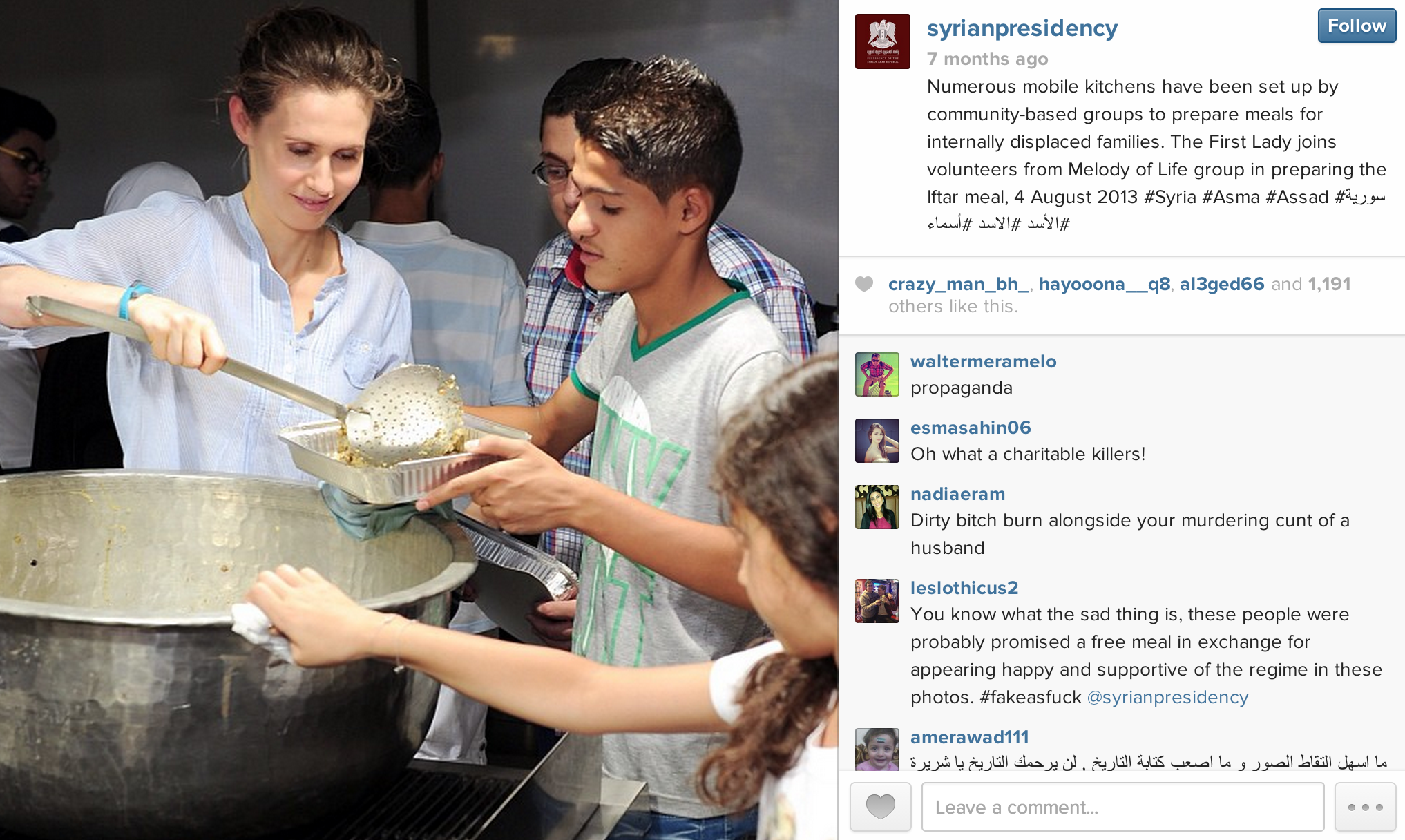
Previous Dish on Assad’s starvation strategy here. More recent coverage of Syria here. The above screenshot of Assad’s wife is from his propagandist Instagram account, covered here and here.

Where Slums Come From

dish_slumlords

C.W. connects slumlord practices to their colonial roots:

new paper by Sean Fox of Bristol University focuses on absentee landlords in Kibera [a slum in Nairobi]. Well-connected types, Mr Fox finds, can acquire control over swathes of land thanks to their political connections. One survey found that 41% of Kibera’s landlords were in fact government officials: 16% were politicians. These landlords can exploit their privileged position. Research from MIT, again in Kibera, finds that when the chief of the local area and the landlord come from the same tribe (but the tenant does not), renters end up paying 6-11% more. Chiefs and landlords collude to extract higher rents. … Mr Fox reckons that these arrangements are partially a legacy of colonial rule. He argues:

Colonial administrative structures were weak and highly centralised, and municipal authorities were granted very limited authority over development and regulation … In a context of rapid population expansion, such structures have proven cumbersome and have contributed to the proliferation of unplanned settlements.

In other words, clumsy colonial governments were bad at controlling urban development. Mr Fox demonstrates this empirically. Legal fragmentation in the colonial era, a proxy for indirect rule, is strongly correlated with contemporary slum incidence (measured [in the above chart] as the percentage of a country’s urban population living in slums)….

A Sweet IPO

As the makers of Candy Crush prepare to go public, Derek Thompson marvels at how much money the addictive game has made them:

candy-crushKing Digital Entertainment, the company behind the mega-hit game Candy Crush, has filed its IPO papers with the SEC, offering investors a look inside its massive popularity. And, well, dear God. Last year the company took in $1.88 billion with $568 million in profits—half $1 billion in profits! To put this in perspective, a mobile gaming company specializing in colored sugar baubles made more than a quarter of Amazon’s lifetime earnings in a year.

Yglesias advises against investing, saying the sugar high isn’t likely to last:

These things become monster hits because they’re basically fads (or “memes” that “go viral” as we say in 2014) that benefit from attention spirals that eventually burn out. The very fact that King Digital wants to do this IPO right now should actually tell you something.

It’s not like the company desperately needs to go public to raise capital. And it’s not like the company has become so big that it’s in the Facebook situation of being basically unable to incrementally expand without going public. What you have is a case of founders and early investors trying to cash out while Candy Crush is still popular.

But, with few precedents, it’s hard to predict how the company might fare:

Wary investors could (and should) look to Zynga as an example. The gaming company behind uber-popular Facebook-based games like Farmville went public in 2011, but has been in freefall ever since, due to the company’s inability to launch another game as popular. But the jury’s still out on Zynga, which some say could be just as profitable as initially thought. Yahoo Finance writer Kevin Chupka thinks Zynga is due for a comeback, arguing that the company’s stock dip was due to their lack of mobile offerings. King, on the other hand, operates primarily in the mobile sphere, relying on mobile apps for seventy percent of its revenue.

The Bright Side Of Surveillance

Jason G. Goldman reviews research from the University of Newcastle in the UK that suggests being watched can crack down on crime:

By using the university’s crime database, [researchers] identified three spots on campus that suffered extremely high rates of bike theft, and installed signs at each location. Thesigns featured a pair of male eyes gazing outwards, along with the headline “Cycle Thieves: We Are Watching You”, the name “Operation Crackdown”, and the logo of a local police service. The signs caused an impressive 62% decrease in thefts in each of the three locations. Unfortunately, there was an equivalent increase in thefts elsewhere. While the intervention only displaced the thieves to other spots on campus, it was clear that the feeling of being watched was an effective deterrent.

dish_cyclethievesLater that year, with the “Operation Crackdown” signs still up, the same researchers returned to the three experimental sites on campus to see whether the same watchful eyes would crack down on littering, despite the fact that the signs were explicitly written to discourage bike theft. To stack the odds against the experiment participants, the researchers used a rubber band to affix a flyer to the handlebars of each bike, giving them the opportunity to just drop the paper onto the ground. Half the time, the researchers pre-littered the area, which they suspected might have made people more likely to litter. After all, what’s one more piece of paper? So they pitted the watchful eyes against the already littered ground. As expected, the eyes made the unwitting participants less likely to litter (compared with spots without the signs), and the pre-littered ground did not make it any more likely.
(Image of poster used in study via BBC Future)

Where The Entrepreneurs Are

Michael Mazerov looks at why business creators go where they go:

The 150 executives surveyed by Endeavor Insight, a research firm that examines how entrepreneurs contribute to job creation and long-term economic growth, said a skilled workforce and high quality of life were the main reasons why they founded their companies where they did; taxes weren’t a significant factor.  This suggests that states that cut taxes and then address the revenue loss by letting their schools, parks, roads, and public safety deteriorate will become less attractive to the kinds of people who found high-growth companies. …

As I wrote last year on why studies show state income tax cuts aren’t an effective way to boost small-business job creation, “Nascent entrepreneurs are not particularly mobile.  Rather, they tend to create their businesses where they are, where they are familiar with local market conditions and have ties to local sources of finance, key employees, and other essential business inputs.”

California’s Endless Summer, Ctd

CA Drought

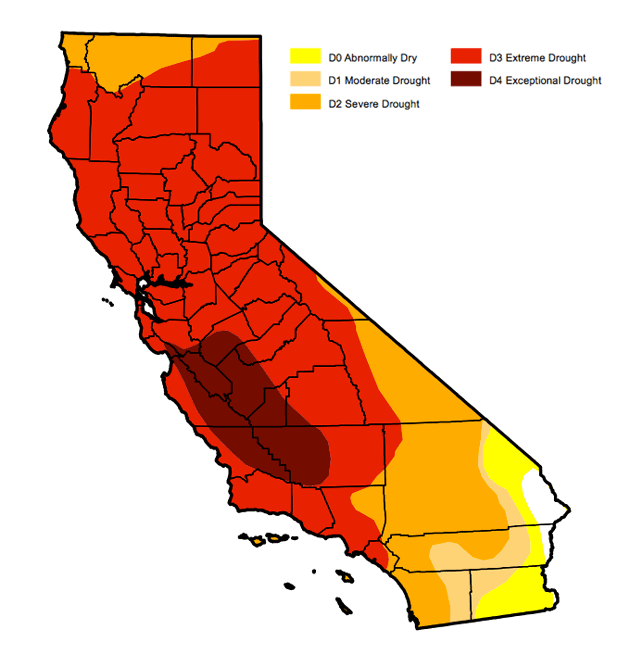
David Dayen runs through what it means for residents, farmers, and the rest of the country:

The conditions have created impossible, Sophie’s Choice-type dilemmas. The State Water Project, which supplies water to agencies serving 25 million residents, announced they would make no deliveries this month for the first time in history. Seventeen California communities and water districts, primarily in the Central Valley, may not have drinking water in the next 60-90 days. Residents in these cities are being asked to cut their water usage by as much as 30 percent.

Farmers may have to leave half a million acres fallow this planting season, a record loss that could cost more than $2 billion. They must choose between watering perennially thirsty almond and cherry trees and planting annual crops like tomatoes and lettuce. Any choice will result in lower yields and increased food prices across the country. Migrant workers won’t get hired to cultivate crops, leading to unemployment that could top 50 percent in some Central Valley towns. The state has banned fishing in several rivers to protect thinning populations. The dry conditions create breeding grounds for wildfires, which started this year as early as January. Ranchers have been forced to sell off their calves at half their usual sale weight because of a lack of grass, a predicament that has even faced rancher and Congressman John Garamendi, who has sold one-third of his herd. “It’s going to affect everything that goes on in the state,” Garamendi said.

Alex Park and Julia Lurie add:

Even though some rain has finally come, it would be nearly impossible for California to make up the water it needs. According to the Department of Water Resources, the state would need to experience heavy rain or snowfall every other day from now until May in order to achieve average annual precipitation levels. Dr. Peter Gleick, codirector of the water-focused research nonprofit the Pacific Institute, explained that because California’s reservoirs are already depleted from a dry past two years, “We need a really, really wet rest of the season. And that’s statistically unlikely.”

Earlier Dish on the drought here.

(Map from the US Drought Monitor)

Do Children Have A Right To Die?

Late last week, Belgian lawmakers overwhelmingly passed a measure that would allow euthanasia for terminally ill children. Ben White and Lindy Willmott explain:

Belgium has removed the age limits to access its assisted dying regime and this has been reported as a world first. This is true, but it is also important to note that the scheme in the Netherlands permits access for children as young as 12, provided various conditions are met. So, the key difference in Belgium is that access to euthanasia is not limited by age. A child will only be eligible to access the legislation if all of the following conditions are satisfied:

  • The child must be “conscious” and display “a capacity of discernment”. This refers to a child who is competent to decide for themselves. …
  • The child must “be in a hopeless medical situation of constant and unbearable suffering that cannot be eased and which will cause death in the short-term”.
  • The child must be counselled by doctors and a psychiatrist or psychologist, and the child’s decision must be approved by his or her parents.

What is apparent is that the cohort of children who may access euthanasia in Belgium is narrow: terminally ill children who cannot otherwise be helped and who are capable of making a considered decision about seeking assistance to die. The capacity aspect serves as an indirect limit related to age, as only older, mature children would be able to satisfy that criterion.

Eugene Kontorovich fiercely objects:

Allowing minors to take their lives, or have them been taken, necessarily makes assumptions about their capacity that is at odds with many liberal features of international law.

International treaties, including the Rome Statute of the ICC, make the recruitment of child soldiers a crime, and European countries have been active in promoting the expansion of these norms. Being a child soldier (under 15) is not a crime, only enlisting them. Crucially, the consent of the child, her parents or any psychologists is not a defense. Indeed, consent is presumed, as the crime covers accepting voluntary enlistees. As the Special Court for Sierra Leone put it:

The act of enlisting presupposes that the individual in question voluntarily consented to be part of the armed force or group. However, where a child under the age of 15 years is allowed to voluntarily join an armed force or group, his or her consent is not a valid defense.

But is this still a far cry from euthanasia? Not if the underlying issue is one of capacity to make life-imperiling decisions.

The Belgians, who overwhelmingly approve of euthanasia for adults, seem to have been caught off guard by the international outcry. As Clare Wilson reports, even Belgian kids seem to support euthanasia, at least in certain cases:

There is some research on how children themselves view euthanasia. Take Femke, a fictional 14-year-old girl who has terminal bone cancer, cannot tolerate the pain and wants to die. Her hypothetical case was presented to 1,769 Belgian teenagers aged around 14 at 20 secondary schools. Of these, 61 per cent said Femke should be offered euthanasia, compared with only 18 per cent for Nathalie, a girl with severe but not life-threatening burns. In another study, 90 per cent of adolescent cancer survivors interviewed said terminally ill children should be free to make end-of-life decisions. ”Most children say they would want to make the decision on their own,” says Johan Bilsen of the end-of-life care research group at the Free University of Brussels and Ghent University, who co-authored both studies, “but would want their parents involved.”

King Of The Anthill

Meet the crazy ant:

Researchers recently discovered that crazy ants have a natural defense against the venom of fire ants:

When a crazy ant is sprayed with venom from the abdomen of a fire ant, the crazy ant secretes formic acid from its own abdomen, takes the secretion in its mouth, and smears it over its body. According to Furturity, exposed crazy ants that were allowed to detoxify themselves had a 98 percent survival rate in lab experiments. When [researcher Edward] LeBrun and his team sealed up the crazy ants’ abdominal glands with nail polish, the number of survivors dropped to below half. On the battlefield, this makes the crazy ants impervious to the weapons of the fire ant.

Kate Shaw Yoshida has more on the evolutionary arms race between the species:

While this rare ability confers a huge advantage for crazy ant survival, its biggest implications are ecological.

Ever since fire ants were imported into the southern US in the 1930s, they have been the dominant ant species in most grassland ecosystems. But crazy ants—introduced only about 12 years ago—are now taking over, thanks in part to their ability to detoxify fire ant venom. When the two species fight over food or space, crazy ants come out on top 93 percent of the time.

Digging into these two species’ past sheds light on this asymmetry. Tawny crazy ants and red imported fire ants share an evolutionary history since their native ranges overlap in parts of South America. Their arms race began there, with fire ants evolving venom to defend themselves and crazy ants evolving a detoxification mechanism as a counter-defense. Now the chemical warfare has been re-engaged here on a second continent, playing out across the Gulf Coast. And for a second time in the past century, a new invasive ant species is dominating and drastically transforming ecological communities.

George Dvorsky calls crazy ants “a total headache”:

As they make their way north at a rate of 600 feet a year, they’re wreaking havoc on populations of insects, spiders, centipedes and crustaceans. This is likely to cause deleterious effects on various ecosystems. They can’t be stopped with conventional pesticide, they’ve been known to disable a huge industrial plant, and they frequently short out electrical equipment.

Unfriending Facebook, Ctd

A reader pushes back against the Facebook defenders:

There’s something distinctly unfriendly in requiring people to participate in your chosen broadcast forum in order to participate in your life, rather than reaching out to them individually. It’s like that older aunt who sends out a form letter once a year to tell you all about that family vacation and their kids’ successful lives and the new car they bought, with the only personal touch being the signature at the end: she isn’t interested in you or your path through life, she’s just proudly announcing her own satisfaction at you. Which is great – I’m glad that people are happy and want to share that – but that’s not a friendship.

Another reader:

My problem with Facebook isn’t my all-too-happy friends. I love my happy friends and find happiness in their happiness. I love seeing pictures of their vacations, of their children, and hearing about their life events. But finding that in my newsfeed is getting harder and harder. Instead, I’m barraged with videos that someone thinks funny, shared articles about how Obama or the Republicans are destroying America (while I love to hear about my friends’ lives, I have no interest in hearing about their politics), or the endless stream of link bait that some friends seem incapable of not sharing. News flash to my friends: I never click on the links you share.

Another:

I’m 28 – about the same age as your reader who “can’t imagine leaving the site” – and I deleted my Facebook account last fall, after being a user since 2004. This happened to be a few months after I departed the city I’d lived in for five years, leaving behind most of my closest friends, and moved across the country.

Guess what? My friends are, miraculously, still my friends.

They still know what’s going on in my life, and I theirs. I’m still in daily contact with most of them, via old-fashioned means like texting, G-chatting, e-mails, and phone calls. (Not getting sucked into the Facebook/Buzzfeed/Upworthy meme-industrial complex five times a day means I have a lot more time for actual conversations.)

A telling anecdote: An old friend I hadn’t heard from in two years texted me out of the blue one night. She wondered how I was doing, and when she couldn’t find me on Facebook, she figured she’d ask me herself. We ended up meeting a few weeks later and rekindling our friendship. Not only did this happen despite my not being on Facebook; it seems like it happened because I was not on Facebook.

Another reader, on the other hand, emphasizes that social networking is what you make it:

I find Facebook to be interesting, broadening, connecting, and other very positive things. So many of my Facebook friends post links to great articles or TED talks or whatnot that I would not otherwise see. Virtually none of my friends “brag,” unless it’s about a big deal (“My daughter had her baby!”).

On the other hand, I am FB friends with exactly one high school friend and one college friend. I am FB friends only with family members I feel like keeping intimately up to date with, which includes my husband’s second cousin’s wife (because I adore her) but only two of my nine nephews. I have 178 friends, not 590 or 823 or 1,672. I am friends with people whose opinions I value and whom I care about.

Here are 10 topics my friends have posted about today:

  • Rejoicing over getting concert tickets.
  • Asking for recommendations for a hair stylist.
  • Dad died this morning after a long illness.
  • Link to NYT article on food co-ops (and how they fail).
  • Lament that former elementary school is being torn down.
  • Ill dog is continuing to recover.
  • Lament about lousy winter weather. (Lots of those!)
  • Family photo from 1968.
  • Discouraged over (temporary) work issue.
  • (This is my favorite!) “Looking at Charles Ingalls’ and Almanzo Wilder’s land claims.” (by my friend who is an archivist)

You want Facebook to be a positive experience? Select the people you choose to be friends with.

Read the whole thread here. More readers share their unfiltered thoughts on our Facebook page. For instance:

For someone with a business, being active on Facebook is almost a necessity. Facebook is our primary (and free) method of advertising/getting our name out there. I suppose we’d get by without it, but it sure makes things easier.