In the latest manifestation of intolerance, the Museum of Jewish Heritage has withdrawn a previous invitation to John Judis to give a talk on his new book, Genesis: Truman, American Jews, And the Origins Of The Arab-Israeli Conflict. It’s distressing how some in the American Jewish community seem so terrified of open public debate about Israel, America and Zionism, and particularly poignant in this case. I knew John as a colleague at TNR for many years, and he is a sober, restrained, reasoned intellectual: always careful, never inflammatory, but also possessed of a very keen sense of social justice. We didn’t see eye to eye on a lot of things, but I was proud to edit and publish him. It does not surprise me that the usual hatchet-men are on his case for daring to question the accepted story of Israel’s birth, and to pinpoint the moral costs of it. But it is depressing nonetheless. All I can do in response is to order the book from Amazon. You can too. A decent review can be found here. Another rave was just published in the Boston Globe.
So I brought up the parallels between Hillary Clinton and the fictional Claire Underwood. No, I’m not trying to rehash the 1990s. I actually think that Clinton’s best argument for the presidency is that she’s a tough “old broad” who knows how to make things work in Washington. It has the added benefit of being true, unlike all the Clintonista bullshit.
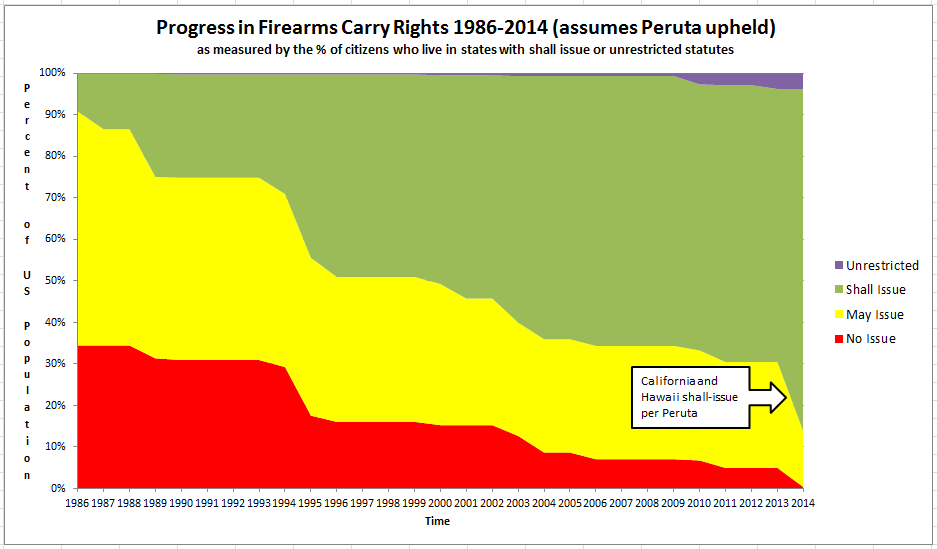
Last week, the Ninth Circuit issued what Lyle Denniston calls “the most sweeping decision yet on the right to carry a gun in public places.” David Kopel points out that “shall issue” is becoming the rule rather than the exception:
In its ruling, the court wrote that “to forbid nearly all forms of public arms bearing would be to destroy the right to bear arms entirely.” California issues concealed carry permits on a “may issue” basis, meaning that in many counties, citizens must apply to the county’s sheriff department and show “good cause” to have a [concealed carry weapon (CCW) permit]. A majority of states have a “shall issue” rule, which forces local governments to justify the denial of a permit by citing a criminal record, mental health issue, or some other potential public safety risk. Approximately 0.1% of California citizens have CCWs, which is almost 20 times lower than in the average shall-issue state, a statistic that supports the court’s opinion that the “good cause” rule is destroying, or at least severely hindering, the right to bear arms.
Once the Supreme Court ruled that the Second Amendment protected the keep a gun in one’s home for self-defense in Heller, and then ruled that, like the rest of the Bill of Rights, the Second Amendment applied to the states in McDonald v. Chicago, it was inevitable that the day would come when the Federal Courts in general, and the Supreme Court specifically, would be required to rule on the issue of whether or not the right recognized in Heller extended beyond the confines of the home. Logically, of course, there’s no reason why it shouldn’t, and while there is arguably a good case to be made that states should be permitted to create some reasonable regulations when it comes to the right to carry, whether it be open or concealed, it seems unlikely that a Supreme Court that still treats Heller as good law will decide that individuals only have Second Amendment rights inside their home. How far the right extends beyond that is something we’ll have to wait to find out.
After four days of deliberation, the jury in the racially tinged trial of Michael Dunn, a Florida man who set off another firestorm over the state’s self-defense laws when he shot a teenager to death in a parking lot during a dispute over loud music, said it could not agree on whether Mr. Dunn had acted to protect himself or was guilty of murder. The jurors did find Mr. Dunn guilty of three counts of second-degree attempted murder for getting out of his car and firing several times at the Dodge Durango sport utility vehicle in which Jordan Davis, 17, was killed. Three other teenagers, the subjects of the attempted murder charges, were in the car but were not struck. Mr. Dunn continued to fire at the vehicle even as it pulled away. On the attempted murder convictions, he could be sentenced to 60 years in prison.
In other words, a white man was found guilty of firing shots at a car filled with unarmed black teenagers, yet somehow he is not responsible for the young man who died inside. TNC is livid:
I wish I had something more to say about the fact that Michael Dunn was not convicted for killing a black boy. Except I said it after George Zimmerman was not convicted of killing a black boy. Except the parents of black boys already know this. Except the parents of black boys have long said this, and they have been answered with mockery. …[T]he inability of black parents to protect their children is an ancient tradition.
What is bracing about these regular deaths is how easily I can slot myself into the same circumstance. Follow me in a Jeep, then follow me on foot and we might come to blows. Demand that I turn down my music, at 17, and you might well not like my response. And I do not think this is a fact of black magic, of pathologies, of my culture. I think it is product of 17. I ride the trains in New York and I see boys of all colors who are very loud, because they finally can be, and no one can stop them. I see them and smile, and remember my own days back in Baltimore, my first freedoms, talking shit and being out in the world.
Bouie describes the cases of Zimmerman and Dunn as “our Dirty Harry epidemic”:
[Both] stories rely on particular tropes. Martin and Davis aren’t just rude or rowdy teenagers, they are dangerous intruders — aggressive thugs who can turn violent at any moment. And it’s up to the keepers of the peace – Zimmerman and Dunn – to play Dirty Harry and put them in their place. To wit, in one of his letters from prison, Dunn said as much: “This may sound a bit radical, but if more people would arm themselves and kill these (expletive) idiots when they’re threatening you, eventually they may take the hint and change their behavior.” …
Put simply, the narratives of Dunn and Zimmerman reflect a cultural near-consensus on the idea of the threatening black criminal. And, when trying to explain the verdicts in both cases – Zimmerman’s acquittal and Dunn’s hung jury on the count of first degree murder – it’s worth considering the extent to which they found receptive audiences; jury members who believed their stories, or at least, could empathize with their fear of “thugs.”
Meanwhile, David Kopel argues that Stand Your Ground laws had nothing to do with the verdict:
Because the jury convicted Dunn of three counts of attempted murder, it is certain that the jury determined that Dunn was not acting in lawful self-defense. Stand Your Ground is a rule about one detail of when self-defense is lawful. Accordingly, the assertion that Stand Your Ground may have been a reason why the jury hung on the first degree murder charge is totally implausible. The three convictions for second-degree murder show that the jury had determined there was no self-defense; ergo, jury confusion about self-defense was not the reason why the jury deadlocked on first-degree murder.
The right to “stand your ground” when attacked in a public place did not figure prominently in the trial, but Dunn’s lawyer, Cory Strolla, did mention it during his closing argument, saying, “His honor will further tell you that if Michael Dunn was in a public place where he had a legal right to be, he had no duty to retreat and had the right to stand his ground and meet force with force, including deadly force.” As in the Zimmerman case, the jury instruction concerning justifiable homicide mentioned that right, and it is more plausible in this case that it made a difference, since Dunn arguably could have driven away even if, as he claimed, Davis menaced him with a shotgun.
If Davis had a shotgun and threatened to kill Dunn, as Dunn claims, the shooting was justified. If Davis had no weapon and made no threats, the shooting was not justified. If Davis threatened Dunn (or merely shouted curses at him) and was holding something that Dunn mistook for a shotgun, the question is fuzzier: In the circumstances, was it reasonable for Dunn to believe Davis had a gun and intended to use it? But the question of what Dunn reasonably believed has nothing to do with the presence or absence of a duty to retreat. … Jurors across the country face this same challenge of deciding whether a homicide was justified based on the reasonable-belief standard, regardless of whether their state imposes a duty to retreat.
And Corrine McConnaughy considers the research on racial bias in the courtroom:
A courtroom environment where race is present but not consciously checked is precisely the kind that research has shown is conducive to a number of cognitive biases entering the legal process. Studies have shown that jurors in these circumstances are more likely to selectively remember and misremember the facts of the case in ways that are more consistent with racial stereotypes – being more likely to recall, for example, facts related to aggression by African Americans. They also demonstrate that white jurors are more likely (pdf) to find black defendants guilty in the absence of conscious processing of the racial meaning of the case. While this case did not involve a black defendant, it did involve a need for jurors to judge the culpability of Jordan Davis for his own death in order to decide upon Dunn’s self-defense claims. Whether and how the absence of individuating details about Davis in the trial mattered in the jury’s decisions thus stands an open but legitimate question.
“There have been seven disasters since humans came on the earth, very similar to the one that’s just about to happen. I think these events keep separating the wheat from the chaff. And eventually we’ll have a human on the planet that really does understand it and can live with it properly. That’s the source of my optimism,” – maverick British scientist (with a great track record), James Lovelock, on what he considers the pending catastrophe of climate change. Bonus money quote:
Enjoy life while you can. Because if you’re lucky it’s going to be 20 years before it hits the fan.
Update from a reader:
You link to a six-year-old Guardian piece showcasing Lovelock’s alarmism about global warming, but do you think your readers deserve to know that the same Lovelock, in 2012, said this: “‘I made a mistake’: Gaia theory scientist James Lovelock admits he was ‘alarmist’ about the impact of climate change.” (Also this: “James Lovelock walks back his alarmism on climate”). Sadly, I don’t expect your team to follow-up on this. All cheerleading, no critical thinking: that’s what I am used to get from the Dish coverage of this tremendously important issue.
Neuroskeptic examines new research on the therapeutic benefits of ketamine:
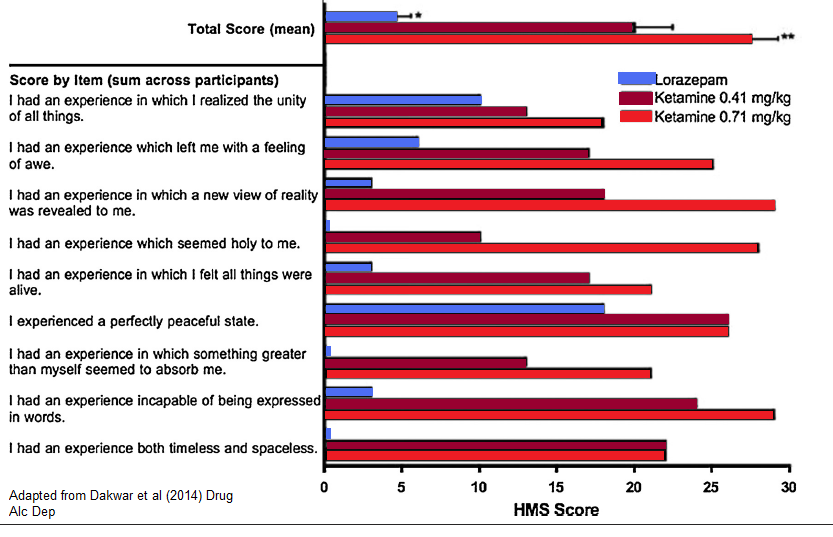
[Researcher Elias] Dakwar et al took 8 crack cocaine addicts who wanted to go clean. They gave them three injections (in a random order, within-subjects). These were ketamine 0.41 mg/kg, ketamine 0.71 mg/kg, and lorazepam [a benzodiazepine] 2 mg. The ketamine doses are, respectively, slightly lower than, and substantially higher than, the dose used in depression studies (0.5 mg/kg). …
The goal was to see whether ketamine increased the ‘motivation to quit’ crack. But Dakwar et al also used questionnaires to formally assess the psychoactive effects. The key finding was that both doses of ketamine caused much stronger ‘mystical experiences’ than lorazepam, as measured with the HMS scale. Participants reported feeling “a new view of reality”, “incapable of being expressed in words”, “a feeling of awe”… pretty impressive, basically.
Furthermore, there was a strong correlation between the intensity of the injection-induced mystical experience, and subsequent motivation to quit. This is consistent with (although not proof of) the idea that the clinical effect of ketamine in addiction is an indirect effect of its psychoactive properties, rather than a direct pharmacological effect.
Donald Trump is acting like he’s going to run for governor of New York. But McKay Coppins finds the reality TV star’s act wearing thin:
Standing by the press riser in the back of the cafeteria, I kept looking around to see if Trump’s comments were setting off the sort of frenzy he routinely generated in the political media during the 2012 campaign cycle. Instead, I saw a bored gaggle of blank-faced cameramen and sleepy local reporters begrudgingly there on their editors’ orders. Some chatted idly with one another, ignoring Trump’s speech entirely, while others swiped casually at their iPhones. I became mildly self-conscious when I realized I was the only reporter from a national outlet who had ventured outside the Acela corridor to see the Donald in action. All morning, I got the same question over and over from the local reporters. “You didn’t come all the way up here for this, did you?”
Kilgore calls the piece “the long-overdue obituary of Trump’s pseudo-political career.” The Donald was not pleased:
The profile has already cost one Trump aide his job, 32-year-old political consultant Sam Nunberg. Trump told the New York Post that Nunberg promised him that Coppins was “a friend of mine” who’d write “a fair story.” Trump promised him that if the piece turned out to be “a wise-guy story, you’ll be fired.” It was, and he was.
Ellen Page came out at an HRC event on Friday. Harriet Williamson argues for why we should care:
The normalization of homosexuality by famous names even makes it harder for young people to bully their LGBTQ peers. I wish Ellen Page had been out when I was a scared twelve-year-old who knew she had to get a boyfriend to fit in and stop the taunts of ‘ugly lesbian bitch’.
Alyssa applauds another part of Page’s coming-out speech, in which she criticized Hollywood’s “crushing standards” of beauty and success – for women and men, gays and straights alike:
When Page said that these standards “serve no one. Anyone who defies these so-called norms becomes worthy of comment and scrutiny,” she’s making an important jump. LGBT actors and actresses, and LGBT people who have to live in the world shaped by Hollywood products, may have a great deal to gain by tearing down these standards. But their heterosexual peers will benefit, too. Maybe their gains will be smaller: maybe they’ll be able to go out of the house without makeup, or they won’t have to make themselves sick preparing their bodies for a part. But whatever the potential benefits, we all have a common interest in a world where there are more than one way to be beautiful, more than one kind of good life, more than one barometer for success. This isn’t Page’s cause, this is all of ours.