Can We Read The News As Literature?

Lee Siegel suggests that, in the wake of news scandals such as the Woody Allen and Dylan Farrow case, “you could be forgiven for feeling that literary art … has been largely displaced by life—or, at least, by the pictures of life ceaselessly produced by the all-powerful media—as the realm in which we lose ourselves in a moral problem”:

There are those events in which something unequivocally bad is claimed to have been done, but we cannot know what actually happened: Farrow and Allen. Then there are those in which we know that something happened but can’t decide if it was bad: Edward Snowden. Finally (though there are countless sub-categories), there are situations in which we know that something unequivocally bad happened, and we know who did it, but, because the law in these situations seems so weak, even perverse, we—society—do not know whether to blame the perpetrator, the victim, or the legal system: George Zimmerman and Trayvon Martin; the recent shooting over texting in the Florida movie theatre.

The confusion created by these mounting, everyday enigmas is so impenetrable that it is difficult to say whether this trend of being incapable of moral closure is itself good or bad. On the one hand, we are now able to talk about injuries and abuses that were formerly swept under the rug. Twenty years ago, adults who, as children, had been sexually abused by Catholic priests, or were the young victims of Jerry Sandusky, would not have come forward, for fear of being accused of mendacity or mental illness. On the other hand, our conscientious parsing of particulars may lead us to miss the blazing forest for some smoldering trees. As we labor over our public enigmas, the country does not seem to be becoming more equal or more fair to people left behind. Perhaps, on some level, and in the face of social problems that are ultimately simple cases of gross injustice, we find these murky ethical situations gratifying, as if they offer us an excuse—human existence is just too complicated!—not to try to make meaningful changes in our public life. Or maybe our attempts to get at the truth of an imbroglio, like that involving Farrow and Allen, reflect a frustrated aspiration to retrieve some kind of shared, collective truth, period.

Are Colleges Failing Their Mentally Ill Students?

Katie J.M. Baker investigates:

“Schools should encourage students to seek treatment. But a lot of policies I see involve excessive use of discipline and involuntary leaves of absence, and they discourage students from asking for the help they need,” says Karen Bower, a private attorney who specializes in disability discrimination cases in higher education. “Ultimately, that makes the campus less safe.”

Two large-scale studies found that around 10 percent of college student respondents had thought about suicide in the past year, but only 1.5 percent admitted to having made a suicide attempt. Combined with data from other studies, that suggests that the odds that a student with suicidal ideation – the medical term for suicidal thoughts – will actually commit suicide are 1,000 to 1. “Thus, policies that impose restrictions on students who manifest suicidal ideation will sweep in 999 students who would not commit suicide for every student who will end his or her life,” Paul S. Appelbaum writes in Law & Psychiatry: “Depressed? Get Out!”

“Colleges don’t want people who are suicidal around, so what’s supposed to happen to them?” says Ira Burnim, legal director of the D.C. Bazelon Center for Mental Health Law. “We’re going to lock them in a bomb shelter?” Kicking students off campus for mental health issues typically does more harm than good by isolating them from their support systems when what they really need is stability and empathy, he says. Moreover, it’s often a completely unnecessary overreaction.

How Scientific Is Astrology?

dish_horoscopes

Skeptical stargazers are increasingly rare:

[A] substantial minority of Americans, ranging from 31 to 45 percent depending on the year, say consider astrology either “very scientific” or “sort of scientific.” That’s bad enough—the NSF [National Science Foundation] report compares it with China, where 92 percent of the public does not believe in horoscopes—but the new evidence suggests we are also moving in the wrong direction. Indeed, the percentage of Americans who say astrology is scientifically bunk has been declining ever since a high point for astrology skepticism in 2004, when it hit 66 percent.

The recent increase in astrological credulity was most dramatic among those with less science education and less “factual knowledge,” NSF reported. In the latter group, there was a staggering 17 percentage point decline in how many people were willing to say astrology is unscientific, from 52 percent in 2010 to just 35 percent in 2012. Also apparently to blame are younger Americans, aged 18 to 24, where an actual majority considers astrology at least “sort of” scientific, and those aged 35 to 44. In 2010, 64 percent of this age group considered astrology totally bunk; in 2012, by contrast, only 51 percent did, a 13 percentage point change.

Update from a reader:

Just to let you know: the claim that 40% of Americans believe astrology is scientific is complete bullshit. As I suspected when I saw the result, many confused “astrology” with “astronomy”.  The poll did not explain the difference.  As a professional astronomer, this happens to me quite a bit.  With a cold poll, I am guessing that many people, hearing the word “scientific”, got even more confused.

Another:

I had to laugh out loud when I saw the update from the professional astronomer saying that the results of the recent survey were “complete bullshit.”  Once again we see astronomers overreacting in sheer panic at the mere thought that millions and millions of Americans actually use and enjoy astrology.  The horror, the horror! Here are the facts:

1) The professional astronomer should have actually read the study before offering his/her de facto statement of absolute scientific truth. The study is available online for anyone to see (pdf). The astrology survey in question is on page 1729 of the survey.  While the astronomer is correct that people often confuse astrology and astronomy, the drafters of the survey made it very clear that they were specifically referring to astrology. They ask two very pointed, specific questions:

1062. Now, for a new subject. Do you ever read a horoscope or your personal astrology report?

1063. Would you say that astrology is very scientific, sort of scientific, or not at all scientific?

So each interviewee was prompted with detailed astrological language to help prevent the confusion between astronomy and astrology.  The professional astronomer is shooting from the hip (his own opinions), not from the actual facts as stated in the report.

2) “Complete bullshit” would assume that closer to 0% of the population believes in astrology. According to the latest survey from the Pew Research Center’s Religion & Public Life Project, 25% of the American population believes in astrology. The question again was framed in a manner that would allow no confusion between astronomy and astrology. 25% is over 78 million people.  For someone to discount nearly a quarter of our nation’s population is incredibly insulting.  And unscientific.

Previous Dish on horoscopes here, here, and here.

CB2 vs HIV

The Dish stumbles upon the Holy Grail:

The changes that THC produces in the gut a process formally known as “microbial translocation,” isn’t as complicated as it sounds. Kush_closeDuring HIV infection, one of the earliest effects is that the virus spreads rapidly throughout the body and kills a significant part of cells in the gut and intestine. This activity damages the gut in a way that allows the HIV to leak through the cell wall of the intestines and into the bloodstream.

When THC is introduced into this environment, it activates the CB2 receptors in the intestines to build new, healthy bacterial cells that block the virus from leaking through the cell walls. In other words, the body works hard to keep bad stuff in the intestines and the good stuff out.

Put another way: HIV kills the cells that protect the walls— THC brings them back. Reducing the amount of the virus in the lower intestines could then help keep uninfected people uninfected.

How It Feels To Slaughter Animals

Rhys Southan Bob Comis, who raises pigs for meat, confesses that “no matter how well it’s done, I can’t help but question the killing itself”:

In a well-managed, small-scale slaughterhouse, a pig is more or less casually standing there one second, and the next second it’s unconscious on the ground, and a few seconds after that it’s dead. As far as I can tell — and I’ve seen dozens of pigs killed properly — the pig has no experience of its own death. But I experience the full brunt of that death.

It’s not the sight of blood that troubles me, but the violence of the death throes. Livestock science would assure us that these convulsions are a sign of the pigs’ insensibility, but as a witness, it is almost impossible to believe that the pigs are not thrashing around because they are in pain. And then that sudden lifelessness of the body as it is mechanically hoisted into the air, shackled by a single hind leg. I don’t think anything could be done to make the deaths of the pigs weigh less heavily on me.

I think a lot of animal farmers have the same ethical struggles me, although I’m not sure how many struggle as intensely as I do. I believe this is likely the case with even non-corporate factory farmers. Feeling nothing strikes me as mildly sociopathic.

Update from a reader:

Bob Comis has just followed up with an article in The Dodo. He has taken the next step:

In the current discourse, happy pigs are the ideal alternative to the miserable and abused pigs raised in factory farms. Happy pigs become happy meat, and happy meat is good. We should feel good about eating happy meat.

Happy meat, really? I am haunted by the ghosts of nearly 2,000 happy pigs.

(About a month ago, I had my final crisis of conscience, in a decade of more or less intense crises of conscience. Having abandoned the last vestige of what seemed to be at the time legitimate justification, happiness and a quick, painless death, I became a vegetarian. I am now in the beginning stages of the complicated process of ending my life as a pig farmer.)

Speaking of happy pigs, another reader sends along a video:

Previous Dish on swimming pigs here. One more reader:

I’m a meat eater, I confess. I like meat. That said, I also worked in a slaughterhouse for three years. I don’t think it’s woo-woo to say that I think the people who do the actual killing and dismemberment of animals pay a deep spiritual price. Problem is, in this culture there is no way to process that effectively. Some cultures have a sense of gratitude for the animals and a humility in taking the life of another creature. We don’t. Nowhere is that more pointed than on the slaughterhouse (dis)assembly line. I gave a presentation at a conference a few years ago where I asserted that the line workers carry the psycho-spiritual burden for all of us and particularly for corporate leaders and investors who profit financially. A job shifting more and more to Hispanic immigrants, among those with the least privilege in our culture. I wondered how practices might evolve if executives were expected spend time working the line, both for the sacrificed animals and for the workers. We need a genuine gratitude for both.

Previous Dish on processing livestock here, here, and here.

A Poem For Monday

Nympheas_71293_3

“Monet’s ‘Waterlilies'” by Robert Hayden:

Today as the news from Selma and Saigon
poisons the air like fallout,
I come again to see
the serene great picture that I love.

Here space and time exist in light
the eye like the eye of faith believes.
The seen, the known
dissolve in iridescence, become
illusive flesh of light
that was not, was, forever is.

O light beheld as through refracting tears.
Here is the aura of that world
each of us has lost.
Here is the shadow of its joy.

(From The Collected Poems of Robert Hayden, edited by Frederick Glaysher  1970 by Robert Hayden. Used by permission of Liveright Publishing Corporation. Painting of waterlilies by Claude Monet, circa 1915, via Wikimedia Commons)

What Do Marriage Equality And Capital Punishment Have In Common?

Scott Bland draws a parallel:

oimg-1Washington Gov. Jay Inslee’s decision to suspend the state’s death penalty Tuesday fits into a national trend. Eight states in the past decade have rolled back the death penalty, an accelerated pace mimicking the rapidly changing public opinion surrounding same-sex marriage that started at the same time. Public opinion over these two cultural wedge issues of the 1990s has changed dramatically since that time. And in blue states, both public opinion and public policy have moved significantly since Bill Clinton said Democrats “should no longer feel guilty about protecting the innocent” with capital punishment. (To prove he was tough on crime, Clinton left the campaign trail in 1992 to preside over the execution of convicted murderer Rickey Ray Rector.) Clinton also later signed the Defense of Marriage Act barring federal recognition of same-sex marriages two decades ago. Now, more than 100 million people live in states without the death penalty. …

Support for the death penalty for murders, which peaked at 80 percent in 1994, according to Gallup, has declined markedly since. The last time the polling company measured public opinion, in October, support was down to 60 percent, the lowest mark since the 1970s. While support for capital punishment trends downward, support for same-sex marriage has swung up at about the same rate, from 27 percent in 1996 to 54 percent last year, again according to Gallup.

Dick Cheney Has No Regrets, Ctd

A reader writes:

Permit this slow reflection from an avid Dish reader over many years, who has tended to skim your Sunday stuff. But two threads recently caught my eye and, as I pondered them over a lazy weekend, I’ve found myself (to the amazement of this life-long agnostic) cheney-no-regretspushed towards a re-appraisal of Original Sin.
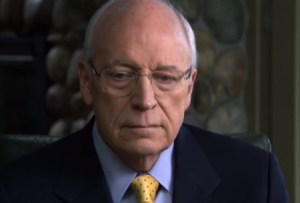
First, Dick Cheney and Donald Rumsfeld: men who commit evil without “thinking much about it” (as you write) because it’s something “other people do.” Reflecting on this it suddenly struck me that Original Sin (which I’d long mocked as an absurdity) serves precisely as a prophylactic against this kind of complacency.

I’m no theologian, but an assumption that one is evil – because we are all inherently fallen – makes it one’s job as a human being to meditate on the evil (or, if you prefer the term, “error”) permanently inherent in oneself. Our obligation is to identify it and to try to root it out. Or at least (since rooting it out is by definition impossible) to moderate it, to channel it positively, to restrict it. Hence your passion for Pope Francis: “I am a sinner” is his first reply.

Nothing one can do, as a being born into sin, can be a “no brainer” (as Cheney describes his decision to permit waterboarding). A profoundly Christian obligation to meditate on his own evil would have led Cheney (and the grinning Rumsfeld) at least to the point of “wrestling with the choice” of whether to torture, as opposed to the glib certainty you, and so many of us, find, well, evil. (I guess there’s an argument that the deliberate choice of evil is morally worse than unreflecting self-deception … but we’ll leave that for another time.)

In other words – if I may be permitted briefly to mix religion and politics – Original Sin is a concept that liberals can embrace, from an epistemological if not a theological perspective. Perhaps after all it’s not something that should be “laundered out of our culture” (to quote today’s post on Sam Harris). We need Original Sin as a restraint against our arrogant – and possibly evil – self-certainty.

Another reader gives Cheney a civics lesson on Presidents’ Day:

The quote taken from Cheney reveals part of the problem in this thoughtless man’s life-long failure and/or inability to think. He said:

Tell me what terrorist attacks that you would have let go forward because you didn’t want to be a mean and nasty fellow. Are you gonna trade the lives of a number of people because you want to preserve your, your honor, or are you going to do your job, do what’s required first and foremost, your responsibility to safeguard the United States of America and the lives of its citizens.

But his job wasn’t to safeguard the United States of America. And it wasn’t even his job to safeguard the lives of American citizens. Presidents and Vice-Presidents do not swear to defend America or Americans. They swear that they will “preserve, protect and defend” the Constitution. The putative “no-brainer” would seem to become rather brain-intensive when this critical difference is taken into account.

To recap: No Constitutional obligation whatsoever to protect the borders, the soldiers, the buildings, or the people. On the other hand, an obligation to protect the Constitution that is as close to iron-clad and unambiguous as anything to be found in the document. He evidently never read the job description. The “honor” he sneers at is the entire point. It’s not one desideratum among many; it’s the only one.

Update from another reader, who doesn’t think it’s that simple:

Your smugly ill-informed “civics lesson”-giving reader has compelled me to do the unthinkable: stand up for Dick Cheney. (Don’t worry, I’ll be sure to shower afterwards.) To suggest that the job of the chief executive of the country does not include protecting its people and property is simply not true.

First, the presidential oath of office is not an exhaustive list of presidential duties. But even if it were, the oath is not limited to preserving, protecting and defending the Constitution. The first obligation of the oath is to “faithfully execute the Office of the President of the United States” – protecting the Constitution is mentioned second as an additional obligation. The Office of the President of the United States, per Article II of the Constitution, includes wielding the “executive Power” of the federal government and being the Commander in Chief. Article II is, fortunately or unfortunately, silent about the contours of the “executive Power,” which is why we’re still debating the powers of the executive branch 225 years later. But as the first – and possibly the only universally agreed – role of the state is to be a “night watchman,” it is absolutely within the job description of the President and Vice President to protect citizens from enemies foreign and domestic.

None of this excuses Cheney or Rumsfeld, or the dime-store Eichmanns they employed, for torturing in violation of settled U.S. law and basic morality. I just can’t abide smug sermonizing by people who don’t know what they’re talking about and reification of the Constitution by people who can’t actually have read it. Thanks for letting me vent.

A reminder of the veep’s oath of office:

I do solemnly swear (or affirm) that I will support and defend the Constitution of the United States against all enemies, foreign and domestic; that I will bear true faith and allegiance to the same; that I take this obligation freely, without any mental reservation or purpose of evasion; and that I will well and faithfully discharge the duties of the office on which I am about to enter: So help me God.

One more reader:

No doubt a level of security is necessary for democracy. Figuring out where to draw constitutional lines is often difficult. But the point about the no brainier line is that he doesn’t even consider the constitutional issues valid. This is what drives so many of us nuts whether liberal or conservative: who are you to decide for me what liberties to take away for my safety?  We are entitled to make these decisions as a nation and not have the security apparatus hide behind top security clearance telling us “you can’t handle the truth” a la Jack Nicholson.